Córdoba
Córdoba was the capital of Muslim Spain from the eighth century to the eleventh, and for much of that time the largest and most cultivated city of the western Mediterranean. This article follows the city itself: its Roman origins, its rise under the Umayyads, its court and learning, and its fall.
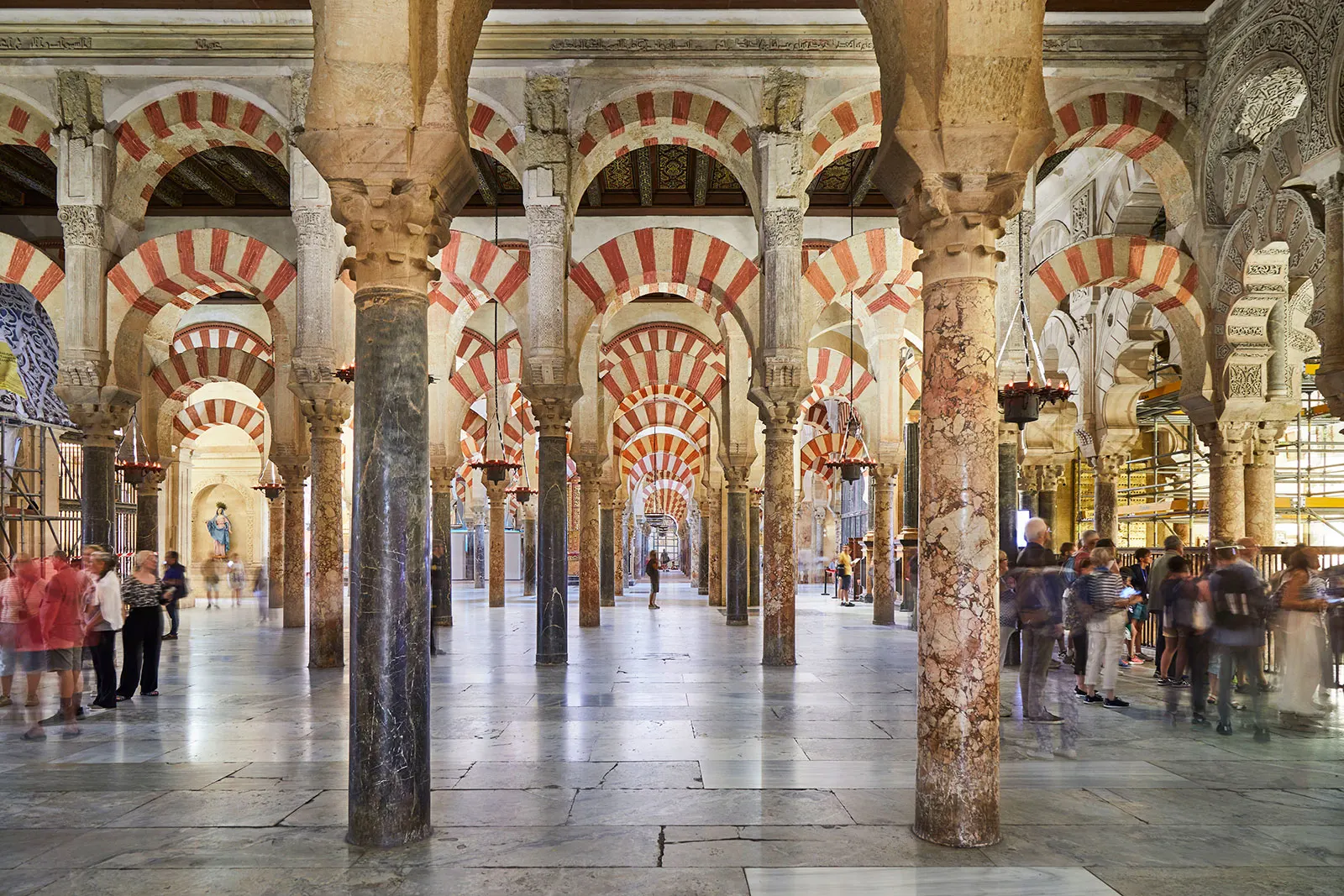
Córdoba was the capital of Muslim Spain from the early eighth century until the end of the Umayyad caliphate in the eleventh, and for much of that time the principal city of the western Mediterranean. It stood on the north bank of the Guadalquivir in the plain of southern Spain, on a site that had already served as a provincial capital under Rome, and it owed its later importance to the same natural advantages: a navigable river, a crossing point, and command of a rich agricultural hinterland.
This article follows the city itself — its site, its rise under the Umayyad rulers, its court and its learning, its people, and its later history. The dynasty that ruled from it is treated in the Umayyads of Córdoba, the region it governed in al-Andalus, its principal monument in the Great Mosque of Córdoba, the palace-city built beside it in Madinat al-Zahra, and the scholarly culture of the region in intellectual life in al-Andalus.
A word on the evidence is useful at the outset. The account below rests principally on a narrative history of the emirate period and on two reference treatments; the underlying Arabic chronicles are reached through the first of these rather than consulted directly. In consequence the emirate — roughly 756 to 852 — can be described in more detail than the caliphal century that followed, which the approved sources cover more briefly than its importance would warrant.
The Site and the Roman City
Córdoba existed long before the Muslim conquest. It is believed to have been founded by the Carthaginians, who reached Spain around 500 BCE, and it had become prominent enough by 152 BCE for the Romans to make it the capital of their southern province. That province they called Baetica, after the river Baetis that flowed past its capital. The Muslim conquerors first knew the river as the Shaqunda, from the suburb of Secunda on its south bank, and later renamed it the Wadi al-Kabir — the great valley — which Spanish usage turned into Guadalquivir.
The setting shaped the city's fortunes throughout its history. Spain lies between two seas and two continents, joined to Africa across the narrow Strait of Gibraltar and to the rest of Europe across the Pyrenees, and it has long been a meeting point of the two. The Guadalquivir gave Córdoba a navigable link to the Atlantic and watered a broad and fertile plain, while the Sierra de Córdoba to the north supplied stone and fresh water. A river crossing, good farmland, and a defensible position together made the site a natural centre, which is why it served as a capital under successive rulers.
Under Rome, Córdoba grew into a prosperous commercial and cultural centre of the empire. Roman rule over the peninsula ended early in the fifth century CE, when Germanic peoples crossed the Pyrenees. Among them were the Vandals, whose Silingi branch settled in the south and gave Baetica the name Vandalicia, the origin, through Arabic, of al-Andalus. The Vandals soon crossed into North Africa, and the Goths became masters of Spain, holding it until 711.
By the time of the conquest the population of the region was Christian in its official religion, following the Roman Catholic faith that the Gothic king Reccared had adopted late in the sixth century in place of the earlier Arian Christianity. Older beliefs persisted alongside it in the countryside, and Jewish communities were long established in the towns. This was the mixed society that came under Muslim rule in the eighth century.
The Conquest of 711 and the Making of a Capital
Muslim forces entered Spain in 711 under Tariq ibn Ziyad, who broke Gothic resistance in two battles, at Barbate and Ecija, and then advanced on Toledo, leaving Córdoba to be taken by one of his commanders. That commander was Mughith al-Rumi, a figure the sources find worth remarking on: his epithet means "the Roman" and some took him to be one, but he is described as an Arab of princely descent, a great-grandson of the last Arab king of Busra in Syria. He took the city after its Gothic garrison had held out for a time in the church of Saint Acisclo, and afterwards built a residence there that remained a city landmark. His descendants stayed prominent for generations: a son, Abd al-Wahid, served as a minister to Abd al-Rahman I, and a grandson, Abd al-Karim, became one of the emirate's leading generals.
Córdoba was not the first Muslim capital of Spain. Seville held that position under Abd al-Aziz, son of Musa ibn Nusayr, and the seat of government moved to Córdoba only in 716 or 717. The sources differ over who ordered the move — one credits Ayyub ibn Habib, a nephew of Musa ibn Nusayr who held the governorship briefly; another his successor al-Hurr ibn Abd al-Rahman al-Thaqafi — and the question is left open. Whichever it was, Córdoba then remained the capital for some three centuries.
For about forty years the country was governed from Córdoba by governors appointed by the caliph in Damascus or by his viceroy at Qairawan. This was the period in which Muslim expeditions reached deep into Frankish territory, as far as the encounter with Charles Martel near Poitiers in 732, before the northern campaigns gave way to internal division within Spain. That division, drawn along the old tribal lines the Arab settlers had brought with them, set the setting for the arrival of the man who would found the dynasty.
The Founding of the Umayyad Emirate
Abd al-Rahman I, a surviving prince of the Umayyad house, reached Spain in 756 after several years of travel from the east, landing on the south coast at Almuñécar at the invitation of clans loyal to his family. Over a reign of some thirty-three years he established Umayyad rule across the peninsula and made Córdoba the seat of an independent emirate — independent in that it no longer answered to the Abbasid caliphate in the east, while continuing to acknowledge the caliphate's symbolic standing in the Muslim world. His Abbasid contemporary, the caliph al-Mansur, is said to have called him the Falcon of the Quraysh, in tribute to a prince who crossed deserts and sea to establish a realm in an unfamiliar land.
Abd al-Rahman I gave the city two of its enduring features. He built a fortified palace on the north bank, on ground near that of the later Alcázar, and he began the Great Mosque, the monument that successive rulers would enlarge over the following two centuries. He also organised a standing army — a body of North African Berbers and of soldiers recruited into military service — which gave the emirate a professional core independent of the tribal levies.
Abd al-Rahman I's son and chosen successor, Hisham I, is remembered for two things. In religion, he established the Maliki school of law as the common legal tradition of Muslim Spain, giving its leading Andalusi authority, Yahya ibn Yahya, his support; this gave the religious life of Córdoba and of al-Andalus a single, settled framework of jurisprudence that would last for centuries and that the source followed here credits with giving the country an unusual religious cohesion. In the fabric of the city, he continued his father's building. He directed a share of the proceeds of the northern campaigns to completing the Great Mosque and to building a second mosque within the palace grounds, and he rebuilt the bridge over the Guadalquivir — the Roman bridge that gave the city much of its character, first built under the governor Samh ibn Malik around 719–721 and since damaged by flooding. Hisham had the money spent on it and, by the account followed here, supervised the reconstruction himself. The rebuilt bridge and the enlarged mosque were among the works that gave eighth-century Córdoba the appearance of a capital.
The reigns of Abd al-Rahman I and Hisham I thus established the pattern that the ninth-century rulers would extend: an independent seat of Umayyad power on the Guadalquivir, with a great congregational mosque, a fortified palace, a river bridge, and a single school of law.
The Peopling of the City
By the early ninth century the population of Córdoba had changed profoundly from that of the Visigothic town. Within a century of the conquest the majority of the people of Spain had accepted Islam, and the large cities had become predominantly Muslim. Most of these Muslims were not of Arab descent but converts of Iberian origin and their descendants, known as muwallad, rendered in Spanish as muladí. A few came from noble Gothic and Hispano-Roman families; most were ordinary townspeople and cultivators whose circumstances had improved under the new order. In Córdoba many of them lived in the flourishing suburb of Secunda, on the south bank of the Guadalquivir opposite the main city, described in the sources as an industrious and thrifty quarter and a centre of the schools of Maliki law.
Alongside this Muslim majority lived long-established Christian and Jewish communities, and the arrangements under which they lived shaped the character of the city for centuries. They kept their places of worship and their clergy, ran their own community affairs under their own law through their own officials, and paid the jizya, a poll tax assessed by means and not levied on women, children, monks, or the poor, in place of military service. Many Christians served in the army or held posts at court and in noble households. Over time a large part of the Christian population adopted Arabic and Arabic literary culture so thoroughly that they became known as musta'rab, Arabised — the Mozarabs. A ninth-century Córdoban writer, Alvaro, recorded with some feeling how eagerly his fellow Christians read and collected Arabic poetry and letters. The mixing of communities and languages was one of the marks of the city, and coexistence in al-Andalus is treated more fully in its own article.
The Emirate at Its Height: al-Hakam I and Abd al-Rahman II
Under al-Hakam I and especially Abd al-Rahman II, who reigned from 822 to 852, Córdoba grew rapidly and acquired the institutions of a capital rather than a provincial town.
The machinery of government took its lasting shape in this period. Abd al-Rahman II was the first Muslim ruler of Spain to organise a formal cabinet and secretariat, housed at the entrance to the palace grounds, with departments for justice and for finance whose accounts were regularly audited, and a judicial branch with its police, the shurta, and its magistrates. Civil and military office were not sharply separated, and the same man might serve as both minister and general. Every city was given two officers whose titles describe their duties: the sahib al-suq, prefect of the market, who oversaw prices and the regulation of weights and measures, and the sahib al-madina, prefect of the town, who managed municipal affairs. Abd al-Rahman II was also the first of the dynasty to maintain a formal court with settled rules of protocol, its ministers, officials, stewards and a chamberlain in overall charge — modelled, the sources say, on the Abbasid court at Baghdad.
The physical city was deliberately improved in the same reign. Embankments were raised along the Guadalquivir and a new road built along the north bank. A canal brought fresh water down from the Sierra de Córdoba, the range to the north, to the palace, and was later extended to a large marble public fountain — an addition to canals already laid out by the earlier Umayyads. The city spread westward with new buildings, mosques and bath-houses, put up partly by noble families and partly at public expense. Building extended beyond the capital as well: the same reign endowed schools in several cities and built or improved bridges and roads, with mosques at Seville and Jaén among the works recorded. The Great Mosque itself was enlarged, the existing prayer hall having become too small for the numbers attending.
Two places outside the walls belong to the city's map. Rusafa, the country estate built by Abd al-Rahman I about two miles to the north-west, gave its name to the heights above it. Musara, two miles out along the north bank, was the site of the battle by which Abd al-Rahman I had won the country.
The economy prospered across the board in this period — in agriculture, in the crafts, and in trade — and the revenues of the state grew accordingly. Commercial relations with the states of the Mediterranean increased to the mutual benefit of Córdoba and its partners, and the goods of the city and its region travelled widely. The fertility of the Guadalquivir plain, worked with care, made the region an agricultural mainstay, and the crafts and commerce of the city rested on that base.
By the middle of the ninth century the effect of all this was a capital of real standing. The reign of Abd al-Rahman II, in the assessment of the source followed here, was the period in which Muslim Spain became the most powerful state of Europe and North Africa — a position it held once the Frankish empire built by Charlemagne fragmented after the death of Louis the Pious.
The Court of Córdoba
The court of Córdoba became a magnet for talent from across the Muslim world, and its reputation for cultivation rests substantially on the musicians, scholars and poets whom Abd al-Rahman II drew to it.
The most celebrated was Ziryab. Born Ali ibn Nafi, a musician of Persian descent, he trained at Baghdad under Ishaq al-Mawsili, the chief court musician of the Abbasid caliph, and after a period at Qairawan came west to Córdoba, arriving in 821–822 at the age of thirty-two. He was received with great generosity — a stipend, provision for his sons, payments for performances at the two Eids, and the income of estates near the city — and spent the remaining thirty years of his life in Spain. His influence went far beyond music. He founded a school of music that trained pupils and that his own children — several of whom inherited his gift — continued after him, so that his manner of performance and teaching outlived him in the city. In the instrument itself he added a fifth string to the four-stringed lute, which he associated with the soul, and introduced a plectrum cut from an eagle's talon in place of the wooden one. He also shaped the manners of the city, introducing the wearing of different dress by season, new styles of hairdressing, new dishes some of which were named after him, glassware in place of gold and silver on the table, and refined preparations for the household. Cultivated Córdoba followed his lead in dress, food, and conversation, and through the city his innovations passed into the wider culture of Muslim Spain. A tradition holds that his music came to him from a jinn in his sleep; this belongs to the stories that gathered around him rather than to the record of his life, and is noted here as such.
The court also drew scientists. Abbas ibn Firnas, from the district of Takurunna near Ronda, gained a reputation in mathematics, physics and astronomy. One episode marks both his ability and the intellectual position of Córdoba at the time: when a merchant brought from the east a copy of the treatise on Arabic prosody by Khalil ibn Ahmad — the eighth-century Baghdad philologist who had compiled the first Arabic dictionary — no one in Spain could make sense of the unfamiliar work until it was given to Abbas, who mastered it. He is also remembered for an attempt at flight, building silk-covered wings and gliding some distance from a height near the Rusafa palace before landing.
Among the men of letters was Yahya ibn al-Hakam, known as al-Ghazal, "the gazelle," a name given him in youth for his looks and bearing. A poet and adviser who served three successive rulers, he lived to the age of ninety-four, spanning the reigns of five Umayyad rulers, and it was he whom Abd al-Rahman II chose for the most important diplomatic mission of the reign.
Córdoba and the Wider World
By the middle of the ninth century Córdoba had become an independent power whose friendship the states of the Mediterranean sought, and the embassies of Abd al-Rahman II's reign are the clearest measure of its standing.
The most significant came from Byzantium. The emperor Theophilus, seeking allies in his long contest with the Abbasid caliphate, sent an embassy to Córdoba — the first ever from Christian Byzantium to Muslim Spain — carrying gifts and a letter proposing common cause. It was received as the compliment it was, an acknowledgement that Córdoba now mattered in Mediterranean affairs. Abd al-Rahman II returned a warm and courteous reply while committing himself to nothing that would set him against other Muslim states, and sent al-Ghazal at the head of a return embassy to Constantinople, where the ambassador made a strong impression at the imperial court and established relations that could be built upon. There were exchanges of embassies with the Frankish rulers as well — with Charlemagne, Louis the Pious and Charles the Bald — though the sources say little about their outcomes, and a general increase in commercial relations to the mutual advantage of Córdoba and the Mediterranean states.
Through all of this the rulers of Córdoba kept the title of amir and did not claim that of caliph, out of respect for the caliphate as the symbol of Muslim unity — a restraint they maintained until the following century.
A second embassy, to the land of the Normans, is also attributed to al-Ghazal, but the sources themselves treat it with reserve: its narrative closely repeats the story of the Constantinople mission, and the scholar Lévi-Provençal judged it an invention. It is mentioned here only to be set aside.
Learning and Law in the City
Córdoba in the ninth century housed two centres of intellectual life side by side: the scholars, poets and scientists gathered at the court, and the jurists of the Maliki school led by Yahya ibn Yahya. Yahya's standing in the religious life of the city was considerable. Though he held no formal judicial office, his authority in matters of law was such that the appointment of judges effectively passed through him, and his influence over religious observance extended even to the ruler, who on one occasion accepted and kept a penance of a two-month fast at his direction. On Yahya's death in 849 his son Isa succeeded to his standing, and the family became known in the city as the Bani Yahya.
The two centres represented different casts of mind, and together they made Córdoba a place where the religious sciences and the wider learning of the age were both pursued at a high level. The presence of the Maliki jurists gave the city and the country a settled framework of law and religious observance; the court's patronage of music, poetry and the sciences gave it a reputation for cultivation that reached across the Mediterranean. The schools of Córdoba drew students from across the Muslim world, and their standing was such that they attracted some Christian students as well. It was this combination — a great mosque, a body of learned jurists, a cultivated court, and schools of wide repute — that gave the city its lasting character as a seat of learning, and that made it, over the following century, one of the foremost centres of scholarship in the medieval world.
Toward the Caliphate
Abd al-Rahman II died in 852. The emirate he left was the leading power of the western Mediterranean, secure in its institutions and its capital, though the frontier with the Christian north and the management of a diverse population remained the standing tasks of his successors. Over the following two generations the authority of Córdoba over the outlying regions weakened, and by the early tenth century much of Spain had ceased to obey the capital. The recovery of that authority, and the raising of the emirate to a caliphate, was the work of Abd al-Rahman III.
The Caliphate of Córdoba
Abd al-Rahman III came to power in 912, at the age of twenty-three, and set about restoring the authority of the capital over the peninsula. He remitted taxes that lacked sanction in the sharia, offered amnesty to those who returned to their allegiance, and brought the regional centres — Bobastro, Badajoz, Zamora, Simancas, Osma and Toledo — back under Córdoba one by one, then secured tribute from the Christian kingdoms of the north. The most serious internal challenge, the long resistance of Umar ibn Hafsun, drew support from the Fatimids of North Africa; a Fatimid fleet sent across the Mediterranean was intercepted, and the resistance was eventually brought to an end.
In 929 Abd al-Rahman III took the title of caliph and Amir al-Mu'minin. The step reflected the changed shape of the Muslim world: the Fatimids had proclaimed a caliphate in North Africa in 910, and the Abbasid caliphate in the east had lost effective power. Three caliphates thus stood at once in the tenth century, and Córdoba was the seat of one of them. Embassies came to the city from Constantinople, Germany, France and the Italian principalities.
For the city itself the reign brought two changes of scale. The Great Mosque was enlarged and further embellished, and a new palace-city, Madinat al-Zahra, was built about three miles away, to which the caliph moved his court and where he was buried on his death in 961. The building of a separate seat of government beside the old capital is the most important single fact about Córdoba at its height, and it is treated in its own article.
Under Abd al-Rahman III and his son al-Hakam II, Córdoba reached the peak of its size, prosperity and cultural fame. It drew scholars, poets and craftsmen from across the Muslim world, and the wealth of the caliphate supported building, learning and the arts on a scale the emirate had not matched. Al-Hakam II was himself a scholar and a patron of scholarship, and he assembled a great library at Córdoba that made the city one of the foremost centres of learning of its age — a natural culmination of the tradition of schools and patronage established under his predecessors. The Great Mosque reached its final dimensions at the end of the tenth century, under the chamberlain al-Mansur ibn Abi Amir, by which time it had become the largest covered mosque of its kind. For a century the city was, by common account, the most populous and most cultivated in western Europe.
Later History
The caliphate of Córdoba came to an end in the early eleventh century, and the city's political primacy ended with it. Spain divided into a number of independent principalities — among them Saragossa, Toledo, Seville, Malaga, Granada, Almeria, Denia and Valencia — and Córdoba was in time incorporated into the kingdom of Seville, the city it had itself displaced as capital three centuries before.
The division of the peninsula changed the balance with the Christian kingdoms of the north. Toledo passed to Castile in 1085. Two successive movements from North Africa, the Almoravids under Yusuf ibn Tashfin in the late eleventh century and the Almohads in the twelfth, restored Muslim strength in the peninsula for a time; the Almohads held the frontier for some fifty years and won a notable victory at Alarcos. Both drew their strength from the Maghrib, and when that support receded in the early thirteenth century the frontier moved south. Following the battle of Las Navas de Tolosa in 1212, the Christian kingdoms advanced, and Córdoba passed to Castile in 1236, with Seville following in 1248. Of the Muslim polities of the peninsula only Granada remained, surviving until 1492.
The learning that Córdoba and the other Andalusi centres had accumulated outlasted the city's political independence, and this is the most enduring part of its story. Over the eighth to eleventh centuries the city had gathered, preserved and added to the scientific, philosophical and literary inheritance of the Greek, Persian and Indian traditions as it had reached the Muslim world, together with the original work of its own scholars. After the city passed to Castile, the translation of these Arabic works into Latin — carried on at Toledo and elsewhere — made much of that inheritance available to the rest of Europe, and it contributed substantially to the intellectual life of the later medieval centuries. This transmission is traced in Islamic influence on Europe.
The city's greatest monument endured in physical form. The Great Mosque, begun by Abd al-Rahman I and enlarged by ruler after ruler until it reached its final size at the end of the tenth century, became a cathedral after 1236 and still stands. It remains the building by which Córdoba is known, and the most complete surviving expression of the city's centuries as the capital of Muslim Spain.
Historiographical Note
A few points about the sources and the evidence will help a reader weigh what this article can and cannot establish.
The size of the city. Very large figures are often quoted for tenth-century Córdoba — a population in the hundreds of thousands or approaching a million, together with correspondingly large counts of houses, shops, mosques, baths, and library volumes. Figures of this kind appear in one of the sources used here, but they cannot be corroborated from the approved source base, and the works that carry them do not indicate where the numbers originate. This article therefore does not state a specific figure. What can be said with confidence is that Córdoba was a large city by the standards of its age, and probably the largest in western Europe.
Uneven coverage. The emirate, from Abd al-Rahman I to Abd al-Rahman II, is treated here in more detail than the caliphal century that followed, and this reflects the sources available rather than the relative importance of the periods. The principal work consulted is a narrative history that ends with the death of Abd al-Rahman II in 852; for the tenth and eleventh centuries the article relies on two shorter reference pieces. The caliphal period — al-Hakam II's library, the time of al-Mansur, and the city at its architectural height — is therefore treated more briefly than its importance warrants, and a fuller account would require a scholarly history of al-Andalus that the project does not yet hold. The relative brevity of the later sections should not be read as a measure of the period's importance.
The character of the principal source. The main work consulted is a narrative history of the emirate written in a vivid and strongly expressed style, and footnoted throughout to the Arabic chronicles — Ibn Hayyan, Ibn Idhari, Ibn al-Athir, Ibn al-Qutiyya and al-Maqqari — and to the European scholarship of Dozy and Lévi-Provençal. Its factual content has been used; its characterisations and its editorial colouring have not been carried into this article, in keeping with the encyclopaedia's neutral standard.
Where the sources disagree, the disagreement is reported rather than silently resolved: the transfer of the capital in 716 or 717 and which governor ordered it, and the number of songs attributed to Ziryab's memory, given differently in different accounts. Where a source flags its own figures as uncertain — as with the reported numbers of those who left Spain to settle at Alexandria and Fez in the ninth century — that caution has been preserved.
References and Further Reading
Primary Islamic Sources
- Ibn Hayyan al-Qurtubi. Al-Muqtabas. [11th century CE]. The fullest Andalusi chronicle for the emirate, drawing on earlier material; the principal documentary basis for the period described above. Cited here through Akram, not consulted directly.
- Ibn al-Qutiyya. Tarikh Iftitah al-Andalus. [10th century CE]. Early Andalusi historical account of the conquest and the emirate. Cited through Akram.
- Al-Maqqari, Ahmad ibn Muhammad. Nafh al-Tib. [17th century CE]. Compilation preserving much earlier Andalusi material, including the accounts of Ziryab. Cited through Akram.
- Alvaro of Córdoba. Ninth-century Latin writings from the city, recording the enthusiasm of Córdoban Christians for Arabic letters. Quoted through Akram.
Classical Islamic Sources
- Ibn Idhari. Al-Bayan al-Mughrib. [13th century CE]. Andalusi and Maghribi chronicle; among the sources for the emirate and for al-Mansur's tribute to Abd al-Rahman I. Cited through Akram.
- Ibn al-Athir. Al-Kamil fi al-Tarikh. [13th century CE]. General chronicle drawn on for events of the emirate. Cited through Akram.
- Ibn Khaldun, Abd al-Rahman. Al-Muqaddimah and Kitab al-Ibar. [14th century CE]. Consulted for its account of the tenth-century caliphate.
Academic and Scholarly Sources
- Akram, Agha Ibrahim (Lt Gen). The Rise of Cordoba. Rawalpindi: Army Education Press, GHQ, 1st edn 1992. ISBN 969-8125-05-1. Directly consulted; the principal source for this article. It supplies the Roman and Visigothic background and the conquest of the city; the transfer of the capital; the founding and consolidation of the emirate; the composition of the population; the institutions, court, building works and diplomacy of the reign of Abd al-Rahman II; and the careers of Ziryab, Abbas ibn Firnas and al-Ghazal.
- Kamal, Ahmad Adel. Atlas of the Islamic Conquests. Riyadh: Darussalam, 2010. Directly consulted for the geography of the conquest and of Andalusi towns.
- Ahmed, Nazeer. "Abdur Rahman III of Spain." History of Islam (historyofislam.com). Directly consulted; the source for the caliphal section — the accession of 912, the restoration of central authority, the assumption of the caliphal title in 929, the embassies, and Madinat al-Zahra.
- Ahmed, Nazeer. "Cordoba, the Fall of." History of Islam (historyofislam.com). Directly consulted for the eleventh- to thirteenth-century history, the taifa principalities, the Almoravid and Almohad periods, Las Navas de Tolosa, and the dates of the later conquests.
Further Reading
- Britannica, entry on Córdoba, Spain. Reference treatment of the city's history and monuments. [Approved external source no. 2.]
- History of Islam (historyofislam.com), articles in the Classical Period section on al-Andalus and its scholars. [Approved external source no. 29.]
- Related articles on this site: al-Andalus for the region; the Umayyads of Córdoba for the dynasty; the Great Mosque of Córdoba and Madinat al-Zahra for the monuments; intellectual life in al-Andalus for the scholarly culture; Abd al-Rahman I and Abd al-Rahman III for the founders of the emirate and the caliphate; Lubna of Córdoba and Ibn Rushd for figures of the city.
Mentioned In
49 articles reference this topic
and 37 more articles