The Dome of the Rock
Comprehensive history of the Dome of the Rock, one of Islam's most iconic monuments and the oldest surviving Islamic building, built in Jerusalem in 691 CE
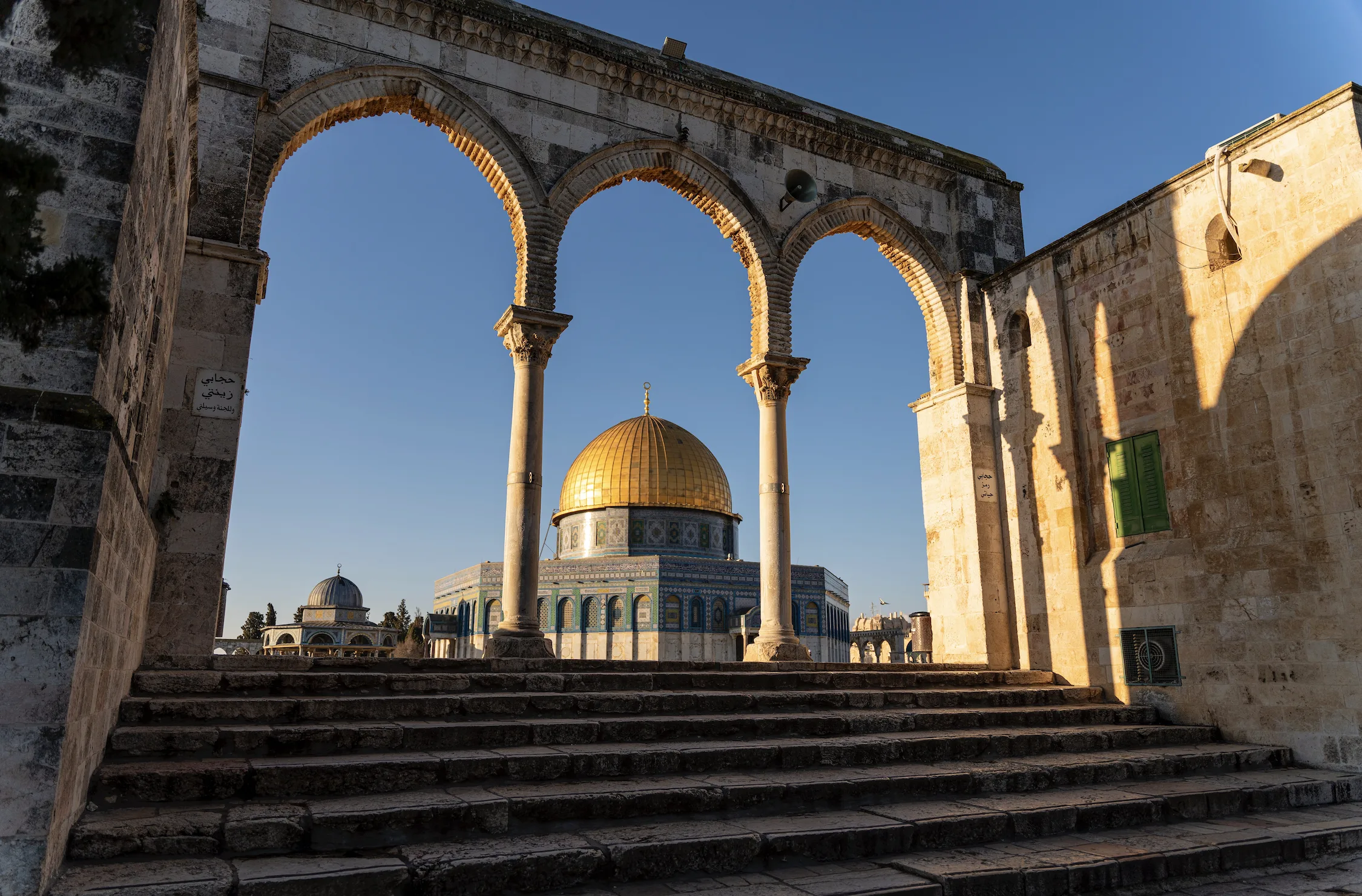
The Dome of the Rock stands as one of the most recognizable and significant monuments in Islamic architecture and history. Built in 691 CE by the Umayyad Caliphate Caliph Abd al-Malik ibn Marwan, this magnificent structure with its golden dome has dominated the Jerusalem skyline for over thirteen centuries. Located on the Temple Mount, known to Muslims as the Haram al-Sharif (Noble Sanctuary), the Dome of the Rock is not merely an architectural masterpiece but a profound statement of Islamic faith, political power, and cultural achievement. As the oldest surviving Islamic building in the world, it represents a crucial moment in the development of Islamic art and architecture, establishing aesthetic and symbolic patterns that would influence mosque design for centuries to come.
The building's significance extends far beyond its architectural beauty. It marks the site where Islamic tradition holds that the Prophet Muhammad ascended to heaven during the Night Journey (Isra and Mi'raj), making it one of the holiest sites in Islam after Mecca and Medina. The rock itself, which gives the structure its name, is believed to be the place from which the Prophet began his miraculous ascent. This sacred association, combined with the building's historical importance and artistic magnificence, has made the Dome of the Rock a powerful symbol of Islamic civilization and a focal point of religious devotion for Muslims worldwide.
Historical Context and Construction
The Dome of the Rock was constructed during a pivotal period in early Islamic history. By the late seventh century, the Umayyad Caliphate had established itself as the dominant power in the Middle East, having conquered vast territories from Spain to Central Asia. Jerusalem, captured by Muslim forces in 638 CE during the reign of Caliph Umar ibn al-Khattab, had become an important city in the Islamic empire, revered for its connection to earlier prophets and its role in Islamic sacred history.
Caliph Abd al-Malik ibn Marwan, who ruled from 685 to 705 CE, commissioned the construction of the Dome of the Rock in 691 CE. The caliph's motivations for building this magnificent structure were complex and multifaceted. On one level, the building served to commemorate and honor the site of the Prophet Muhammad's Night Journey, establishing a permanent monument to this miraculous event. The Quran refers to this journey in Surah Al-Isra: "Glory be to Him who made His servant journey by night from the Sacred Mosque to the Farthest Mosque, whose surroundings We have blessed, that We might show him some of Our signs."
However, the construction also had important political dimensions. Abd al-Malik was consolidating Umayyad power during a period of internal Islamic conflict. A rival caliphate had been established in Mecca by Abdullah ibn al-Zubayr, making pilgrimage to the Kaaba difficult or impossible for those loyal to the Umayyads. Some historians have suggested that Abd al-Malik intended the Dome of the Rock to serve as an alternative pilgrimage site, though this interpretation is debated. More certainly, the building served as a powerful statement of Umayyad legitimacy and Islamic civilization's ability to create monuments rivaling those of earlier empires.
The construction of the Dome of the Rock also represented a deliberate engagement with the Christian and Jewish heritage of Jerusalem. The Temple Mount had been the site of the Jewish Temple, destroyed by the Romans in 70 CE, and Jerusalem was a major center of Christianity, filled with churches and Christian monuments. By building a magnificent Islamic structure on this contested sacred site, Abd al-Malik was asserting Islam's place in the Abrahamic tradition and its supersession of earlier revelations. The building's inscriptions, which include Quranic verses emphasizing Islamic monotheism and rejecting Christian doctrines of the Trinity and Jesus's divinity, make this theological claim explicit.
The actual construction of the Dome of the Rock was overseen by two engineers, Raja ibn Haywah and Yazid ibn Salam, who managed a workforce that included local craftsmen as well as artisans brought from across the Islamic empire. The building was completed in 691 CE, remarkably quickly given its complexity and scale. Contemporary sources report that the construction cost 100,000 gold dinars, though seven years' worth of Egypt's tax revenue was allocated to the project, suggesting the actual expenditure may have been even greater. This massive investment reflected the building's importance to Abd al-Malik and the Umayyad state.
Architectural Design and Features
The Dome of the Rock is a masterpiece of early Islamic architecture, combining elements from Byzantine, Persian, and Arab architectural traditions into a distinctive and influential synthesis. The building's design is based on a centralized plan, with the sacred rock at its center, surrounded by two concentric ambulatories that allow pilgrims to circumambulate the rock in a ritual procession. This centralized design, while having precedents in Byzantine martyria and Persian fire temples, was adapted and transformed to serve Islamic religious and aesthetic purposes.
The structure consists of an octagonal exterior wall enclosing a circular inner colonnade, which in turn surrounds the rock itself. The octagonal plan, with each side measuring approximately 20.6 meters, creates a building that appears different from every angle while maintaining perfect geometric harmony. The use of the octagon, a shape midway between the square (representing earth) and the circle (representing heaven), may have symbolic significance, suggesting the building's role as a link between the earthly and divine realms.
The building's most distinctive feature is its magnificent dome, which rises to a height of approximately 20 meters and has a diameter of about 20 meters. The dome sits on a circular drum supported by twelve columns and four piers, creating an open, light-filled space beneath. The dome's double-shell construction, with an inner wooden dome and an outer dome originally covered in lead (later replaced with gold-anodized aluminum), was an engineering achievement that influenced subsequent Islamic architecture. The golden dome, which has become the building's most recognizable feature, was added in the sixteenth century during Ottoman renovations, replacing the original lead covering.
The exterior walls of the Dome of the Rock are covered with intricate decorative programs that represent some of the finest examples of early Islamic art. The lower portions of the walls feature marble panels, while the upper sections are adorned with elaborate mosaics. These mosaics, created by Byzantine craftsmen working under Islamic patronage, depict stylized vegetal motifs, jeweled crowns, and architectural elements, but notably exclude any human or animal figures in accordance with Islamic aesthetic principles. The mosaics' rich colors—blues, greens, golds, and whites—create a dazzling visual effect that has been compared to a jeweled crown.
The interior of the Dome of the Rock is even more spectacular than its exterior. The walls and columns are covered with marble panels, mosaics, and decorative inscriptions. The mosaics inside the building are among the most extensive and best-preserved examples of early Islamic art, covering approximately 1,200 square meters. They feature elaborate vegetal scrolls, jeweled vessels, and architectural motifs executed in glass tesserae with gold backgrounds. These decorations create an otherworldly atmosphere, transforming the interior into a vision of paradise.
The building's inscriptions are particularly significant, representing the oldest surviving monumental Islamic inscriptions. A 240-meter-long inscription band runs around the inner octagonal arcade, containing verses from the Quran along with statements about the building's construction and purpose. These inscriptions emphasize Islamic monotheism and include verses that specifically address Christian doctrines, such as Surah Maryam 19:35: "It is not befitting to (the majesty of) Allah that He should beget a son. Glory be to Him! When He determines a matter, He only says to it, 'Be,' and it is." This theological messaging reflects the building's role in asserting Islamic beliefs in a city dominated by Christian monuments.
The rock itself, which gives the building its name, is a large limestone outcrop measuring approximately 13.5 by 11.5 meters. Islamic tradition identifies this as the site from which the Prophet Muhammad ascended to heaven during the Night Journey. The rock shows evidence of having been worked and shaped in antiquity, and a cave beneath it, known as the Well of Souls, adds to the site's mystical significance. The rock is surrounded by a wooden screen, and pilgrims traditionally circumambulate it while reciting prayers and supplications.
Religious Significance in Islamic Tradition
The Dome of the Rock's religious significance in Islam is profound and multifaceted, rooted in the site's connection to the Prophet Muhammad's Night Journey and its place in Islamic sacred geography. According to Islamic tradition, the Prophet Muhammad was transported from Mecca to Jerusalem in a single night, an event known as the Isra. From Jerusalem, specifically from the rock now enclosed by the Dome, he ascended through the seven heavens in an experience called the Mi'raj, meeting earlier prophets and receiving instructions about prayer before returning to Mecca.
This miraculous journey is referenced in the Quran and elaborated in hadith literature. The Night Journey established Jerusalem's status as Islam's third holiest city, after Mecca and Medina, and the Temple Mount as a sacred site. The Dome of the Rock, by marking and commemorating this event, became a focal point for Islamic devotion and pilgrimage. While not required as part of the Hajj, visiting the Dome of the Rock and praying at the site has been considered a meritorious act throughout Islamic history.
The site's significance is enhanced by its connection to earlier prophets recognized in Islam. Islamic tradition identifies the Temple Mount as the location of Solomon's Temple and associates it with Abraham, David, and other prophets. This continuity with earlier Abrahamic traditions reinforces Islam's self-understanding as the culmination and perfection of monotheistic revelation. The Dome of the Rock, by its very presence on this ancient sacred site, makes a powerful statement about Islam's place in sacred history.
The building has also played an important role in Islamic eschatology and mystical thought. Some traditions associate the rock with the Day of Judgment, suggesting it will be the first place where the dead are resurrected. Sufi mystics have seen the Dome of the Rock as a symbol of spiritual ascent, with the Prophet's Mi'raj serving as a model for the soul's journey toward God. These mystical interpretations have added layers of meaning to the building's significance, making it not just a historical monument but a living symbol of spiritual aspiration.
Throughout Islamic history, scholars, poets, and travelers have written extensively about the Dome of the Rock, contributing to its legendary status. Medieval geographers and historians included detailed descriptions of the building in their works, often emphasizing its beauty and sacred significance. Pilgrims' accounts describe the emotional and spiritual impact of visiting the site, and poets composed verses celebrating its magnificence. This literary tradition has helped maintain the Dome of the Rock's prominence in Islamic consciousness across centuries and geographical distances.
Historical Transformations and Renovations
Over its thirteen-century history, the Dome of the Rock has undergone numerous renovations, restorations, and modifications, each reflecting the political, aesthetic, and religious priorities of different Islamic dynasties and rulers. These changes have altered aspects of the building's appearance while preserving its essential form and character, demonstrating both the structure's durability and its continuing importance to successive Muslim rulers.
The first major renovation occurred during the Abbasid period in the eighth and ninth centuries. After an earthquake damaged the building in 746 CE, Caliph al-Mansur undertook repairs and modifications. His successor, al-Mahdi, carried out more extensive renovations between 780 and 785 CE, replacing much of the original mosaic decoration and modifying some inscriptions. These Abbasid renovations maintained the building's Umayyad character while updating certain elements to reflect Abbasid aesthetic preferences and political messaging.
The Crusader period (1099-1187) brought dramatic changes to the Dome of the Rock's function and appearance. When Crusader forces captured Jerusalem in 1099, they converted the Dome of the Rock into a Christian church, calling it the Templum Domini (Temple of the Lord). They added a Christian altar, placed a cross atop the dome, and covered some of the Islamic inscriptions. The Knights Templar, who took their name from this building, used the adjacent Al-Aqsa Mosque as their headquarters. Despite these modifications, the Crusaders recognized the building's architectural magnificence and largely preserved its structure.
The recapture of Jerusalem by Saladin in 1187 marked another turning point in the Dome of the Rock's history. Saladin immediately restored the building to Islamic use, removing Christian additions and undertaking repairs and renovations. He commissioned new inscriptions, including one commemorating his liberation of Jerusalem, and restored Islamic decorative elements. Saladin's renovations were part of his broader program of re-Islamizing Jerusalem and establishing his legitimacy as defender of Islam's holy sites.
The Mamluk period (1250-1517) saw continued attention to the Dome of the Rock's maintenance and decoration. Mamluk sultans, who controlled Jerusalem from Cairo, undertook various restoration projects, adding new decorative elements and repairing earthquake damage. They also enhanced the surrounding Haram al-Sharif with additional structures, creating the complex of Islamic monuments that characterizes the Temple Mount today. The Mamluks' work reflected their role as guardians of Islam's holy sites and their desire to leave their mark on Jerusalem's sacred landscape.
The Ottoman period (1517-1917) brought the most extensive renovations to the Dome of the Rock since its original construction. Sultan Suleiman the Magnificent undertook major restoration work in the sixteenth century, replacing much of the exterior mosaic decoration with the colorful ceramic tiles that characterize the building's current appearance. These tiles, produced in Ottoman workshops, feature intricate floral and geometric patterns in blues, greens, yellows, and whites, creating the distinctive appearance familiar today. Suleiman also added the golden covering to the dome, replacing the original lead, though this gold covering has been renewed several times since.
Later Ottoman sultans continued to maintain and restore the building. Sultan Mahmud II undertook repairs in the early nineteenth century, and Sultan Abdul Hamid II carried out extensive renovations in the late nineteenth century. These Ottoman renovations preserved the building's essential character while updating its appearance to reflect Ottoman aesthetic preferences. The Ottomans' careful stewardship ensured the Dome of the Rock's survival through centuries of political change and natural disasters.
The first restoration of the mandate period was organised from Jerusalem itself. The Supreme Muslim Council, established under the British mandate and presided over by the grand mufti Amin al-Husseini, took responsibility from 1922 for raising funds to repair the building, securing a contribution of 38,000 golden lira from Sharif Hussein bin Ali of Mecca and inviting Emir Abdullah of Transjordan to supervise the work and its accounts; the restoration was completed by 1928.
In the modern period, the Dome of the Rock has undergone several further major restoration projects. King Hussein of Jordan, whose Hashemite family held custodianship of Jerusalem's Islamic holy sites, initiated a major restoration in the 1960s, including re-gilding the dome with 80 kilograms of gold. More recent renovations in the 1990s and 2000s have focused on structural repairs, conservation of decorative elements, and updating the dome's gold covering. These modern restorations have employed both traditional techniques and contemporary conservation methods to preserve the building for future generations.
Political and Cultural Symbolism
Throughout its history, the Dome of the Rock has served as a powerful political and cultural symbol, representing different things to different groups at different times. For the Umayyad caliphs who built it, the structure was a statement of Islamic power and legitimacy, demonstrating the new religion's ability to create monuments rivaling those of earlier empires. The building's magnificence proclaimed the Umayyads' wealth and sophistication, while its location on the Temple Mount asserted Islam's supersession of Judaism and Christianity.
For subsequent Islamic dynasties, control and maintenance of the Dome of the Rock became a mark of legitimacy and piety. Rulers who undertook renovations or additions to the building could claim the prestige of being guardians of one of Islam's holiest sites. The inscriptions added by various rulers, commemorating their restoration work, served as permanent records of their devotion and authority. This pattern continued through the Abbasid, Fatimid, Ayyubid, Mamluk, and Ottoman periods, with each dynasty leaving its mark on the building.
The Dome of the Rock has also played a significant role in Islamic art and architecture more broadly. Its design influenced the development of mosque architecture, particularly the use of domes and the integration of decorative programs. The building's mosaics and inscriptions established aesthetic patterns that would be repeated and elaborated in Islamic art for centuries. Miniature paintings and architectural drawings of the Dome of the Rock appeared in manuscripts throughout the Islamic world, spreading its influence even to regions far from Jerusalem.
In the modern period, the Dome of the Rock has become a symbol of Palestinian and broader Arab identity, representing both Islamic heritage and resistance to Israeli control of Jerusalem. The building's image appears on flags, posters, and political materials, serving as a visual shorthand for Palestinian claims to Jerusalem. This political symbolism has made the Dome of the Rock a focal point of the Israeli-Palestinian conflict, with disputes over access to and control of the Temple Mount/Haram al-Sharif remaining one of the most sensitive issues in the region.
The building has also become an icon of Islamic civilization more generally, recognized worldwide as a symbol of Islamic art, architecture, and culture. Its distinctive golden dome and octagonal form are instantly recognizable, appearing in countless photographs, artworks, and media representations. For Muslims around the world, the Dome of the Rock represents a connection to Islamic sacred history and a reminder of Islam's architectural and artistic achievements. This symbolic power has ensured the building's continued prominence in Islamic consciousness despite the political complexities surrounding it.
Architectural Influence and Legacy
The Dome of the Rock's influence on Islamic architecture has been profound and lasting, establishing design principles and aesthetic patterns that would be repeated and elaborated throughout the Islamic world. As the first major Islamic building, it set precedents that shaped the development of mosque architecture and Islamic monumental building more generally. Its centralized plan, use of the dome, integration of decorative programs, and emphasis on geometric harmony became characteristic features of Islamic architecture.
The building's most obvious influence was on the use of domes in Islamic architecture. While domes had been used in earlier Byzantine and Persian architecture, the Dome of the Rock demonstrated how this architectural element could be adapted to Islamic purposes and aesthetics. The dome's symbolic associations with heaven and its practical advantages in creating impressive interior spaces made it a favored element in mosque design. From the great mosques of the Umayyad and Abbasid periods to the Ottoman imperial mosques of Istanbul, domes became a defining feature of Islamic religious architecture.
The Dome of the Rock's decorative programs also had lasting influence. The building's extensive use of mosaics, geometric patterns, and vegetal motifs established aesthetic principles that would characterize Islamic art. The avoidance of figural representation in favor of abstract and vegetal decoration became a hallmark of Islamic religious art, though the reasons for this were complex and evolved over time. The building's inscriptions, integrating Quranic verses into the architectural design, established a pattern that would be repeated in mosques and other Islamic buildings throughout history.
The octagonal plan of the Dome of the Rock inspired numerous later buildings, though few replicated it exactly. The use of geometric shapes and mathematical proportions in the building's design reflected broader Islamic interests in geometry and mathematics, which would find expression in both architecture and decorative arts. The building's emphasis on geometric harmony and proportional relationships influenced Islamic architectural theory and practice for centuries.
Specific buildings that show the Dome of the Rock's influence include the Great Mosque of Damascus, built by the same Umayyad caliph shortly after the Dome of the Rock's completion, which incorporated similar decorative programs and architectural elements. Later buildings, such as the Dome of the Chain adjacent to the Dome of the Rock itself, the Qubbat al-Sakhra in Cairo, and various commemorative structures throughout the Islamic world, drew inspiration from the Jerusalem monument. Even buildings that did not directly copy its form often incorporated elements of its decorative vocabulary or design principles.
The Dome of the Rock's influence extended beyond the Islamic world. European travelers and Crusaders who saw the building were impressed by its magnificence, and their descriptions influenced European perceptions of Islamic architecture. During the Renaissance and later periods, European architects and artists studied Islamic buildings, including the Dome of the Rock, as examples of exotic and sophisticated design. This cross-cultural influence contributed to the development of architectural styles that incorporated Islamic elements, such as Moorish Revival architecture in the nineteenth century.
Conservation Challenges and Modern Stewardship
Preserving the Dome of the Rock for future generations presents numerous challenges, ranging from structural issues to political complexities. As a building over thirteen centuries old, it faces the natural deterioration that affects all ancient structures, including weathering of materials, structural stresses, and damage from earthquakes and other natural events. These physical challenges are compounded by the building's location in a politically contested area and its status as a active religious site visited by thousands of people annually.
The building's structural integrity has been a concern throughout its history, with earthquakes posing a particular threat. Jerusalem sits in a seismically active region, and several earthquakes have damaged the Dome of the Rock over the centuries. Modern engineering assessments have identified areas of structural weakness that require ongoing monitoring and maintenance. The dome itself, with its double-shell construction and heavy gold covering, places significant stress on the supporting columns and drum, requiring careful structural management.
The decorative elements of the Dome of the Rock also require specialized conservation. The mosaics, both interior and exterior, are fragile and susceptible to damage from moisture, temperature fluctuations, and air pollution. The marble panels and columns need regular cleaning and maintenance to prevent deterioration. The ceramic tiles added during the Ottoman period require periodic replacement and repair. Modern conservation efforts must balance the need to preserve original materials with the practical necessity of ensuring the building's continued use and stability.
The political situation surrounding the Dome of the Rock complicates conservation efforts. The Temple Mount/Haram al-Sharif is administered by the Islamic Waqf under Jordanian custodianship, but Israel controls access to the site and the surrounding area. This divided authority can create challenges for coordinating conservation work and securing necessary resources. Any work on the site is politically sensitive, with different groups scrutinizing changes for their potential political implications. This political dimension adds complexity to what would otherwise be purely technical conservation decisions.
Despite these challenges, significant conservation work has been carried out in recent decades. The Jordanian government, which maintains custodianship of Jerusalem's Islamic holy sites through the Hashemite family's historical role, has funded major restoration projects. International organizations, including UNESCO, have provided technical expertise and support for conservation efforts. These projects have employed both traditional craftsmanship and modern conservation techniques, seeking to preserve the building's historical character while ensuring its structural stability.
Modern technology has also been applied to the Dome of the Rock's conservation. Laser scanning and photogrammetry have created detailed three-dimensional models of the building, providing valuable documentation and aiding in conservation planning. Non-invasive testing methods allow conservators to assess the condition of materials without causing damage. Climate control systems help protect interior decorations from environmental damage. These technological approaches complement traditional conservation methods, providing new tools for preserving this ancient monument.
The challenge of balancing preservation with continued religious use is ongoing. The Dome of the Rock remains an active site of Islamic worship and pilgrimage, with thousands of visitors entering the building regularly. This continued use is essential to the building's significance and vitality, but it also creates wear and tear that must be managed. Conservation efforts must accommodate the building's religious function while protecting its historical and artistic value, a balance that requires ongoing dialogue between religious authorities, conservation professionals, and political stakeholders.
The Dome of the Rock in Contemporary Context
In the contemporary world, the Dome of the Rock continues to hold profound significance, though its meaning and symbolism have evolved to reflect modern political, religious, and cultural contexts. The building remains one of Islam's holiest sites, attracting Muslim pilgrims and visitors from around the world who come to pray and experience its sacred atmosphere. For many Muslims, visiting the Dome of the Rock represents a spiritual aspiration and a connection to Islamic sacred history, particularly the Prophet Muhammad's Night Journey.
The building's role in the Israeli-Palestinian conflict has made it a symbol of contested sovereignty and religious identity. The Temple Mount/Haram al-Sharif, on which the Dome of the Rock stands, is claimed as holy by both Muslims and Jews, with Jews regarding it as the site of the ancient Jewish Temple and Muslims revering it as the location of the Prophet's ascension. This dual claim has made the site one of the most sensitive flashpoints in the conflict, with disputes over access, worship rights, and sovereignty regularly causing tension and sometimes violence.
The Dome of the Rock's image has become ubiquitous in Palestinian and broader Arab political and cultural expression. It appears on posters, flags, stamps, and currency, serving as a symbol of Palestinian identity and claims to Jerusalem. This political symbolism has made the building's image itself a contested element, with its use in political contexts sometimes drawing criticism or controversy. The building's symbolic power extends beyond the immediate conflict, representing for many Muslims worldwide the broader issue of Islamic holy sites and their protection.
In the digital age, the Dome of the Rock has gained new forms of visibility and significance. Photographs and videos of the building circulate widely on social media, making it one of the most recognizable Islamic monuments globally. Virtual tours and three-dimensional models allow people who cannot visit Jerusalem to experience the building remotely. This digital presence has both positive and negative aspects, increasing awareness and appreciation of the building while also potentially reducing it to a mere image divorced from its physical and spiritual reality.
The building continues to inspire contemporary Islamic art and architecture. Modern architects and artists reference the Dome of the Rock in their work, drawing on its forms, decorative vocabulary, and symbolic associations. New mosques and Islamic cultural centers around the world sometimes incorporate design elements inspired by the Dome of the Rock, maintaining its influence on Islamic architectural expression. Contemporary artists create works that engage with the building's history and symbolism, exploring themes of faith, identity, and cultural heritage.
Academic study of the Dome of the Rock continues to yield new insights into its history, architecture, and significance. Scholars from various disciplines—including art history, archaeology, religious studies, and political science—examine different aspects of the building and its role in Islamic civilization. Recent scholarship has challenged earlier interpretations, revealed new details about the building's construction and decoration, and explored its complex meanings in different historical and cultural contexts. This ongoing scholarly engagement ensures that our understanding of the Dome of the Rock continues to deepen and evolve.
The Dome of the Rock and Islamic Sacred Geography
The Dome of the Rock occupies a unique position within Islamic sacred geography, serving as a physical and spiritual link between the earthly and heavenly realms. Its location in Jerusalem, Islam's third holiest city, places it within a sacred landscape that includes the Al-Aqsa Mosque and numerous other sites associated with prophets and sacred events. This concentration of holy sites in Jerusalem has made the city a focal point of Islamic devotion and pilgrimage throughout history, with the Dome of the Rock serving as the most visually striking and symbolically powerful monument within this sacred precinct.
The relationship between the Dome of the Rock and the nearby Al-Aqsa Mosque is complex and often misunderstood. While the Dome of the Rock is the more visually prominent structure with its golden dome, the Al-Aqsa Mosque is technically the main congregational mosque of the Haram al-Sharif. The two buildings serve different but complementary functions within the sacred complex. The Dome of the Rock is primarily a commemorative monument marking the site of the Prophet's ascension, while Al-Aqsa serves as the main prayer hall for congregational worship. Together, they form the heart of Jerusalem's Islamic sacred landscape, with the entire Temple Mount platform considered holy ground.
The concept of the Haram al-Sharif as a unified sacred precinct developed over centuries of Islamic rule in Jerusalem. The Umayyads, who built both the Dome of the Rock and the original Al-Aqsa Mosque, conceived of the Temple Mount as a comprehensive Islamic sacred space that would rival Mecca and Medina in importance. Subsequent Islamic dynasties enhanced this sacred landscape with additional structures, including smaller domes, fountains, madrasas, and other buildings that created a rich architectural ensemble. The Dome of the Rock, as the oldest and most magnificent of these structures, became the visual and symbolic centerpiece of this sacred complex.
The Dome of the Rock's role in Islamic pilgrimage practices has evolved over time. While visiting Jerusalem and praying at the Dome of the Rock has never been a required element of the Hajj pilgrimage to Mecca, it has long been considered a highly meritorious act. Medieval Islamic scholars debated the spiritual rewards associated with prayer at the Dome of the Rock, with some traditions suggesting that prayers offered there carried special blessings. Pilgrims to Jerusalem would typically visit both the Dome of the Rock and Al-Aqsa Mosque, circumambulating the rock and offering prayers at various locations within the Haram al-Sharif.
The building's connection to earlier prophets recognized in Islam adds another dimension to its sacred significance. Islamic tradition holds that the Temple Mount was the site of Solomon's Temple, built to house the Ark of the Covenant and serve as a center of monotheistic worship. The rock itself is associated with Abraham's near-sacrifice of his son, an event commemorated in Islamic tradition during Eid al-Adha. These connections to earlier prophets reinforce Islam's understanding of itself as the culmination of Abrahamic monotheism, with the Dome of the Rock serving as a physical manifestation of this theological continuity.
The Dome of the Rock's place in Islamic eschatology has contributed to its mystical significance. Some Islamic traditions hold that the rock will play a role in the events of the Day of Judgment, serving as a gathering place for souls or as the location where the scales of justice will be set up to weigh human deeds. While these eschatological traditions vary and are not universally accepted, they have added to the building's aura of sacred mystery and its importance in Islamic religious imagination. The rock's association with both the Prophet's ascension to heaven and the final judgment creates a powerful symbolism of spiritual transformation and divine encounter.
The Dome of the Rock in Islamic Art and Literature
Throughout Islamic history, the Dome of the Rock has been a subject of extensive artistic and literary attention, inspiring poets, artists, historians, and travelers to create works celebrating its beauty and significance. This rich tradition of artistic and literary engagement has helped maintain the building's prominence in Islamic cultural consciousness and has contributed to its status as an icon of Islamic civilization. The ways in which Muslims have represented and written about the Dome of the Rock reveal much about Islamic aesthetic values, religious devotion, and cultural identity across different periods and regions.
Medieval Islamic geographers and historians devoted considerable attention to describing the Dome of the Rock in their works. Writers such as al-Muqaddasi, a tenth-century geographer from Jerusalem, provided detailed descriptions of the building's architecture, decorations, and sacred significance. Al-Muqaddasi's account emphasizes the building's beauty and magnificence, describing its mosaics, marble columns, and golden dome in terms that convey both aesthetic appreciation and religious reverence. His description, like those of other medieval writers, served to spread knowledge of the Dome of the Rock throughout the Islamic world, making it familiar even to Muslims who had never visited Jerusalem.
The tradition of pilgrimage literature, or rihla, produced numerous accounts of visits to the Dome of the Rock. Pilgrims and travelers from across the Islamic world wrote descriptions of their journeys to Jerusalem and their experiences visiting the sacred sites. These accounts often combine practical information about routes and accommodations with spiritual reflections on the significance of the holy places. The Dome of the Rock features prominently in these narratives, with writers describing the emotional and spiritual impact of seeing the building for the first time, entering its sacred precincts, and praying at the site of the Prophet's ascension.
Islamic poets composed verses celebrating the Dome of the Rock and Jerusalem's sacred landscape. These poems, written in Arabic, Persian, Turkish, and other Islamic languages, employ rich metaphorical language to describe the building's beauty and spiritual significance. Poets compared the golden dome to the sun, the mosaics to gardens of paradise, and the rock itself to a gateway between earth and heaven. This poetic tradition helped establish the Dome of the Rock as a symbol of divine beauty and spiritual aspiration, embedding it deeply in Islamic literary culture.
Visual representations of the Dome of the Rock appear in various forms of Islamic art, though with important limitations. Islamic religious art traditionally avoids realistic depictions of sacred sites, preferring stylized or symbolic representations. Miniature paintings in manuscripts sometimes include schematic depictions of the Dome of the Rock, often as part of illustrations of the Prophet's Night Journey. These images typically show the building in a highly stylized manner, emphasizing its symbolic rather than realistic appearance. The golden dome and octagonal form are usually recognizable, but the images serve more as religious symbols than as architectural documentation.
Calligraphic art has provided another medium for celebrating the Dome of the Rock. Calligraphers have created works featuring Quranic verses associated with the Night Journey, often incorporating stylized representations of the building or its dome into the composition. These calligraphic works combine the Islamic arts of beautiful writing and architectural symbolism, creating pieces that serve both aesthetic and devotional purposes. The tradition of calligraphic art celebrating the Dome of the Rock continues in contemporary Islamic art, with modern calligraphers creating innovative works that reference this historic monument.
The Dome of the Rock has also appeared in Islamic decorative arts, including ceramics, textiles, and metalwork. Tiles depicting the building adorned mosques and palaces throughout the Islamic world, serving as reminders of Jerusalem's sacred significance. Prayer rugs sometimes featured stylized images of the Dome of the Rock, allowing worshippers to symbolically orient themselves toward Jerusalem during prayer. These decorative representations helped disseminate the building's image throughout Islamic civilization, making it a familiar and beloved symbol even in regions far from Jerusalem.
In modern times, the Dome of the Rock has become one of the most photographed and reproduced images in Islamic visual culture. Photographs of the building appear in homes, mosques, and public spaces throughout the Muslim world, serving as reminders of Islamic heritage and sacred geography. The building's image has been adapted for use in various media, from postage stamps and currency to digital art and graphic design. This widespread visual presence has made the Dome of the Rock perhaps the most recognizable symbol of Islamic architecture and culture in the contemporary world.
The Dome of the Rock and Interfaith Relations
The Dome of the Rock's location on a site sacred to Judaism, Christianity, and Islam has made it a focal point for interfaith dialogue and conflict throughout its history. The Temple Mount, known to Jews as Har HaBayit and to Muslims as the Haram al-Sharif, carries profound religious significance for multiple faith communities, creating both opportunities for mutual understanding and sources of tension. The Dome of the Rock, as the most visible monument on this contested sacred site, embodies the complex religious and political dynamics that have characterized Jerusalem for centuries.
For Jews, the Temple Mount is the holiest site in Judaism, the location of the First and Second Temples and the place where Jewish tradition holds that God's presence dwelt most intensely on earth. The Western Wall, the last remaining structure from the Second Temple complex, is located at the base of the Temple Mount platform on which the Dome of the Rock stands. The destruction of the Second Temple by the Romans in 70 CE was a catastrophic event in Jewish history, and the hope for the Temple's eventual rebuilding has been a central element of Jewish religious thought and prayer. The presence of Islamic structures on the Temple Mount, particularly the Dome of the Rock, creates a complex situation in which Jewish religious aspirations and Islamic sacred sites occupy the same physical space.
Christian connections to the Temple Mount are less direct but still significant. Christians revere Jerusalem as the site of Jesus's ministry, crucifixion, and resurrection, and the Temple Mount features in Gospel accounts of Jesus's life. The Temple where Jesus taught and drove out the money changers stood on this site, making it part of Christian sacred geography. During the Crusader period, Christians controlled the Temple Mount and converted the Dome of the Rock into a church, demonstrating the site's importance in Christian religious imagination. While the Temple Mount is not as central to Christianity as it is to Judaism and Islam, it remains part of the broader sacred landscape of Jerusalem that holds deep meaning for Christians worldwide.
The history of the Dome of the Rock reflects the changing dynamics of interfaith relations in Jerusalem. During most periods of Islamic rule, Jews and Christians were allowed to live in Jerusalem and practice their religions, though with certain restrictions and under the legal status of dhimmi (protected minorities). Access to the Temple Mount itself was generally restricted to Muslims, but Jews could pray at the Western Wall and Christians could visit their holy sites elsewhere in the city. This arrangement, while not equal by modern standards, allowed for a degree of religious coexistence that was relatively unusual in the medieval world.
The Crusader conquest of Jerusalem in 1099 and the subsequent conversion of the Dome of the Rock into a Christian church represented a dramatic disruption of this interfaith dynamic. The Crusaders' massacre of Jerusalem's Muslim and Jewish populations and their appropriation of Islamic sacred sites created deep wounds that have influenced Christian-Muslim relations ever since. Saladin's recapture of Jerusalem in 1187 and his restoration of the Dome of the Rock to Islamic use, accompanied by his relatively merciful treatment of the city's Christian population, offered a contrasting model of interfaith relations, though one still based on Islamic political and religious dominance.
In the modern period, the Dome of the Rock has become a symbol of the Israeli-Palestinian conflict and the broader tensions between the Islamic world and Israel. The 1967 Six-Day War, in which Israel captured East Jerusalem including the Temple Mount, created a new political reality in which the site is under Israeli sovereignty but administered by the Islamic Waqf under Jordanian custodianship. This arrangement has been a source of ongoing tension, with disputes over access rights, worship practices, and sovereignty regularly causing crises. The Dome of the Rock, as the most visible symbol of Islamic presence on the Temple Mount, has become a focal point for these conflicts.
Efforts at interfaith dialogue regarding the Dome of the Rock and the Temple Mount have had mixed results. Some religious leaders and scholars from Jewish, Christian, and Muslim communities have engaged in conversations aimed at promoting mutual understanding and finding ways to respect each community's connection to the site. These dialogues have explored possibilities for shared access, mutual recognition of religious claims, and cooperative preservation of the site's historical and religious significance. However, these efforts face significant obstacles, including political conflicts, religious extremism, and the deep emotional and spiritual attachments that each community feels toward the site.
The question of how to balance competing religious claims to the Temple Mount remains one of the most difficult challenges in interfaith relations. Some have proposed various arrangements for shared sovereignty or administration, while others argue that the site's religious significance makes any compromise impossible. The Dome of the Rock, standing at the center of this contested space, serves as a reminder of both the potential for religious conflict and the possibility of coexistence. Its continued existence as a functioning Islamic sacred site, despite centuries of political change and conflict, demonstrates the resilience of religious devotion and the enduring power of sacred places.
The Dome of the Rock and Islamic Identity
The Dome of the Rock has played a significant role in shaping and expressing Islamic identity across different periods and contexts. As one of the oldest and most magnificent Islamic monuments, it has served as a symbol of Islamic civilization's achievements and a source of pride for Muslims worldwide. The building's association with the Prophet Muhammad's Night Journey connects it to the foundational narratives of Islam, while its architectural beauty demonstrates the sophistication and creativity of Islamic culture. These multiple dimensions of significance have made the Dome of the Rock a powerful symbol of Islamic identity in both historical and contemporary contexts.
During the medieval period, the Dome of the Rock served as a symbol of Islamic power and legitimacy for successive dynasties that controlled Jerusalem. Rulers who undertook renovations or additions to the building could claim the prestige of being guardians of one of Islam's holiest sites, enhancing their religious credentials and political authority. The inscriptions added by various rulers, commemorating their restoration work, served as permanent records of their devotion and legitimacy. This pattern of using the Dome of the Rock to assert Islamic identity and authority continued through the Umayyad, Abbasid, Fatimid, Ayyubid, Mamluk, and Ottoman periods.
The Dome of the Rock also played a role in defining Islamic identity in relation to other religious communities. The building's location on the Temple Mount, a site sacred to Judaism and Christianity, and its inscriptions explicitly rejecting Christian doctrines of the Trinity and Jesus's divinity, made it a statement of Islamic theological distinctiveness. By building a magnificent Islamic monument on this contested sacred site, Muslims asserted their place in the Abrahamic tradition while claiming to supersede earlier revelations. This use of architecture to express religious identity and make theological claims was a distinctive feature of early Islamic civilization.
In the modern period, the Dome of the Rock has become a symbol of Palestinian and broader Arab identity, representing both Islamic heritage and resistance to Israeli control of Jerusalem. The building's image appears on Palestinian flags, posters, and political materials, serving as a visual shorthand for Palestinian claims to Jerusalem and the broader struggle for Palestinian statehood. This political symbolism has made the Dome of the Rock a powerful icon of Palestinian national identity, transcending its purely religious significance to become a symbol of political aspiration and cultural heritage.
For Muslims worldwide, the Dome of the Rock represents a connection to Islamic sacred history and a reminder of Islam's architectural and artistic achievements. The building's image is familiar to Muslims from Morocco to Indonesia, appearing in homes, mosques, and public spaces as a symbol of Islamic civilization. This widespread recognition has made the Dome of the Rock one of the most important symbols of Islamic identity in the contemporary world, representing both the historical achievements of Islamic civilization and the ongoing vitality of Islamic culture.
The Dome of the Rock has also played a role in debates about Islamic modernization and the relationship between Islamic tradition and contemporary life. Some Muslims see the building as a symbol of Islam's glorious past, a reminder of a time when Islamic civilization led the world in art, architecture, and learning. This nostalgic view of the Dome of the Rock can inspire efforts to revive Islamic cultural achievements and resist Western cultural dominance. Others see the building as evidence of Islam's capacity for creativity and adaptation, demonstrating that Islamic civilization has always been dynamic and innovative rather than static and traditional.
The question of how to preserve and present the Dome of the Rock in the contemporary world raises important issues about Islamic identity and heritage. Should the building be maintained exactly as it has been, preserving every historical layer and change, or should it be restored to its original seventh-century appearance? Should it be presented primarily as a religious site, an architectural monument, or a political symbol? These questions reflect broader debates within Islamic communities about how to relate to Islamic history and heritage in the modern world, and how to balance religious devotion, historical preservation, and political concerns.
Conclusion
The Dome of the Rock stands as a testament to Islamic civilization's artistic, architectural, and spiritual achievements. For over thirteen centuries, this magnificent building has dominated Jerusalem's skyline, serving as a place of worship, a political symbol, and an architectural masterpiece. Its golden dome and intricate decorations continue to inspire awe and devotion, while its historical significance and sacred associations make it one of the most important monuments in Islamic history.
The building's enduring power lies in its multiple layers of meaning and significance. As the site of the Prophet Muhammad's miraculous Night Journey, it connects Muslims to a foundational moment in Islamic sacred history. As an architectural achievement, it demonstrates the sophistication and creativity of early Islamic civilization. As a political symbol, it has represented Islamic power, Palestinian identity, and contested sovereignty. These various dimensions of significance have ensured the Dome of the Rock's continued relevance across centuries of historical change.
The Dome of the Rock's influence on Islamic architecture and art has been profound and lasting. Its design principles, decorative programs, and symbolic associations have inspired countless later buildings and artworks throughout the Islamic world. The building established aesthetic patterns and architectural forms that became characteristic of Islamic religious architecture, from the use of domes and geometric designs to the integration of Quranic inscriptions into architectural decoration. This architectural legacy ensures that the Dome of the Rock's influence extends far beyond Jerusalem, shaping Islamic visual culture across vast geographical and temporal distances.
The building's role in interfaith relations reflects the complex religious dynamics of Jerusalem and the broader Middle East. As a monument standing on a site sacred to Judaism, Christianity, and Islam, the Dome of the Rock embodies both the potential for religious conflict and the possibility of coexistence. Its history includes periods of interfaith tolerance and cooperation as well as episodes of conquest, conversion, and conflict. Understanding this complex history is essential for addressing contemporary challenges related to religious coexistence and the protection of sacred sites.
The challenges facing the Dome of the Rock in the contemporary world—from conservation needs to political conflicts—reflect broader issues confronting Islamic heritage sites and the communities that value them. The building's future depends on the ability of diverse stakeholders to cooperate in its preservation while respecting its religious significance and navigating complex political realities. The international community's interest in protecting this world heritage site offers hope that the Dome of the Rock will continue to stand for future generations.
As both a historical monument and a living religious site, the Dome of the Rock embodies the continuity of Islamic civilization and the enduring power of faith and artistic expression. Its beauty and significance transcend the political conflicts that surround it, offering a vision of human creativity and spiritual aspiration that speaks to people of all backgrounds. The Dome of the Rock remains not just a building but a symbol of humanity's capacity to create monuments that inspire, uplift, and endure across the centuries. Its golden dome continues to shine over Jerusalem, a beacon of Islamic heritage and a reminder of the sacred connections that bind Muslims to this holy city and to their faith's foundational narratives.
References and Further Reading
Primary Islamic Sources
- Quran, Surah Al-Isra (17:1) — "Exalted is He who took His Servant by night from al-Masjid al-Haram to al-Masjid al-Aqsa, whose surroundings We have blessed."
- Sahih al-Bukhari, Book of the Stories of the Prophets, Hadith 3366 — The Night Journey and the Prophet's ascension from the rock.
- Sahih Muslim, Book of Faith, Hadith 162 — The Mi'raj narrative and the Prophet's journey through the heavens.
- Mujir al-Din al-Hanbali. Al-Uns al-Jalil bi-Tarikh al-Quds wa al-Khalil (History of Jerusalem). Amman: Maktabat al-Muhtasib, 1973. [Original c. 1496 CE]
- The Dome of the Rock Inscriptions — Dedicatory inscriptions from 691 CE by Caliph Abd al-Malik ibn Marwan (with later modifications by al-Ma'mun).
Classical Islamic Sources
- Al-Muqaddasi, Shams al-Din. Ahsan al-Taqasim fi Ma'rifat al-Aqalim, detailed description of the Dome of the Rock. Leiden: Brill, 1877. [Original c. 985 CE]
- Nasir-i Khusraw. Safarnama, eyewitness account of the Dome of the Rock in 1047 CE. [Original c. 1052 CE]
- Al-Wasiti, Abu Bakr. Fada'il al-Bayt al-Muqaddas (Merits of Jerusalem). [Original c. 1019 CE]
- Ibn al-Faqih, Ahmad. Kitab al-Buldan, on the merits and description of the Noble Sanctuary. [Original c. 903 CE]
Academic and Scholarly Sources
- Grabar, Oleg. The Shape of the Holy: Early Islamic Jerusalem. Princeton: Princeton University Press, 1996.
- Grabar, Oleg. The Dome of the Rock. Cambridge: Harvard University Press, 2006.
- Rabbat, Nasser. "The Meaning of the Umayyad Dome of the Rock." Muqarnas 6 (1989): 12–21.
- Creswell, K.A.C. Early Muslim Architecture, Vol. 1, Part 1. Oxford: Clarendon Press, 1932.
- Elad, Amikam. Medieval Jerusalem and Islamic Worship. Leiden: Brill, 1995.
- Hillenbrand, Robert. Islamic Architecture: Form, Function, and Meaning. Edinburgh: Edinburgh University Press, 1994.
- Rosen-Ayalon, Myriam. The Early Islamic Monuments of al-Haram al-Sharif: An Iconographic Study. Jerusalem: Hebrew University, 1989.
- Flood, Finbarr Barry. The Great Mosque of Damascus: Studies on the Makings of an Umayyad Visual Culture. Brill, 2001.
- Khoury, Nuha N.N. The Dome of the Rock, the Kaaba, and Ghumdan: Arab Myths and Umayyad Monuments. Muqarnas, Vol. 10, 1993.
Further Reading
- Armstrong, Karen. Jerusalem: One City, Three Faiths. New York: Knopf, 1996.
- Peters, Francis E. Jerusalem: The Holy City in the Eyes of Chroniclers, Visitors, Pilgrims, and Prophets. Princeton: Princeton University Press, 1985.
- Bloom, Jonathan M., and Sheila S. Blair. Islamic Arts. London: Phaidon, 1997.
- Le Strange, Guy. Palestine Under the Moslems. London: Alexander P. Watt, 1890.
Mentioned In
21 articles reference this topic
and 9 more articles