Prophet Muhammad ﷺ
Prophet Muhammad ﷺ (c. 570–632 CE) was the final prophet and messenger in Islam. Born in Mecca, he proclaimed the Qur'an, formed a community in Medina, and led it through the final decade of his life.
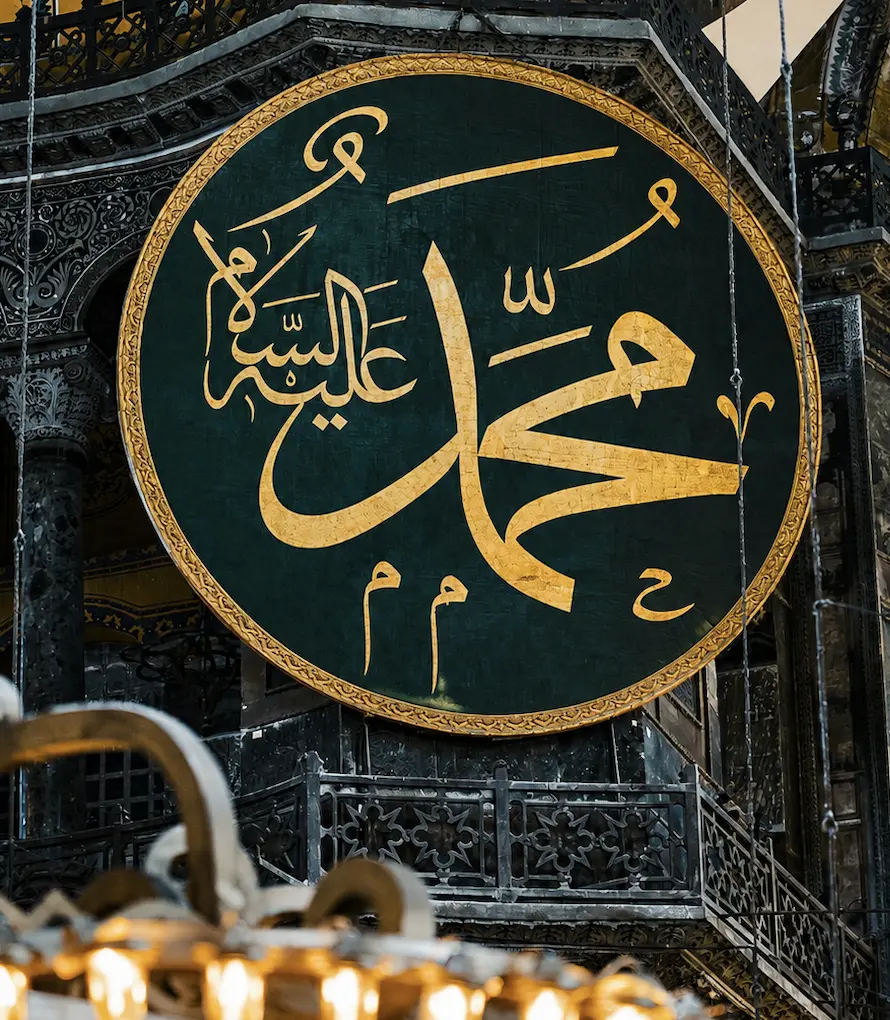
Muhammad ibn Abdullah ibn Abd al-Muttalib (c. 570–632 CE / 53 BH–11 AH) is regarded in Islam as the final prophet and messenger of Allah, the recipient of the Qur'an, and the founder of the first Muslim community. The Qur'an calls him the Messenger of Allah, a witness, bearer of good news, and warner (Qur'an 33:40, 33:45–46), and presents his conduct as an example for believers (Qur'an 33:21). It also describes his character in terms of a great moral disposition (Qur'an 68:4). His life is known through the Qur'an, hadith collections, early and later biographical works, and the historical memory of the Muslim community.
The broad outline is clear: Muhammad was born in Mecca into the Banu Hashim clan of Quraysh; he lost both parents while still a child; he worked in his youth and married Khadijah bint Khuwaylid; he received the first revelation in Mecca; and he called people to worship Allah alone. After years of opposition and persecution, he migrated with his followers to Yathrib, later called Medina, where he established a community whose religious, social, legal, and political life was organised around the Qur'an and his teaching. He returned to Mecca in the eighth year after the Hijra, completed the public proclamation of his message in the remaining years of his life, and died in Medina in 11 AH.
The approved sources do not preserve every date or detail with the same degree of certainty. This article therefore distinguishes between what the Qur'an establishes, what sound hadith reports, what the seerah literature transmits, and what later authors interpret. Where identifiable sources disagree, the disagreement is stated rather than silently settled. Devotional language belonging to a source is not used as a substitute for evidence, and reports that cannot be established are not retained merely because they are familiar.
Arabia before Islam
Mecca, Quraysh, and the sanctuary
Muhammad was born in the western Arabian town of Mecca, in the Hijaz. Mecca was not the capital of a territorial state. Its influence rested on the Kaaba, the pilgrimage associated with it, the offices connected with feeding and watering pilgrims, and the relationships that Quraysh maintained with the tribes who came to the sanctuary. Trade moved through the town and connected the Hijaz with Syria, Yemen, and other parts of Arabia. The absence of a central territorial monarchy did not mean the absence of political order: kinship, protection, alliance, oath, arbitration, and customary obligation governed relations between groups.
The sanctuary was understood as a protected place in which violence was restricted and visitors could gather. The pilgrimage seasons created repeated contact among tribes that otherwise lived in separate political units. Meccan influence therefore depended on more than caravan trade. It also depended on reputation, hospitality, the management of sacred offices, and the ability of Quraysh to maintain relationships with the groups who visited the Kaaba. The sources describe the clans of Quraysh as holding different responsibilities connected with the sanctuary. They do not present Mecca as a bureaucratic state with a single ruler.
The Qur'an connects the Kaaba with Abraham and Ishmael and describes the sanctuary as a place of security and pilgrimage. The seerah works describe Quraysh as having divided among its clans the offices that governed the sanctuary and the pilgrimage. Within Quraysh, the Banu Hashim held responsibilities associated with hospitality and the provision of water. These offices gave the clan standing, but they did not make every member wealthy. The later account of Muhammad's childhood in the household of Abu Talib repeatedly presents the family as respected but materially constrained. (Ibn Kathir, Al-Sira al-Nabawiyya; Haykal, The Life of Muhammad; al-Mubarakpuri, The Sealed Nectar.)
Meccan authority was consequently personal and corporate rather than bureaucratic. A person's protection came through family and alliance. The same structure that enabled a protected man to resist pressure also made a challenge to the religious and commercial arrangements of the sanctuary a challenge to the standing of the clans that managed it. This helps explain why the earliest opposition to Muhammad was expressed through ridicule, negotiation, social pressure, and physical abuse rather than through a state apparatus.
The pre-Islamic background should not be reduced to one description of all Arabs. The sources distinguish between the sanctuary and its surrounding tribes, between merchants and dependants, between people who followed inherited polytheistic practices and individuals who sought a different understanding of God, and between settled communities and mobile groups. The later Qur'anic criticism of injustice and idolatry is a central Islamic interpretation of the period; it is not a reason to treat every person in Arabia as having the same beliefs or social position.
Arabia between larger powers
The Arabian Peninsula was connected to the two large imperial systems that bordered it. The Byzantine Empire influenced Syria and the northern Arabian frontier, while the Sasanian Empire exercised power in Iraq and the east. Arab client kingdoms and allied tribal groups occupied parts of those frontiers. The Lakhmids at al-Hirah were associated with the Sasanian sphere, while Arab groups in Syria were linked to Byzantine interests. Yemen had its own history of Himyarite, Aksumite, and Persian influence. The Hijaz remained outside direct imperial administration, though trade and pilgrimage connected it to these wider political worlds.
The routes that linked Mecca to Syria and Yemen also brought news of distant rulers, religious communities, and political changes. The seerah's accounts of later correspondence with rulers, the expedition to Mu'tah, and the march to Tabuk should be read against this geography. Muhammad's community was initially a local Meccan movement and then a Medinan polity, but the people with whom it came into contact included the rulers and frontier communities of the surrounding world. The approved sources do not justify reducing the background to a simple contest between Islam and two empires; Arabia contained local communities, tribal confederations, and religious groups whose positions changed over time. (Haykal, The Life of Muhammad; al-Mubarakpuri, The Sealed Nectar; TDV/İSAM, “Muhammed.”)
Religious communities and practices
The religious landscape of the Hijaz included Arabian polytheism, Jewish communities, Christian groups, and other religious currents. The seerah literature describes idols associated with particular tribes and sanctuaries, including Hubal in Mecca and al-Lat, al-Uzza, and Manat. The Qur'an criticises the attribution of divine powers to such objects and repeatedly calls people back to the worship of the one Creator.
Jewish communities were established in and around Yathrib and in settlements farther north, including Khaybar. The Medinan narrative names Banu Qaynuqa, Banu Nadir, and Banu Qurayza among the Jewish communities whose political relationships with the Muslim community later changed. Their presence was not an incidental result of Muhammad's arrival: they had their own settlements, alliances, agriculture, and political standing. The exact history and composition of these communities is presented differently in the sources, so broad statements about every Jewish person in the region are avoided here.
Christianity was present in the northern and southern regions of Arabia and among groups connected to the Byzantine and Aksumite worlds. The Qur'an addresses Christians and Jews as communities who possessed earlier scripture, while also disputing particular theological claims. Zoroastrian influence was present in the Persian sphere and in parts of Arabia under Persian authority. The result was a region in which the Quraysh's religious practices coexisted with knowledge of monotheist traditions and with contact through trade and travel.
The biographies also name individuals who are portrayed as dissatisfied with idol worship and interested in the religion of Abraham. Zayd ibn Amr ibn Nufayl is one such figure in the early reports. These accounts belong to the seerah tradition and should not be turned into a claim that a formally organised pre-Islamic monotheist community existed in Mecca. They do, however, show that the sources themselves distinguish between inherited public practice and the religious choices of particular people.
The seerah preserves a Muslim account of how idolatry became established at the Kaaba. It attributes a decisive role to Amr ibn Luhayy of Khuza'ah, who is said to have brought an idol from Syria and encouraged its veneration. This is a report in the biographical and hadith literature, not a separately dated inscriptional history of the Arabian sanctuary. Its importance within the Islamic narrative is that Muhammad's preaching was understood as a return to the monotheism associated with Abraham and Ishmael rather than as the creation of an unrelated religious idea. (al-Mubarakpuri, The Sealed Nectar; Ibn Kathir, Al-Sira al-Nabawiyya.)
Family, birth, and childhood
Lineage and the Banu Hashim
Muhammad was Muhammad ibn Abdullah ibn Abd al-Muttalib ibn Hashim ibn Abd Manaf ibn Qusayy ibn Kilab, of the Banu Hashim clan of Quraysh. His father was Abdullah ibn Abd al-Muttalib and his mother was Aminah bint Wahb of the Banu Zuhrah. The genealogical traditions trace the line through Adnan and associate Adnan with the descendants of Ishmael, the son of Abraham. Ibn Kathir and other classical authorities, however, caution against presenting the names between Adnan and Ishmael as an established chain. The detailed genealogy therefore stops at Adnan rather than filling the gap with a long list whose transmission is uncertain.
The family line placed Muhammad within a branch of Quraysh connected with Qusayy ibn Kilab, whose descendants are associated in the genealogical accounts with the organisation of Meccan authority. The point is not that a later political office was inherited by Muhammad. Rather, the line explains his membership in a clan that was known in the sanctuary and had obligations toward visitors. The sources distinguish social standing from wealth and public office from personal possession.
Abd al-Muttalib held high standing in Mecca and was associated in the sources with the well of Zamzam and the provision of water and food for pilgrims. The accounts of the rediscovery of Zamzam describe him seeing the well in a dream, locating it with the help of al-Harith, and restoring access to a source that had been covered. The same narrative contains a report of a vow concerning one of his sons and the substitution of a large number of camels after the lot fell on Abdullah. These details belong to the early genealogical and seerah tradition; the established point for Muhammad's biography is Abd al-Muttalib's position as his grandfather and a leading member of Banu Hashim.
The account of his family places Muhammad within a clan that carried recognized responsibility at the sanctuary, while also showing that the Prophet's immediate household did not possess the wealth of every Qurayshi merchant family. This combination of lineage, public responsibility, and personal vulnerability remained part of the way the early sources described him.
The Year of the Elephant
The Qur'an contains a short chapter about the “companions of the elephant” and describes the defeat of their plan against the sacred house (Qur'an 105:1–5). The seerah identifies the leader of this expedition as Abraha, the ruler of Yemen associated with the Aksumite power, and places the campaign near the year of Muhammad's birth. It relates that Abraha had built a church at Sana'a and then marched toward Mecca with an army that included elephants. These narrative details come from the seerah tradition; the Qur'anic text itself does not name Abraha or provide the later chronology's full account.
One widely transmitted episode has Abd al-Muttalib meet Abraha after the army seized some of his camels. In Ibn Kathir's transmission from Ibn Ishaq, Abd al-Muttalib asks for the camels and leaves the protection of the Kaaba to its Lord. The exchange is part of the remembered biography and illustrates the position of the Meccan custodian before an invading army; it should not be expanded beyond what the source reports. The campaign's connection with the Qur'anic chapter is a central part of the Muslim account of Muhammad's birth, while the exact calendar conversion from the Year of the Elephant to the Common Era remains approximate.
The Qur'anic chapter does not name the commander, explain the expedition's political background, or provide a full account of the destruction of the army. Those details come through the sira tradition and are marked as such. The article therefore treats the Qur'anic account as the primary scriptural reference and the longer narrative as a transmitted historical account whose details are not all equally secure.
Birth and the death of Abdullah
The sources agree that Muhammad was born in Mecca in the year associated with the Elephant and that his birth occurred on a Monday in Rabi al-Awwal. They do not agree on a single day of that month. The ninth and twelfth are among the dates most often given, while other dates also appear in the chronological literature. The Common Era year is commonly given as 570, with other reckonings placing it in 569 or 571. The chronology therefore uses an approximate date rather than treating one conversion as certain. (Ibn Kathir, Al-Sira al-Nabawiyya; al-Mubarakpuri, The Sealed Nectar; TDV/İSAM, “Muhammed.”)
The more widely transmitted view is that Abdullah died before Muhammad's birth, after returning from a journey and falling ill at Yathrib. Ibn Kathir records this as the more probable account, but also preserves reports placing Abdullah's death after the birth, including reports with different intervals. What is certain within the narrative is that Muhammad did not grow up with his father and that his mother was left to care for him as an infant. The Qur'an later recalled his orphanhood: “Did He not find you an orphan and give you refuge?” (Qur'an 93:6).
Aminah named him Muhammad. The early biographical works describe Abd al-Muttalib taking the newborn to the Kaaba and giving thanks. Reports about extraordinary portents at the birth—such as the shaking of the Persian palace, the extinguishing of the fire of the Magians, or the drying of Lake Sawa—are found in some later compilations, but the chains and evaluations given by the approved seerah sources do not establish them as events with the same certainty as the birth itself. They are therefore treated in the Historiographical Note as reports in the literature, not asserted as historical fact.
The reports about the naming also contain explanations of why the name Muhammad was chosen and how it was received among Quraysh. Those explanations should not be made to carry a prediction about later events. The secure biographical point is the name by which he was known in his family and community, together with the later Qur'anic use of Muhammad and Ahmad.
Halimah and the years in the desert
In accordance with a custom described by the seerah authors, the infant Muhammad was placed with a wet nurse from the desert. The woman was Halimah bint Abi Dhu'ayb of Banu Sa'd, commonly called Halimah al-Sa'diyyah. The sources present the arrangement as a period in which a Meccan child lived with a Bedouin household and acquired the language and habits of the desert. Exact claims about the health benefits or social purpose of the custom are less secure than the basic fact that Muhammad spent part of his early childhood with Halimah.
Halimah's own account, as transmitted in the seerah, describes her family's poverty and the abundance that followed after she accepted the orphaned child: milk became available to her and her infant, her mount strengthened, and her flocks returned with fuller udders than those of her neighbours. These are reports about what Halimah remembered and narrated about the household. They are included in the biography as part of the tradition surrounding his infancy, not converted into an independent economic observation.
Another childhood episode, the opening of the chest (shaqq al-sadr), is transmitted in Sahih Muslim from Anas ibn Malik. In the report, Jibril came to Muhammad while he was with other boys, opened his chest, removed a clot, washed his heart, and returned it. The account includes the children's fear and Halimah's decision to return him to his mother. Because this report is in a canonical hadith collection, it is distinguished from the weaker birth-portent material; it is treated as a transmitted hadith report without adding narrative details not present in the source.
A second report of the opening of the chest is associated with the period of the Night Journey in the hadith literature. The two reports are not silently collapsed into one childhood scene. The first is placed in the early years with Halimah, while the later account forms part of the preparation narrative for the ascent. Both are reported according to their sources, without adding a psychological interpretation that the texts themselves do not make.
Aminah, Abd al-Muttalib, and Abu Talib
Muhammad remained with Aminah after the period with Halimah. When he was about six, Aminah took him to Yathrib to visit relatives connected with Abdullah. The sources mention Umm Ayman, also known as Barakah, as a member of the household who accompanied or cared for him. On the return journey Aminah died at al-Abwa. Muhammad was therefore left without either parent while still a child.
Umm Ayman brought him back to Mecca, where Abd al-Muttalib assumed responsibility for him. The seerah describes the grandfather's affection and his place in the assemblies of Quraysh. Reports that Abd al-Muttalib gave Muhammad a special place at the Kaaba and defended him from being moved away occur in the biographical tradition. They convey the household's affection, but the exact wording of the conversations varies between accounts.
Abd al-Muttalib died when Muhammad was still young. Responsibility then passed to Abu Talib, his father's brother. Abu Talib had a large household and limited means, yet the sources consistently describe him as protecting Muhammad and treating him as a member of his family. Muhammad grew up alongside Abu Talib's children, including Ali ibn Abi Talib. Fatimah bint Asad, Abu Talib's wife and Ali's mother, is also remembered in the sources as having cared for Muhammad.
The sources associate Abu Talib's protection with the clan structure of Mecca. It gave Muhammad a degree of security against direct seizure, but it did not prevent ridicule, pressure, or attempts to negotiate his silence. That protection later became politically important when Quraysh demanded that Banu Hashim surrender him. The reports about Abu Talib's own final religious position differ in emphasis and are treated as a separate question from the fact of his public protection.
The Qur'an's later references to orphanhood and care for the vulnerable give this childhood history a moral setting, but they do not justify inventing episodes from the years for which the sources are silent. The approved biographies provide a sequence of guardianship—Aminah, Abd al-Muttalib, then Abu Talib—rather than a detailed daily record of every year.
Youth, work, and marriage to Khadijah
Shepherding and travel
Muhammad worked as a shepherd in his youth. In Sahih al-Bukhari, he says that Allah sent no prophet who had not tended sheep and, when asked about himself, states that he had tended the sheep of the people of Mecca for a small payment. The hadith establishes the occupation; claims that it automatically produced particular leadership skills are interpretation and are not presented as if they were part of the report.
The seerah also describes Muhammad accompanying Abu Talib on a commercial journey toward Syria while still young. The account of the monk Bahira, who is said to have recognized signs in him at Busra, exists in different forms. A longer narrative is transmitted through Ibn Ishaq in the biographical tradition, while a shorter account appears in Jami' al-Tirmidhi. The source history and the strength of the details are discussed in the Historiographical Note. It is safe to say that the biographies associate Muhammad with a journey in Abu Talib's caravan; the elaborate dialogue, the cloud, the tree, and every detail of the recognition scene are not treated as equally established.
As he grew older, he took part in commercial activity. His reputation for honesty was important to the next stage of his life because Khadijah bint Khuwaylid entrusted him with goods for trade. The title al-Amin, “the trustworthy,” is preserved in the biographical memory of the Meccans. It is supported by the repeated picture of people depositing goods with him, including people who later opposed him, but the exact date at which the title became current is not fixed.
Commercial travel brought Muhammad into contact with the routes beyond Mecca, but the sources do not preserve a continuous account of his journeys. Later biographies sometimes attach specific ages, profits, or conversations to the Syrian trips. Those details are retained only where the source tradition gives them sufficient support. The central point is that he had experience in work and trade before the prophetic mission and was known in Mecca for reliable conduct.
The Hilf al-Fudul and the rebuilding of the Kaaba
The seerah reports that Muhammad was present as a young man when a group of Meccan clans formed the Hilf al-Fudul, an agreement to support a wronged person in Mecca regardless of the person's tribal protection. The episode is remembered as an example of a pre-Islamic pact concerned with redress, but the accounts differ in their chronology and in the degree of detail they supply. The Prophet's later approval of the principle is transmitted in the biographies; the report does not establish that the pact was an Islamic institution before revelation.
Another well-known episode concerns the rebuilding of the Kaaba before the first revelation. When the clans disputed who would have the honour of placing the Black Stone, they agreed to accept the decision of the first person to enter the sanctuary. Muhammad arrived, asked for a cloth, placed the stone on it, and had representatives of the clans lift it together before he set it in position. The narrative appears in the seerah and is consistent with the reputation for arbitration associated with his youth. Its details are not supported by a Qur'anic verse, so it is identified as a biographical report.
These episodes show the way the early sources present his pre-prophetic public reputation: not as a ruler, scholar, or commander, but as a member of Qurayshi society whose reliability allowed him to be entrusted with trade and arbitration. The later prophetic mission did not begin from a position of political office.
Khadijah's trade and their marriage
Khadijah bint Khuwaylid was a respected woman of Quraysh who managed commercial property. The seerah describes her employing Muhammad to lead a trading venture toward Syria and receiving favourable reports from her servant Maysarah about his conduct. The ages often assigned to Khadijah and Muhammad at this point are conventional chronological calculations and are not treated as exact here. The sources do establish that they married before the beginning of revelation and that their marriage lasted for about twenty-five years.
Khadijah was the first person to accept Muhammad's account of the revelation. When he returned from Hira distressed after the first encounter with Jibril, she reassured him, brought him to Waraqah ibn Nawfal, and remained his principal support during the earliest period. The emotional and material role of Khadijah is described in the hadith and seerah literature: she provisioned his retreats, believed him when others rejected him, and used her resources in the household's support. These facts do not require the later biographies' more generalised claims about every motive or social purpose of the marriage.
Their household was formed before the prophetic mission and continued through the first decade of revelation. The reports of Khadijah's support are therefore not only accounts of a spouse's personal reassurance; they also describe the household in which the earliest revelation was received, discussed, and protected. Muhammad's relationship with Khadijah remained a reference point in later reports about loyalty, family memory, and grief after her death.
Their children included al-Qasim, Abdullah, Zaynab, Ruqayyah, Umm Kulthum, and Fatimah. The sons died young. In Medina, Muhammad also had a son, Ibrahim, whose mother is identified in the sources as Mariyah. The daughters' marriages and the deaths of Ruqayyah, Umm Kulthum, and Zaynab are part of the later Medinan narrative. Fatimah outlived him by a short period, and the descendants traced through her became important in later Muslim history.
Revelation and the Meccan call
Retreat in Hira and the first revelation
Before the first revelation, the biographies describe Muhammad withdrawing to the cave of Hira for periods of devotion and reflection, taking provisions and returning to Khadijah when those provisions ended. Aisha's account in Sahih al-Bukhari describes the beginning of revelation and says that the first experience took place while he was in Hira. The seerah uses the term tahannuth for the practice of retreat; it is not treated as the name of a fully defined pre-Islamic religious order.
The same account says that true visions came to Muhammad before the angel appeared and that the visions came like the break of day. This is a detail of the hadith report, not a reason to construct a complete account of his inner life before revelation. The sources establish a period of retreat, worship, and preparation as remembered by Aisha and the early biographers.
The first revelation is identified with the opening verses of Surat al-'Alaq: “Read in the name of your Lord who created” through the statement that Allah taught by the pen (Qur'an 96:1–5). The account in Sahih al-Bukhari describes Jibril's command to read, Muhammad's response that he could not read, the repeated encounter, and his return to Khadijah in fear. The source does not present the first experience as a calm public sermon; it presents a human being returning to his household seeking reassurance.
Khadijah told him that Allah would not abandon him because he maintained ties of kinship, helped the needy, honoured guests, and supported people in difficulty. She took him to Waraqah ibn Nawfal, a relative familiar with earlier scripture. Waraqah identified the visitor as the same messenger who had come to Moses, according to the report. Waraqah died soon afterwards, and the account places an interval before revelation continued. The identification is part of the hadith report and is not expanded into an independent biography of Waraqah.
After the first experience, the sources describe a pause in revelation. They then associate the command to rise and warn with the opening of Surat al-Muddaththir: “O you who are wrapped up, arise and warn; and your Lord glorify” (Qur'an 74:1–5). The relationship between the first revealed verses and the first command to public warning is preserved through the hadith and exegetical tradition. The article distinguishes the event of the first encounter from the later beginning of the public mission rather than treating every early verse as one undifferentiated moment.
The first believers and the private call
The earliest believers included Khadijah, Abu Bakr, Ali ibn Abi Talib, Zayd ibn Harithah, and others. Lists differ because the sources distinguish between the first woman, first adult man, first youth, first freedman, and the order in which individuals publicly accepted the message. The safe historical statement is that a small group formed around Muhammad and that the call initially spread through personal contact before it was proclaimed openly.
The early believers met for prayer and instruction. The Qur'an's first Meccan revelations established the central themes of the call: the oneness of Allah, the reality of resurrection and judgment, the obligation to care for the orphan and poor, the rejection of injustice, and the accountability of the individual before God. The early passages often use short, forceful addresses because they were forming a community's basic convictions rather than setting out a full legal code.
The Qur'an also describes the Prophet as receiving revelation through Jibril and as warning his people. The later detail that revelation could impose physical strain is transmitted in Aisha's reports and in the opening chapters of the canonical hadith collections. It is not necessary to embellish that description with invented visual scenes. The central fact for the biography is that Muhammad understood the message to be divine revelation and that his followers received it as the Qur'an.
The early community had no independent public building or territorial authority. Instruction took place among households and trusted companions. Later seerah accounts associate a house belonging to al-Arqam ibn Abi al-Arqam with the gathering and teaching of believers. The house is remembered as a protected setting in which new Muslims could learn and worship, but the length of time for which it was used and the exact chronology of every meeting are not fixed by one uncontested report.
Public proclamation and Qurayshi opposition
After the initial period, Muhammad was commanded to warn his close relatives and then to proclaim the message publicly. The Qur'an records the command to warn the nearest relatives (Qur'an 26:214) and to proclaim what had been commanded (Qur'an 15:94). The seerah describes him calling Quraysh at al-Safa and asking whether they would believe him if he warned them of an approaching army. Their answer acknowledged his truthfulness before they rejected the message he brought. The exact exchanges are transmitted in several forms; the historical point is the transition from private preaching to open public proclamation.
His preaching challenged the religious meaning of the sanctuary, the authority of inherited custom, and the social consequences of tribal privilege. The Qur'an attacked the worship of idols and condemned the exploitation of the weak, the withholding of charity, fraud in measure, and pride in wealth. It also rejected the idea that lineage protected a person from judgment. The opposition was therefore not only a dispute over ritual. It touched the moral and social claims of the emerging community.
The seerah records several methods by which Quraysh tried to stop the movement. They mocked Muhammad, called the Qur'an poetry or sorcery, demanded visible signs, and offered him wealth, status, or leadership if he would stop preaching. One account describes Utbah ibn Rabi'ah making such an offer and then returning impressed by the speech he had heard, while still remaining outside Islam. This is a report in the seerah and is not used as a general statement about every Qurayshi leader.
When negotiation failed, members of the weaker Muslim families were abused. Bilal ibn Rabah, Khabbab ibn al-Aratt, the family of Yasir, and others are named in the biographies. Sumayyah bint Khayyat and Yasir are remembered among the earliest victims of persecution, while Ammar survived and continued with the community. The sources differ in the details of individual incidents, but they agree that social protection affected the degree of harm a person could resist. Abu Talib's protection helped shield Muhammad from direct seizure, even though Abu Talib did not accept the message according to the dominant Muslim reports. The persecution of the early believers is one reason the community looked beyond Mecca for a place of safety.
The opposition also affected families who had not all made the same decision. Uthman ibn Affan and Ruqayyah, for example, are connected with the first migration to Abyssinia, while Abu Salamah and Umm Salamah appear in the reports of people who left Mecca under pressure. The early movement was therefore not only a set of individual conversions; it involved marriages, households, protectors, and the loss of ordinary social security.
Migration to Abyssinia
The first migration to Abyssinia took place during the Meccan period. The sources give different numbers for the migrants, including accounts of approximately fifteen people and accounts that count eleven men and four women. The difference reflects the way the reports count the groups and the stages of the migration. The common feature is that a number of Muslims left Mecca for the protection of the Christian ruler known in the Arabic sources as the Najashi.
A second and larger migration followed. Its total is reported with differing figures, including counts around eighty-three men and additional women. Ja'far ibn Abi Talib is described as speaking before the Najashi, explaining the community's former religious condition, Muhammad's call to monotheism and moral reform, and the Qur'anic account of Mary and Jesus. The accounts connect the king's response with his recognition of a scriptural continuity, but the precise political details and the number of migrants vary.
The Quraysh sent representatives to retrieve the migrants. The seerah's account of the exchange presents the Muslims as protected by the Najashi after Ja'far's explanation and recitation from Surat Maryam. The story is important for the early history of the community because it records Muslims seeking justice from a ruler outside Arabia and because it presents the first migrants as remaining connected to the Meccan movement rather than forming an independent colony.
The reports about the Najashi also show the early Muslim community using speech and scripture in a diplomatic setting. Ja'far's account includes the condition of the people before Islam, the changes brought by Muhammad's teaching, and the Qur'anic description of Mary and Jesus. The wording in later retellings should not be treated as a verbatim transcript, but the episode is consistent across the sources in its broad shape: the migrants explained their faith before a foreign ruler and received protection.
Hamza, Umar, and the changing balance in Mecca
Hamza ibn Abd al-Muttalib accepted Islam during the period of persecution. The seerah connects his decision with an insult directed at Muhammad and with his own subsequent resolve to defend his nephew. Umar ibn al-Khattab also accepted Islam during the Meccan period. The narratives of their conversions differ in detail, but the biographies agree that their entry strengthened the public presence of the Muslims and made the Quraysh more conscious that the movement was not disappearing.
The community remained vulnerable. Numbers, protection, and social status varied, and acceptance by an influential person did not remove the pressure on poorer believers. The Qur'an continued to call the believers to patience, prayer, and steadfastness while describing the consequences of rejecting the message. The Meccan period was therefore a period of preaching and formation, not only a series of confrontations.
The boycott, the Year of Sorrow, and the approach to Medina
The boycott of Banu Hashim
As the movement continued, Quraysh imposed a boycott on Banu Hashim and Banu al-Muttalib, the clans whose collective protection had shielded Muhammad. The seerah describes a written agreement that restricted marriage, trade, and ordinary social contact with the two clans until Muhammad was surrendered. The families withdrew to the valley later known as Shi'b Abi Talib and remained there for an extended period, generally described as about three years.
The boycott did not mean that every member of the two clans was a Muslim. Abu Talib's protection was a clan responsibility, and the sources describe Muslims and non-Muslims from the protected families sharing the hardship. This distinction matters because the event was a conflict over protection and political pressure as well as a religious dispute. The biographies describe shortages, reduced access to trade, and the involvement of people outside the two clans who objected to the arrangement.
The details of the written document are a point of difference in the sources. Several seerah accounts say that the document was placed inside the Kaaba and that Allah caused insects to consume everything in it except the words invoking His name. The form varies between reports, including descriptions involving termites or ants. The Sealed Nectar includes this account. The report is retained as a seerah tradition rather than asserted as an independently verified event.
The boycott ended when several Qurayshi men objected to the treatment of their relatives and agreed to break the document. The reports differ over the participants and the exact sequence. What is clear in the narrative is that the agreement did not continue indefinitely and that Muhammad and the protected clans returned to ordinary Meccan life before the next major losses of the Meccan period.
Khadijah and Abu Talib
Khadijah died after the boycott, followed not long afterwards by Abu Talib. The seerah calls the period the Year of Sorrow because Muhammad lost both the household support that had sustained him and the public protection that had restrained Qurayshi action. The deaths are historical events within the biography; the label is a later description of their effect on the community.
After Abu Talib's death, the pressure on Muhammad increased. The source tradition preserves Abu Talib's final conversations and his family's grief, but the details of his last statement and his final religious position are transmitted in reports that must be distinguished. The important point for the public history is that the clan protection he had provided was no longer available in the same way.
The loss of Khadijah also changed the household. She had been the first believer, the person who received Muhammad immediately after the first revelation, and a source of material support during the Meccan call. Later reports remember Muhammad speaking of her loyalty after her death, but the article does not turn those reports into a complete psychological account of bereavement. The chronology establishes the loss of both Khadijah and Abu Talib before the migration to Medina.
Ta'if
Muhammad travelled to Ta'if and sought support from the leaders of Thaqif. The accounts describe rejection, ridicule, and a hostile crowd that drove him from the town. Zayd ibn Harithah was with him and attempted to shield him. The report of his prayer after the rejection is widely transmitted in the seerah, while the exact wording varies.
The Prophet did not establish a political base at Ta'if at this time. He returned toward Mecca under the protection of a Meccan notable, according to the biographies. The Ta'if episode illustrates the difficulty of finding a protected place for the movement after the death of Abu Talib. It also appears in the later religious memory of Muhammad's endurance, but the report itself does not require the moral conclusions of later storytellers.
The later siege of Ta'if, after the Conquest of Mecca, belongs to a different political phase. Keeping the two visits separate is important: the first was an attempt to find support during the Meccan crisis, while the second followed the formation of a Medinan polity and the conquest of Mecca.
Isra and Mi'raj
The Qur'an states that Allah took His servant by night from al-Masjid al-Haram to al-Masjid al-Aqsa, “whose surroundings We have blessed,” to show him signs (Qur'an 17:1). This is the scriptural basis for the Isra. The hadith in Sahih al-Bukhari and Sahih Muslim provide the account of the ascent, or Mi'raj, including the meetings with earlier prophets and the prescription of the daily prayers.
The reports describe Muhammad travelling on al-Buraq to Jerusalem, leading the prophets in prayer, and then ascending through the heavens. The canonical accounts name Adam in the first heaven, Jesus and John in the second, Joseph in the third, Idris in the fourth, Aaron in the fifth, Moses in the sixth, and Abraham in the seventh. They also mention the Lote Tree of the Utmost Boundary and the Frequented House. The order and detail of the reports should be read from the hadith collections; popular additions are not automatically part of the sound account.
The five daily prayers are connected in the hadith to the initial prescription of fifty prayers and the subsequent reduction to five. The report presents Moses advising Muhammad to ask for a reduction because of the burden on his community, until Muhammad declined to return again after the number had been fixed at five. The theological significance of the event is stated by the sources themselves: the prayers became a central obligation and the journey connected Muhammad's mission with the earlier prophets.
The exact date of the Isra and Mi'raj is not established by the approved sources as one uncontested day. Chronologies place it at different points in the Meccan period, and no particular anniversary is assigned here. The events described by the Qur'an and sound hadith are kept distinct from later commemorative dates.
The pledges of al-Aqabah
During the pilgrimage seasons, Muhammad met people from Yathrib. The first group consisted of men from Khazraj who accepted Islam and returned to their city. In the following year, a larger group took the First Pledge of al-Aqabah. The wording preserved in the seerah and hadith centres on worshipping Allah alone, avoiding theft, adultery, killing children, slander, and disobedience in what is right. It was a pledge of faith and conduct rather than yet a military treaty.
Muhammad sent Mus'ab ibn Umayr to Yathrib to teach the Qur'an and Islam. Mus'ab's work, together with the acceptance of influential men of Aws and Khazraj, helped create a community prepared to receive the emigrants. The reports connect his teaching with the acceptance of leaders such as Sa'd ibn Mu'adh and Usayd ibn Hudayr, though the speeches and conversion scenes vary between accounts. The sources describe the spread of Islam among households in Yathrib, but they do not justify presenting every resident as converted before the Hijra.
At the Second Pledge of al-Aqabah, the reports count seventy-three men and two women from Yathrib. Other narrative details vary, but the pledge included a commitment to protect Muhammad as the delegates protected their own families. The delegates were also organised under a group of leaders, commonly described as twelve naqibs, representing the two tribal groupings. The exact names and allocation of the leaders are transmitted in the seerah; the political meaning is clearer than every individual detail.
This changed the political possibility of the movement. The Meccan believers could now migrate to a city whose Muslim supporters had undertaken to receive and defend them, while Muhammad remained in Mecca until the migration was ready. The reports differ over whether the number of men at the second pledge was seventy, seventy-three, or seventy-five when the two women are counted separately. The article uses the commonly transmitted 73-plus-2 form and records the variant rather than treating the count as a settled census.
The Hijra and the foundations of Medina
The migration from Mecca
The Quraysh responded to the new alliance by planning to kill Muhammad. The seerah places the decision at a council of the clans and describes a plan in which several young men would strike together so that responsibility would be distributed among the clans. The Qur'an refers to the plot: “They plan, and Allah plans” (Qur'an 8:30). The names of the council and the exact number of men in the watch are transmitted differently; the account uses the collective description rather than a precise number not required by the evidence.
Muhammad instructed Ali ibn Abi Talib to sleep in his bed and to return the deposits that people had entrusted to him. The report of the deposits is consistent with the way the sources describe Muhammad's reputation for trustworthiness, including among people who opposed him. Ali remained in Mecca for this task and then travelled to Medina; the popular association of every event of the night with other Qur'anic verses is avoided where the verse itself does not refer to the migration.
Muhammad left with Abu Bakr. Abu Bakr had prepared two riding animals and arranged for a guide, while the members of his household helped carry information and provisions. They travelled south and took shelter in the Cave of Thawr. The Qur'an records Muhammad's words to his companion: “Do not grieve; indeed Allah is with us” (Qur'an 9:40). The hadith also records the phrase, “What do you think of two, the third of whom is Allah?” The Qur'an and the hadith are not merged into one quotation. The search party came near the cave, but the two men were not discovered.
The migration arrangements included Abdullah ibn Abi Bakr, who brought news from Mecca; Asma bint Abi Bakr, who is associated with preparing provisions; Amir ibn Fuhayrah, who provided the flock and milk and helped cover the tracks; and Abdullah ibn Urayqit, a guide trusted for his knowledge of the route even though he had not yet accepted Islam. The report is significant because it records the use of skill and trustworthiness in a moment of danger. It does not turn the guide's religious status into a general political claim.
The pair travelled by a less direct route. Suraqah ibn Malik pursued them in hope of the reward offered by Quraysh. His horse repeatedly failed him, and he asked for a guarantee of safety. In the account preserved in Sahih al-Bukhari, Muhammad directed Amir ibn Fuhayrah to write the guarantee. The reports of Suraqah's later acceptance and of the fulfilment of a prediction about the bracelets of the Persian ruler appear in the broader historical tradition; the core of the pursuit and the guarantee is kept distinct from later elaborations.
The Hijra was not a single movement completed by Muhammad's arrival. Many companions had already left for Yathrib, while others followed in groups after the danger in Mecca eased. Families were separated, property was abandoned, and the emigrants entered a city whose two main tribal groupings had their own memories of conflict. The migration therefore created both a religious beginning and a practical task of resettlement.
Quba and entry into Yathrib
The chronology of the arrival distinguishes between reaching Quba and entering the central settlement of Yathrib. The TDV/İSAM account places the arrival at Quba on 8 Rabi al-Awwal and the entry into Medina on 12 Rabi al-Awwal, while other seerah chronologies give different dates. The Hijra year itself was later adopted as the beginning of the Islamic calendar under Umar ibn al-Khattab; the calendar's year one does not mean that the migration occurred on the first day of Muharram.
Muhammad stayed at Quba and established a mosque there. The Qur'an refers to a mosque founded on righteousness from the first day (Qur'an 9:108), and the hadith literature records the virtue of prayer at Quba. The sources describe Ali joining the migrants after completing the return of entrusted property. The exact number of days Muhammad remained at Quba varies in the chronology, so the chronology supports only the statement that he stayed there before entering Yathrib.
On the way to the settlement, Muhammad led a Friday prayer in the territory of Banu Salim ibn Awf according to the biographical accounts. He then continued toward Yathrib. The story of the camel stopping at a plot used for drying dates and the purchase of the land from its owners is preserved in the seerah. The site became the place of the Prophet's Mosque. The sources differ in some details about the owners' guardianship and the terms of the purchase; what matters for the institutional history is that the mosque was established as a central place of prayer, assembly, teaching, and community administration.
The city was subsequently known as Medina, “the city,” or al-Madinah al-Nabawiyyah, the city of the Prophet. The change did not erase the existing communities. Aws and Khazraj, the emigrants from Mecca, Jewish groups, and people who did not join the Muslim faith continued to occupy different positions in the city's political life. The Medinan community developed through agreements, household ties, worship, public decisions, and conflict rather than through a single act that made every resident Muslim.
The Muhajirun and Ansar
Muhammad established a bond of brotherhood between the Muhajirun, the emigrants from Mecca, and the Ansar, the Muslims of Medina. The reports describe particular pairings and acts of material generosity. The Ansar offered housing and resources, while the Muhajirun did not remain permanently dependent where they were able to work. The narrative of Abd al-Rahman ibn Awf asking to be shown the market is used in the sources to illustrate this pattern of migration, assistance, and economic participation.
The arrangement had a practical purpose and a religious meaning. The emigrants had left property and family protection in Mecca; the Ansar had accepted the risk of receiving them. The new bond did not abolish kinship, but it made faith and communal obligation part of the public relationships through which the city functioned. The Qur'an praises the generosity of the Ansar and the care of those who migrated (Qur'an 59:9).
The brotherhood also helped turn migration into membership. The emigrants were not treated simply as visitors who depended on private charity, and the Ansar were not reduced to a political constituency. The reports present shared work, trade, housing, and mutual support as part of the settlement of a community whose members had come from different local histories.
The mosque, the market, and the people of the Suffa
The Prophet's Mosque was a place of prayer and Qur'an instruction, but the hadith also shows it serving as a shelter and a place where public matters were handled. Companions who lacked homes or family support stayed in the shaded area known as the Suffa. Sahih al-Bukhari records reports about their poverty, their lodging in the mosque, and the Prophet's direction that food be shared with them. Abu Hurayra's account of milk being brought and then distributed among the people of the Suffa is one example.
The reports should not be transformed into a claim that every activity of the Medinan state occurred inside the mosque or that the Suffa had one fixed membership throughout the decade. They do establish that worship, learning, hospitality, and care for the poor were physically connected in the earliest community. The mosque was not only a devotional building; it was one of the places through which the community learned, met, and received visitors.
The sources also associate the early Medinan community with the establishment of a market in which the emigrants could earn their livelihood. The market belonged to the practical work of giving the new community economic space rather than leaving all commercial relationships under the control of existing groups. The surviving reports do not warrant a complete reconstruction of its regulations, but they show that worship, social support, and economic activity were being organised together.
The Constitution of Medina
The document commonly called the Constitution of Medina is preserved principally through the sira tradition associated with Ibn Ishaq and later transmitters. It sets out relationships among the believers and groups associated with Medina, including clauses about mutual responsibility, compensation, protection, and referring disputes to Allah and Muhammad. One clause describes the Jewish groups who join the pact as a community with the believers while affirming that Jews have their religion and Muslims theirs.
The document should not be reduced to the modern phrase “religious freedom” without explaining the form of the original arrangement. It was a pact among named groups in a tribal society, not a modern constitution with an impersonal citizen body. Nor should “the Jews” be read as a statement about every Jewish community in Arabia: the text concerns its signatories and the political relationships to which its clauses apply. The sources also differ over the text's transmission, the date of its compilation, and the identity of all parties.
Its clauses deal with mutual defence, the consequences of wrongdoing, blood-compensation, the protection of Medina, and the authority to which disputes were referred. They show a society in which responsibility still operated through named groups, while the pact created obligations that crossed older lines of allegiance. The document does not erase the separate religions or the existence of groups outside the pact.
Its historical importance is that it records an attempt to organise a city of distinct groups around mutual defence, blood-compensation rules, and a common political responsibility while allowing religious distinctions to remain. The document's use of the term ummah and its allocation of obligations are part of the evidence for how the Medinan polity understood membership at an early stage. The article does not quote later paraphrases that replace its concrete clauses with modern political vocabulary.
The changing qibla and the Medinan religious order
For an initial period after the Hijra, Muslims prayed toward Jerusalem. Revelation then directed Muhammad to turn toward the Sacred Mosque in Mecca (Qur'an 2:142–150). The change established a distinct ritual orientation for the community while preserving the Kaaba's place in the Abrahamic narrative. The Qur'an presents the change as a test of obedience and as part of the formation of a community with its own direction.
The call to prayer became another public feature of the Medinan community. The reports describe the choice of the words of the adhan and Bilal ibn Rabah's role as a caller to prayer. The details are preserved in hadith and seerah reports with different forms, but they consistently connect public prayer with the organisation of communal time. The mosque, the call, and the qibla made the community's religious practice visible in the city.
The Medinan revelations also established Ramadan fasting, rules of charity, family and inheritance, marriage and divorce, commercial conduct, and principles of testimony and justice. The law was revealed over time, in response to the community's circumstances and questions. It is therefore misleading to describe Medina as receiving a complete written code in one act. The Qur'an and the Prophet's judgments together formed an evolving body of religious and public guidance.
The Medinan community and the major campaigns
Badr
The encounter at Badr took place in Ramadan of 2 AH. The immediate circumstances involved a Qurayshi caravan and the wider conflict created by the expulsion of the Muslims from Mecca and the seizure or loss of property. The sources present the Muslim force as much smaller than the Qurayshi force. Numbers vary: the Muslim army is commonly given as approximately 305 or 313, while the Quraysh are often counted at around 1,000. The article uses approximate figures because the reports do not give a single uncontested count.
The caravan's movement, the departure from Medina, and the arrival of the Qurayshi relief force created a changing decision. The Muslim community was not simply choosing between a planned battle and an empty road; it had to decide whether to continue when the opposing force approached. The accounts describe consultation with both the Muhajirun and the Ansar. Sa'd ibn Mu'adh's support is especially prominent in the seerah, although the precise speeches are not treated as verbatim records.
The Qur'an refers to the day of Badr as a day of distinction and describes the believers' fear, the arrival of divine support, and the moral danger of pride (Qur'an 3:123–127; 8:5–19, 41–44). The hadith and seerah describe Muhammad consulting his companions, choosing the wells, and receiving the support of the Muhajirun and Ansar. A shelter was prepared for him while the battle took place, and commanders were assigned to different groups. The language of the Qur'an and the reports is not reduced to a modern military account; Badr was remembered by the Muslims as a battle in which divine aid and human preparation were both present.
The battle ended in a Muslim victory and the deaths of leading Qurayshi opponents, including Abu Jahl. The sources describe the treatment of prisoners, consultation about ransom and punishment, and instructions that some prisoners be taught reading and writing or be released through other arrangements. The reports differ in the details and in the way the Prophet's decisions are connected to later verses. It is enough to state that the treatment of captives became part of the early community's legal and ethical memory, rather than repeating one simplified version as the only account.
Badr changed the political position of Medina. It did not end the conflict with Mecca, and it did not mean that every Arabian tribe immediately accepted Islam. It made the Muslim community a power that Quraysh had to treat as a continuing political and military opponent. The Qur'anic discussion of Badr also made the event a lesson about obedience, consultation, gratitude, and the danger of attributing success to numbers alone.
Expeditions and the changing relations of Medina
The period after Badr included smaller expeditions, patrols, and negotiations as well as major battles. The seerah gives different names and sequences for several of these movements, including expeditions connected with Banu Sulaym, al-Sawiq, and the routes toward Syria. They were part of a setting in which the Medinan community had to monitor the movement of Quraysh, protect its approaches, and maintain relations with surrounding tribes. Because the reports do not agree on every date or objective, the article does not turn a later list of expeditions into a precise annual register.
The Medinan sources describe the relationship between the Muslim community and the Jewish group Banu Qaynuqa as deteriorating after Badr. Accounts differ over the precipitating incident and over the roles of Abdullah ibn Ubayy and other leaders. They agree in the broad sequence that the group was besieged and then left Medina under terms of expulsion. The article does not present a single anecdote about the marketplace as if every detail were independently established, nor does it assign a motive beyond what the named source accounts state.
The sources also record the death of Ka'b ibn al-Ashraf after Badr. The reports differ in their wording, chronology, and description of his relationship with Quraysh and Medina. The article treats the episode as a specific political and security report from the sira tradition, not as a general rule about people who criticised Muhammad or disagreed with the Medinan community.
Banu Nadir was later expelled after a confrontation in which the sources connect the group with a plot or refusal involving blood-compensation. The Qur'an's Surat al-Hashr refers to the expulsion and to the distribution of property (Qur'an 59:2–7). The date is generally placed in 4 AH, although some chronologies place related events differently. The account should be read in its political setting: these were relations between communities and their leaderships within a changing Medinan polity, not a generic rule about every Jewish person.
The settlement of Khaybar remained outside Medina and became important in the later sequence. It contained Jewish communities and agricultural strongholds. Its relationship with Medina changed after the campaigns that followed the Trench. The sources preserve agreements about land and cultivation, but the terms and later developments must be distinguished from the earlier Constitution of Medina.
Uhud
The Quraysh marched against Medina in 3 AH to reverse the political result of Badr. The battle took place at Uhud. The sources commonly describe a Qurayshi force of about 3,000 and a Muslim force that was reduced when Abdullah ibn Ubayy withdrew with his followers, leaving approximately 700. Other reports give different counts, including a smaller initial Muslim force or variations in the date within Shawwal. The counts are conventional figures in the seerah and are not needed to establish the battle's sequence; they are stated as approximate.
Muhammad positioned archers on a hill and instructed them not to abandon their place. The report identifies Abdullah ibn Jubayr as their commander. When many of them left after the first stage of the battle, the Qurayshi cavalry attacked from the rear. The Qur'an uses the event to discuss obedience, disagreement, fear, and the consequences of turning from an instruction (Qur'an 3:152–155). The Muslim line suffered heavy losses, and Muhammad was wounded. Hamza ibn Abd al-Muttalib was among those killed.
The reports describe companions gathering around Muhammad, including Abu Talhah, Talhah ibn Ubaydullah, Sa'd ibn Abi Waqqas, and others, but the details of individual acts are not equally transmitted. Mus'ab ibn Umayr, who had carried the message to Yathrib, was also killed. Rumours spread that Muhammad had been killed. The Qur'an rejected the idea that a messenger's death would justify abandoning the faith (Qur'an 3:144). The later reports describe companions defending him and the burial of the dead.
The precise details of every individual wound or exchange are transmitted with different strengths. The established outline is a Muslim defeat or severe setback at Uhud, followed by a period in which Medina remained under threat and the community had to absorb the loss. The Qur'anic account also turns the battle into a setting for discussing repentance, divine testing, and the difference between a messenger's mortality and the permanence of the message.
The date of Uhud is given as 7 or 11 Shawwal in different reports. Gregorian conversions also vary because of the lunar calendar and differing calculations. The article therefore identifies it as a battle of 3 AH and does not present one solar date as certain.
After Uhud: Hamra al-Asad, al-Raji, and Bi'r Ma'una
The day after Uhud, the sources describe Muhammad calling the companions who had taken part in the battle to pursue or confront the Quraysh at Hamra al-Asad. The movement showed that the setback at Uhud had not ended Medina's ability to act. The accounts differ in their details and in the reports of what the Quraysh considered after leaving the battlefield, but the Qur'an's discussion of those who responded after being wounded is associated with this period (Qur'an 3:172–175).
The period after Uhud also included expeditions, security arrangements, and serious losses among Muhammad's companions. The biographies record the incidents at al-Raji' and Bi'r Ma'una, in which men sent to teach or represent the Muslim community were attacked and killed. Accounts differ over the precise circumstances and the relationship of each group to the parties in Medina. The Qur'an and hadith preserve the community's grief, while the seerah places the incidents within the continuing struggle between Medina, Mecca, and allied tribes.
The Prophet's community did not consist only of soldiers. Qur'an reciters, teachers, envoys, and negotiators were sent to groups beyond Medina. Their deaths affected the development of relations with those groups and shaped later decisions about security. The reports of the “reciters” and of the supplication made after their killing are treated as hadith and seerah material; the article does not use them to supply numbers or motives that the relevant source does not establish.
The incident of al-ifk and Banu al-Mustaliq
The expedition against Banu al-Mustaliq is placed by the seerah accounts before the Trench, although the exact chronology and the expedition's date differ. Aisha accompanied Muhammad and was separated from the returning caravan after looking for a necklace. Safwan ibn al-Mu'attal found her and brought her back to the group. Rumours then circulated in Medina, and the sources identify Abdullah ibn Ubayy among those who repeated the accusation.
Aisha's detailed account in Sahih al-Bukhari and Sahih Muslim describes her illness, the distress of Muhammad's household, the questioning of those involved, and the eventual revelation of the verses that addressed the matter. Qur'an 24:11–20 condemns the spreading of the accusation, requires evidence for such a charge, and instructs the believers not to treat it as harmless speech. The passage does not merely record Aisha's personal vindication; it establishes a rule about evidence, rumour, and the dignity of people whose reputations are attacked.
The same expedition is associated in the sources with Juwayriyah bint al-Harith and with the later marriage that changed her status. The reports differ in how they describe the distribution of captives and the sequence of events, but they agree that Juwayriyah came to Muhammad seeking a way out of captivity and that her marriage was followed by the release of people from her group in accounts transmitted by the seerah. The episode is described as a specific family and communal event, not as a universal explanation for every marriage in the Prophet's household.
The incident also shows the limits of a biography assembled from later summaries. The hadith account contains the household's uncertainty and the delay before the revelation, while shorter retellings often reduce the episode to a single sentence. The article retains the Qur'anic principle and the established outline without repeating every later detail or assigning a motive to every person named in the reports.
The Trench and the Confederates
In 5 AH, a coalition of Quraysh and allied groups advanced against Medina. The Muslim community dug a trench in the exposed approaches to the city. The seerah associates the proposal with Salman al-Farisi, though the precise wording of the consultation is part of the biographical tradition. The trench changed the form of the encounter: the coalition could not easily bring its cavalry into the city, and the siege became a contest of endurance, fear, and shifting alliances.
The labour of digging is described in reports that place Muhammad among the workers. The sources differ in their exact descriptions of the trench's dimensions, the distribution of the work, and the songs or statements made during the labour. The stable historical point is the adoption of a defensive construction unusual in the local military setting and the participation of the community in preparing it.
The Qur'an's account of the Confederates describes the danger, the believers' fear, the arrival of the coalition, and the eventual withdrawal of the opposing forces (Qur'an 33:9–27). It refers to the wind and unseen forces that contributed to the coalition's departure, while the seerah also records the practical pressure created by the weather, the trench, and the failure of a rapid assault. The battle was not a conventional open-field victory; the coalition withdrew without taking Medina.
The reports also describe efforts to gather information during the siege, including an account of Hudhayfah ibn al-Yaman entering the enemy camp. The wording of the scene varies, and it should not be enlarged into a complete intelligence system. It does show that the defence of Medina involved observation and communication as well as the physical barrier of the trench.
The same Qur'anic passage refers to a group from the People of the Scripture who supported the confederates and were brought down from their fortifications (Qur'an 33:26–27). The seerah identifies this group as Banu Qurayza and describes a siege after the coalition withdrew. According to the reports, the group accepted the judgment of Sa'd ibn Mu'adh, who had been chosen as arbiter, and the sources record a judgment against the fighting men and the taking of dependents and property. The numbers reported in later accounts vary widely and are not reproduced here. The episode is addressed in the Historiographical Note because the source traditions differ over details, chronology, and the relationship between the Qur'anic passage and the later narrative.
The event's public meaning within the Medinan narrative was that an internal alliance and the city's security had been tested at the same time. It marked the end of the major coalition's attempt to defeat Medina by siege. The political initiative thereafter increasingly moved toward Muhammad's community, although further battles and negotiations remained.
From Hudaybiyyah to the Conquest of Mecca
The expedition to Hudaybiyyah
In 6 AH, Muhammad set out with the intention of performing the lesser pilgrimage. The Muslims did not set out as an army for battle, and they brought sacrificial animals. Quraysh prevented them from entering Mecca, and negotiations took place at Hudaybiyyah. The sources describe the initial envoy, the rumour of his death, the pledge under the tree, and the arrival of Suhayl ibn Amr as Quraysh's negotiator.
The treaty was written in terms that required Muhammad to accept “Muhammad ibn Abdullah” rather than “Muhammad, the Messenger of Allah” in the document. It set a period of truce and established arrangements for people who came to Muhammad from Mecca and for people who returned to Quraysh. The wording and the application of particular clauses are given with differences in the sources. The companions initially found some terms difficult, but the Qur'an called the treaty a clear victory (Qur'an 48:1, 18, 27).
The reports of the treaty include the arrival of Abu Jandal, who sought protection after escaping Mecca, and the later movement of Abu Basir and other people who were subject to the treaty's return clause. These episodes are important because they show how a written agreement could create difficult personal consequences even while it reduced the likelihood of a wider war. Their exact chronology and wording vary, so the article uses them to illustrate the operation of the treaty rather than as a complete legal commentary on every clause.
The pledge under the tree took place after Uthman ibn Affan was sent to negotiate and a rumour spread that he had been killed. The reports differ in the count of those who gave the pledge, but they connect it with Qur'an 48:18. The treaty changed the conditions of communication. A period of relative truce allowed people to meet Muslims without the immediate pressure of battle and allowed the Medinan community to deal with tribes as a recognised political party.
Khaybar and the northern frontier
After Hudaybiyyah, Muhammad led a campaign against Khaybar. The sources place the campaign in 6 or 7 AH, and the chronological disagreement is not resolved by selecting one year silently. They describe a series of fortresses and a settlement whose agricultural resources were important to the region. The campaign is associated with the role of Ali ibn Abi Talib and with arrangements that allowed the inhabitants to continue cultivating land while giving a share of its produce. The precise terms of the agreement and the later history of the land are reported in different ways.
Khaybar was not simply a religious dispute detached from geography. It was a fortified settlement north of Medina connected to groups who had been involved in earlier conflict and to the routes toward Syria. The sources describe the campaign, the surrender of the fortresses, and the management of the land; they do not justify an unqualified description of every person living there as having the same political role.
The reports connect Safiyyah bint Huyayy with the aftermath of Khaybar and with her marriage to Muhammad. They describe her as coming from a leading family of the settlement and later entering the Prophet's household. The details of her status, the sequence of the fortresses, and the timing of the marriage differ in the sources; the family history is therefore presented without turning a later biographical phrase into a complete account of every individual involved.
Muhammad also performed the lesser pilgrimage in accordance with the Hudaybiyyah agreement. The return to Mecca was a public sign that the treaty had created a new relationship, even though the truce would later be broken by allied groups.
Correspondence and diplomacy
The seerah and later historical works preserve letters attributed to Muhammad to Heraclius, the ruler of Byzantium; the Persian ruler known as Kisra; the Najashi; al-Muqawqis of Egypt; and rulers or governors in Bahrain, Yemen, and Oman. The reports differ in the chains, wording, and survival of the documents. Their existence in the literary tradition is established; not every surviving text can be treated as an independently preserved original.
The letters are significant because they show Muhammad's community engaging rulers beyond the Hijaz and presenting the message of Islam in a diplomatic form. The recipients were addressed according to the political world of the sources, not as an undifferentiated “outside world.” Some accounts describe a ruler's response, a gift, or the treatment of the envoy; those details are attributed to the relevant seerah report rather than treated as universal outcomes.
The use of a seal for correspondence is also connected with this period. The hadith describes a silver ring bearing the words “Muhammad, Messenger of Allah” in an arrangement in which the name of Allah appears above the name of the Messenger. The object is a report about administrative correspondence, not a surviving original archive of every letter attributed to Muhammad.
The same period saw the dispatch of teachers, governors, judges, and military commanders to different regions. Mu'adh ibn Jabal, Abu Musa al-Ash'ari, and others appear in reports about instruction and judgment. Because the dates and chains of individual appointments vary, the article retains the general pattern—Muhammad delegated trusted companions to teach and govern—without constructing a complete administrative register from later lists.
Mu'tah and the northern expeditions
The expedition to Mu'tah in 8 AH followed the killing of a Muslim envoy, according to the seerah accounts. Muhammad appointed Zayd ibn Harithah, then Ja'far ibn Abi Talib, then Abdullah ibn Rawahah as successive commanders, with Khalid ibn al-Walid assuming command after the first three were killed. The battle took place in the northern frontier zone and involved forces connected with Byzantine authority or its Arab allies; the sources differ in their estimates of the opposing army.
The event marks the distance between the Medinan community and the imperial frontier. It also shows the use of named commanders and a succession plan. Later accounts praise Khalid's tactical withdrawal, but the article does not turn a disputed military estimate into a precise victory claim. The established sequence is that the expedition met a much larger opponent, lost its appointed commanders, and returned to Medina under Khalid's leadership.
Other expeditions in the later Medinan period are mentioned in the sources in connection with routes, tribes, and the protection of envoys. They included movements toward the northern and eastern approaches to Arabia and the dispatch of small groups under named commanders. The records are not uniform enough to support a complete list in this article. Their cumulative importance is that the Medinan community had developed a system of delegating military responsibility rather than relying on Muhammad to lead every movement personally.
The breach of Hudaybiyyah and the Conquest of Mecca
The Hudaybiyyah truce was broken when Banu Bakr, supported by members of Quraysh, attacked Khuza'ah, which was allied with Muhammad. Khuza'ah sought help in Medina. The seerah presents the breach as the immediate cause of Muhammad's march toward Mecca. Negotiations to repair the treaty failed, and Muhammad advanced with a large force in 8 AH. The commonly given figure is 10,000, though the article does not require a more exact count.
The march was planned so that the scale of the force became clear while the city was approached from more than one direction. The sources describe Abbas ibn Abd al-Muttalib communicating with Abu Sufyan and the granting of safety to people who remained in their homes or entered the house of Abu Sufyan. These reports vary in detail, but they support the broad account of a negotiated surrender in which the city did not face a prolonged open battle.
The Muslims entered Mecca with limited fighting. At the Conquest of Mecca, particular cases were also treated separately. This is why the popular phrase “general amnesty” needs qualification: the sources do record broad protection, but they do not make every person and every case identical. The conquest was a political and religious turning point, but the account avoids replacing the documented terms with a single celebratory formula.
Muhammad entered the Kaaba and removed the idols, reciting that truth had come and falsehood had perished (Qur'an 17:81). The seerah records the destruction or removal of images and the performance of prayer in the sanctuary. The exact number of idols is given differently in the sources and is not needed here. Bilal's call to prayer from the Kaaba is a prominent report, but its details are kept with the seerah tradition rather than used to generalise about every action that day.
The conquest brought many former opponents into a new political relationship with Medina. Some accepted Islam immediately and others did so later. Muhammad appointed officials and left arrangements for teaching and worship. Mecca remained a sacred sanctuary, and the conquest did not turn Muhammad's life into a royal court: the sources continue to describe him living simply and returning to Medina after the major affairs of the city were settled.
Hunayn, Ta'if, Tabuk, and the delegations
Hunayn and the distribution at Ji'ranah
After the Conquest of Mecca, the tribes of Hawazin and Thaqif gathered against the Muslims. The encounter at Hunayn in 8 AH is referred to in the Qur'an, which recalls that the believers' large number did not benefit them when they became confident in it and that Allah then granted assistance (Qur'an 9:25–27). The sources describe an initial retreat followed by the regrouping of the Muslims around Muhammad and the eventual defeat of the opposing force.
The battle was followed by the taking of captives and property. A delegation from Hawazin later came to Muhammad and asked for the return of their families and property. The reports describe a decision involving the return of captives and the consent of the Muslims who held them. The distribution of the spoils at Ji'ranah, including gifts to leading men whose support was being sought, appears in the hadith and seerah. The article does not label those decisions with modern political motives; it reports the practical and communal context in which the sources place them.
The reports of Hunayn also preserve a moment in which a large force did not prevent an initial retreat. That detail is important because it prevents the campaign from being narrated as a simple sequence of effortless victories. Muhammad's position near the danger, the rallying of companions, and the subsequent organisation of the force are reported in the hadith and seerah, while the exact speeches and numbers vary.
Ta'if
The Muslim army then moved toward Ta'if, where Thaqif had withdrawn. The sources describe a siege and the use of defensive measures. Muhammad did not take the city at that time and eventually withdrew. Thaqif later sent a delegation to Medina and accepted Islam under arrangements preserved in the seerah.
The chronology of the siege, the question of property and vineyards, and the exact terms of the later delegation differ in the sources. The broad sequence is stable: the community that had rejected Muhammad during the Meccan period remained outside his control after the conquest, resisted at Ta'if, and entered a new relationship with Medina later.
A report in Sahih al-Bukhari and Sahih Muslim describes the angel of the mountains offering to crush the people who had rejected Muhammad at Ta'if and Muhammad declining that course in the hope that their descendants would worship Allah. The account is a hadith report about a specific offer and response. It is not used to erase the later siege or to assign a single emotional interpretation to the earlier journey.
Tabuk
In 9 AH, Muhammad led the expedition to Tabuk toward the northern frontier. The sources associate the expedition with reports of a Byzantine or allied threat, though the anticipated confrontation did not occur in the way the reports expected. The journey was remembered as difficult because of heat, distance, scarcity, and the need for preparation. Qur'an 9:38–117 addresses the reluctance of some people, the excuses of hypocrites, the sincerity of those who remained loyal, and the repentance of those whose absence was accepted after a period.
The expedition also involved agreements with communities along the route. These arrangements are described in the seerah as protection or treaty relationships, but the exact names and wording of every document are not equally secure. Tabuk extended the political reach of Medina toward the north without producing a major battle there.
The reports of the three men whose repentance was delayed—Ka'b ibn Malik, Murarah ibn al-Rabi'ah, and Hilal ibn Umayyah—are preserved in hadith accounts connected with Surat al-Tawbah. They describe their absence, their refusal to invent excuses, and the period in which the community was instructed to suspend ordinary social contact with them. The account is included as a report about repentance and public discipline; the exact chronology of every related verse is not reconstructed beyond what the sources establish.
The Year of Delegations
After the Conquest of Mecca and the campaigns of 8 and 9 AH, delegations arrived in Medina from different Arabian tribes. The sources call 9 AH the Year of Delegations, though the process of accepting Islam, sending representatives, and making agreements extended beyond one calendar year. Delegations asked questions, accepted instruction, or negotiated terms. Muhammad appointed teachers and governors for communities that entered Islam and sent letters or messages to groups that remained outside it.
The delegation accounts are not evidence that every Arabian tribe underwent the same conversion process at the same moment. Some reports concern a tribe's leader, others a small delegation, and others a treaty relationship. They do show the transformation of the Muslim community from a persecuted Meccan movement into the centre of a network of Arabian relationships.
Some delegations were received in the mosque and were taught by Muhammad and the companions. Others were sent away with written instructions, teachers, or officials. The reports preserve questions about prayer, charity, lawful and unlawful conduct, and the meaning of membership in the Muslim community. Because individual delegation stories vary in reliability and detail, the article describes the institutional pattern rather than treating every story as a uniform conversion narrative.
Abu Bakr led the pilgrimage in 9 AH, and Ali delivered passages of Surat al-Tawbah concerning the end of particular agreements with polytheist groups. The sources distinguish the pilgrimage led by Abu Bakr from Muhammad's later Farewell Pilgrimage. The distinction matters because the Farewell Pilgrimage was the only pilgrimage he performed after the Hijra according to the dominant account.
The Farewell Pilgrimage, final illness, and death
The Farewell Pilgrimage
Muhammad performed the Farewell Pilgrimage in 10 AH. The sources describe his journey from Medina, his arrival in Mecca, the rites at Mina, Arafah, Muzdalifah, and the sanctuary, and the presence of a large number of Muslims. Exact estimates of the crowd differ, so the article calls it a large gathering rather than giving a single total as certain.
Jabir ibn Abdullah's long hadith in Sahih Muslim is one of the principal records of the pilgrimage. Other details are preserved in Sahih al-Bukhari, Sunan Abi Dawud, and other collections. Muhammad performed the rites and taught the people by word and action. He circumambulated on his mount at times so that people could see him and ask questions, and he instructed them to take the rites from his example.
The journey included the consecration state, the arrival at Mecca, the circumambulation, the ritual walk, the stay at Mina, the standing at Arafah, the night at Muzdalifah, the stoning, sacrifice, shaving or shortening of the hair, and the return to the sanctuary. The reports differ over the order of some acts and the form of the pilgrimage Muhammad combined, so the article states the common sequence without presenting one variant as the only possible reconstruction.
At Arafah he addressed the people. The sermon is preserved across more than one hadith report rather than as one single transcript in the form often quoted in modern summaries. The reports include the sanctity of blood and property, the ending of certain pre-Islamic claims, duties toward women, the brotherhood of believers, and the requirement to convey the teaching to those absent. The article uses the themes only where the relevant reports establish them and does not add modern slogans to the sermon.
Qur'an 5:3 is associated in the hadith and exegetical tradition with the day at Arafah: “Today I have perfected for you your religion, completed My favour upon you, and approved for you Islam as your religion.” The exact chronological relationship between this verse and the other final revelations is discussed differently in the sources. Surat al-Nasr is also read in the Muslim tradition as a sign that the mission was approaching its completion, but the date of its revelation is not treated here as an uncontested point.
The final months
After returning to Medina, Muhammad continued to receive delegations and to direct the community. He prepared an army under Usamah ibn Zayd for the northern frontier. The sources describe discussion and delay around the departure because of the Prophet's illness, and the army did not complete its mission before his death. The appointment of a young commander is part of the narrative of leadership through delegation; the article does not use later judgements about Usamah's age to assign a motive not stated in the reports.
The death of Ibrahim, Muhammad's son by Mariyah, occurred before the final illness. When Ibrahim died, Muhammad wept and said that the eye sheds tears and the heart grieves, but that believers speak only what pleases Allah (Sahih al-Bukhari). The report is important for the account of his family life because it records grief without treating grief as a failure of faith. The reports also connect the solar eclipse on the day of Ibrahim's death with Muhammad's rejection of the idea that the sun eclipsed for a person's death; he directed the people to pray instead.
During the final illness, Muhammad stayed in Aisha's room with the agreement of his wives, according to the hadith. Abu Bakr was instructed to lead the prayer when the illness made it difficult for Muhammad to do so. The sources preserve reports of his concern for prayer, his advice about worship, and his statements to Fatimah and his household. They differ in the precise order of some conversations, so the article does not combine separate reports into one speech.
The reports also describe Muhammad visiting the graves of the people of Uhud and praying for the community, warning against treating graves as places of worship, and giving instructions about maintaining prayer and the rights of those under authority. These reports come in different forms and are not arranged here as one final address. They show that the final illness did not remove concern for worship, public responsibility, and the community's future.
Death and burial
Muhammad died in Medina on a Monday in Rabi al-Awwal of 11 AH. The sources do not agree on one day of the month, and Common Era conversions differ. The widely used year is 632 CE. Traditional calculations often give an age of sixty-three lunar years, while the uncertain birth-year chronology makes a precise solar age less secure. The article therefore states the year and the lunar period without claiming an exact day or a precise solar age.
He died in Aisha's room. The community was shocked. Abu Bakr recited the Qur'anic verse, “Muhammad is only a messenger; other messengers have passed on before him. So if he dies or is killed, will you turn back on your heels?” (Qur'an 3:144). The verse had been revealed earlier in the context of Uhud, but Abu Bakr applied its meaning to the immediate crisis. Umar and the other companions then accepted the reality of the death.
The sources preserve more than one account of the immediate hours. One report records some companions pledging allegiance in the mosque after Abu Bakr had addressed them. The more detailed account transmitted by Ibn Kathir places Abu Bakr, Umar, and Abu Ubaydah going to the meeting at the Saqifah of Banu Sa'idah on the day of the death, while the Prophet's household remained occupied with the death and the funeral arrangements. The Ansar and the Muhajirun debated the succession there, and the first collective allegiance to Abu Bakr was given in that account. The reports differ in how they present the debate and in the emphasis they place on the claims of the Ansar, the Muhajirun, and the Prophet's family.
Ibn Kathir's account places the wider public allegiance on the following day, Tuesday, in the mosque and before the burial. This distinguishes the first allegiance at Saqifah from the general pledge at the minbar. It also means that the succession question was not settled only after burial, as a compressed chronology can imply.
After the allegiances, preparations for the burial began. The seerah account says that the body was washed on Tuesday while still in its shirt, then dried and wrapped in three cloths; other reports preserve differences over the details. The people prayed over him in groups rather than under one continuing imam. The burial-place question was resolved through Abu Bakr's report that a prophet is buried where he dies, so Muhammad was buried beneath the bed in Aisha's room, the place where he had died.
The exact burial time remains disputed in the approved sources. Reports place it on Tuesday, in the middle of Wednesday night, or on the night of Wednesday. The article therefore states only the supported sequence—death, the initial and public allegiances, preparation of the body, prayers, and burial—without selecting one burial day or claiming a more precise order for every act than the sources allow.
Names, titles, and the finality of prophethood
The Qur'an names him Muhammad and Ahmad. It uses Muhammad in passages about his mission and the community's response, and names Ahmad in the account of Jesus giving good news of a messenger to come after him (Qur'an 3:144; 33:40; 61:6). Sahih al-Bukhari and Sahih Muslim record a hadith in which Muhammad enumerates names including Muhammad, Ahmad, al-Mahi, al-Hashir, and al-Aqib. The report explains al-Mahi as the one through whom Allah effaces disbelief, al-Hashir as the one after whom people are gathered, and al-Aqib as the one after whom there is no prophet.
Other reports in Sahih Muslim add names or descriptions such as Nabi al-Tawbah and Nabi al-Rahmah. The distinction matters because a long list of devotional epithets should not be presented as if every item had the same status as the names in the canonical reports.
The Qur'anic names and descriptions also reflect different aspects of the mission: warning, bringing good news, witnessing, teaching, and calling people to Allah. They are not treated as a chronological list of titles adopted by an institution. The article retains the distinction between names found in the Qur'an or sound hadith and later devotional compilations that gather many attributes under one heading.
The title “Seal of the Prophets” comes from Qur'an 33:40. In Islamic doctrine it means that Muhammad is the final prophet in the line that includes Adam, Noah, Abraham, Moses, Jesus, and the other messengers. The Qur'an presents the prophets as calling to the worship of Allah, while each mission was given in a particular historical setting. Muhammad's message is presented as confirming earlier revelation and as completing the prophetic sequence.
Household and family life
Wives and the Mothers of the Believers
The Qur'an calls Muhammad's wives the Mothers of the Believers and sets out particular rules concerning their relationship with him and with the community (Qur'an 33:6, 28–34, 53). Khadijah was his wife throughout the Meccan period, and the sources state that he did not marry another woman while she was alive. The later marriages took place in Medina and involved women of different backgrounds and circumstances.
The wives named in the principal biographical accounts are Sawdah bint Zam'ah, Aisha bint Abi Bakr, Hafsah bint Umar, Zaynab bint Khuzaymah, Umm Salamah, Zaynab bint Jahsh, Juwayriyah bint al-Harith, Umm Habibah, Safiyyah bint Huyayy, and Maymunah bint al-Harith. The reports about the dates and circumstances of the marriages are not all equally detailed. Some women were widows, some were connected to leading families, and some marriages followed a change in the political relationship between their communities and Medina. It is more accurate to describe the documented circumstances of each marriage than to assign one universal purpose to all of them.
Sawdah bint Zam'ah was among the early Muslim women who migrated to Abyssinia and later became Muhammad's wife after the death of Khadijah. The reports describe her as part of the household during the early Medinan years. Aisha's hadith about Sawdah giving up her allotted day is transmitted as a specific household arrangement; it should not be generalized into a description of every aspect of their relationship.
Aisha bint Abi Bakr was the daughter of Abu Bakr and became one of the most important transmitters of the Prophet's household life. Her reports preserve details of prayer, fasting, cleanliness, marriage, illness, and the treatment of family members. She was central to the account of al-ifk and later transmitted legal and historical knowledge to the Muslim community. Reports about her age at marriage and the chronology of the marriage are discussed differently in later historical treatments; this article does not add a precision that the approved source record does not require.
Hafsah bint Umar had previously been married to Khunays ibn Hudhafah, who died after the Battle of Badr according to the biographical accounts. Her marriage to Muhammad connected her household with the early emigrant community. Later reports associate Hafsah with the written collection of Qur'anic material that was kept after Abu Bakr's collection and before Uthman's standardisation. That role belongs to the post-prophetic history of the text, but it is part of Hafsah's significance in the transmission record.
Zaynab bint Khuzaymah was known in the sources for care of the poor and was widowed before her marriage to Muhammad. She died not long after the marriage, according to the dominant biographical account. The brief duration of the marriage is one reason it is better to identify her separately rather than merge her story into a general account of the later household.
Umm Salamah, Hind bint Abi Umayyah, had migrated to Abyssinia and then to Medina and was widowed after the death of Abu Salamah. Her reports preserve family and legal knowledge, and the seerah associates her with counsel during Hudaybiyyah. The account of her advice after the companions hesitated to perform the rites is a hadith and biographical report; its value is as a concrete example of her participation in the household and public crisis, not as a complete theory of her political role.
Zaynab bint Jahsh's marriage is discussed in relation to Qur'an 33:37 and the abolition of the pre-Islamic treatment of an adopted son as a biological son for purposes of marriage prohibition. The article states the Qur'anic context without assuming that every detail in later narrative explanations is equally established. Her household also appears in reports about charity and care for the poor.
Juwayriyah bint al-Harith came from Banu al-Mustaliq and entered the Prophet's household after the expedition associated with her people. The reports connect the marriage with the release of people from her group, though the wording and sequence vary. She later transmitted reports about worship and family life. The episode is presented as a particular change in status and relationship, not as a universal explanation for the Prophet's marriages.
Umm Habibah, whose name is given as Ramla bint Abi Sufyan, migrated to Abyssinia with her husband. The reports describe her husband dying or leaving the faith there and the Najashi arranging her marriage to Muhammad. The account is transmitted in hadith and seerah sources, but details of the chronology and the financial arrangements differ. Her marriage also placed the Prophet's household in a relationship with the family of Abu Sufyan before the Conquest of Mecca.
Safiyyah bint Huyayy is associated with Khaybar and with a family that held a leading position in the settlement. The reports describe her becoming part of Muhammad's household after the campaign. Accounts differ in their details of the sequence, dowry, and journey to Medina. Her later reports provide information about worship and household conduct, while the article avoids reducing her identity to the political history of Khaybar.
Maymunah bint al-Harith was married to Muhammad after the lesser pilgrimage connected with the Hudaybiyyah agreement, according to the biographical tradition. The sources differ over the exact location and date of the marriage. She was the last woman whom Muhammad married in the dominant account and transmitted reports about his worship and personal conduct.
Aisha and Umm Salamah became major sources for the community's knowledge of Muhammad's private conduct, worship, legal teaching, and family life. The wives were not only figures in a household list; their reports shaped Islamic knowledge of matters that could not have been learned from public sermons.
Mariyah al-Qibtiyyah is identified in the sources as the mother of Ibrahim. Later writers differ in how they classify her legal status and relationship to Muhammad, so she is not inserted into the list of wives without qualification. Rayhanah is treated similarly in the source tradition. The distinction is retained because family terms in later biographies are not always used with one consistent legal meaning.
The sources commonly count nine wives as living at Muhammad's death, while marriages to Khadijah and Zaynab bint Khuzaymah had ended through death before that time. The total depends on how the sources classify particular women and on whether a marriage was completed or remained only a proposal. The list above follows the principal biographical account while leaving the classifications that the sources themselves dispute qualified.
Children and grandchildren
Muhammad's sons al-Qasim and Abdullah died young. Abdullah is also called al-Tayyib and al-Tahir in the source tradition, though the relationship between these names is discussed differently by biographers. His daughters were Zaynab, Ruqayyah, Umm Kulthum, and Fatimah. Ruqayyah and Umm Kulthum were each married to Uthman ibn Affan at different times after the death or divorce of the previous marriage, and Zaynab's family life appears in the Meccan and Medinan narratives. Fatimah married Ali ibn Abi Talib and was the only daughter to remain alive at Muhammad's death according to the dominant account.
Zaynab married Abu al-As ibn al-Rabi' and her story appears in accounts of the early migration, the separation caused by the Meccan conflict, and the later change in their relationship. Ruqayyah and Uthman migrated to Abyssinia and later to Medina. Ruqayyah became ill around the time of Badr, and Uthman did not take part in the battle because he was caring for her; a report in Sahih al-Bukhari states that Muhammad granted him the reward and share of one who had taken part (Sahih al-Bukhari 3130). Ruqayyah died around the time of Badr. Umm Kulthum later married Uthman after Ruqayyah's death. The sources differ in the detail of individual dates, but the sequence of the daughters' marriages and deaths is part of the established family narrative.
Fatimah married Ali ibn Abi Talib in Medina. The reports describe her place in the household, her closeness to Muhammad, and her role as the mother of al-Hasan and al-Husayn. Her relationship with her father appears in reports of visits, affection, advice, and the final illness. The accounts of the conversation between them during the illness are transmitted in more than one form; the article does not combine them into one speech when their details differ.
Muhammad's grandsons al-Hasan and al-Husayn were born to Fatimah and Ali. The hadith records Muhammad carrying, kissing, and praying for them, and it records the companions observing his treatment of children. Other grandchildren, including Zaynab and Umm Kulthum, also appear in the family reports. These accounts show the household as a place of affection and instruction, not only as a line of later descent.
Ibrahim died in Medina during infancy. The hadith about Muhammad's grief records the death of a child in the Prophet's household without turning the event into a rhetorical illustration. His relationship with his daughters and grandchildren is likewise described through concrete acts: he stood for Fatimah, kissed her, carried or embraced al-Hasan and al-Husayn, and corrected the companions' understanding of children and prayer through his own conduct.
The family reports were transmitted especially by Aisha, Umm Salamah, Fatimah, Ali, Anas ibn Malik, and other members of the household or close community. They include disagreements over wording and chronology. Their importance is that they preserve dimensions of Muhammad's life—eating, sleeping, worship, grief, conversation, and household work—that public political reports cannot supply.
Appearance, character, and conduct
Physical descriptions
The physical descriptions of Muhammad come from people who saw him in daily life. Reports in Sahih al-Bukhari, Sahih Muslim, and the works of hadith and biography describe him as neither exceptionally tall nor short, with broad shoulders, a well-proportioned body, a full beard, and hair that reached at different times to his ears or shoulders. The reports differ over the exact length of the hair because they describe different occasions and stages of grooming.
Companions described his complexion and face through comparisons with the moon or with light. Those are the language of the eyewitnesses and should remain similes attributed to them. The article does not turn poetic descriptions into a claim that his face emitted a physical light. His physical appearance is known through the remembered observations of companions, not through an image; the project's image policy consequently uses calligraphy rather than a human depiction.
The reports also describe the way he walked and turned when addressed, his moderate voice, his clear speech, and his smile. He repeated important points when teaching and allowed people time to understand. A description in Sahih Muslim records that one who saw him suddenly felt awe and that one who associated with him came to love him; this is a companion's remembered impression, not a license to use unqualified evaluative adjectives in the article.
The shama'il reports also mention a visible seal of prophethood between his shoulders. This is a hadith description attributed to companions and is not used to justify any later pictorial reconstruction. Reports about his hair, clothing, gait, and fragrance describe different occasions and should not be compressed into one unchanging physical portrait.
Truthfulness and trust
The Meccans' description of Muhammad as al-Amin is part of the pre-prophetic narrative, while the Qur'an repeatedly demands truthful testimony and fulfilment of trusts. During the Hijra, Muhammad's arrangement for Ali to return the property deposited with him is one concrete example of the way the biography connects reputation and conduct. The fact that people who opposed his preaching had left property with him is an important detail; the article does not claim that every Meccan trusted him in every political matter.
Aisha described his character as the Qur'an, according to a report in Sahih Muslim. The statement is a compact way of saying that his conduct embodied the moral teaching of revelation. It does not mean that his life can be reduced to a catalogue of virtues detached from difficult decisions, grief, conflict, and public responsibility. His character is best understood through the whole narrative: worship, family obligations, agreements, judgements, mercy, correction, and endurance.
Mercy and justice
The Qur'an describes Muhammad as a mercy to the worlds (Qur'an 21:107) and instructs him to be gentle with the believers (Qur'an 3:159). The hadith gives concrete examples: he shortened prayer when he heard a child crying, visited the sick, attended funerals, and instructed people to care for servants and animals. These reports do not eliminate the military and judicial parts of his public life; they show that mercy was a practice within, not a replacement for, communal responsibility.
He also insisted that law should not be applied according to wealth or clan. In Sahih al-Bukhari, when intercession was sought for a woman from a prominent family who had stolen, he stated that earlier peoples were destroyed because they punished the weak and spared the powerful, and he said that even Fatimah bint Muhammad would not be exempt if she committed the offence. The hadith is cited as a statement of equal legal accountability, not as a reason to add a general judgement about every legal case in the period.
Muhammad's instructions about prisoners, treaties, property, and retaliation appear in different contexts and must be read with their specific conditions. A statement made about a battlefield is not automatically a rule about a civilian, and a general ethical instruction is not a complete account of one disputed event. The source discipline is part of neutrality: the article records the instruction actually given rather than using a virtue-word to settle the history.
Humility, generosity, and work
Reports describe Muhammad sitting where there was room, eating simple food, accepting invitations, repairing his own belongings, and helping in his household. Aisha and other companions describe him serving his family and attending to his own needs. The hadith also records his generosity, especially during periods when resources came to Medina. He sometimes gave away what he had, but the sources also show him managing communal property, distributing spoils, and maintaining the rights of wives, children, orphans, and dependants.
He built or helped build the mosque and worked with the companions during difficult tasks such as digging the trench. His work did not mean that he abandoned public leadership; it showed that leadership did not place him outside the physical labour expected of the community. The report that the best food is what a person earns by the work of his own hands appears in Sahih al-Bukhari, while the accounts of his household work appear in the hadith and seerah literature.
Generosity in the reports is not indistinguishable from unplanned distribution. Muhammad gave gifts, accepted gifts, allocated public resources, and sometimes declined a request when a legal or communal reason required it. The narrative is more accurate when each report is kept in its setting than when all are combined into the sentence that he “never refused anyone.”
Patience, courage, and forgiveness
The Meccan years required endurance under ridicule, boycott, bereavement, and the loss of protection. The Medinan years required courage in battle, the capacity to negotiate, and the ability to absorb the death of close companions. Reports of the battles often place Muhammad near danger, while other reports show him consulting, appointing commanders, and accepting the judgement of trusted companions.
Forgiveness also appears in specific situations. At the Conquest of Mecca, many people who had opposed him received protection, though the sources also record particular exceptions. A report in Sahih al-Bukhari and Sahih Muslim describes his refusal to ask for the destruction of the people of Ta'if when offered that possibility. The established pattern is that forgiveness was sometimes granted, but it did not erase every claim, treaty, or legal consequence.
The balance is important. Muhammad's conduct cannot be represented accurately by a portrait of unqualified softness, nor by a portrait built only from conflict. He protected the community, fought when the sources place him in armed conflict, accepted treaties that constrained his immediate interests, and pardoned people in circumstances where he had the power to punish them. These are the concrete features from which the ethical description should be drawn.
Worship and daily life
Prayer and remembrance
Prayer shaped the rhythm of Muhammad's life. The five daily prayers were connected in the hadith to the Mi'raj, and the Qur'an repeatedly commands prayer, remembrance, and reliance on Allah. The reports of Aisha, Ibn Abbas, Anas, and other companions describe his standing in night prayer, his recitation, and his attention to the obligatory prayers even during travel and illness.
He sometimes prayed for so long that his feet became swollen. When asked why he exerted himself despite the forgiveness and favour Allah had given him, he replied, “Should I not be a grateful servant?” The report is in Sahih al-Bukhari and expresses worship as gratitude rather than as a method for earning prophetic status. The article does not turn it into a timetable that the sources do not give.
The Prophet also taught through variation. He sometimes lengthened a prayer, shortened it when circumstances required, recited aloud in some prayers and quietly in others, and prayed sitting when illness made standing difficult. He warned imams not to make prayer unnecessarily burdensome for people who included the weak, elderly, and those with needs. The combination of devotion and consideration for others is repeatedly visible in the hadith.
He observed i'tikaf in the mosque during Ramadan according to reports from Aisha and other companions. The reports also describe his increased recitation and night worship in the final part of the month. The exact number of nights and the practice in every year are not reconstructed as one fixed schedule; the recurring pattern is that Ramadan brought an intensified form of worship and community instruction.
Fasting, pilgrimage, and charity
Fasting Ramadan was established in Medina through Qur'an 2:183–187. Muhammad fasted Ramadan and taught its rules through practice and statement. The hadith record voluntary fasting on particular days and months, but the reports differ in the regularity of some practices. It is therefore safer to describe the occasions attested in sound reports than to state one unchanging weekly routine.
The Farewell Pilgrimage was the major pilgrimage of his Medinan life. Muhammad taught the rites by performing them and answering questions. Charity and the care of the poor were also central to the community's religious life. Zakat was not presented as a private act of generosity only; it was an obligation with recognised recipients and public administration. The people of the Suffa and the emigrants who had arrived without property appear in the sources as part of the community's responsibility.
The Qur'an's legislation about fasting, charity, pilgrimage, and sacrifice was taught through a combination of recitation, explanation, and practice. Muhammad answered questions about travel, illness, family obligations, and the treatment of mistakes. The reports do not produce a single day-by-day manual of his worship, but they show how ritual knowledge was transmitted through repeated public acts and private instruction.
Food, sleep, and personal cleanliness
The hadith reports describe Muhammad eating what was available and not criticising food. He ate dates, bread, meat, milk, honey, and other foods named in individual reports, but no complete menu can be inferred from them. He taught people to mention Allah's name, eat with the right hand, take food from the part of the dish before them, and avoid waste. The report about filling one-third of the stomach with food, one-third with drink, and leaving one-third for breath is in Jami' al-Tirmidhi 2380, graded sahih in the approved edition.
He used the miswak and encouraged its use before prayer, as recorded in Sahih al-Bukhari and Sahih Muslim. He performed ablution and ritual bathing, wore perfume, and encouraged clean clothing. Aisha's report that she applied perfume to him during the rites of pilgrimage is in Sahih al-Bukhari. Claims about a single favourite scent or a detailed daily grooming schedule are less uniform and are not stated as settled facts.
The reports of sleep include lying on the right side and reciting supplications before sleep. They also show that he rested, travelled, received visitors, judged disputes, and dealt with military and administrative matters. The source material is episodic rather than a modern diary. A responsible account of daily life therefore combines the recurring practices that several reports establish with an acknowledgement that the hours between them are not fully recorded.
Aisha's household reports describe Muhammad sharing domestic space with his wives, washing, mending, and attending to ordinary needs. Other reports concern the etiquette of entering, greeting, eating, and sleeping. These details are not used to create a romanticised portrait or a complete timetable; they show that the prophetic household included ordinary work alongside public teaching and leadership.
Clothing and appearance in public
Muhammad wore shirts, cloaks, waist wrappers, turbans, sandals, and leather socks according to the hadith and seerah. He wore white clothing and also wore other colours; the reports do not support a rule that he wore only one colour. Sunan Abi Dawud and Sunan an-Nasa'i contain the report encouraging white garments, while other reports describe green, red, black, or yellow garments.
He used a silver seal ring inscribed with “Muhammad, Messenger of Allah” for correspondence. The reports identify the arrangement of the inscription and its later transmission to Abu Bakr, Umar, and Uthman, ending with its loss during Uthman's caliphate. Because the ring is a concrete object in the hadith tradition, it is different from later images that attempt to reconstruct his appearance. No portrait is used for this article.
The sources also describe his use of perfume, care with cleanliness, and avoidance of extravagance. They record acceptance of gifts, including clothing, and the use of whatever was available within the household. A later rule inferred from one report alone would be too narrow; the evidence supports a pattern of cleanliness, dignity, and moderation rather than one compulsory costume.
Supplication and etiquette
Supplication in daily life
Supplication was part of Muhammad's ordinary worship, not only a response to danger or public crisis. The approved booklet A Dua a Day: Prophetic Prayers for Ramadan gathers reports from the Qur'an and hadith about the supplications he taught and used, while the underlying reports remain the primary evidence. One report from Umm Salamah records a supplication that Muhammad repeated frequently: “O Turner of hearts, set firm my heart upon Your religion.” Another report from Anas gives the same practice. The wording places steadfastness within the Prophet's own worship rather than presenting faith as a condition that removed the need for continued prayer. (A Dua a Day; Jami' al-Tirmidhi.)
A report in Sahih Muslim records Muhammad teaching Ali ibn Abi Talib to say, “O Allah, guide me and make me steadfast,” and explaining that guidance should be remembered as a straight path and steadfastness as an arrow aimed at its target (Sahih Muslim 2725). The teaching combines a short formula with an explanation of the meaning its words were intended to carry. Another report records the morning remembrance he taught Juwayriyah: praising Allah three times with words measuring the praise by the number of His creation, His pleasure, the weight of His Throne, and the extent of His words (Sahih Muslim 2726). These reports are cited as transmitted supplications; they are not used to reconstruct a complete daily timetable.
The sources also preserve limits on supplication. The booklet's report from Abdullah ibn Mughaffal presents the Prophet's disapproval of an excessively specific request and Aisha's description that he preferred comprehensive supplications. The point is not that personal prayer had to use one fixed formula, but that the Prophetic teaching valued concise, comprehensive requests grounded in the Qur'an and Sunnah. Material that merely attributes a popular prayer to Muhammad without an identifiable report is not included.
Greeting children and household tenderness
Muhammad's etiquette extended to people whom public authority could easily overlook. Sahih Muslim records that he passed by children and greeted them with salam (Sahih Muslim 2168). Another report describes him patting the cheeks of children he met after the dawn prayer (Sahih Muslim 2329). These are small acts in the narrative, but they are concrete evidence of how he conducted ordinary encounters rather than generalised praise about his personality.
The same collection records his care for Ibrahim: Muhammad visited the child while he was being nursed outside Medina, held him, and kissed him (Sahih Muslim 2315–2316). Reports also record him kissing al-Hasan and teaching that the person who does not show mercy will not be shown mercy (Sahih Muslim 2317–2318). The household reports therefore preserve affection and religious composure together, without requiring the biographer to suppress either element.
The etiquette material belongs beside the political and military narrative rather than replacing it. The same person who received delegations, judged disputes, and appointed commanders also greeted children, attended to a nursing child, and taught supplications for ordinary worship. The evidence is strongest when each practice is kept in its reported setting.
Teaching, law, and public leadership
The Qur'an and the Sunnah
Muhammad's primary message was the worship of Allah alone. The Qur'an rejects the idols of Mecca, teaches that Allah created and sustains the world, and calls people to repentance, justice, charity, prayer, and accountability in the Hereafter. Muhammad taught the meaning of these revelations, recited them, judged cases in their light, and embodied their obligations in his own conduct.
The Qur'an calls him a messenger, warner, bearer of good news, and teacher. The Sunnah includes his statements, actions, approvals, and decisions. The hadith collections preserve material about worship and theology alongside family life, trade, law, warfare, diplomacy, and personal manners. It is not accurate to separate “religion” from “public leadership” in the Medinan period as if the Prophet himself made that division; the sources show one community receiving guidance across these areas.
The Qur'an was revealed over the course of Muhammad's mission. It was memorised and written in portions during his lifetime, with companions serving as reciters and scribes. The collection into a single codex occurred after his death, especially under Abu Bakr and Umar and through the work associated with Zayd ibn Thabit, while the standardisation of written copies took place later under Uthman. Those later steps should not be attributed to Muhammad as if he had completed a bound codex during his lifetime.
Monotheism and earlier prophets
Muhammad taught that Allah had sent prophets to earlier peoples and that the essential call to worship Allah was continuous. The Qur'an names Adam, Noah, Abraham, Ishmael, Isaac, Jacob, Moses, Jesus, and many others. It rejects the deification of Jesus while affirming his prophethood and his miraculous birth. The accounts of Isra and Mi'raj place Muhammad in direct relation to earlier prophets, but the article does not convert those accounts into a claim that all details of later prophetic literature are equally established.
The finality of prophethood is expressed in Qur'an 33:40. Muhammad's teaching about himself therefore has two connected parts: he is a messenger with a particular revelation, and he stands at the end of the prophetic sequence. His message calls people to follow the Qur'an and his Sunnah; the sources do not describe his office as a hereditary priesthood.
Worship and moral responsibility
The Meccan and Medinan revelations together establish the pillars and obligations of Muslim life: testimony of faith, prayer, fasting, charity, pilgrimage, repentance, family obligations, honest trade, care for orphans and the poor, and restraint from murder, adultery, intoxication, usury, fraud, and oppression. These rules were revealed over time. The Qur'an's prohibition of wine, for example, appears through stages, and the Medinan community learned how an instruction applied through Muhammad's teaching and judgement.
Muhammad connected worship with treatment of people. The hadith about the neighbour, the servant, the orphan, the debtor, the animal, and the traveller are not separate from theology; they show how belief was to become conduct. The Qur'an's command to stand firm for justice even against oneself or one's relatives (Qur'an 4:135) is reflected in the Prophet's legal statements, while Qur'an 49:13 places human distinction in piety rather than lineage or tribe.
The source base also contains legal and ethical rulings whose application requires their original conditions. A short biography should not present a hadith about a particular case as an unrestricted law, and it should not import later juristic disagreement without identifying it. This article confines itself to principles and concrete examples that the approved sources directly support.
Education and correction
Muhammad taught through recitation, explanation, question and answer, analogy, repetition, demonstration, and correction. He sometimes repeated a statement three times so that listeners could remember it. He took account of a person's age, understanding, and circumstances. Reports describe him answering a question with a fuller explanation when the questioner needed it, and giving a concise answer when a short instruction was sufficient.
He corrected mistakes without making every correction a public humiliation. The hadith of the man who urinated in the mosque, the young man who asked for permission to commit adultery, and the Bedouins who misunderstood ritual matters are transmitted in different collections and show different forms of teaching. The article does not reproduce the anecdotes as if one had a single agreed wording; the principle supported by them is that instruction combined clarity with attention to the learner.
Muhammad also taught by asking questions, presenting examples, drawing distinctions, and using physical demonstration. Reports about prayer, purification, pilgrimage, charity, and inheritance show the companions watching an action and then repeating it. This method was important because the community was learning practices that were not all reducible to a short definition. The reports preserve the method more securely than any single modern summary of his pedagogy.
The companions were expected to remember and transmit. Muhammad asked them to convey what they heard, while the hadith tradition also preserves warnings against attributing words to him falsely. The tension between transmission and verification became part of Islamic scholarship after his death.
Consultation and delegation
Muhammad consulted his companions in matters of war, public security, and community organisation. At Badr he listened to the Muhajirun and Ansar; at Uhud he accepted the view of those who favoured meeting Quraysh outside the city; at the Trench he adopted the proposal associated with Salman. The sources do not portray consultation as a vote that removed prophetic authority. They show a leader hearing those affected by a decision and then acting within the authority the community recognised in him.
He appointed governors, judges, commanders, collectors, teachers, and envoys. A report about Mu'adh ibn Jabal's appointment to Yemen describes a sequence of consulting the Qur'an, the Sunnah, and reasoned judgement where no direct text was known. The report is used here only to illustrate the pattern of delegation and instruction, not as a complete constitutional formula. Other appointments are preserved through letters and biographical lists with varying reliability.
The community's size and geographical reach made delegation necessary. Companions were sent to Yemen, Bahrain, Oman, Najran, and other regions in reports that vary in date and wording. Some served as teachers or judges, while others collected charity or negotiated agreements. The article records the pattern without treating every later administrative list as a verbatim register from Muhammad's lifetime.
The Medinan leadership therefore combined revelation, personal judgement, consultation, delegation, treaty, and enforcement. It cannot be described accurately as only a spiritual office or only a monarchy. Muhammad did not inherit a throne, and the succession after his death was a contested community decision rather than an automatic hereditary transfer. The sources themselves are the basis for this description; no modern political label is treated as an exact equivalent.
Treaties, war, and restraint
Muhammad's public life included armed conflict, but also long periods in which agreements structured relations. The Constitution of Medina, the truce at Hudaybiyyah, arrangements at Khaybar, protections for delegations, and treaties with communities around Tabuk show a recurring use of written or witnessed agreements. The conditions varied, and a treaty could be broken by one party or superseded by a later arrangement. The article does not describe every agreement as permanent or every breach as identical.
The Qur'an permits fighting in specific circumstances and places limits on transgression. The hadith and seerah record instructions about women, children, monks, envoys, trees, prisoners, and property, but the individual reports must be checked for authenticity and context. In a biography, it is safer to state the instructions that a sound report actually preserves than to assemble a universal law from disconnected battlefield anecdotes.
Muhammad's military decisions also involved intelligence, route selection, reconnaissance, negotiation, and withdrawal. At the Hijra he used a guide and a concealed route; at Badr he sought information about the opposing force; at the Trench he used a defensive construction; at Hudaybiyyah he accepted a treaty that postponed entry into Mecca. These are documented decisions. The article avoids calling them “genius,” “revolutionary,” or “unprecedented,” because the facts are more useful than an unsupported verdict.
The reports of warfare also contain instructions about treatment of prisoners and the distribution of property. The circumstances of Badr, Hunayn, Khaybar, and other campaigns are not identical, and the same rule cannot be inferred from every narrative. The source policy therefore requires the reader to distinguish an instruction in a particular incident from a later juristic synthesis. This article reports the incidents and the principles explicitly attached to them, without pretending that a biography can replace the detailed work of legal scholarship.
Transmission and the historical memory of Muhammad
The Qur'an during his lifetime
The Qur'an was recited publicly and privately throughout Muhammad's mission. Companions memorised passages and wrote them on available materials. The revelation was not delivered as one book at the beginning; passages addressed particular events and questions and were later arranged in the form known to Muslims. Muhammad taught the companions how to recite and where passages belonged within the revealed text according to the Islamic tradition.
The Qur'an's own references to events are not always chronological. A verse may console, warn, legislate, or interpret an event without naming every person involved. The seerah's chronological narrative must therefore be built by comparing the Qur'an with hadith and early reports, not by assuming that the order of the chapters is the order of the biography.
The preservation of the Qur'an after his death is a later stage of the community's history. Abu Bakr's collection followed the deaths of reciters at Yamamah according to the report in Sahih al-Bukhari. Umar urged the collection, and Zayd ibn Thabit was assigned the work. Zayd gathered the text from written materials and from the memories of reciters; the manuscript remained with Abu Bakr, then Umar, and then Hafsah. Uthman's later standardisation addressed differences in recitation and written copies as the Muslim territories expanded. A further report names Zayd, Abdullah ibn al-Zubayr, Sa'id ibn al-As, and Abd al-Rahman ibn al-Harith as the committee that prepared several written copies, with the instruction that disagreements be written in the language of Quraysh. This sequence is mentioned to distinguish the Prophet's lifetime of recitation and instruction from the later collection and standardisation of manuscripts; neither later operation is attributed to Muhammad as if he had completed a bound codex during his lifetime.
Hadith and the household witnesses
The hadith record was built through the memories and writings of companions and later transmitters. Aisha preserved details of household life and legal practice; Umm Salamah transmitted matters of worship and family; Ali and his household transmitted reports; Anas, Abu Hurayrah, Jabir, Ibn Abbas, Ibn Umar, and many others preserved public and private episodes. The canonical collections were compiled after the first generation, and their compilers used methods of isnad criticism and comparison.
The location of a report in a canonical collection does not remove the need to understand what the report actually says. A hadith may preserve a statement, an action, a question, or a companion's observation. It may establish an event without settling its date, or preserve a practice without recording how often it occurred. The article therefore uses reports for the claims they support and does not fill their silences with assumed continuity.
Hadith references identify the collection and, where available in the cited edition, the report number. Reports that the approved editions grade as weak are not used as established facts merely because they fit a familiar portrait. Where a report is sound but its historical interpretation remains debated, the report is retained and the debate is stated.
Early biography and later seerah
The Qur'an is not a continuous biography. It refers to episodes in Muhammad's life to teach, warn, console, and legislate. The chronological narrative is reconstructed from hadith, early reports, genealogies, military accounts, and later biographies. Ibn Ishaq's material survives principally through later transmitters, including Ibn Hisham; Ibn Kathir's Al-Sira al-Nabawiyya quotes, compares, and evaluates earlier material. The Sealed Nectar reorganises the seerah into a readable chronology, while Haykal explains a modern method that gives particular weight to the Qur'an and the sound hadith and is cautious about miraculous narratives.
These works are not interchangeable. A report may be central to a later devotional biography while absent from a canonical hadith collection; a Qur'anic verse may establish a broad event without establishing every later detail attached to it. The historian's task within this encyclopaedia is therefore not to choose the most vivid version, but to identify what each source actually supports.
Ibn Kathir's work is especially useful for showing the layers within the classical material because it quotes earlier reports, notes chains, compares versions, and sometimes comments on strength or plausibility. That does not make every passage in a large compilation equally strong. The article follows the source's own distinctions where they are given and otherwise avoids presenting a report as settled merely because it appears in a seerah chapter.
Historical memory
Muslim communities remembered Muhammad through recitation, hadith, prayer, legal practice, sermons, biography, poetry, family traditions, and the places associated with his life. The early community's memory was not only an archive of dates. It preserved the way the Qur'an was understood in events, how a decision was made, how a prayer was performed, how a treaty was written, and how a household responded to death.
At the same time, the growth of devotional literature produced layers of embellishment and interpretation. Later writers sometimes supplied speeches, numbers, physical details, or portents not supported equally by earlier reports. The existence of a long-standing tradition is itself historically relevant, but it is not proof that every item in that tradition occurred exactly as narrated. That distinction is essential to a biography that aims to be respectful and trustworthy.
The continuing importance of Muhammad to Muslims is expressed first through the sources themselves: the Qur'an's command to obey Allah and the Messenger, the practice of sending blessings upon him, and the preservation of his Sunnah. His historical significance is shown through the formation of the Qur'anic community, the institutions of Medina, the spread of the message after his death, and the durable textual tradition that records his life.
Historiographical Note
The following are documented disagreements between identifiable sources. They are not a list of research gaps, and they are not a licence to preserve claims that no approved source establishes.
Birth, chronology, and death
The common year of birth is around 570 CE, but chronological works also give 569 or 571. The month is Rabi al-Awwal and the weekday Monday in the dominant tradition, but the day differs. Ibn Kathir records multiple accounts of Abdullah's death, with the view that he died before Muhammad's birth treated as more probable while other placements are preserved. The date of the Prophet's arrival at Quba and entry into Medina likewise differs; TDV/İSAM distinguishes 8 Rabi al-Awwal at Quba from 12 Rabi al-Awwal in Medina, while other chronologies calculate the journey differently. The exact date of Isra and Mi'raj is not fixed by the approved sources. The death is placed on Monday in Rabi al-Awwal 11 AH, but the day of the month and the Common Era conversion vary.
The length of the Meccan period is also expressed in more than one way. The dominant chronological account places the beginning of revelation about thirteen years before the Hijra, while reports that count the mission or the public call use different totals. The article uses the broad Meccan period and the Hijra year rather than constructing a false precision from incompatible calculations.
These are not contradictions that can be silently repaired by selecting the date most familiar to modern readers. The article uses the stable year or period where one exists and names the variants where the exact date affects the narrative.
Early reports and miracles
The Qur'an contains the account of the “companions of the elephant” and describes the defeat of their plan against the sacred house (Qur'an 105:1–5). The seerah identifies the leader of this expedition as Abraha, the ruler of Yemen associated with the Aksumite power, and places the campaign near the year of Muhammad's birth. Birth portents such as the palace, fire, and lake occur in later reports whose chains are evaluated differently by Ibn Kathir and al-Mubarakpuri. The opening of the chest is transmitted in Sahih Muslim and is treated differently from those weaker birth-portent narratives.
Haykal's methodological discussion argues that a biography should give priority to the Qur'an and sound hadith and should not make later miracle reports the foundation of historical reconstruction. Ibn Kathir transmits a broader body of reports while recording their chains and comments, and the Sealed Nectar includes some reports with explicit qualifications. This is a documented methodological difference between identifiable authors. The article consequently reports the sound account where one exists and describes weaker material as a report in the literature rather than asserting it as ordinary history.
The Bahira story presents the same problem at a smaller scale. A short recognition report appears in a hadith source, while the elaborate Ibn Ishaq narrative supplies dialogue and signs not established in the same way. The article keeps the journey and attributes the recognition narrative to its sources without treating every scene as equally certain.
Abyssinia and al-Aqabah
The numbers of those who migrated to Abyssinia differ between the early reports, as do the counts of men and women in the two migrations. The accounts of Ja'far before the Najashi agree in their broad structure but vary in wording and in the political details of the Qurayshi delegation. Similarly, the reports of the First and Second Pledges of al-Aqabah preserve the existence and substance of the pledges while differing over the exact numbers and some names. The article reports the stable institutional development—migration for protection, teaching in Yathrib, and the pledge of mutual defence—rather than treating one numerical list as a census.
The boycott document
The seerah accounts agree that a boycott was imposed on Banu Hashim and Banu al-Muttalib, but the details of the document and its destruction differ. Some reports say that insects consumed the document except the words invoking Allah; the Sealed Nectar includes this version, while other presentations omit or qualify it. The article does not state that the episode is absent from the approved base, and does not present it as independently verified. The disagreement concerns the report's transmission and status, not whether the historical boycott occurred.
The Hijra and early Medina
The accounts of the Hijra agree on Muhammad's companionship with Abu Bakr, the Cave of Thawr, the use of a guide, the arrival at Quba, and the later entry into Medina. They differ over the exact days, the route's stages, the length of the stay at Quba, and the wording of individual conversations. The article retains the route and the people involved while avoiding a single day-by-day itinerary where the reports do not support one.
The Constitution of Medina survives in a transmitted text whose wording, parties, and date have been discussed by historians and editors. The text's clauses about believers, Jewish groups, mutual responsibility, and religious practice are reported here without treating the document as a modern constitution. The later histories also differ in their treatment of the relations with Banu Qaynuqa, Banu Nadir, and Banu Qurayza.
The Medinan pacts and Banu Qurayza
The Qur'an refers to the Confederates and to a group from the People of the Scripture being brought down from their fortifications (Qur'an 33:26–27). The sira identifies that group as Banu Qurayza and records a judgement associated with Sa'd ibn Mu'adh. Later reports give different numbers and details of the punishment. Because the approved sources do not yield one uncontested numerical account, the article states the sequence and the reported judgement without importing one set of numbers as certain. The existence of the disagreement is itself relevant; vague claims about “what some sources say” without naming a source would not be sufficient.
Campaign chronology and the Farewell Pilgrimage
The dates of Banu al-Nadir, Banu al-Mustaliq, the Trench, and Khaybar are arranged differently in the seerah chronologies. Khaybar is especially often placed in 6 or 7 AH. The article follows the sequence required by the broader narrative but names the disagreement where it affects a date. The Farewell Pilgrimage's sermon is likewise preserved in several reports rather than one complete, universally identical transcript.
Reports of the Prophet's qualities
The hadith collections preserve descriptions of Muhammad's appearance, speech, worship, and character, but individual reports differ in wording and in the detail they emphasise. A companion's comparison of his face with the moon is not the same kind of evidence as a report about the colour of a garment or the number of times a statement was repeated. The article attributes poetic descriptions to the companions and retains concrete practices only where the approved collections establish them.
This distinction also applies to the names and titles attributed to him. Sahih al-Bukhari and Sahih Muslim preserve a numbered group of names, while later devotional writers collect additional descriptions. The article does not treat every epithet in later literature as an independently transmitted proper name.
The Farewell sermon and final revelations
The Farewell sermon is not preserved in one single universally identical transcript. Its themes are distributed across hadith reports, and later writers combine them into a continuous speech. The article attributes the themes to the reports and avoids presenting a modern composite as a verbatim document. Qur'an 5:3 is associated with Arafah in the approved tafsir and hadith tradition, while the chronology of the last verses and the exact date of Surat al-Nasr are discussed differently. These distinctions do not undermine the central narrative; they prevent the article from claiming more precision than the sources provide.
References and Further Reading
Primary Islamic Sources
- The Qur'an: English Translation of the Meanings — Saheeh International.
- The Meanings of the Noble Qur'an — Muhammad Taqi-ud-Din al-Hilali and Muhammad Muhsin Khan.
- Sahih al-Bukhari — Muhammad ibn Isma'il al-Bukhari.
- Sahih Muslim — Muslim ibn al-Hajjaj.
- Sunan Abi Dawud — Abu Dawud al-Sijistani.
- Jami' al-Tirmidhi — Muhammad ibn Isa al-Tirmidhi.
- Sunan an-Nasa'i — Ahmad ibn Shu'ayb al-Nasa'i.
- Sunan Ibn Majah — Muhammad ibn Yazid Ibn Majah.
- Musnad Ahmad ibn Hanbal — Ahmad ibn Hanbal.
Classical Islamic Sources
- Al-Sira al-Nabawiyya — Isma'il ibn Umar Ibn Kathir.
- Tafsir Ibn Kathir — Isma'il ibn Umar Ibn Kathir.
- Al-Adab al-Mufrad — Muhammad ibn Isma'il al-Bukhari.
Academic and Scholarly Sources
- The Life of Muhammad — Muhammad Husayn Haykal, translated by Isma'il Razi A. al-Faruqi.
- The Sealed Nectar (Ar-Raheeq al-Makhtum) — Safi-ur-Rahman al-Mubarakpuri.
- Strategies of Prophet Muhammad — Omer Khayyam Sheikh.
- The Final Prophet: Proofs for the Prophethood of Muhammad — Mohammad Elshinawy.
- Muhammed — TDV İslâm Ansiklopedisi, İSAM, https://islamansiklopedisi.org.tr/muhammed.
Further Reading
- The Prophet Muhammad: How to Know Him — Yaqeen Institute, https://yaqeeninstitute.org/what-islam-says-about/prophet-muhammad. Consulted as a modern thematic source; it is not used here to settle contested historical claims.
- A Dua a Day: Prophetic Prayers for Ramadan — Yaqeen Institute. Consulted for its presentation of hadith-sourced Prophetic supplications; the primary reports are identified in the body text.
Mentioned In
177 articles reference this topic
and 165 more articles