Abdullah ibn Abd al-Muttalib: Father of the Prophet
The father of Prophet Muhammad and the youngest, best-loved son of Abd al-Muttalib. When his father's vow of sacrifice fell on him by lot he was ransomed with a hundred camels, raising the blood-price among the Arabs. He married Amina bint Wahb and died at Medina aged about twenty-five.
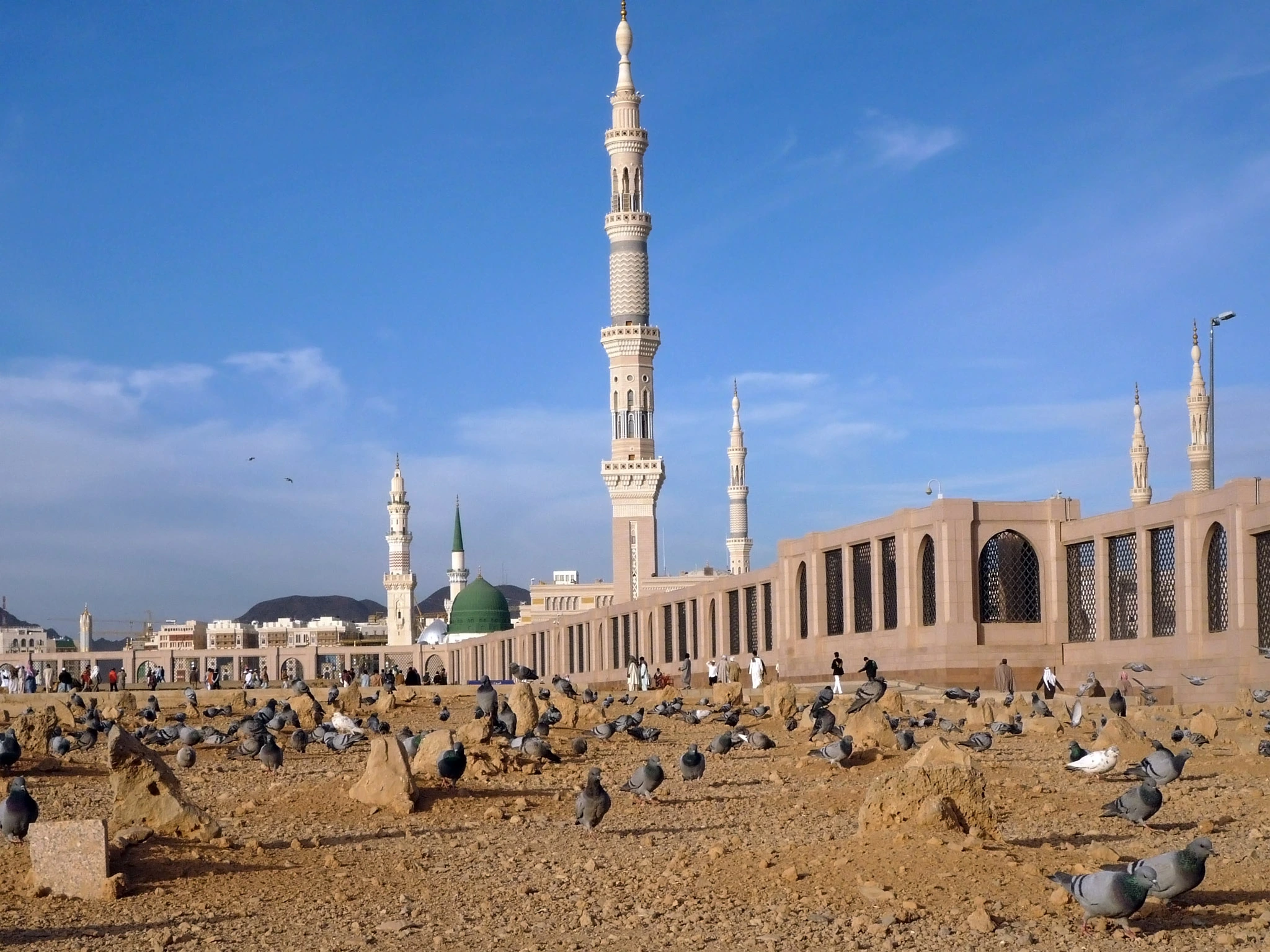
Abdullah ibn Abd al-Muttalib (c. 545–570 or 571 CE) was the father of Prophet Muhammad ﷺ. He was the youngest of the ten sons of Abd al-Muttalib, chief of the Quraysh and custodian of Zamzam, and the son his father loved most. The sira preserves his life in three episodes: the vow of sacrifice that fell on him by lot and the hundred camels that ransomed him, a transaction that permanently raised the blood-price among the Arabs; his marriage to Amina bint Wahb of the Banu Zuhrah; and his death on a trading journey at Medina, aged about twenty-five, before his son was old enough to remember him. He left five camels, a few goats, and a servant named Barakah, better known as Umm Ayman, who would go on to help raise the child.
Birth and Family
Abdullah was born at Mecca to Abd al-Muttalib and Fatima bint Amr ibn A'idh ibn Imran ibn Makhzum. Ibn Hisham records that Fatima was also the mother of Abu Talib, al-Zubayr, and every one of Abd al-Muttalib's daughters except Safiyya, which made Abdullah the full brother of Abu Talib — the uncle who would later take charge of his orphaned son — and of five of the six daughters of the house, among them Atika. Safiyya, born to a different mother, was his half-sister.
One further connection in his ancestry shaped the end of his life and, long afterwards, the fate of his son's community. Abd al-Muttalib's own mother was Salma bint Amr, a woman of the Banu Adi ibn al-Najjar, a clan of the Khazraj at Yathrib, the city later known as Medina. Hashim had married her while passing through the settlement on a trading journey to Syria. The family therefore held kin in Yathrib two generations before there was any reason to think the city mattered, and it was among these relatives that Abdullah would fall ill and die.
The Vow of Abd al-Muttalib
Ibn Ishaq relates that the vow arose out of a specific quarrel. When Abd al-Muttalib met heavy opposition from the Quraysh over his digging of Zamzam, he vowed that if ten sons were born to him who grew to manhood and protected him, he would sacrifice one of them for God at the Kaaba.
In time he had ten grown sons — al-Harith, al-Zubayr, Hajl, Dirar, al-Muqawwim, Abu Lahab, al-Abbas, Hamza, Abu Talib and Abdullah — and he assembled them, told them of the vow, and asked them to help him honour his pledge. They agreed and asked what he wanted of them. He told each to take an arrow, write his name on it, and bring it back.
The lots were cast inside the Kaaba at the station of the idol Hubal, beside the well in which offerings to the sanctuary were placed. Seven divining arrows were kept there, used to settle questions of consequence — matters of blood-money, of kinship, and the like — and the Quraysh accepted whatever judgement the arrows gave. When the arrows were drawn, the one bearing Abdullah's name came out.
He was the youngest of the brothers and his father's favourite, and Abd al-Muttalib nevertheless took him by the hand, drew his knife, and led him towards the idols Isaf and Na'ila to carry out the vow. At this the Quraysh left their meeting-places and asked him what he intended. When he told them, they and Abdullah's own brothers pressed him to find another course, and the argument they made was about precedent rather than affection:
"By God, do not sacrifice him without seeking forgiveness for him; if you do this men will keep bringing their sons to sacrifice, and how could that go on?"
Yunus ibn Bukayr, transmitting from Ibn Ishaq, preserves a harder detail of that moment: it was al-Abbas who dragged Abdullah out from beneath his father's foot, Abd al-Muttalib having already set it on him to hold him down, and in doing so he tore Abdullah's face so badly that the scar was said to have remained visible for the rest of his life.
The ransom of the hundred camels
The Quraysh advised Abd al-Muttalib to consult a woman diviner in the Hijaz who was said to have an attendant spirit, and to abide by her ruling: if she ordered the sacrifice, let it proceed; if she offered a way out, let him take it. They travelled to Yathrib, learned that the diviner — named Sajah in Yunus ibn Bukayr's transmission — was at Khaybar, and rode on to her. She told them to leave her for a day until her spirit came.
When they returned she asked what blood-price they set, and was told ten camels, which was then the rate. Her instruction was to set Abdullah on one side and ten camels on the other and cast the arrows between them; if the arrow fell against the man, they were to add to the camels until the god was satisfied, and when it fell against the camels, to slaughter those in his place.
Back at Mecca they did so. The arrow fell against Abdullah at ten camels, and again at twenty, and kept falling against him as ten were added each time, until the number reached one hundred. Then the arrow came out for the camels. The Quraysh told Abd al-Muttalib, who was standing beside Hubal in prayer, that the matter was closed and his god was satisfied — but he refused to accept it until the arrows had been cast three times over. Three times they fell to the camels. The hundred were slaughtered and left where they lay for anyone to eat from, and Ibn Hisham adds that it was said they were left for the wild beasts as well.
The consequence outlasted the occasion. The Sealed Nectar records that the customary blood-price in Arabia, until then ten camels, was raised after this event to a hundred, and that Islam later confirmed that figure. The episode is also the background to a saying attributed to the Prophet, who described himself as "the offspring of the slaughtered two" — meaning Ismail, whose sacrifice was likewise commuted, and his own father Abdullah.
Ibn Kathir records a variant in which the arrow continued to fall against Abdullah past a hundred camels, so that the number was doubled to two hundred and then raised to three hundred before it fell to the animals; he judges the first account, ending at a hundred, to be the sound one. He also preserves the episode's afterlife in law. When a woman who had vowed to sacrifice her son sought a ruling, Ibn Abbas told her to offer a hundred camels instead and cited this precedent; Abdullah ibn Umar declined to rule at all; and Marwan ibn al-Hakam, then governor of Medina, held that neither had answered correctly, forbade her to sacrifice the child, ordered no camels, and directed her to give what charity she could — a judgement the people accepted.
Marriage to Amina bint Wahb
Ibn Ishaq's narrative continues directly from the sanctuary: Abd al-Muttalib left holding his son by the hand, and on the way they passed a woman who had been at the Kaaba and who stopped to stare into Abdullah's face. She is named as Umm Qattal, whose given name was Raqiqa bint Nawfal, a woman of Banu Asad and the sister of Waraqah ibn Nawfal. She asked where he was going, and when he answered that he was with his father, she made him an offer: if he would have her then, he could have camels to the number of those that had just been sacrificed for him. His reply was brief — that he was with his father and could neither oppose him nor leave him.
Abd al-Muttalib took him on to Wahb ibn Abd Manaf ibn Zuhra ibn Kilab, at that time the leader of the Banu Zuhrah in both age and honour, who agreed to give him his daughter Amina — described as the most highly regarded woman among her people. The Sealed Nectar records that her standing came through her father's eminence as chief of the Banu Zuhrah, and that the marriage was contracted at Mecca.
The marriage was consummated, and Amina conceived. Passing the same woman afterwards, Abdullah asked why she was not repeating the offer she had made the day before. Her answer turned on the sign she claimed to have seen in him:
"The light you bore yesterday has left you, and I need you no more."
Ibn Ishaq explains her motive: she had heard from her brother Waraqah, who had become a Christian and studied the scriptures, that a prophet was to arise among that people, and she had wanted him born to herself. Ibn Kathir notes that some authorities understood her offer as a proposal of marriage rather than anything illicit, and thinks that the likelier reading; he adds that Abdullah's restraint reflected not his own merit but the standing of the son he was to father, and cites the verse, "And God knows best where to place His prophethood" (Quran 6:124). Verses of disappointment attributed to Umm Qattal are preserved through al-Bayhaqi.
A parallel account, transmitted through Ibn Abbas, names the woman differently — as Fatima bint Murr al-Khath'amiyya, a diviner who had adopted the Jewish faith and read the scriptures — and has her see the light of prophethood in Abdullah's face and offer him a hundred camels. In this version his refusal is given in verse:
"I'd rather die than do the forbidden, and staying here is not allowed, I clearly see. So how could we do what you desire?"
Here too he married Amina, stayed three nights with her, and only then felt the impulse to accept the earlier offer; and here too the woman turned him away, saying she was no woman of doubtful morals, that she had seen a light in his face and wished it for herself, and that God had refused to place it anywhere but where He willed.
Ibn Kathir also preserves, on the authority of Abu Nu'aym's Dala'il al-Nubuwwa, an account of how the match came about. Abd al-Muttalib had travelled to Yemen on a winter journey and lodged with a Jewish scholar of the scriptures, who examined him and told him that he would hold power in one hand and prophethood in the other, but that prophethood was to be found among the Banu Zuhrah — and advised him, when he returned, to marry into that clan. Abd al-Muttalib accordingly married Hala bint Wahb, of the same house as Amina, who bore him Hamza and Safiyya; and his son Abdullah married Amina bint Wahb, who bore the Prophet. When the two marriages were made, the men of the Quraysh remarked that Abdullah had won out over his father.
The Journey and His Death
The fullest account of Abdullah's death reaches Ibn Kathir from al-Waqidi through Ibn Sa'd. Abdullah travelled to Ghazza with a Quraysh trading caravan, and when the company had finished its business and turned for home it passed through Yathrib. By then Abdullah had fallen ill, and he asked to be left there among the Banu Adi ibn al-Najjar, his family's kin through Salma bint Amr. He remained with them, sick, for a month, while his companions went on to Mecca.
When they arrived, Abd al-Muttalib asked after his son and was told that he had been left ill among his relatives. He sent his eldest son, al-Harith, to bring him home. Al-Harith found that Abdullah had already died and been buried in the house of al-Nabigha al-Ja'di, and returned to Mecca with the news. Ibn Kathir records that Abd al-Muttalib and Abdullah's brothers and sisters grieved bitterly. The Sealed Nectar gives his age at death as twenty-five, records that Amina commemorated him in a deeply felt eulogy, and preserves two further versions of the journey itself: that his father had sent him to Medina to buy dates, or that he had gone to Syria on a trading journey and died at Medina on the way back.
The date of his death
The sources do not agree on when Abdullah died relative to his son's birth, and the disagreement is old and openly recorded. Al-Waqidi and Ibn Sa'd held that he died while the Prophet was still unborn, and Ibn Sa'd judged that the better-established position; Ibn Kathir observes that this represents the completest form of orphanhood. Al-Zubayr ibn Bakkar transmits, through Ibn Kharbudh, that Abdullah died at Medina when his son was two months old, adding that Amina died when the boy was four and Abd al-Muttalib when he was eight, after which he passed into the care of his uncle Abu Talib. Hisham ibn Muhammad al-Kalbi and Awana ibn al-Hakam placed the death considerably later, when the child was twenty-eight months old, and a further report gives seven months. The Sealed Nectar summarises the balance of opinion as most historians favouring a death some two months before the birth, with others placing it two months or more after it.
What He Left
Abdullah's estate was small: five camels, a few goats, and a woman-servant named Barakah, known by her kunya Umm Ayman. She entered the household of the child she survived to help raise, remained attached to it for the rest of her life, and is remembered among those closest to the Prophet's family.
Aftermath
The consequences of Abdullah's early death shaped his son's childhood. The boy passed first into the guardianship of his grandfather Abd al-Muttalib, and on his death into that of Abu Talib, Abdullah's full brother. Amina died at al-Abwa, between Mecca and Medina, when her son was six — and she died on the road home from Yathrib, where she had taken him, with Umm Ayman in company, to visit the maternal relatives among whom his father had died and lay buried.
The kinship that drew Abdullah to Yathrib in his last illness surfaced once more, decades later and to different effect. When the Prophet entered the city at the Hijra and his camel made its way through the quarters of the Ansar, the Banu Adi ibn al-Najjar came out and pressed him to stop among them, claiming him on the strength of that descent from Salma bint Amr — the same tie that had given his father a place to be laid to rest in a city that was not yet his own.
References and Further Reading
Primary Islamic Sources
- Ibn Ishaq, Sirat Rasul Allah, in the recension of Ibn Hisham — the vow occasioned by the dispute over Zamzam, the casting of arrows at Hubal, the intervention of the Quraysh and of Abdullah's brothers, the diviner and the ransom of the hundred camels, and the marriage to Amina
- Yunus ibn Bukayr, transmitting from Ibn Ishaq — the naming of the diviner Sajah, and the report that al-Abbas pulled Abdullah from beneath his father's foot and scarred his face
- Ibn Sa'd, transmitting from al-Waqidi — the journey to Ghazza, the illness at Yathrib among the Banu Adi ibn al-Najjar, al-Harith's errand, and the burial in the house of al-Nabigha al-Ja'di
- Abu Nu'aym, Dala'il al-Nubuwwa, as reported by Ibn Kathir — Abd al-Muttalib's Yemen journey and the counsel to marry into the Banu Zuhrah
- Al-Bayhaqi, as reported by Ibn Kathir — the verses attributed to Umm Qattal
Classical Islamic Sources
- Ibn Kathir, Ismail ibn Umar. Al-Sira al-Nabawiyya, English translation, Volumes 1 and 2 — the principal source for this article, and the authority for the competing datings of Abdullah's death and for the preference between the variant camel-counts
- Ibn Hisham, recension of Ibn Ishaq's Sirat Rasul Allah — the genealogy of Abd al-Muttalib's household and Fatima bint Amr's motherhood
- Al-Zubayr ibn Bakkar, as reported by Ibn Kathir — the dating of the death to the Prophet's second month
- Hisham ibn Muhammad al-Kalbi and Awana ibn al-Hakam, as reported by Ibn Kathir — the dating to the Prophet's twenty-eighth month
Academic and Scholarly Sources
- Al-Mubarakpuri, Safi-ur-Rahman. The Sealed Nectar (Ar-Raheeq Al-Makhtum). Riyadh: Darussalam — for the blood-price and its confirmation in Islam, the hadith of "the slaughtered two", the variant journeys, the burial, the age at death, the estate, and Amina's eulogy
- Najeebabadi, Akbar Shah. History of Islam, Volume 1 — for Salma bint Amr among the Banu Adi ibn al-Najjar and their claim of kinship at the Hijra
Further Reading
These works were not consulted for this article and are listed for readers who wish to pursue the subject further. Nothing in the body text rests on them.
- Guillaume, Alfred, trans. The Life of Muhammad: A Translation of Ibn Ishaq's Sirat Rasul Allah. Oxford: Oxford University Press, 1955 — the standard English Ibn Ishaq, in which the vow, the ransom and the marriage may be read in their original sequence
- Ibn Sa'd, Muhammad. Kitab al-Tabaqat al-Kabir, Volume 1 — the classical biographical dictionary's treatment of the Prophet's forebears, including the text of Amina's eulogy for her husband
- Al-Tabari, Muhammad ibn Jarir. Tarikh al-Rusul wa al-Muluk — the parallel narrative of the vow and the ransom in the great universal history
- Lings, Martin. Muhammad: His Life Based on the Earliest Sources. Cambridge: Islamic Texts Society, 1983
Mentioned In
5 articles reference this topic