Abd al-Muttalib: Grandfather and Guardian of the Prophet
Chief of the Quraysh and custodian of Zamzam. Born at Yathrib as Shayba, he redug the lost well, ransomed his son Abdullah with a hundred camels after a vow of sacrifice, faced Abraha before the Year of the Elephant, and raised his orphaned grandson Muhammad.
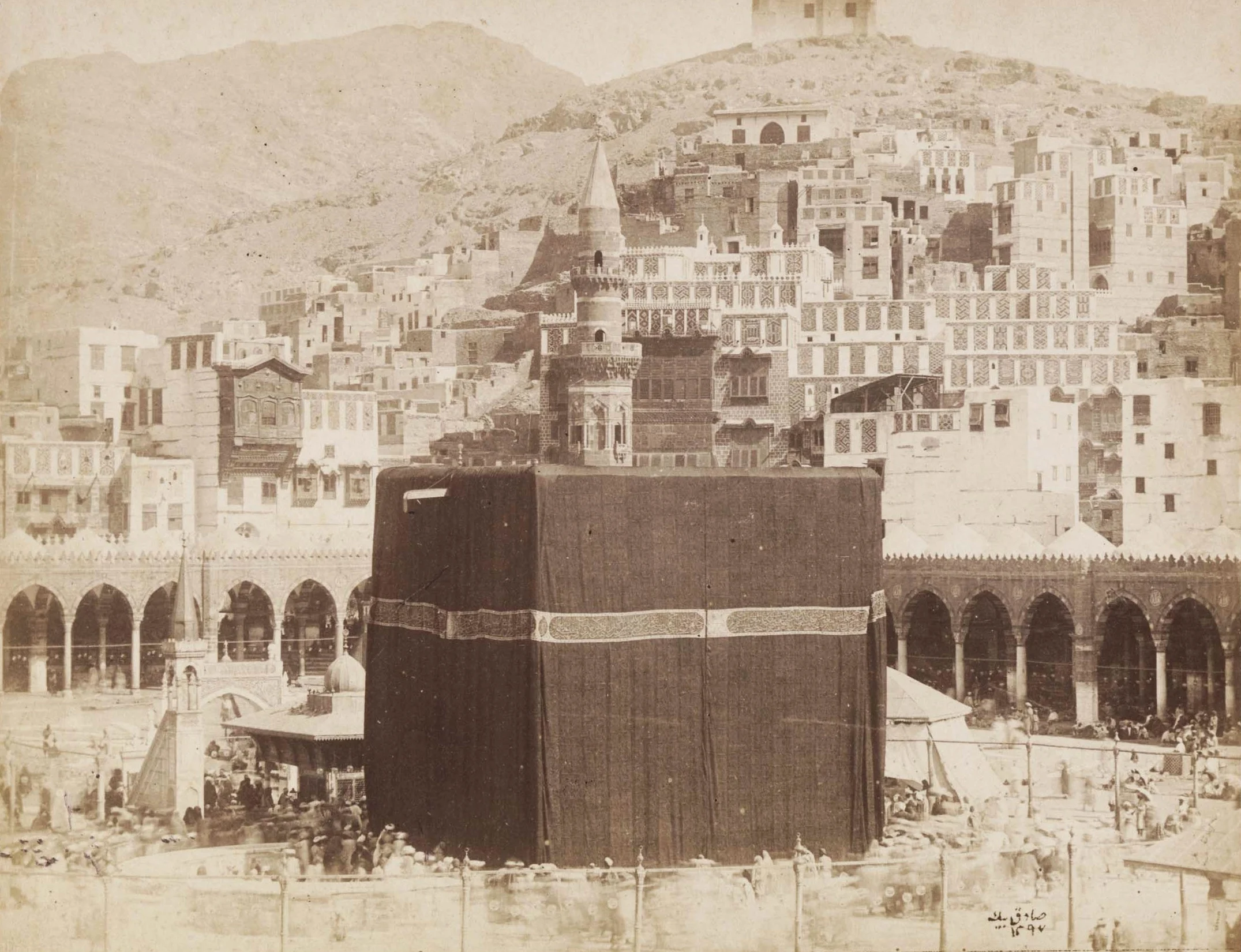
Abd al-Muttalib ibn Hashim (c. 497–578 CE) was chief of the Quraysh of Mecca, custodian of the well of Zamzam, and the paternal grandfather of Prophet Muhammad ﷺ. He was born at Yathrib under the name Shayba and grew up there among his mother's people before an uncle brought him to Mecca, where a misunderstanding about his status gave him the name he is remembered by. He recovered the buried well of Zamzam and held its water thereafter; he vowed to sacrifice one of his sons and, when the lot fell on his youngest and best-loved, Abdullah, ransomed him with a hundred camels; he stood before the Abyssinian commander Abraha in the year the elephants came against Mecca; and after the deaths of Abdullah and of his daughter-in-law Amina he took his orphaned grandson into his own keeping until his death, when the boy was eight.
Birth at Yathrib and the Name Shayba
His father was Hashim ibn Abd Manaf, one of the leading men of the Quraysh, whose trading journeys to Syria took him through Yathrib. There he lodged with Amr ibn Zayd, of the Banu Adi ibn al-Najjar of the Khazraj and leader of his tribe, and was much taken with Amr's daughter Salma. He asked for her in marriage and Amr agreed, but on a condition — that she should remain with her own people; some accounts give the condition more narrowly, that she should give birth only there at Yathrib. Hashim consummated the marriage on his return from Syria and took her to Mecca; but when he next set out on business she was pregnant, and he left her at Yathrib and went on to Syria, where he died at Ghazza.
Salma bore the child at Yathrib and named him Shayba, "grey" — a name the sources explain two ways, either from his grey hair or as meaning one praised for his generosity. He stayed there with his maternal uncles of the Banu Adi ibn al-Najjar for seven years, and his father's people in Mecca knew nothing of him.
Then his uncle al-Muttalib ibn Abd Manaf, who had taken over Hashim's Meccan offices, came for him and took the boy away from his mother without her knowledge, returning with him to Mecca. When people saw the two of them riding in and asked who the boy was, al-Muttalib answered, "My abd" — my servant. They came up and welcomed him, and addressed him from then on as Abd al-Muttalib, "al-Muttalib's servant." The name displaced Shayba for the rest of his life and ever after.
The kinship formed by Hashim's marriage outlasted the circumstances that made it. It was the tie to the Banu Adi ibn al-Najjar of Yathrib that would later draw Abdullah to that city in his last illness, that took Amina there with her son, and that the clan itself would invoke when the Prophet's camel reached their quarter at the Hijra.
Custodian of Zamzam
Al-Muttalib died some years afterwards and his offices passed to his nephew, who became the foremost man of the Quraysh in his generation. The act on which that standing rested was the recovery of Zamzam, the well of Ishmael, which the Jurhum had filled in and levelled before leaving Mecca, and whose location had been lost for generations.
Ibn Ishaq gives the account on the authority of Ali ibn Abi Talib, who reported Abd al-Muttalib's own telling of it. He was sleeping in the sanctuary when a voice in a vision told him, "Dig Tiba." He asked what Tiba was, and the vision vanished. The next night it returned: "Dig Barra." Again he asked, and again it vanished. The third night: "Dig al-Madnuna." The fourth night it named the thing plainly — "Dig Zamzam" — and when he asked what Zamzam was, he was told: it will never fail or dry up; it will water the grand pilgrim; and it lies between the dung and the blood, near the nest of the crow with the white leg and the ants' nest.
Ibn Ishaq also preserves a second account of how the location was settled, in which Abd al-Muttalib first told the Quraysh he had been ordered to dig Zamzam but did not know where it lay, and they sent him back to his bed with a test: if the vision came from God it would be made clear to him, and if from Satan it would not return. It returned, in rhymed prose, and told him the place.
He took his pickaxe the following day and went out with al-Harith, his only son at that time — al-Umawi's version adds a servant named Asram — and found the ants' nest and the crow pecking beside it. The spot lay between Isaf and Na'ila, the two idols at which the Quraysh made sacrifice, and when he began to dig they blocked him, refusing to let him break ground between their idols. He turned to his son: "Protect me so I can dig, for by God I shall carry on and do what I was ordered." Seeing that he would not be moved, they gave way.
He had not dug long before the ancient coping stone of the well appeared, and he cried out in praise of God. The Quraysh, understanding that he had found it, came to claim a share: this was the well of their father Ishmael, and they had a right in it. He refused — "I was specifically assigned to this without you" — and when they would not let the matter rest he offered to submit it to an arbitrator of their choosing. They named the woman diviner of the Banu Sa'd ibn Hudhaym, who lived in the uplands of Syria, and he agreed.
What happened on that journey settled the dispute before it reached her. The party — Abd al-Muttalib with men of the Banu Umayya, and representatives of each clan of the Quraysh — crossed waterless country and ran dry. Abd al-Muttalib's group asked the others for water and were refused, on the grounds that they feared the same fate themselves. He then made a proposal of grim practicality: that each man dig his own grave while he still had strength, so that as each died the others could put him in it and cover him, until only one was left unburied — "better the loss of one than that of a whole company." They agreed, dug, and sat down to wait for death.
Then he changed his mind about waiting. "By God, our casting ourselves down by our own hands like this for death without searching the land and exerting ourselves is truly weakness; God may well provide us water somewhere in this land. Mount up!" As he urged his own mount forward, a spring of sweet water broke from beneath its hoof. He and his companions praised God, drank and filled their flasks, and then he called across to the Quraysh who had been watching: "Come on over to the spring. God has given us water." They came, drank, and filled their own flasks — and conceded the case there in the desert, telling him that the God who had given him water in that country was the God who had given him Zamzam. The company turned back without ever consulting the diviner, and the Quraysh left him in undisputed possession of the well.
The buried treasure and the doors of the Kaaba
Digging on at Zamzam, he found what the Jurhum had buried there before their departure: two golden gazelles, swords of white metal, and breastplates. The Quraysh claimed a share of these too, and this time he proposed the divining arrows — a fair division decided at the station of Hubal. Two yellow arrows were made for the Kaaba, two black for himself, and two white for the Quraysh, on the rule that whoever's arrows came out took the thing, and whoever's stayed behind took nothing.
The verses he prayed before the casting are preserved:
"O God, You are the much-praised King; my Lord; You are the one who initiates and repeats, The one who is firmly holding the rocky mountain; from You comes all that is new or that is old. If You wish, You give inspiration as You want, to find the place of the ornaments and the steel. So make clear today what You wish; I have made a vow to Him who decides."
The two yellow arrows came out for the gazelles, giving them to the Kaaba; the two black came out for the swords and armour, giving them to Abd al-Muttalib; and the arrows of the Quraysh stayed behind. He beat the swords into a door for the Kaaba and set the two golden gazelles into it — by report the first gold ornament the Kaaba ever carried.
The water of Zamzam
From then the siqaya, the provision of water to the pilgrims, was his. He ruled that no one should wash in the well: its water was hillun wa ballun — freely available and permitted — for people to drink, and to that end he kept two basins, one for drinking and one for ablution, holding it improper that the mosque should be washed in. Zamzam overshadowed the other wells of Mecca, whose users came to prefer it for its nearness to the sanctuary, the quality of its water, and its descent from Ishmael, and the clan of Abd Manaf claimed a precedence over the rest of the Quraysh because of it.
The office stayed with him as long as he lived and then passed to his son Abu Talib, who lost it in a way the sources record plainly. Abu Talib fell into difficulty and borrowed ten thousand from his brother al-Abbas against the following year, spent it on the watering of the pilgrims, and had nothing when the year came round. He asked for a further fourteen thousand, promising to repay the whole; al-Abbas agreed only on the condition that if he defaulted the well would pass to him. Abu Talib defaulted, and the office went to al-Abbas and after him to his descendants.
The Vow and the Ransom of Abdullah
The opposition Abd al-Muttalib met from the Quraysh over the digging is the occasion Ibn Ishaq gives for his vow: that if ten sons were born to him who grew to manhood and protected him, he would sacrifice one of them for God at the Kaaba.
In time he had ten grown sons — al-Harith, al-Zubayr, Hajl, Dirar, al-Muqawwim, Abu Lahab, al-Abbas, Hamza, Abu Talib and Abdullah — and he told them of the vow and asked them to help him keep it. They agreed and did as he asked: each wrote his name on an arrow and returned it. The lots were cast inside the Kaaba at the station of Hubal, beside the well where offerings were placed and where seven divining arrows were kept for questions of consequence. The arrow that came out bore the name of Abdullah — his youngest son and the one he loved most, whom The Sealed Nectar describes as the most chaste of them as well.
He took the boy by the hand, drew his blade, and led him towards Isaf and Na'ila to do it. The Quraysh left their meeting-places and asked what he intended, and when he told them they argued him out of it on the ground of precedent: he must not sacrifice his son without first seeking a way out, for if he did, men would go on bringing their sons to sacrifice, and where would that end. Ibn Ishaq has the Quraysh and Abdullah's own brothers make this case; The Sealed Nectar names among them Abdullah's maternal uncles of the Makhzum and his brother Abu Talib. Yunus ibn Bukayr, transmitting from Ibn Ishaq, adds the hardest detail of the scene: that al-Abbas dragged Abdullah out from beneath his father's foot, which was already set on him, and tore his face so badly that the mark was said to have stayed with him for life.
On the advice of the Quraysh he went to consult a woman diviner of the Hijaz, on the understanding that if she ordered the sacrifice it would proceed and if she found a way out he would take it. The party went to Yathrib, learned that the diviner — Sajah, in Yunus ibn Bukayr's transmission — was at Khaybar, and rode on to her. She asked what blood-price they set and was told ten camels, the rate at that time. Her instruction was to set the man against ten camels and cast the arrows; if the arrow fell against him, to add to the camels until the god was satisfied; and when it fell against the camels, to slaughter them in his place.
At Mecca the arrow fell against Abdullah at ten camels, and again at twenty, and went on falling against him as ten were added each round, until the number reached a hundred and the arrow came out for the camels. The Quraysh told Abd al-Muttalib, standing beside Hubal in prayer, that it was over and his god was content — and he refused to accept it until the arrows had been cast three times more. Three times they fell to the camels. The hundred were slaughtered and left where they lay for anyone to eat from, and by one report for the wild beasts as well. Ibn Kathir notes a variant in which the arrow kept falling against Abdullah past a hundred, so that the number was doubled and then raised to three hundred, and judges the account ending at a hundred to be the sound one.
The customary blood-price in Arabia, ten camels until then, was raised after this to a hundred, and Islam later confirmed the figure. The episode also lies behind the saying attributed to the Prophet that he was "the offspring of the slaughtered two" — Ismail, whose sacrifice was commuted, and his own father.
The Two Marriages
Abd al-Muttalib went from the sanctuary still holding his son's hand and took him to the quarter of the Banu Zuhrah, where he asked Wahb ibn Abd Manaf — leader of that clan in age and honour — for his daughter Amina. Abdullah was twenty-four. Haykal notes that some accounts place the negotiation instead at the house of Amina's uncle Uhayb, on the understanding that her father had died and she stood under her uncle's protection.
On the same occasion Abd al-Muttalib married a kinswoman of Amina's named Hala — given by Ibn Kathir as Hala bint Wahb, which would make her Amina's sister, and in History of Islam as Hala bint Wuhaib, a relative rather than a sister. She bore him Hamza and Safiyya, with the result that Hamza, the Prophet's paternal uncle, was close to him in age. When the two weddings were made together the men of the Quraysh remarked that Abdullah had won out over his father.
Ibn Kathir preserves, on the authority of Abu Nu'aym's Dala'il al-Nubuwwa, an account of why the Zuhrah connection was sought. Abd al-Muttalib had travelled to Yemen on a winter journey and lodged with a Jewish scholar of the scriptures, who examined him and told him he would hold power in one hand and prophethood in the other — but that prophethood was to be found among the Banu Zuhrah, and that he should marry into that clan when he returned home.
Abdullah died within months, on the way back from a trading journey to Ghazza, falling ill at Yathrib among the Banu Adi ibn al-Najjar and dying there. Abd al-Muttalib, told by the returning caravan that his son had been left behind sick, sent his eldest son al-Harith to fetch him; al-Harith arrived to find him already buried.
Before the Elephant: The Embassy to Abraha
Abd al-Muttalib was seventy or more when Abraha, the Abyssinian viceroy of Yemen, marched on Mecca with an army that included elephants, intending to destroy the Kaaba. Abraha's forces seized two hundred camels belonging to him, and his envoy Hunata required Abd al-Muttalib to come to the camp.
He went with some of his sons, and on arriving asked first for Dhu Nafr, a friend of his then held prisoner in the camp. Dhu Nafr had no counsel to offer a man expecting execution, but he had a friend in Unays, the keeper of the elephant, and sent him a message commending Abd al-Muttalib as lord of the Quraysh and custodian of the well of Mecca, a man who "feeds both men in the plains and wild animals on the mountains," and asking him to obtain an audience. Unays put the same words to Abraha, and Abraha admitted him.
Ibn Ishaq describes Abd al-Muttalib as the most dignified, handsome and impressive of men, and records that Abraha, seeing him, wished to honour him but would not have the Abyssinians see a Meccan seated beside him on the throne — so he came down from it himself, sat on a carpet, and placed his visitor beside him there. Through an interpreter he asked what he wanted. Abd al-Muttalib said he wanted the two hundred camels back.
"You impressed me when I saw you, but you displeased me when you spoke," Abraha answered. "You want to talk to me about 200 camels I took from you in compensation, but not about the building which is your religion and your ancestors' religion that I have come to destroy?"
"I am the owner of the camels; the building has its own master who will protect it."
"He won't protect it from me."
"Then it's between you and Him."
Abraha returned the camels. Ibn Ishaq adds that Abd al-Muttalib was accompanied by Ya'mur ibn Nafatha, leader of the Banu Bakr, and Khuwaylid ibn Wa'ila of Hudhayl, and that these men offered Abraha a third of the produce of Tihama to turn back, which he refused — noting of the offer only that God alone knows whether it happened.
Leaving the camp, Abd al-Muttalib told the Quraysh to withdraw to defensive positions in the hills. Then he took hold of the metal knocker on the door of the Kaaba and stood there with a party of Quraysh, praying:
"O God, Your worshippers protect their homes, so protect Your building, Let not their cross and their power vanquish Yours tomorrow. If You should leave them free with our qibla, then that is what You will."
Ibn Hisham records these as the verses he found to be authentic among those in circulation. Abd al-Muttalib then let go of the knocker and went up into the hills with his men to wait.
What followed is told in the Quran and belongs to the story of the Kaaba rather than to his own: the elephant Mahmud, which knelt and would not be driven towards Mecca however it was beaten, though it rose readily when turned towards Yemen or Syria; the birds that came from the sea carrying stones; the rout of the army and Abraha's death at Sana'a. Ibn Ishaq reports that measles and smallpox were seen in Arab lands for the first time that year. The Quran gives the episode in Surah al-Fil: "Have you not seen how God dealt with those who had elephants?" (Quran 105:1–5).
The Birth of Muhammad
Amina bore her son not long after, and her first act was to send word to Abd al-Muttalib, who was at the Kaaba. He came at once, took the infant in his hands, carried him into the Kaaba, and there gave him the name Muhammad — a name known among the Arabs but not in common use. He then returned the child to his mother and waited beside her for the wet-nurses of the Banu Sa'd to arrive, as was the practice of the Meccan nobility.
He appears once more during the years the boy spent fostered among the Bedouin. Halima, bringing the child back and anxious for his safety, lost him on the approach to Mecca and could not find him. She went to Abd al-Muttalib, who set out with a party to search; Waraqah ibn Nawfal and another man of the Quraysh found the boy and brought him in. His grandfather lifted him onto his shoulders, carried him round the Kaaba praying for his protection, and returned him to his mother.
Guardian of the Orphan
Amina died at al-Abwa when her son was six, and the boy came into Abd al-Muttalib's own keeping. Ibn Ishaq says he treated him with a closeness he had not shown his own sons, letting him come in to him when he was alone or resting.
The scene the sources return to is a small domestic one. A spread would be laid for Abd al-Muttalib in the shade of the Kaaba, and none of his sons would sit on it while he was coming, out of deference. The boy would come and sit on it, and when his uncles moved to lift him off, his grandfather would stop them — "Leave my son alone; he has great things ahead of him," in Ibn Ishaq's wording, or in The Sealed Nectar's, "Leave my grandson. I swear by Allah that this boy will hold a significant position." He would then seat the child beside him, rub his back, and take open pleasure in whatever he did. Men of the Banu Mudlij told him to take good care of the boy, saying they had never seen anyone of so noble a lineage, and Abd al-Muttalib repeated their words to Abu Talib.
Death
As death approached he charged Abu Talib with the keeping of his grandson. He also summoned his daughters — Arwa, Umayma, Barra, Safiyya, Atika and Umm Hakim al-Bayda — and told them to compose elegies for him, and Ibn Ishaq records the unusual circumstance that he heard them recited while he was still living, judging their words extremely eloquent. Ibn Hisham, preserving them, added that he had never met any scholar of poetry who knew those verses.
Abd al-Muttalib then died and was buried at al-Hajun. The Sealed Nectar reckons the date at eight years, two months and ten days of the Prophet's life; a variant chronology which Ibn Kathir marks as resting on a weak authority puts it at ten. The keeping of the boy passed to Abu Talib, Abdullah's full brother, who took him in among his own children and, the sources agree, preferred him to them.
His line ran on through the sons who survived him. Through Abdullah came the Prophet; through al-Abbas came the Abbasid Caliphate; Hamza and Safiyya, the children of Hala, and the six daughters and their descendants carried the house of Hashim into the first century of Islam and past it.
References and Further Reading
Primary Islamic Sources
- Quran 105:1–5 (Surah al-Fil) — the destruction of Abraha's army, following upon Abd al-Muttalib's embassy and his prayer at the Kaaba door
- Ibn Ishaq, Sirat Rasul Allah, in the recension of Ibn Hisham — Hashim's marriage to Salma and the naming of Shayba; the vision and the digging of Zamzam on the authority of Ali ibn Abi Talib; the divination over the buried treasure; the vow and the ransom of Abdullah; the embassy to Abraha; and the guardianship of the orphaned Muhammad
- Yunus ibn Bukayr, transmitting from Ibn Ishaq — the naming of the diviner Sajah, and the report that al-Abbas drew Abdullah from beneath his father's foot
- Abu Nu'aym, Dala'il al-Nubuwwa, as reported by Ibn Kathir — the Yemen journey and the counsel to marry into the Banu Zuhrah
- Al-Umawi, work on the maghazi, as reported by Ibn Kathir — the ruling on Zamzam's water, the passage of the office to al-Abbas, and the servant Asram at the digging
Classical Islamic Sources
- Ibn Kathir, Ismail ibn Umar. Al-Sira al-Nabawiyya, English translation, Volume 1 — the principal source throughout, and the authority for the preference between the variant camel-counts and for marking the weak chronology of his death
- Ibn Hisham, recension of Ibn Ishaq's Sirat Rasul Allah — including his authentication of the verses prayed at the Kaaba door and his note on the daughters' elegies
- Al-Suhayli, as reported by Ibn Kathir — on the kneeling of the elephant
Academic and Scholarly Sources
- Al-Mubarakpuri, Safi-ur-Rahman. The Sealed Nectar (Ar-Raheeq Al-Makhtum). Riyadh: Darussalam — for those named as intervening against the vow, the raising of the blood-price, the hadith of "the slaughtered two", his words over his grandson, and the reckoning of his death
- Haykal, Muhammad Husayn. The Life of Muhammad — for his age at Abraha's march, Abdullah's age at marriage, the Uhayb variant, and the naming of the infant in the Kaaba
- Najeebabadi, Akbar Shah. History of Islam, Volume 1 — for Salma bint Amr among the Banu Adi ibn al-Najjar, and for Hala as bint Wuhaib
Further Reading
These works were not consulted for this article and are listed for readers who wish to pursue the subject further. Nothing in the body text rests on them.
- Guillaume, Alfred, trans. The Life of Muhammad: A Translation of Ibn Ishaq's Sirat Rasul Allah. Oxford: Oxford University Press, 1955 — the standard English Ibn Ishaq, in which Zamzam, the vow and the Abraha episode may be read in their original sequence
- Al-Tabari, Muhammad ibn Jarir. Tarikh al-Rusul wa al-Muluk — the parallel narrative of Abd al-Muttalib's life in the great universal history
- Ibn Sa'd, Muhammad. Kitab al-Tabaqat al-Kabir, Volume 1 — the classical biographical dictionary's treatment of the Prophet's forebears
- Lings, Martin. Muhammad: His Life Based on the Earliest Sources. Cambridge: Islamic Texts Society, 1983
Mentioned In
15 articles reference this topic
and 3 more articles