Abdul Ghaffar Khan: The Frontier Gandhi and Apostle of Non-Violence
Khan Abdul Ghaffar Khan (1890–1988), known as Badshah Khan and the Frontier Gandhi, was a Pashtun independence leader and apostle of non-violence who founded the Khudai Khidmatgar movement. A close ally of Gandhi, he opposed Partition and received the Bharat Ratna in 1987.
Introduction
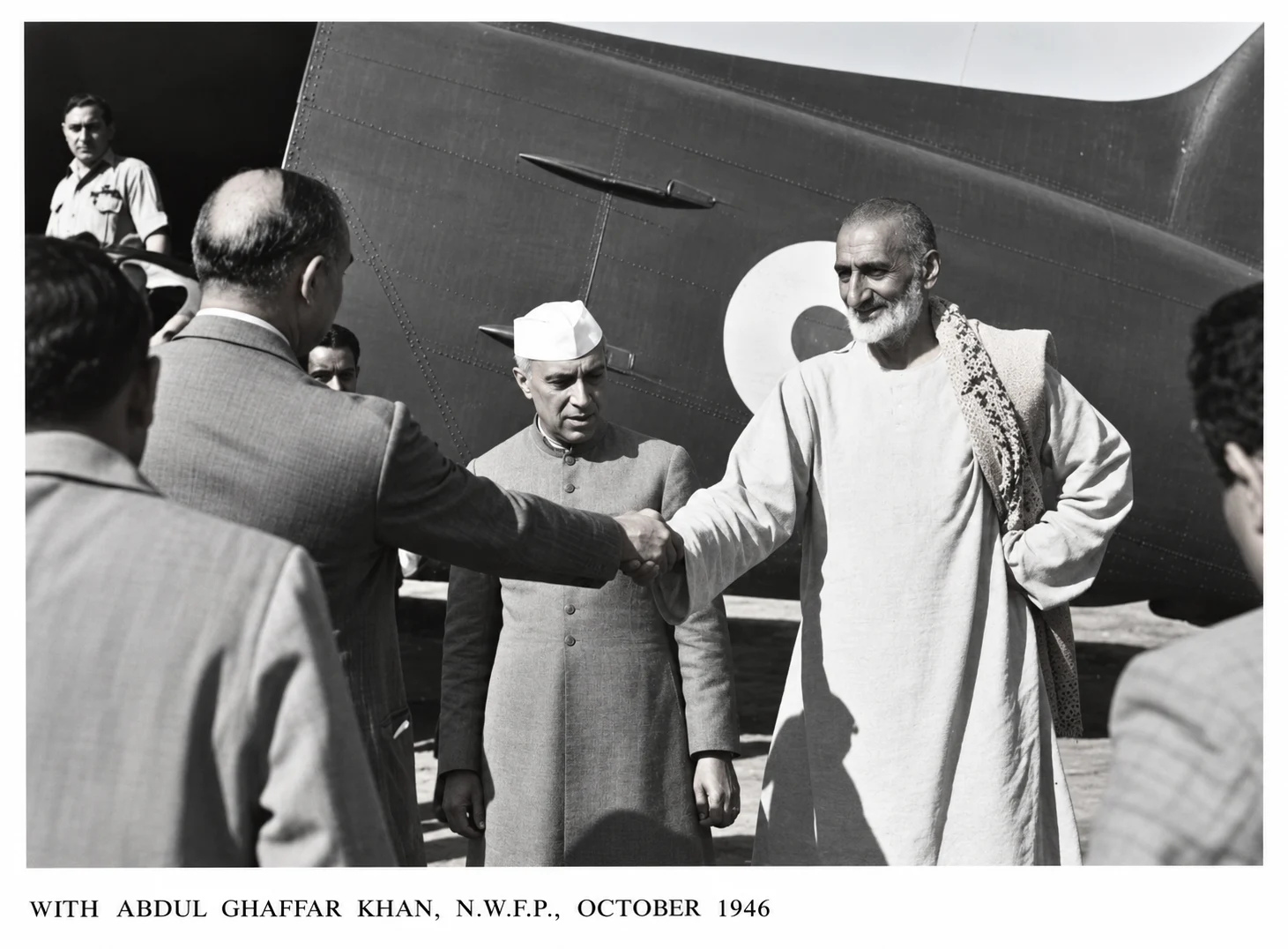
Khan Abdul Ghaffar Khan was one of the most remarkable figures produced by the Indian independence movement — remarkable not only for the scale and duration of his political achievement, but for the profound improbability of what he accomplished. He built a mass non-violent political movement among the Pashtuns of the North-West Frontier Province of British India, a people whose culture, history, and martial tradition were so thoroughly defined by the values of courage, honor, and armed resistance that European observers and Indian politicians alike had considered them constitutionally unsuited to non-violence. He proved them wrong, and the movement he built — the Khudai Khidmatgar, the Servants of God — became one of the most disciplined, enduring, and courageous non-violent organizations in the history of the independence movement, enduring decades of brutal British repression without abandoning its commitment to peaceful resistance.
He was known by many names: Badshah Khan (the King of Khans, a title of popular affection rather than formal rank), the Frontier Gandhi (a designation given to him by Indians who recognized in his methods and values a kinship with Mahatma Gandhi's approach), and Fakhr-e-Afghan (the Pride of Afghans). Of these names, Badshah Khan is perhaps the most telling — not a title he sought or claimed but one bestowed by the people of the Frontier who recognized in him a quality of leadership that transcended ordinary political authority.
His alliance with Gandhi was one of the most improbable and one of the most profound partnerships of the entire independence movement. A Pashtun Muslim tribal leader and a Hindu Gujarati lawyer, rooted in entirely different cultural and religious traditions, meeting on the shared ground of non-violence, human dignity, and resistance to colonial oppression. Their friendship was genuine, intellectually serious, and mutually transformative; Gandhi acknowledged that Ghaffar Khan had demonstrated the capacity of non-violence in conditions far more challenging than those in which Gandhi himself had operated, and Ghaffar Khan found in Gandhi a moral seriousness and a strategic vision that confirmed and deepened his own convictions.
The partition of India in 1947 was, for Ghaffar Khan, a catastrophe of the first order. He opposed it on multiple grounds — moral, political, and personal — and when it occurred despite his opposition, he found himself and his movement consigned to the new state of Pakistan, whose founders regarded him with deep suspicion and whose security apparatus would spend most of the following decades imprisoning him, exiling him, and attempting to suppress the movement he had built. He spent more years in Pakistani prisons than he had spent in British ones, and the irony of this — that the independence he had fought for brought him not liberation but continued imprisonment, now at the hands of a state whose creation he had opposed — was not lost on him or on those who knew his story.
He died in Peshawar in January 1988, at the age of ninety-seven or ninety-eight, after a life of extraordinary length that had encompassed nearly a century of South Asian history. In 1987, the Government of India had awarded him the Bharat Ratna — the highest civilian honor of the country for whose independence he had worked — making him the first non-Indian citizen to receive the award. He accepted it with the characteristic simplicity and lack of ostentation that had defined his public life from its beginning.
Early Life and Background
Abdul Ghaffar Khan was born in 1890 in Utmanzai, a village in the Peshawar district of the North-West Frontier Province of British India. The exact date of his birth is uncertain — like many people of his generation and region, he was born before systematic civil registration was established, and the date of 6 February 1890 that appears in most biographical sources is a reconstruction rather than a documented fact. He died in January 1988, and various estimates of his age at death range from ninety-five to ninety-eight.
His family, the Muhammadzai clan of the Pashtun people, was prosperous and of high social standing in the Peshawar valley. His father, Behram Khan, was a large landowner who held a position of local authority and respect. The family's wealth and standing gave the young Ghaffar Khan access to educational opportunities that were not available to most children of the Frontier, and it also exposed him to the tensions between traditional Pashtun society and the administrative and cultural demands of British colonial rule.
The North-West Frontier Province was one of the most contested territories of the British Indian empire. The Pashtun people — known in the older literature as Pathans — had resisted British expansion from the earliest days of the empire's westward push, and the Frontier remained a zone of persistent military action, diplomatic negotiation, and tribal resistance throughout the nineteenth and early twentieth centuries. The Great Game — the strategic competition between the British and Russian empires for influence in Central Asia — gave the Frontier its geopolitical significance, and the periodic tribal uprisings that punctuated British administration of the region gave it its reputation as the most dangerous and ungovernable territory of the empire.
Into this environment Ghaffar Khan was born, and its specific conditions shaped him in fundamental ways. The Pashtun code of honor — Pashtunwali — with its demands for hospitality, revenge, and the defense of personal and communal dignity, was the social air he breathed from childhood. The experience of British military operations against Pashtun communities — operations that included the destruction of villages, the burning of crops, and collective punishments that fell on entire communities for the resistance of individual members — gave him an early and direct understanding of the violence that colonial rule routinely inflicted on subject peoples.
Education and Early Formation
Ghaffar Khan received his initial education in a local maktab (Islamic school) and subsequently at the Mission High School in Peshawar, one of the institutions established by British missionaries to provide modern education to the children of the Frontier's elites. His time at the Mission School exposed him to English language and literature, to the history and philosophy of the Western tradition, and to the Christian missionary culture that ran the institution — an exposure that deepened rather than diminished his own Islamic conviction while giving him tools for thinking across cultural and religious boundaries that would serve him throughout his life.
He had an opportunity to proceed to England for further education — an opportunity available to the sons of prosperous Frontier families — but declined it, reportedly from a reluctance to leave his homeland and from an early sense that his life's work lay in the Frontier rather than in the metropolitan world. This choice was decisive for the direction of his subsequent career: he remained rooted in the specific conditions of Pashtun society rather than developing the kind of metropolitan perspective that shaped many of his contemporaries in the independence movement.
His early adulthood was marked by a period of intense reflection on the condition of his people and on the relationship between the values of Islam and the actual conduct of the Muslim communities he knew. He was troubled by what he saw as the degradation of Pashtun society under colonial rule — not merely the political subordination but the social and moral consequences of a century of British domination: the ignorance, the superstition, the violence that served colonial interests by keeping Pashtun communities divided and incapable of collective action. He began to see education — particularly the education of the rural poor who constituted the vast majority of the Frontier's population — as the foundation of any genuine social and political transformation.
The Educational Movement and Early Activism
Ghaffar Khan's first organized activity was educational rather than explicitly political. In the 1910s, he began establishing schools in Pashtun villages — small institutions that combined basic literacy with instruction in the values and practices of Islam and in the history and culture of the Pashtun people. These schools were not merely educational in the narrow sense; they were expressions of a vision of social transformation through which Pashtun communities would develop the internal capacities — literacy, self-discipline, collective organization — necessary for genuine self-governance.
The schools brought him into conflict with British colonial authorities, who were suspicious of any organized activity among the Pashtun population that was not under their direct control. The British administration of the Frontier operated on the assumption that Pashtun society was inherently unstable and prone to violence, and any organized movement — even an educational one — was seen as a potential threat to colonial order. Ghaffar Khan's early encounters with British administrative suspicion and repression deepened his understanding of colonialism as a system rather than merely as a collection of individual injustices.
He also came into contact with the broader currents of Indian political life during this period, traveling to other parts of India and encountering the growing nationalist movement. He met leaders of the Indian National Congress, was influenced by the writings of Bal Gangadhar Tilak and other nationalist intellectuals, and began to develop his understanding of Pashtun liberation as part of a broader Indian national struggle rather than as an exclusively Frontier concern.
His first imprisonment by the British came in 1919, following his participation in protests against the Rowlatt Act — the repressive legislation that allowed detention without trial and that provoked the non-cooperation response across India, including the tragic Jallianwala Bagh massacre in Amritsar. His arrest and imprisonment marked his formal entry into the political dimension of the independence movement and the beginning of a pattern of imprisonment and release that would define much of his subsequent life.
The Founding of the Khudai Khidmatgar
The Khudai Khidmatgar — the Servants of God — was formally established in 1929, though its foundations were laid through years of prior educational and organizational work. The movement was a revolutionary achievement: a disciplined, uniformed, non-violent mass organization in a society for which non-violence was not a traditional value but an entirely new approach to collective action.
The founding of the Khudai Khidmatgar was preceded by years of consultation, persuasion, and organizational work. Ghaffar Khan traveled extensively through the villages of the Frontier, speaking to jirgas (tribal councils) and to ordinary farmers and laborers, arguing that the Pashtun people's genuine interests lay not in the intermittent violence of tribal resistance — which the British had shown they could suppress with overwhelming force — but in the organized non-violent resistance of a disciplined mass movement. This argument required not merely logical persuasion but the kind of personal moral authority that came from a life lived in accordance with the values being advocated.
The Khudai Khidmatgar's members, who came to be known as the Red Shirts (Surkh Posh) from the distinctive red garments they wore as their uniform, took an oath of service to God and to their people that committed them to non-violence, to the service of others, and to personal discipline in their conduct. The oath was explicitly Islamic in its language — invoking God and the Prophet Muhammad as witnesses — and Ghaffar Khan argued consistently that non-violence was not a foreign Hindu concept being imported into Muslim practice but was itself an authentic expression of the Islamic values of peace, justice, and service to humanity.
The Organizational Structure
The Khudai Khidmatgar was organized with a military-like discipline that was characteristic of the Pashtun military tradition but put in service of an explicitly non-violent mission. Members wore their red uniforms to public meetings and during political activities. They drilled and practiced the discipline of collective action. They established a chain of command from village-level units through district organizations to Ghaffar Khan's central leadership. They maintained records, collected funds, and coordinated activities across the geographically dispersed settlements of the Frontier with a organizational sophistication that was unprecedented in the region.
The movement's social activities went beyond purely political organizing. Ghaffar Khidmatgar members established schools, resolved disputes through arbitration rather than violence, provided assistance to communities in need, and worked to improve agricultural practices. This combination of political and social work reflected Ghaffar Khan's understanding that genuine social transformation required addressing the material conditions of people's lives and not merely their political subordination.
The movement grew rapidly. By the early 1930s, the Khudai Khidmatgar had tens of thousands of members across the North-West Frontier Province, representing an organizational achievement that the British colonial administration recognized as a genuine threat to its control of the region.
The Qissa Khwani Bazaar Massacre and the Test of Non-Violence
The most severe test of the Khudai Khidmatgar's commitment to non-violence came in April 1930, at the Qissa Khwani Bazaar in Peshawar. The Qissa Khwani — the Storytellers' Bazaar — was one of the great public spaces of Peshawar, a place where for centuries travelers and traders had gathered to exchange news, stories, and goods. In April 1930, following Ghaffar Khan's arrest, Khudai Khidmatgar members and their supporters gathered in the bazaar to protest. British forces, confronting the crowd, opened fire. The estimates of dead range from dozens to hundreds, with Indian nationalist sources and British official records providing significantly different accounts of the casualties.
What happened in the Qissa Khwani Bazaar in the aftermath of the firing has entered the history of non-violence as one of its most powerful demonstrations. When the firing began, members of the crowd fell. As the British forces continued firing, those who were not hit did not flee or retaliate; they came forward in waves, peacefully, to take the places of those who had fallen. This pattern continued until the British soldiers, apparently horrified by what they were doing, refused further orders to fire. The willingness of Pashtun men — in a culture where armed response to attack was a fundamental obligation of honor — to stand unarmed before British guns and accept death rather than abandon their commitment to non-violence was a demonstration of moral courage that few events in the history of non-violent resistance have equalled.
The Qissa Khwani Bazaar massacre became known across India and beyond, and its impact on Gandhi was profound. He acknowledged that what the Pashtuns had demonstrated at Qissa Khwani surpassed in moral terms what he had asked of his own followers, and it deepened his respect for Ghaffar Khan as a leader who had taken the doctrine of non-violence and applied it in conditions of exceptional difficulty with results that proved its universal human applicability.
Alliance with Gandhi and the Independence Movement
The relationship between Abdul Ghaffar Khan and Mahatma Gandhi was one of the defining partnerships of the Indian independence movement. They first met in the late 1920s, and the meeting initiated a friendship and collaboration that would last until Gandhi's assassination in 1948 and that Ghaffar Khan would describe, for the rest of his long life, as one of the most important relationships he had ever known.
The alliance between the two men rested on a shared commitment to non-violence as both a moral principle and a political method, but it was more than merely tactical. Both men saw non-violence as grounded in their respective religious traditions — Gandhi's Hindu concept of ahimsa and Ghaffar Khan's Islamic emphasis on the values of peace, service, and dignity. Both believed that the development of disciplined non-violent resistance required a prior spiritual and moral transformation of the resisters themselves — that you could not build a non-violent mass movement without building human beings who were capable of non-violence in the conditions of their daily lives as well as in the specific circumstances of political confrontation.
Their collaboration was also practically significant. The formal alliance between the Khudai Khidmatgar and the Indian National Congress gave the Frontier movement access to the national political network, the financial resources, and the organizational experience of the broader independence movement. It also gave the Congress credibility in the Frontier that it could not have established through its own organizational efforts, given the cultural and geographical distance between the Frontier and the Congress's primary base in the Hindi-speaking heartland.
Ghaffar Khan participated in the major campaigns of the independence movement — the Civil Disobedience Movement, the Quit India Movement — leading his followers in acts of non-violent resistance that regularly resulted in his imprisonment. His total years of imprisonment under British rule exceeded those of almost any other major figure in the independence movement — estimates suggest he spent more than fifteen years in British jails, a period surpassed only, if at all, by the duration of his subsequent imprisonment in Pakistan.
The Role of Islam in Ghaffar Khan's Non-Violence
One of the most intellectually significant aspects of Ghaffar Khan's life was his sustained argument that non-violence was not a foreign concept being imposed on Muslim tradition but was an authentic expression of Islamic values. This argument was controversial — it challenged conventional understandings of Islamic politics and of the Pashtun tradition — but it was argued with a consistency and a depth of Islamic learning that made it impossible to dismiss.
Ghaffar Khan grounded his commitment to non-violence in the Prophet Muhammad's example and in the Quranic emphasis on peace, justice, and the rights of the oppressed. He argued that the Prophet's conduct in the early Meccan period — when the Muslim community was a persecuted minority accepting suffering rather than responding with violence — provided a model for non-violent resistance to oppression that was not merely historically contingent but expressed a fundamental Islamic value. He pointed to the Islamic concept of sabr (patient endurance) as a foundation for sustained non-violent resistance, and he argued that the Islamic prohibition on oppression and injustice required active resistance to colonial rule by the most effective available methods — and that, given the overwhelming military superiority of the colonial power, non-violence was not merely the most ethical method but also the most practically effective.
This theological argument was not merely rhetorical. Ghaffar Khan was a man of genuine and deep religious conviction whose practice of Islam was regular, informed, and personally meaningful. He fasted during Ramadan, prayed the five daily prayers, and grounded his personal ethical life in the Quranic framework. The Islamic content of his movement — its oaths sworn in God's name, its emphasis on service (khidmat) as a religious obligation, its organization of literacy and education as acts of piety — was not ornamental but constitutive of what the Khudai Khidmatgar was and how it functioned.
Opposition to Partition
Ghaffar Khan's opposition to the partition of India was absolute, consistent, and publicly argued from the earliest stages of the debate about independence arrangements. He shared with Maulana Abul Kalam Azad the position that the two-nation theory was theologically and politically mistaken, and he went further than Azad in arguing from the specific perspective of a Muslim from the Frontier for whom the consequences of partition would be most immediate and most devastating.
His opposition rested on several distinct arguments. The first was moral: the partition of a civilization that had been built over centuries by the shared effort of communities of different faiths was an act of historical vandalism that would produce suffering far exceeding any good it might achieve. The second was theological: the creation of a state on the basis of religious identity was, in his reading of Islamic political philosophy, neither required nor sanctioned by Islamic tradition — Muslims were required to be just and to serve God, not to live in ethnically or religiously homogeneous territorial states. The third was practical: the Muslim populations that would remain in India after partition — concentrated in the United Provinces, Bihar, and other areas far from the proposed Pakistani territories — would be left politically isolated and vulnerable.
The fourth argument was specifically Pashtun: the Frontier Pashtuns were being asked to choose between India and Pakistan without being offered the option that Ghaffar Khan believed they genuinely wanted, which was either to remain in an independent united India or to have the option of an independent Pashtun state — Pashtunistan. The Congress's position, and eventually the British position, foreclosed Pashtunistan as a practical option, leaving the Frontier Pashtuns to be absorbed into Pakistan against the expressed preferences of their largest political organization.
The referendum conducted in the North-West Frontier Province in July 1947 — which asked voters to choose between joining India or Pakistan but not between joining either and independence — was boycotted by the Khudai Khidmatgar at Ghaffar Khan's instruction. The boycott reflected his rejection of the terms of the choice being offered rather than any ambiguity about his opposition to Pakistan, and it resulted in a low turnout that produced a pro-Pakistan majority by default. The legitimacy of this referendum as an expression of Pashtun preferences has been disputed by his supporters ever since.
When partition came, Ghaffar Khan expressed his sense of betrayal with the directness that characterized all his public communications. He famously told Gandhi and the Congress leaders: "You have thrown us to the wolves." This statement, reported in various forms in different sources, expressed not merely personal hurt but a political judgment that the Congress had sacrificed Frontier Pashtun interests to the convenience of achieving independence on the terms available, and that the consequences for the Pashtun people would be severe and lasting.
Life in Pakistan: Persecution and Imprisonment
After the partition of India and the creation of Pakistan, Ghaffar Khan found himself a citizen of a state whose founding ideology — the two-nation theory — he had opposed, and whose political leadership — the Muslim League — regarded him as at best a troublemaker and at worst a traitor. The relationship between Ghaffar Khan and Pakistani state was never anything but hostile, and the decades following partition were marked by repeated imprisonment, house arrest, exile, and suppression of the Khudai Khidmatgar movement.
Pakistani authorities accused Ghaffar Khan of working against the state — allegations that drew on his continued advocacy for Pashtun cultural and political rights, his maintenance of connections with India, and his publicly expressed criticisms of Pakistani governance. He was imprisoned multiple times, spending years in conditions that were in some cases harsher than those of his British imprisonments. His movement was banned, its leadership scattered or imprisoned, and its organizational infrastructure systematically dismantled.
He also spent periods in self-imposed exile in Afghanistan, where he maintained relationships with the Afghan government and with the Afghan Pashtun community. His advocacy for Pashtun rights across the Durand Line — the border between Pakistan and Afghanistan that divided the Pashtun people between two states — was viewed by Pakistani authorities as an affront to Pakistani territorial integrity, and his connections with Afghanistan were used to reinforce accusations of disloyalty to Pakistan.
The irony of his post-partition situation was not lost on contemporaries or subsequent observers: a man who had fought for independence and endured years of British imprisonment now found himself imprisoned by the government of the Muslim state whose creation he had opposed. His response to this situation was characterized by the same patience and moral dignity that had defined his entire public life. He did not abandon non-violence, did not renounce his commitments, and did not accept the Pakistani government's framing of his activities as anti-national. He continued to argue for Pashtun rights, for democratic governance, and for the principles of justice and human dignity that had guided his life's work.
The Pashtunistan Question
Central to the conflict between Ghaffar Khan and the Pakistani state was the question of Pashtunistan — the proposed independent or autonomous Pashtun state that he had advocated before partition and continued to support afterward. Pashtunistan was not simply a political demand but an expression of a cultural and historical reality: the Pashtun people were divided by the Durand Line between Pakistan and Afghanistan, and their cultural cohesion, shared language, and common traditions made the international border a political imposition rather than a social or cultural reality.
Ghaffar Khan's advocacy for Pashtunistan took different forms at different times. Sometimes it was a demand for an independent state; at other times, it was a demand for genuine autonomy within Pakistan; at still other times, it was essentially a demand for the constitutional rights and democratic governance that he believed Pakistani Pashtuns were being denied. Pakistani authorities treated all forms of this advocacy as equally threatening, and the imprisonment and suppression that followed did not discriminate between them.
The Pashtunistan question remained unresolved throughout Ghaffar Khan's lifetime and continues to be a point of political and cultural tension in the region. The demand found sympathy in Afghanistan, which had its own interest in a weaker Pakistan and its own Pashtun population, and this Afghan sympathy was used by Pakistani authorities to characterize Ghaffar Khan's advocacy as foreign-sponsored subversion rather than legitimate domestic political activity.
Personal Character and Spiritual Life
The portrait of Abdul Ghaffar Khan that emerges from the accounts of those who knew him — his close associates in the Khudai Khidmatgar, international figures who visited him, journalists who interviewed him, and the ordinary Pashtun farmers and laborers who made up the rank and file of his movement — is of a man of extraordinary personal authority rooted not in formal power but in personal example.
He was physically imposing — tall, strongly built, with a presence that commanded attention without requiring performance. He spoke with directness and without rhetorical ornamentation, saying what he believed in language that ordinary people could understand. He lived simply, dressing in the coarse homespun that Gandhi had made the symbol of Indian nationalist self-reliance, eating modestly, and maintaining in his personal habits the discipline he demanded of his followers.
His spiritual life was the foundation of his public life in a way that was neither ostentatious nor separable from his political commitments. The Islamic values he proclaimed — service to God through service to humanity, patient endurance of suffering in the pursuit of justice, the rejection of revenge and the embrace of forgiveness — were not merely rhetorical; they were visibly present in his conduct. Contemporaries consistently noted the quality of inner peace that radiated from him even in the most difficult circumstances of imprisonment and persecution, a quality that they attributed to the depth of his religious conviction and the coherence between his beliefs and his actions.
His personal relationships were characterized by warmth and accessibility. He was known for spending time with ordinary villagers, listening to their problems, and engaging with their lives in ways that the distance of high political office usually prevents. His relationship with Gandhi was, by all accounts, one of genuine mutual affection and intellectual respect as well as political alliance. His relationships with his followers in the Khudai Khidmatgar were those of a leader who was genuinely beloved rather than merely respected.
He was married twice. His first wife, Mehri, died relatively young, and he subsequently married Nambata. He had children by both marriages, and his family relationships, though frequently interrupted by imprisonment and political activity, appear to have been sources of genuine warmth and support.
The Bharat Ratna and Final Years
In 1987, the Government of India awarded Abdul Ghaffar Khan the Bharat Ratna, India's highest civilian honor. The award was extraordinary in several respects: it was given to a man who was not a citizen of India and who had spent the decades since partition as a citizen of Pakistan; it was given to a man who was in his late nineties and whose health was fragile; and it was given in recognition of a life's work that had been devoted, in its most active decades, to the independence of a nation of which he was no longer a member.
The award provoked varied responses. In India, it was widely welcomed as a belated recognition of an extraordinary life and as a symbolic statement about the values the Indian republic sought to honor. In Pakistan, it was condemned by some as a provocation — evidence that India was claiming Ghaffar Khan as its own — and welcomed by others as an international recognition of the moral stature of a figure whom Pakistan had treated so badly.
For Ghaffar Khan himself, the award seems to have been received with characteristic simplicity. He accepted it without the kind of elaborate public performance that such honors often generate, and his acceptance statement reflected the lifelong consistency of his values: service to God and to humanity, commitment to non-violence, and the aspiration to justice for all peoples regardless of religious or national identity.
His final years were spent largely in Peshawar and in Afghanistan, where he had moved after Pakistani authorities allowed him to return to the region in the 1980s. His health was declining, but his mental clarity remained, and he continued to receive visitors and to speak about the concerns that had defined his life — the situation of the Pashtun people, the importance of education, the values of non-violence and service.
He died on 20 January 1988 in Peshawar. He was buried in Jalalabad, Afghanistan, at a place he had chosen himself. His funeral was attended by enormous crowds of Pashtuns from both sides of the Durand Line, a final demonstration of the depth of his hold on the affections of his people. The Soviet-Afghan War was ongoing at the time of his death, and even the warring parties observed a ceasefire to allow his funeral procession to proceed — a tribute to his moral authority that transcended the specific political conflicts of the moment.
Legacy
In the Pashtun World
Within the Pashtun communities of Afghanistan and Pakistan, Abdul Ghaffar Khan's legacy is complex and contested. He is revered by many — particularly among educated Pashtuns and those associated with the secular nationalist tradition — as the greatest leader his people have produced: a man who took the specific values of Pashtun culture and transformed them into the foundation of a movement for justice and human dignity that had universal significance. The Khudai Khidmatgar's demonstration that non-violence was possible even among the Pashtuns is seen by his admirers as his most profound legacy, a demonstration that the human capacity for non-violence is not culturally limited but universally available.
The destruction of the Khudai Khidmatgar by Pakistani state repression is seen by many Pashtun nationalists as one of the defining tragedies of the post-partition period — the elimination of an indigenous democratic movement that might have provided the political foundation for a genuinely representative and accountable Pakistani state in the Pashtun territories. The subsequent history of the region — military rule, the growth of armed Pashtun militant movements, the devastation of the Soviet-Afghan War and its aftermath — has led many observers to reflect on what might have been if Ghaffar Khan's vision had been allowed to develop rather than being suppressed.
Critics of his legacy within the Pashtun world have focused on the practical consequences of his political choices — particularly his opposition to partition and his boycott of the 1947 referendum — which, whatever their moral logic, left Frontier Pashtuns in Pakistan without having exercised their electoral voice on the most consequential political decision of their lives. Whether a different choice would have produced better outcomes is a counterfactual that cannot be resolved, but the criticism reflects genuine frustration among those who feel that his absolutism on partition foreclosed options that a more pragmatic approach might have preserved.
In India
In India, Abdul Ghaffar Khan is remembered primarily as the Frontier Gandhi — a figure whose commitment to non-violence and whose alliance with Gandhi placed him in the pantheon of independence movement heroes. His Bharat Ratna reflects this status, and his name appears in the history curricula of Indian schools as one of the great figures of the independence movement.
The Indian memory of Ghaffar Khan has been shaped partly by the symbolic significance of his life for the secular nationalist narrative: a Muslim who chose India, who fought for independence alongside Gandhi, and who was subsequently mistreated by Pakistan, his story serves as a counterpoint to the two-nation theory and as evidence that Indian Muslim patriotism and devotion to the values of the secular republic were genuine and deep-rooted. This use of his memory is not entirely inaccurate, but it risks reducing him to a symbol of Indian secular nationalism rather than engaging with the full complexity of his life, his values, and his own understanding of his commitments.
In the History of Non-Violence
Beyond the specifically Indian and Pashtun contexts, Abdul Ghaffar Khan's legacy has a place in the global history of non-violent movements that is only beginning to receive the attention it deserves. His demonstration that non-violence could be practiced by Pashtun warriors in conditions of extreme repression is one of the most powerful empirical refutations of the argument that non-violence is a culturally specific practice available only to certain traditions or certain temperaments.
His theological argument — that non-violence is not merely a tactical choice but an expression of Islamic values of peace, justice, and service — has had influence in subsequent debates about the relationship between Islam and political action. At a time when discussions of political Islam are often dominated by the most violent manifestations of the tradition, Ghaffar Khan's life offers a powerful counter-example: a man of deep Islamic conviction whose religious faith led him not to violence but to its opposite, and whose movement demonstrated that this path was sustainable across decades of persecution and repression.
Criticisms
Balanced assessment of Ghaffar Khan's legacy requires acknowledgment of several lines of criticism that have been advanced against him.
The most serious political criticism concerns his role in the partition of the Frontier. His decision to boycott the 1947 referendum, while principled on its own terms, effectively handed the decision about the Frontier's future to those who participated — and the outcome was Pakistan, which was precisely what he was trying to prevent. Some political analysts have argued that a more pragmatic approach — participating in the referendum while continuing to argue for Pashtun rights within whatever framework emerged — might have produced better outcomes for Frontier Pashtuns than the boycott, which gave his opponents the legitimacy they needed to proceed without Khudai Khidmatgar participation.
His relationship with Afghan governments — particularly the relatively friendly relations he maintained with the Afghan state — was used by Pakistani authorities to characterize him as a foreign agent, and while this characterization was largely propagandistic, it reflected a genuine tension in his political position: his advocacy for Pashtun unity across the Durand Line necessarily involved him in the politics of Afghanistan as well as Pakistan, and this involvement created complications that a purely domestic political movement would not have faced.
Some critics have also argued that his uncompromising commitment to non-violence, while admirable as a moral stance, left his movement without effective responses to the escalating violence of Pakistani repression, and that the Khudai Khidmatgar's organizational destruction owed something to its own pacifist constraints as well as to the brutality of the state forces arrayed against it.
Comparative Significance: Ghaffar Khan and Gandhi
The comparison between Abdul Ghaffar Khan and Mahatma Gandhi that the title "Frontier Gandhi" invites is illuminating but also has its limitations. Both men were exceptional practitioners and theorists of non-violence; both built mass movements using non-violent methods; both drew on their religious traditions as the theological foundation for their political practice; both spent years in prison for their convictions.
But the differences are also significant. Gandhi operated within the most sophisticated and complex colonial society of the empire — a society with extensive institutions of civil society, a large educated professional class, a developed press, and traditions of legal and political argument that provided a framework for non-violent political action. Ghaffar Khan operated on the edge of empire, in a tribal society that had no equivalent institutional infrastructure, where the tools of political mobilization were not legal petitions and newspaper editorials but personal authority, the force of example, and the transformation of existing cultural codes — above all, the Pashtun code of honor — from support for armed resistance to support for non-violent resistance.
In some respects, what Ghaffar Khan achieved was more improbable than what Gandhi achieved, because the obstacles he faced were in certain respects more fundamental. He had to convince people not merely to adopt a new political strategy but to transform a deep cultural assumption — that armed resistance to insult and oppression was an obligation of honor — into its apparent opposite. That he succeeded, and that the movement he built endured decades of brutal repression without abandoning its non-violent commitment, is a testament to both his personal qualities and to the depth of the Islamic foundation on which his movement rested.
Conclusion
Abdul Ghaffar Khan lived one of the longest, most consequential, and most morally coherent lives in the history of the Indian subcontinent. From his founding of village schools in the Frontier hills in the 1910s to his death in Peshawar in January 1988, he pursued with extraordinary consistency a vision of human life in which service to God was inseparable from service to humanity, in which the practice of non-violence was the highest expression of both Islamic faith and Pashtun honor, and in which the dignity of every human being — regardless of religion, class, or gender — was a fundamental moral commitment.
He paid for this vision with decades of imprisonment and persecution — first by the British, then by the Pakistani state — and he endured this persecution without abandoning his commitments or surrendering his dignity. His Khudai Khidmatgar gave the world one of the most powerful demonstrations in history that non-violence is not a practice limited to any particular culture or tradition but is a universal human capacity that can be cultivated and expressed wherever human beings are willing to do the moral and spiritual work required to sustain it.
His legacy in the Pashtun world, in India, and in the global history of non-violent movements is still being assessed. The region for which he worked — the Pashtun territories of Pakistan and Afghanistan — has endured suffering since his death that he would have found heartbreaking, and the movement he built was destroyed before it could flower into the democratic transformation he envisioned. But the example he set — of a life lived in complete coherence between belief and action, between spiritual conviction and political practice, between the demands of faith and the demands of justice — endures as one of the most powerful in the history of the modern Islamic world.
References and Further Reading
Primary Islamic Sources
- Quran, Surah Al-Ma'idah (5:32) — "Whoever saves one [life] — it is as if he had saved mankind entirely." (Foundation for Khan's non-violent philosophy)
- Quran, Surah Ash-Shura (42:40–43) — "And whoever is patient and forgives — indeed, that is of the matters [requiring] determination."
- Quran, Surah Al-Hujurat (49:9) — "And if two factions among the believers should fight, then make settlement between the two."
- Khan, Abdul Ghaffar. My Life and Struggle: Autobiography of Badshah Khan. Delhi: Hind Pocket Books, 1969.
Classical Islamic Sources
- Al-Ghazali, Abu Hamid. Ihya Ulum al-Din, sections on patience (sabr) and the greater jihad. [Original c. 1097 CE]
- Al-Nawawi, Yahya ibn Sharaf. Riyad al-Salihin, the chapter on patience. [Original c. 1277 CE] — consulted here through the Explanation of Riyadus Saliheen
- Explanation of Riyadus Saliheen (Vol 1) — the commentary on the chapter on patience, and on the hadith gathered under it
- Ibn Qayyim al-Jawziyyah. Uddat al-Sabirin wa Dhakhirat al-Shakirin (Equipment of the Patient). [Original c. 1340 CE]
Academic and Scholarly Sources
- Banerjee, Mukulika. The Pathan Unarmed: Opposition and Memory in the North West Frontier. Oxford: James Currey, 2000.
- Easwaran, Eknath. Nonviolent Soldier of Islam: Badshah Khan, A Man to Match His Mountains. Tomales, CA: Nilgiri Press, 1984.
- Shah, Sayed Wiqar Ali. Ethnicity, Islam, and Nationalism: Muslim Politics in the North-West Frontier Province 1937–47. Karachi: Oxford University Press, 1999.
- Tendulkar, D.G. Abdul Ghaffar Khan: Faith is a Battle. Bombay: Popular Prakashan, 1967.
- Rittenberg, Stephen Alan. Ethnicity, Nationalism, and the Pakhtuns: The Independence Movement in India's North-West Frontier Province. Durham, NC: Carolina Academic Press, 1988.
- Johansen, Robert C. "Radical Islam and Nonviolence: A Case Study of Religious Empowerment and Constraint Among Pashtuns." Journal of Peace Research 34, no. 1 (1997): 53–71.
Further Reading
- Ghosh, Partha S. The Politics of Personal Law in South Asia. New Delhi: Routledge, 2007.
- Minault, Gail. The Khilafat Movement: Religious Symbolism and Political Mobilization in India. New York: Columbia University Press, 1982.
- Metcalf, Barbara D. Islamic Revival in British India: Deoband, 1860–1900. Princeton: Princeton University Press, 1982.
- Lapidus, Ira M. A History of Islamic Societies. 3rd ed. Cambridge: Cambridge University Press, 2014.
Mentioned In
2 articles reference this topic