House of Wisdom
The House of Wisdom (Bayt al-Hikma) was the premier intellectual institution of the Islamic Golden Age, established in Baghdad under the Abbasid caliphs. For over a century it was the world's leading center for translation, research, and scholarship across the sciences.
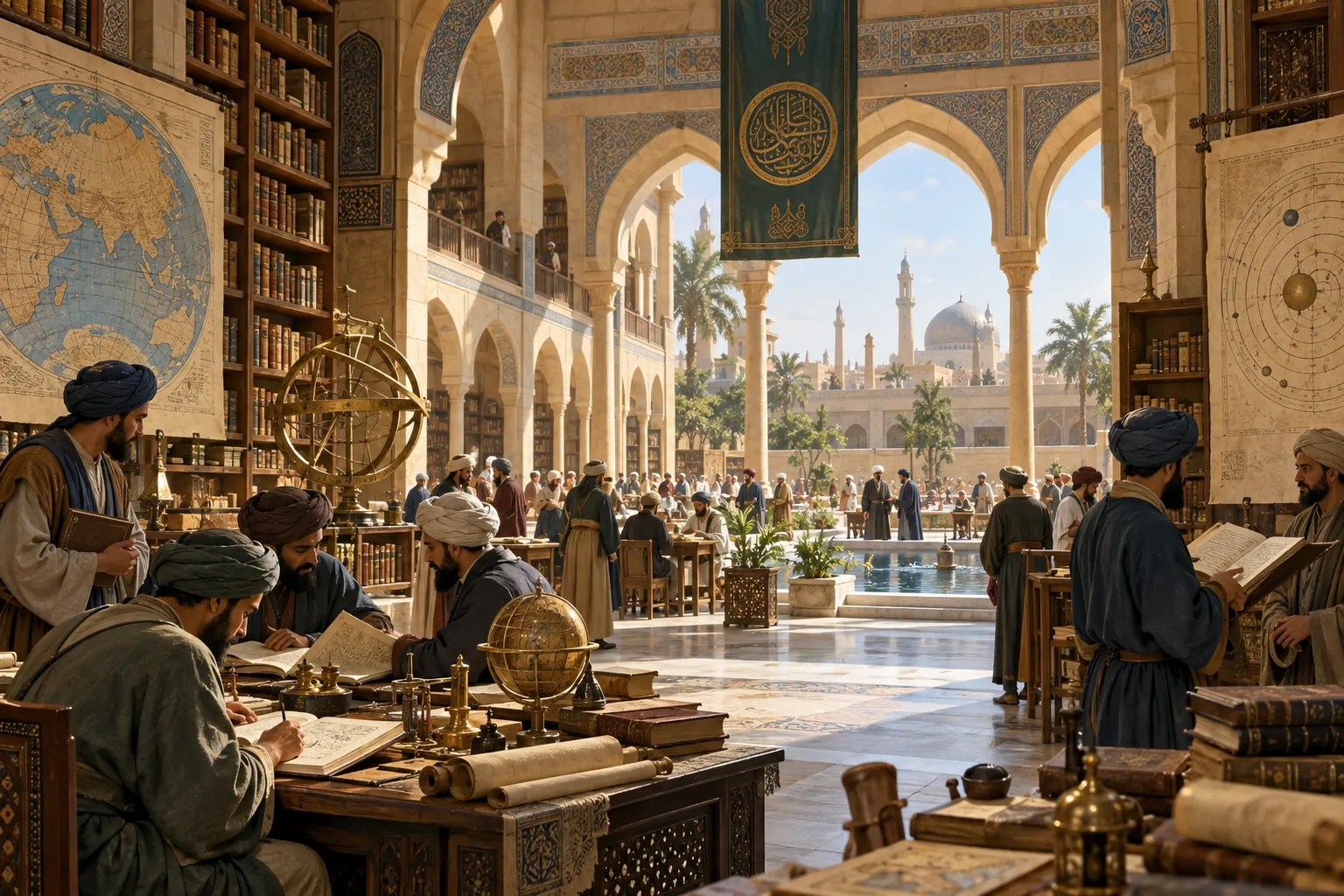
The House of Wisdom (Arabic: بيت الحكمة, Bayt al-Hikma) was the most celebrated intellectual institution of the medieval world, a library, translation bureau, and research center that stood at the heart of Baghdad during the height of the Islamic Golden Age. For more than a century, from its establishment under Caliph Harun al-Rashid in the late eighth century through its expansion under al-Ma'mun in the ninth, it drew the finest scholars of the age — mathematicians, physicians, astronomers, philosophers, and translators — and gave them the resources, the manuscripts, and the intellectual community they needed to produce work that would shape human knowledge for generations.
The institution's significance lies not only in what it preserved but in what it created. The scholars who worked there did not merely copy ancient texts; they engaged with them critically, corrected their errors, extended their arguments, and built upon them to produce original discoveries. The algebra of al-Khwarizmi, the medical encyclopedias of Hunayn ibn Ishaq, the astronomical tables of Thabit ibn Qurra, and the philosophical syntheses of al-Kindi all emerged from this environment of sustained, institutionally supported inquiry. When this knowledge later reached medieval Europe through Latin translations, it helped ignite the intellectual transformation that historians call the Renaissance.
Historical Background: Baghdad and the Abbasid Vision
To understand the House of Wisdom, one must first understand the city and the dynasty that created it. Baghdad was founded in 762 CE by the Abbasid Caliph al-Mansur on the western bank of the Tigris River, at a point where the river bends close to the Euphrates. The city was designed as a perfect circle — the Round City — with the caliph's palace and the great mosque at its center, surrounded by concentric rings of residential and commercial districts. Within a generation it had grown into one of the largest cities in the world, a cosmopolitan metropolis where Arabs, Persians, Syrians, Greeks, Jews, Christians, and Zoroastrians lived and traded alongside one another.
The Abbasid caliphs who ruled from Baghdad were heirs to a revolution. They had overthrown the Umayyad Caliphate in 750 CE partly by appealing to non-Arab Muslims — particularly Persians — who felt excluded from the Arab-dominated Umayyad state. The Abbasid court was consequently more cosmopolitan and more intellectually open than its predecessor. Persian administrative traditions, Persian literary culture, and Persian scholarly networks all flowed into the new capital. The caliphs understood that legitimacy required not only military power and religious authority but cultural prestige, and cultural prestige in the medieval world meant mastery of the accumulated knowledge of antiquity.
This was the context in which the House of Wisdom took shape. The Abbasid caliphs were not simply patrons of learning in the way that wealthy individuals might support a poet or a musician. They were engaged in a deliberate, state-sponsored project to acquire, translate, and master the intellectual heritage of Greece, Persia, and India — and then to surpass it.
Founding Under Harun al-Rashid (786–809 CE)
The institution that would become the House of Wisdom began modestly. Caliph Harun al-Rashid, the fifth Abbasid caliph and the ruler whose court is immortalized in the Thousand and One Nights, established a royal library in Baghdad that served as a repository for manuscripts acquired through trade, diplomacy, and conquest. This library, sometimes called the Khizanat al-Hikma (Treasury of Wisdom), was the seed from which the House of Wisdom grew.
Harun al-Rashid was himself a man of considerable learning, and his court attracted scholars, poets, and musicians from across the Islamic world. He maintained diplomatic relations with the Byzantine Empire and with the Frankish court of Charlemagne, and these contacts facilitated the acquisition of Greek manuscripts that would later be translated at the House of Wisdom. He also patronized the early stages of the translation movement, commissioning Arabic versions of Persian administrative and literary texts and supporting scholars who worked on Greek medical and astronomical works.
The caliph's interest in scholarship was not purely intellectual. Practical knowledge — medicine, astronomy, mathematics — had obvious value for a ruler governing a vast empire. Accurate astronomical tables were needed to determine prayer times and the direction of Mecca. Medical knowledge was needed to staff the hospitals that the Abbasids were establishing across their territories. Mathematical techniques were needed for the complex calculations of taxation, land measurement, and inheritance that Islamic law required. The House of Wisdom served these practical needs even as it pursued knowledge for its own sake.
The Golden Era Under al-Ma'mun (813–833 CE)
The institution reached its greatest prominence under Caliph al-Ma'mun, who transformed it from a royal library into a comprehensive research institution. Al-Ma'mun was perhaps the most intellectually engaged of all the Abbasid caliphs. He had studied philosophy and theology, participated in scholarly debates, and held strong views on questions of reason and revelation that would eventually lead him to impose the controversial Mihna — a theological inquisition that tested scholars on the question of whether the Quran was created or eternal.
Al-Ma'mun's commitment to scholarship was expressed in concrete institutional terms. He expanded the House of Wisdom's staff, increased its budget, and sent emissaries to Constantinople and other centers of learning to acquire Greek manuscripts. According to historical accounts, he wrote to the Byzantine emperor requesting access to ancient texts, and the emperor complied, sending a collection of manuscripts that were then translated in Baghdad. Whether or not this specific account is accurate in all its details, it reflects the scale of al-Ma'mun's ambition: he wanted Baghdad to possess and master the entire intellectual heritage of the ancient world.
Under al-Ma'mun, the House of Wisdom became a true research institution. It had a director (sahib Bayt al-Hikma), a staff of translators, copyists, and scholars, and a library that grew continuously as new works were acquired and translated. Scholars were paid salaries — sometimes very generous ones — to work there, and the caliph himself would visit to participate in discussions and debates. The institution was not a university in the modern sense; it did not have a fixed curriculum or grant degrees. But it was a place where sustained, collaborative intellectual work was possible in a way that had rarely been achieved before.
The Translation Movement: Scope, Method, and Significance
The most celebrated function of the House of Wisdom was its systematic translation of ancient texts into Arabic. This translation movement, which historians sometimes call the Graeco-Arabic translation movement, was one of the most consequential intellectual projects in human history. Over the course of roughly two centuries, from the mid-eighth to the mid-tenth century, virtually the entire corpus of Greek scientific and philosophical writing was rendered into Arabic, along with major works from Persian, Syriac, and Sanskrit traditions.
The scale of this undertaking is difficult to overstate. The works of Aristotle, Plato, Euclid, Archimedes, Ptolemy, Galen, Hippocrates, Dioscorides, and dozens of other ancient authors were translated, often multiple times by different scholars working from different manuscripts. Persian astronomical and mathematical texts, Indian numerical systems, and Syriac medical and philosophical works were also incorporated. The result was a synthesis of ancient knowledge that no single civilization had previously possessed.
The translation methodology developed at the House of Wisdom was sophisticated and self-conscious. Translators understood that effective translation required more than linguistic competence; it required deep understanding of the subject matter. A medical text could not be translated accurately by someone who did not understand medicine. An astronomical treatise required a translator who could evaluate the calculations and identify errors in the source text. The best translators at the House of Wisdom were therefore scholars in their own right, capable of engaging critically with the texts they were rendering.
Translators also faced the challenge of creating Arabic scientific and philosophical vocabulary. Many of the concepts in Greek texts had no direct Arabic equivalents, and translators had to either borrow Greek terms (often through Syriac intermediaries), coin new Arabic words, or adapt existing Arabic terms to new technical meanings. This terminological work was itself a form of intellectual creation, and the vocabulary developed during the translation movement shaped Arabic scientific and philosophical discourse for centuries.
The translation movement was not a purely academic exercise. It was driven by practical needs — the need for medical knowledge to staff hospitals, for astronomical knowledge to determine prayer times and the direction of Mecca, for mathematical knowledge to handle the complex calculations of Islamic inheritance law — as well as by the intellectual curiosity and cultural ambition of the Abbasid court. The caliphs understood that mastery of ancient knowledge was a form of power, and they invested accordingly.
Major Scholars and Their Contributions
Al-Khwarizmi: The Founder of Algebra
Muhammad ibn Musa al-Khwarizmi (c. 780–850 CE) was among the most influential scholars ever associated with the House of Wisdom, and his work there changed the course of mathematics. His treatise Al-Kitab al-mukhtasar fi hisab al-jabr wa'l-muqabala (The Compendious Book on Calculation by Completion and Balancing), written around 820 CE, established algebra as a systematic mathematical discipline. The word "algebra" itself derives from al-jabr, one of the two operations al-Khwarizmi described for solving equations.
What made al-Khwarizmi's contribution revolutionary was not merely the techniques he described — some of which had precedents in earlier mathematical traditions — but the systematic, general framework he created. He classified linear and quadratic equations into standard types and provided step-by-step solution methods for each, accompanied by geometric proofs. His approach was both rigorous and practical: he illustrated his methods with problems drawn from inheritance calculations, land measurement, and commercial transactions, demonstrating that abstract mathematics had direct applications in everyday life.
Al-Khwarizmi also produced a treatise on the Hindu-Arabic numeral system, introducing to the Arabic-speaking world the decimal place-value notation and the concept of zero that had been developed in India. This work, translated into Latin in the twelfth century, introduced European scholars to the numeral system they still use today. The Latinized form of his name, Algoritmi, gave rise to the word "algorithm," a term now central to computer science and mathematics.
His astronomical work was equally significant. He produced a set of astronomical tables (zij) that synthesized Greek and Indian astronomical traditions, providing calculations of planetary positions, solar and lunar eclipses, and other celestial phenomena. These tables were used by astronomers across the Islamic world and were later translated into Latin, influencing European astronomy for centuries.
Hunayn ibn Ishaq: The Master Translator
Hunayn ibn Ishaq (809–873 CE) was the greatest translator of the Islamic Golden Age and one of the most productive scholars ever associated with the House of Wisdom. A Nestorian Christian from the city of al-Hira, he was fluent in Greek, Syriac, Persian, and Arabic — a linguistic range that made him uniquely qualified for the translation work that al-Ma'mun and his successors were sponsoring.
Hunayn's output was extraordinary. He translated more than a hundred Greek works into Arabic and Syriac, including the complete medical corpus of Galen — some sixteen major treatises — as well as works by Hippocrates, Dioscorides, and other ancient physicians. He also translated philosophical works, including texts by Plato and Aristotle, and scientific works on mathematics and astronomy. His translations were distinguished by their accuracy and clarity; he understood that a translation was only as good as the translator's understanding of the subject, and he brought genuine medical and philosophical knowledge to his work.
Beyond translation, Hunayn made original contributions to medicine and ophthalmology. His Ten Treatises on Ophthalmology was the first systematic treatment of eye diseases in any language, describing the anatomy of the eye, the causes of various conditions, and their treatments. It remained the standard reference work on the subject for centuries, used by physicians in both the Islamic world and, after translation, in medieval Europe.
Hunayn also wrote on the methodology of translation itself, leaving behind a remarkable letter in which he described his approach to translating Galen's works — how he sought out multiple manuscripts to compare variant readings, how he evaluated the reliability of different sources, and how he handled passages where the Greek was obscure or corrupt. This methodological self-consciousness was unusual for the period and reflects the intellectual seriousness with which the House of Wisdom approached its work.
Thabit ibn Qurra: Mathematics and the Stars
Thabit ibn Qurra (836–901 CE) came from the Sabian community of Harran, a religious minority in northern Mesopotamia who maintained ancient astronomical and mathematical traditions. He was brought to Baghdad by the mathematician Muhammad ibn Musa al-Khwarizmi, who recognized his exceptional abilities, and he became one of the most prolific scholars of the House of Wisdom's later period.
Thabit translated mathematical and astronomical works from Greek into Arabic, including Euclid's Elements and Ptolemy's Almagest, and he produced Arabic versions of works by Archimedes and Apollonius. But he was far more than a translator. His original mathematical work included discoveries in number theory — he developed a formula for generating pairs of amicable numbers — and contributions to the foundations of what would later become calculus. He also worked on the theory of parallel lines and on the properties of parabolas and other conic sections.
In astronomy, Thabit made careful observations that allowed him to refine Ptolemy's data and correct errors in the Almagest. He developed a theory of the oscillation of the equinoxes — a phenomenon now called trepidation — that, while ultimately incorrect, represented a serious attempt to account for discrepancies between ancient and contemporary astronomical observations. His astronomical tables were widely used throughout the Islamic world.
Al-Kindi: Philosophy and the Sciences
Abu Yusuf al-Kindi (c. 801–873 CE) was the first major Islamic philosopher and a polymath whose interests ranged across mathematics, astronomy, medicine, music theory, optics, and philosophy. He was a prolific writer — medieval bibliographers attributed more than two hundred and fifty works to him, though many have been lost — and his engagement with Greek philosophy helped establish the tradition of Islamic philosophical inquiry that would later produce al-Farabi, Ibn Sina, and Ibn Rushd.
Al-Kindi's philosophical project was to demonstrate that Greek philosophy, properly understood, was compatible with Islamic theology. He argued that reason and revelation were complementary paths to truth, and that the study of philosophy was not only permissible for Muslims but valuable. This position was controversial — some religious scholars viewed Greek philosophy with suspicion — but al-Kindi's standing at the Abbasid court gave him the protection to pursue it.
His scientific work was equally wide-ranging. He wrote on optics, developing a theory of vision that influenced later Islamic and European optical science. He wrote on music theory, applying mathematical analysis to the relationships between musical tones. He wrote on pharmacology, developing a systematic approach to drug dosages. And he wrote on cryptography, producing what may be the earliest known treatise on the analysis of coded messages — a work that demonstrates the breadth of intellectual inquiry that the House of Wisdom made possible.
Other Notable Figures
The House of Wisdom was home to many other scholars whose contributions deserve recognition. Yahya ibn Masawayh (c. 777–857 CE), a physician who served as director of the institution under al-Ma'mun, translated Greek medical texts and wrote original works on dietetics and ophthalmology. Qusta ibn Luqa (c. 820–912 CE), a Greek-speaking Christian from Baalbek, translated works on mechanics, astronomy, and medicine, and wrote original treatises on the difference between the soul and the spirit. Al-Hajjaj ibn Yusuf produced the first Arabic translation of Euclid's Elements and of Ptolemy's Almagest, foundational texts for the mathematical and astronomical work that followed.
The institution also attracted scholars from the eastern reaches of the Islamic world. The Banu Musa brothers — Muhammad, Ahmad, and al-Hasan — were accomplished mathematicians and engineers, known for their work on geometry, mechanics, and the construction of ingenious devices. Their Book of Ingenious Devices described nearly a hundred mechanical contrivances, demonstrating the practical dimension of the House of Wisdom's intellectual culture.
Scientific and Intellectual Achievements
The cumulative achievements of the House of Wisdom's scholars were remarkable in their breadth and depth. In mathematics, they established algebra as a systematic discipline, introduced the Hindu-Arabic numeral system to the Arabic-speaking world, advanced the study of geometry and trigonometry, and made contributions to number theory and the early development of calculus. In astronomy, they produced accurate tables of planetary positions, refined Ptolemy's data through careful observation, and developed new instruments for celestial measurement. In medicine, they translated and extended the Greek medical corpus, established systematic approaches to pharmacology and ophthalmology, and contributed to the development of clinical medicine.
In philosophy, the scholars of the House of Wisdom created the tradition of Islamic philosophy by engaging seriously with Aristotle, Plato, and the Neoplatonists, developing Arabic philosophical vocabulary, and working out the relationship between Greek rational inquiry and Islamic theological commitments. This philosophical tradition would produce some of the most important thinkers of the medieval world, including al-Farabi, Ibn Sina, and Ibn Rushd, all of whom built directly on the foundations laid at the House of Wisdom.
The institution also fostered a culture of empirical inquiry that was unusual for its time. Scholars were encouraged to test theoretical claims against observation, to seek out multiple sources and compare them critically, and to acknowledge uncertainty where it existed. This empirical orientation, combined with the mathematical rigor that the translation of Greek texts had made available, created a distinctive approach to natural knowledge that historians of science have recognized as a significant step in the development of scientific method.
The Physical Institution
The House of Wisdom was located in the Abbasid palace complex in Baghdad, close to the caliph's residence — a proximity that reflected its status as a royal institution and ensured that it had access to the resources and protection of the caliphal court. The institution comprised several distinct spaces: a library that housed the manuscript collection, translation workshops where scholars worked on rendering texts into Arabic, an observatory where astronomical observations were conducted, and spaces for discussion and debate.
The library was the institution's most famous feature. It grew continuously as new manuscripts were acquired through purchase, diplomatic exchange, and the spoils of military campaigns. Manuscripts were copied by professional scribes, and the copies were then available to scholars working at the institution or, in some cases, to scholars elsewhere who could borrow or purchase copies. The library's collection encompassed works in Greek, Syriac, Persian, Sanskrit, and Arabic, making it one of the most comprehensive repositories of knowledge in the medieval world.
The observatory, established under al-Ma'mun, was equipped with instruments for measuring the positions of celestial bodies — armillary spheres, astrolabes, and large graduated circles for measuring angles. Scholars conducted systematic observations over extended periods, comparing their results with the predictions of Ptolemy's astronomical models and identifying discrepancies that required explanation. This observational program produced some of the most accurate astronomical data of the medieval period.
Decline and the Mongol Destruction
The House of Wisdom's period of greatest productivity lasted roughly from the reign of al-Ma'mun (813–833 CE) through the mid-ninth century. As the Abbasid Caliphate weakened in the later ninth and tenth centuries — with real power passing to Turkish military commanders and then to the Buyid dynasty — caliphal patronage of scholarship diminished, and the institution gradually lost its central role in Islamic intellectual life. Scholarship continued, but it dispersed to other centers: to Córdoba in al-Andalus, to Cairo under the Fatimids, to Samarkand and Bukhara in Central Asia.
The symbolic end came in 1258 CE, when the Mongol forces of Hulagu Khan sacked Baghdad in one of the most devastating events in Islamic history. The fall of Baghdad resulted in the destruction of much of the city, the death of the last Abbasid caliph, and the loss of an incalculable number of manuscripts. Medieval accounts describe books thrown into the Tigris River in such quantities that the water ran black with ink. Modern historians treat these accounts with some caution — the destruction, while real and severe, may have been somewhat exaggerated in later retellings — but there is no doubt that the Mongol sack ended whatever remained of the House of Wisdom as an institution and destroyed a significant portion of the manuscript collection it had accumulated.
Legacy and Global Influence
The House of Wisdom's legacy extends far beyond the institution itself. The works produced there, and the intellectual culture it fostered, shaped the development of knowledge across three continents and several centuries.
Within the Islamic world, the translation movement and the original scholarship it enabled established the foundations of Islamic science and philosophy. The mathematical, astronomical, and medical traditions that flourished at the House of Wisdom continued to develop in institutions across the Islamic world for centuries after the institution's decline. The philosophical tradition initiated by al-Kindi and developed by al-Farabi and Ibn Sina shaped Islamic theology and spirituality in ways that are still felt today.
The transmission of this knowledge to medieval Europe was one of the most consequential intellectual transfers in history. Beginning in the twelfth century, European scholars — working primarily in Toledo, Sicily, and other points of contact between the Islamic and Christian worlds — translated Arabic scientific and philosophical texts into Latin. These translations brought to Europe not only the Greek texts that had been preserved and translated at the House of Wisdom, but also the Arabic commentaries, corrections, and original contributions that Islamic scholars had added. The algebra of al-Khwarizmi, the medical encyclopedias of Ibn Sina, the astronomical work of al-Battani, and the philosophical commentaries of Ibn Rushd all reached European universities through this channel, contributing to the intellectual transformation that historians call the twelfth-century Renaissance and, ultimately, to the Scientific Revolution of the sixteenth and seventeenth centuries.
The House of Wisdom also demonstrated something of enduring importance about the conditions under which intellectual progress is possible. It showed that sustained scholarship requires institutional support — resources, libraries, and the freedom to pursue inquiry without immediate practical justification. It showed that intellectual progress is often accelerated by the encounter between different traditions, as the synthesis of Greek, Persian, and Indian knowledge at the House of Wisdom produced results that none of those traditions could have achieved alone. And it showed that translation — the careful, critical rendering of knowledge from one language and cultural context to another — is itself a form of intellectual creation, not merely a mechanical process.
The House of Wisdom endures as a symbol of the Islamic Golden Age at its most ambitious and most productive: a moment when the world's most powerful civilization committed itself to mastering all of human knowledge and, in doing so, advanced that knowledge in ways that still shape our world today.
References and Further Reading
Primary Islamic Sources
- Quran, Surah Al-Alaq (96:1–5) — "Read in the name of your Lord who created... Taught man that which he knew not."
- Quran, Surah Az-Zumar (39:9) — "Are those who know equal to those who do not know?"
- Sunan Ibn Majah, al-Muqaddimah (Introduction), Hadith 224 — "Seeking knowledge is an obligation upon every Muslim." The opening clause is accepted by the hadith scholars on the strength of its multiple corroborating chains. The report is frequently attributed to Sahih al-Bukhari; that attribution is mistaken.
- Sahih al-Bukhari, Kitab al-Ilm (Book of Knowledge), Hadith 79 — the parable likening the guidance and knowledge the Prophet was sent with to abundant rain falling on different kinds of ground
- Sahih Muslim, Book of Dhikr, Hadith 2699 — "Whoever treads a path seeking knowledge, Allah will make easy for him a path to Paradise."
- Al-Khwarizmi, Muhammad ibn Musa. Al-Kitab al-Mukhtasar fi Hisab al-Jabr wa al-Muqabalah. [Original c. 820 CE — composed at the House of Wisdom]
- Hunayn ibn Ishaq. Translation corpus produced at the House of Wisdom, including works of Galen, Hippocrates, and Aristotle. [c. 830–870 CE]
Classical Islamic Sources
- Al-Mas'udi, Ali ibn al-Husayn. Muruj al-Dhahab, Vol. 3–4. Beirut: Dar al-Andalus, 1965. [Original c. 956 CE — accounts of the Abbasid intellectual court and the translation movement]
- Al-Qifti, Jamal al-Din. Tarikh al-Hukama (History of the Learned). Leipzig: Dieterich, 1903. [Original c. 1248 CE — biographical dictionary of scholars, many associated with the House of Wisdom]
- Ibn al-Nadim, Muhammad ibn Ishaq. Al-Fihrist (The Index/Catalogue). Translated by Bayard Dodge. New York: Columbia University Press, 1970. [Original c. 988 CE — the most important bibliographical source for the House of Wisdom and its associated scholars]
- Ibn Abi Usaybi'a, Ahmad. Uyun al-Anba fi Tabaqat al-Atibba (Sources of Information on the Classes of Physicians). Edited by August Müller. Cairo: al-Matba'ah al-Wahbiyyah, 1882. [Original c. 1270 CE — biographical accounts of physicians associated with the House of Wisdom]
Academic and Scholarly Sources
- Gutas, Dimitri. Greek Thought, Arabic Culture: The Graeco-Arabic Translation Movement in Baghdad. London: Routledge, 1998. [The definitive study of the translation movement centered on the House of Wisdom]
- Lyons, Jonathan. The House of Wisdom: How the Arabs Transformed Western Civilization. New York: Bloomsbury Press, 2009.
- Al-Khalili, Jim. The House of Wisdom: How Arabic Science Saved Ancient Knowledge and Gave Us the Renaissance. New York: Penguin, 2011.
- Saliba, George. Islamic Science and the Making of the European Renaissance. Cambridge, MA: MIT Press, 2007.
- Lassner, Jacob. The Topography of Baghdad in the Early Middle Ages. Detroit: Wayne State University Press, 1970.
- Kennedy, Hugh. When Baghdad Ruled the Muslim World. Cambridge, MA: Da Capo Press, 2004.
Further Reading
- O'Leary, De Lacy. How Greek Science Passed to the Arabs. London: Routledge and Kegan Paul, 1949.
- Peters, Francis E. Aristotle and the Arabs: The Aristotelian Tradition in Islam. New York: New York University Press, 1968.
Mentioned In
32 articles reference this topic
and 20 more articles