Samarkand
Samarkand, one of Central Asia's oldest cities, was a major Silk Road hub, a center of early Islamic learning, and the capital of Timur's empire. Under the Timurid ruler Ulugh Beg it became a scientific capital, home to an observatory that produced the era's finest star catalog.
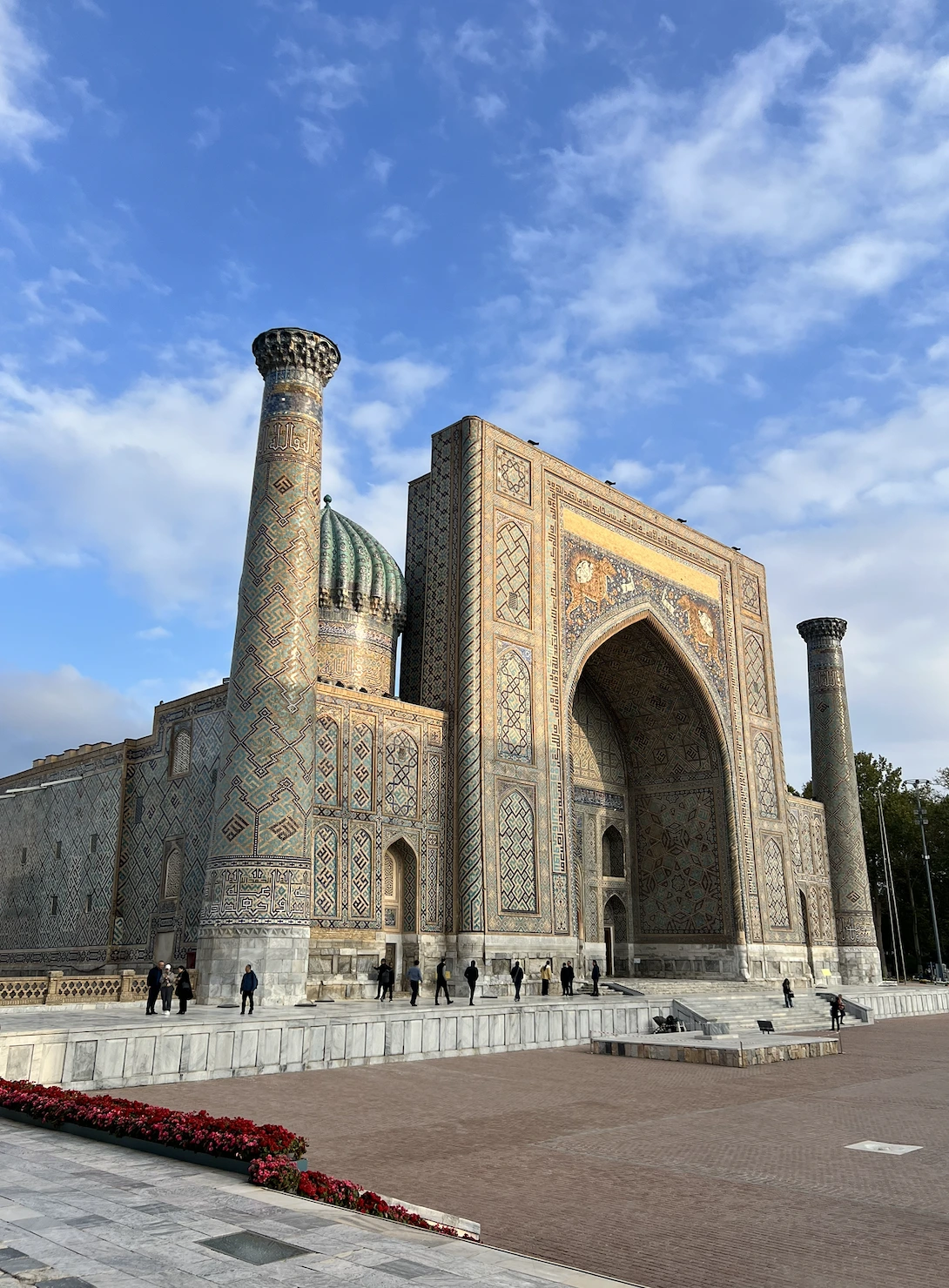
Samarkand (Persian: سمرقند, Samarqand) is one of the oldest continuously inhabited cities in Central Asia, with a history stretching back more than 2,700 years. Situated in the fertile Zeravshan River valley in present-day Uzbekistan, it occupied a position of extraordinary strategic importance at the intersection of the trade routes connecting China with the Mediterranean, India with the steppes of Central Asia, and the Persian world with the Turkic east. That position made it one of the wealthiest cities of the ancient and medieval world, and it made the city a prize that successive empires fought to control.
Its greatest period came under the Timurid dynasty in the fourteenth and fifteenth centuries, when Timur (Tamerlane) transformed it into the capital of an empire stretching from India to Anatolia, and when his grandson Ulugh Beg made it the scientific capital of the medieval world. The monuments that survive from this period — the Registan, the Gur-e-Amir, the Shah-i-Zinda, the ruins of Ulugh Beg's observatory — are among the finest achievements of Islamic architecture and scholarship.
Ancient Origins: The Sogdian City
Before Islam, before the Arabs, before even Alexander the Great, Samarkand was already an ancient city. The Sogdians — an Iranian people who dominated Central Asian trade for centuries — founded the settlement known as Afrasiab on a plateau above the Zeravshan River, and it grew into one of the most prosperous cities of the ancient world. The Sogdians were merchants of genius: their trading networks extended from China to the Byzantine Empire, and Sogdian merchants and their distinctive script have been found in archaeological sites across the entire breadth of Central Asia.
Alexander the Great captured the city in 329 BCE, calling it Maracanda, and was reportedly struck by its wealth and sophistication. The city passed through Seleucid, Parthian, and Kushan hands before the Sogdians reasserted their independence, and it remained a major commercial center through the Sasanian period. By the time the Arab armies arrived in the early eighth century, Samarkand had been a great city for a thousand years.
The Arab Conquest and Early Islamic Period (712–900 CE)
The Arab conquest of Samarkand in 712 CE was led by Qutayba ibn Muslim, the Umayyad Caliphate's governor of Khorasan and one of the most effective military commanders of the early Islamic period. The conquest was not a single battle but a prolonged campaign: Qutayba had to take the city multiple times as the Sogdian nobility repeatedly revolted and sought help from the Turks and the Chinese Tang dynasty. The final incorporation of Samarkand into the Islamic world came only after decades of resistance.
The consequences of the conquest extended far beyond the political. Among the prisoners taken at Samarkand were Chinese craftsmen who knew the technique of making paper from plant fibers — a technology that had been a closely guarded Chinese secret. The paper-making knowledge they transmitted spread rapidly through the Islamic world: paper mills were established in Samarkand, then in Baghdad, then across the entire Islamic world. The availability of cheap, high-quality paper transformed Islamic scholarship, making it possible to produce books in quantities that had been impossible with papyrus or parchment. The House of Wisdom in Baghdad, the great libraries of Cordoba, the manuscript collections of Bukhara — all of this was made possible, in part, by the paper-making technology that came to the Islamic world through Samarkand.
Under the Abbasid Caliphate, Samarkand became an important center of Islamic learning and culture. Muhammad al-Bukhari, the greatest hadith scholar in Islamic history, was born in Bukhara nearby and spent much of his career in the region. Al-Biruni, one of the most original scientific minds of the medieval world, was born in Khwarezm to the northwest and worked in the broader Central Asian intellectual tradition that Samarkand helped define. The Samanid dynasty, which ruled Central Asia from Bukhara in the ninth and tenth centuries, presided over a remarkable cultural flowering in which Samarkand participated — Ibn Sina was born in the Samanid realm, and al-Farabi was born in the Farab region of Central Asia.
The Mongol Catastrophe (1220 CE)
The Mongol invasion of 1220 CE under Genghis Khan was one of the most catastrophic events in the history of Central Asian civilization. Samarkand, which had been one of the largest and most prosperous cities in the world, was almost completely destroyed. The Mongols killed a large proportion of the population, demolished the city's buildings and infrastructure, and diverted the irrigation systems that had sustained the region's agriculture for centuries.
The scale of the destruction was recorded by contemporaries with a sense of horror that has not diminished with time. The Persian historian Juvayni, writing a generation after the conquest, described cities reduced to rubble and fields left untilled for years. The Zeravshan valley, which had supported dense urban settlement for millennia, was depopulated and its agricultural infrastructure shattered. Samarkand itself was largely abandoned, its population scattered or dead, its monuments in ruins.
The recovery was slow and incomplete. Under later Mongol rulers — particularly the Chagatai Khanate, which controlled Central Asia after the division of the Mongol Empire — Samarkand gradually revived as a commercial center, but it never fully recovered the scale and sophistication it had achieved before 1220. The city that Timur would transform in the late fourteenth century was a much-reduced version of the pre-Mongol metropolis.
Timur's Capital: The Timurid Renaissance (1370–1405 CE)
Timur, known in the West as Tamerlane (a corruption of Timur-i-Lang, Timur the Lame), rose to power in the 1360s from a base in the Chagatai Khanate and built, through a series of devastating military campaigns, an empire that at its height stretched from India to Anatolia and from the Caucasus to the Persian Gulf. He was a conqueror of extraordinary military genius and extraordinary violence: his campaigns left pyramids of skulls outside conquered cities and depopulated entire regions. The wealth that funded the transformation of Samarkand was extracted from the devastation of Delhi, Isfahan, Baghdad, and Damascus.
Timur chose Samarkand as his capital and poured the wealth of his conquests into making it the most magnificent city in the world. He brought the finest craftsmen, architects, and artists from every city he conquered — Persian tile-makers, Indian stonemasons, Syrian metalworkers, Chinese silk weavers — and set them to work rebuilding and beautifying Samarkand. The result was a city of extraordinary architectural ambition, where the traditions of multiple civilizations were synthesized into a distinctive Timurid style.
The most visible expression of this ambition was the Bibi-Khanym Mosque, built to commemorate Timur's Indian campaigns and intended to be the largest mosque in the Islamic world. Its massive portal, soaring dome, and spacious courtyard were indeed unprecedented in scale, but the ambition outran the engineering: the structure began to show cracks almost immediately, and it suffered significant damage in an earthquake in 1897. What remains is still impressive, but it is a monument to the limits of ambition as much as to its achievements.
More successful architecturally was the Gur-e-Amir, the mausoleum that Timur built for his grandson Muhammad Sultan and that became his own tomb after his death in 1405 CE. The Gur-e-Amir's ribbed melon dome — covered in turquoise and blue tiles that catch the light in constantly shifting patterns — became one of the most influential architectural forms in the Islamic world. Its proportions and decorative program were studied and imitated by architects across Central Asia and India; the Taj Mahal, built two centuries later by Timur's Mughal descendants, owes a direct debt to the Gur-e-Amir's architectural vocabulary.
The Shah-i-Zinda necropolis, a complex of mausoleums built over several centuries on the slopes of the ancient Afrasiab plateau, reached its greatest elaboration during the Timurid period. The tombs of Timurid nobles and religious figures, each decorated with exquisite tilework in turquoise, cobalt, and gold, represent some of the finest examples of Islamic decorative art in existence. Walking through the Shah-i-Zinda is an experience of accumulated beauty — each facade different from the last, each dome a variation on a theme — that gives a sense of the extraordinary concentration of artistic talent that Timur's patronage had assembled in Samarkand.
Ulugh Beg and the Scientific Capital (1409–1449 CE)
Timur's grandson Ulugh Beg, who ruled Samarkand from 1409 to 1449 CE, was one of the most remarkable figures in the history of science — a ruler who was also a genuine mathematician and astronomer of the first rank. Where Timur had been a conqueror who built monuments, Ulugh Beg was a scholar who happened to rule an empire, and his greatest monument was not a mosque or a mausoleum but an observatory.
The Samarkand Observatory, built around 1420 CE on a hill outside the city, was the largest and most sophisticated astronomical instrument of its time. Its central feature was a sextant of extraordinary scale — a curved track cut into the bedrock of the hill, approximately 40 meters in radius, along which a precisely calibrated instrument could be moved to measure the altitude of celestial bodies with unprecedented accuracy. The observatory also contained smaller instruments for measuring the positions of stars and planets, and it was staffed by a team of astronomers who conducted systematic observations over decades.
The product of this work was the Zij-i-Sultani (The Sultan's Astronomical Tables), completed around 1437 CE — the most accurate star catalog produced in the pre-telescopic era. Ulugh Beg and his team measured the positions of 1,018 stars with a precision that was not surpassed until the work of Tycho Brahe in the sixteenth century. They also produced highly accurate values for the length of the solar year and the obliquity of the ecliptic — measurements that European astronomers would use and refine for over a century after the Zij-i-Sultani was translated into Latin.
Ulugh Beg also built a madrasa on the Registan that became one of the finest educational institutions in the Islamic world. The curriculum emphasized mathematics, astronomy, and Islamic jurisprudence, reflecting his belief that rigorous scientific inquiry and religious faith were complementary rather than competing. He reportedly taught mathematics there himself, and the madrasa attracted students from across Central Asia, Persia, and India.
His end was tragic. In 1449 CE, Ulugh Beg was overthrown by his own son Abd al-Latif, who had him executed — reportedly at the instigation of religious conservatives who resented the prominence given to astronomy and mathematics at the expense of traditional religious scholarship. Abd al-Latif himself was killed within months, but the damage was done: the observatory was abandoned, its instruments dismantled, and the scientific tradition Ulugh Beg had built was dispersed. The observatory's ruins were rediscovered by archaeologists in 1908, and the great sextant track — still visible in the bedrock — is one of the most evocative archaeological sites in Central Asia.
The Registan: Heart of the City
The Registan — literally "sandy place" — was the public square at the center of Timurid Samarkand, and the complex of buildings that surrounds it today is one of the most impressive ensembles of Islamic architecture in the world. The square served as the ceremonial and commercial heart of the city: royal proclamations were made there, great festivals were held, and the surrounding buildings housed madrasas, caravanserais, and markets.
The three madrasas that define the Registan today were built over more than two centuries. Ulugh Beg's madrasa, on the western side, was completed in 1420 CE and is the oldest of the three. The Sher-Dor (Lion-Bearing) Madrasa, on the eastern side, was built in the 1630s and is notable for its facade decoration, which includes images of lions and a human face — unusual in Islamic architecture, which generally avoids representational imagery. The Tilla-Kari (Gold-Covered) Madrasa, in the center, was completed in 1660 CE and served as both a madrasa and a congregational mosque.
The Registan's visual impact comes from the combination of scale, color, and geometric precision. The facades of the three madrasas are covered in tilework in shades of turquoise, cobalt, and gold, arranged in intricate geometric and vegetal patterns that demonstrate the extraordinary mathematical sophistication of Timurid decorative art. The minarets that flank each portal lean slightly outward — a deliberate design choice to make them appear vertical when viewed from below — and the proportions of the portals, domes, and minarets are calculated to create a sense of harmonious grandeur that rewards extended contemplation.
Decline and Legacy
The fall of the Timurid dynasty in the early sixteenth century, when the Uzbek Shaybanids conquered Samarkand and moved their capital to Bukhara, marked the end of Samarkand's period of greatest importance. The city remained a significant regional center, and the Shaybanids and their successors continued to build and maintain its monuments, but the concentration of wealth, talent, and ambition that had made it the capital of a world empire was gone.
The shift of global trade routes from overland to maritime in the sixteenth century further diminished the commercial importance of the Silk Road cities. Samarkand, which had prospered for millennia from its position at the intersection of the great overland routes, found itself increasingly peripheral as European ships carried the trade that had once passed through its markets.
What survived was the architecture. The Registan, the Gur-e-Amir, the Shah-i-Zinda, the Bibi-Khanym Mosque — these monuments, though damaged by earthquakes, neglect, and the passage of centuries, remained as evidence of what Timurid Samarkand had been. When the Russian Empire incorporated Central Asia in the nineteenth century, European travelers and scholars encountered these buildings with astonishment, and the effort to document and preserve them began.
Samarkand's legacy in the history of Islamic civilization is substantial. Its role in transmitting paper-making technology to the Islamic world had consequences that shaped the entire subsequent history of Islamic scholarship. Its position as a center of the Samanid cultural renaissance helped establish the Persian literary and intellectual tradition that would define Islamic civilization from Central Asia to India. And the scientific achievement of Ulugh Beg's observatory — the most accurate astronomical measurements of the pre-telescopic era — represents one of the high points of Islamic science, a reminder that the Islamic Golden Age extended far beyond Baghdad and Cordoba to encompass the cities of Central Asia that had been at the heart of the Islamic world since the earliest centuries of the faith.
References and Further Reading
Primary Islamic Sources
- Al-Istakhri, Abu Ishaq. Masalik al-Mamalik, sections on Samarkand. Leiden: Brill, 1870. [Original c. 951 CE]
- Ibn Hawqal, Abu al-Qasim. Surat al-Ard, description of Samarkand. Leiden: Brill, 1873. [Original c. 977 CE]
- Al-Muqaddasi, Shams al-Din. Ahsan al-Taqasim, account of Samarkand. Leiden: Brill, 1877. [Original c. 985 CE]
- Babur, Zahir al-Din Muhammad. Baburnama, descriptions of Timurid Samarkand. Translated by W.M. Thackston. New York: Modern Library, 2002. [Original c. 1530 CE]
- Clavijo, Ruy González de. Embassy to Tamerlane, 1403–1406, eyewitness account of Timurid Samarkand. Translated by Guy Le Strange. London: Routledge, 1928.
- Abd al-Razzaq Samarqandi. Matla' al-Sa'dayn, on Samarkand under the Timurids. [Original c. 1470 CE]
Classical Islamic Sources
- Yaqut al-Hamawi. Mu'jam al-Buldan, entry on Samarkand. Beirut: Dar Sadir, 1977. [Original c. 1224 CE]
- Narshakhi, Abu Bakr Muhammad. Tarikh-i Bukhara, references to Samarkand. [Original c. 944 CE]
- Ibn Battuta. Rihlat Ibn Battuta, description of Samarkand. [Original c. 1355 CE]
Academic and Scholarly Sources
- Starr, S. Frederick. Lost Enlightenment: Central Asia's Golden Age from the Arab Conquest to Tamerlane. Princeton: Princeton University Press, 2013.
- Manz, Beatrice Forbes. The Rise and Rule of Tamerlane. Cambridge: Cambridge University Press, 1989.
- Lentz, Thomas W., and Glenn D. Lowry. Timur and the Princely Vision: Persian Art and Culture in the Fifteenth Century. Los Angeles: Los Angeles County Museum of Art, 1989.
- Knobloch, Edgar. Monuments of Central Asia: A Guide to the Archaeology, Art and Architecture of Turkestan. London: I.B. Tauris, 2001.
- Soucek, Svat. A History of Inner Asia. Cambridge: Cambridge University Press, 2000.
- Subtelny, Maria Eva. Timurids in Transition. Leiden: Brill, 2007.
Further Reading
- Marozzi, Justin. Tamerlane: Sword of Islam, Conqueror of the World. London: HarperCollins, 2004.
- Frye, Richard N. The Golden Age of Persia. London: Weidenfeld and Nicolson, 1975.
- Hillenbrand, Robert. Islamic Architecture: Form, Function, and Meaning. Edinburgh: Edinburgh University Press, 1994.
- Hodgson, Marshall G.S. The Venture of Islam, Vol. 2. Chicago: University of Chicago Press, 1974.
Mentioned In
39 articles reference this topic
and 27 more articles