The Islamic Calendar - Hijri Calendar System
The Hijri calendar is a lunar calendar of twelve months, four of them sacred, instituted as an era by the caliph Umar ibn al-Khattab and counted from the Hijra of 622 CE. It governs Islamic worship, festivals, and historical dating.
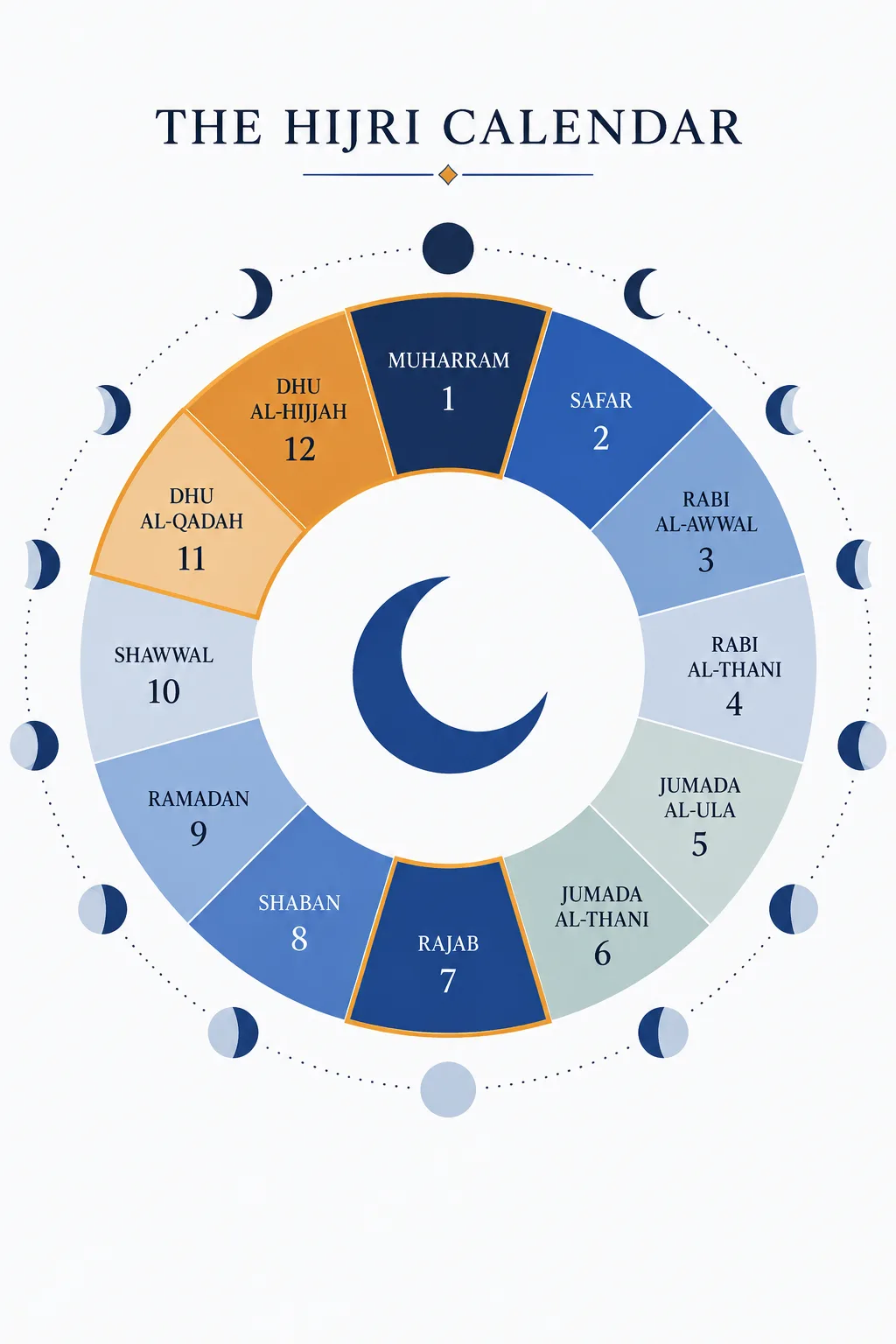
The Islamic calendar, known in Arabic as the Hijri calendar (التقويم الهجري, al-taqwīm al-hijrī), is a purely lunar calendar of twelve months, each beginning with the sighting of the new crescent. It is at once a system of timekeeping and a framework of worship: it fixes the fast of Ramadan, the days of Hajj, the two festivals, and the four months in which fighting was forbidden, and it supplies the dating by which Muslim historians have recorded their past for fourteen centuries.
Two things about it are often conflated and are worth separating at the outset. The months are older than Islam: the Qur'an describes their number as fixed "from the day He created the heavens and the earth", and the Arabs of the Hijaz used them, with their present names, before the revelation. What Islam established was the era — the decision to count years from the Hijra, the migration of Prophet Muhammad from Mecca to Medina in 622 CE — together with the abolition of the practice by which the sacred months had been shifted about. The era was not instituted during the Prophet's lifetime at all. It was the work of the second caliph, Umar ibn al-Khattab, some seventeen years after the migration it commemorates, and the reasoning behind his choice is preserved in some detail.
The Lunar Foundation and Qur'anic Basis
The twelve months and the four sacred
The number of the months, and the sanctity of four of them, are stated directly: "Indeed, the number of months with Allah is twelve lunar months in the register of Allah from the day He created the heavens and the earth; of these, four are sacred. That is the correct religion, so do not wrong yourselves during them" (Quran 9:36).
The verse does not name the twelve, nor identify the four. Both were supplied by the Prophet in the sermon he delivered at Mina during the Farewell Pilgrimage, in a report transmitted from Abu Bakra and recorded in Sahih al-Bukhari in the commentary on this very verse: "Time has come back to its original state which it had when Allah created the heavens and the earth; the year is twelve months, four of which are sacred. Three of them are in succession — Dhu al-Qa'dah, Dhu al-Hijjah and al-Muharram — and the fourth being Rajab of Mudar, which stands between Jumada al-Thani and Sha'ban" (Sahih al-Bukhari 4662; the same report appears at 5550, in Sahih Muslim, and in Sunan Abi Dawud 1947).
The moon as the measure of time
The Qur'an ties the phases of the moon directly to the timing of worship: "They ask you about the new moons. Say, 'They are measurements of time for the people and for Hajj'" (Quran 2:189). Elsewhere it presents the sun and moon together as the instruments by which time is reckoned at all: "It is He who made the sun a shining light and the moon a derived light and determined for it phases, that you may know the number of years and account of time" (Quran 10:5).
A lunar month is the interval between one new crescent and the next, and it cannot be a whole number of days. The Prophet stated the consequence plainly, in a report from Ibn Umar: "We are an unlettered nation; we neither write nor know accounts. The month is like this and this" — indicating, in the narrators' description, sometimes twenty-nine days and sometimes thirty (Sahih al-Bukhari 1913; also Sunan Abi Dawud 2319). A Hijri year of twelve such months runs to about 354 days, some eleven short of the solar year, so the months move steadily backwards through the seasons and return to their starting point after roughly thirty-three years.
That drift is not a defect of the system but a consequence of it, and it has a practical effect on worship. Ramadan falls in high summer for some generations and in midwinter for others, so the difficulty of the fast is distributed across time rather than settling permanently on one region or one lifetime. A further hadith addresses the anxiety that a short month might mean a diminished reward: "The two months of Eid, Ramadan and Dhu al-Hijjah, do not decrease" (Sahih al-Bukhari 1912).
The abolition of nasi'
Pre-Islamic Arabia used a lunar calendar adjusted to the seasons by intercalation — nasi' — the insertion of an additional month, or the displacement of a month from its place, so that the year kept step with the agricultural and commercial cycle. The practical difficulty was not astronomical but moral. Because three of the four inviolable months fell consecutively, and fighting was forbidden in all four, the power to move a month was the power to license a war. The Qur'an condemns the practice in the verse immediately following the one that fixes the number of the months: "Indeed, the postponing of restriction within sacred months is an increase in disbelief by which those who have disbelieved are led further astray. They make it lawful one year and unlawful another year to correspond to the number made unlawful by Allah and thus make lawful what Allah has made unlawful" (Quran 9:37).
The commentators describe what this looked like in practice. The Explanation of Riyadus Saliheen, glossing the Farewell Pilgrimage sermon, records that in the age before Islam the sanctity of a month was transferred to another month, so that the forbidden was made permitted and the permitted forbidden; specifically, that they would treat Muharram as an ordinary month and transfer its sanctity to Safar. The Prophet's statement that "time has come back to its original state" is understood as the announcement that the displacement had ended and the months stood again where they belonged. The year of the Farewell Pilgrimage was itself the year in which the cycle of nasi' happened to coincide with the true position of the sacred months, so that the correction and the calendar agreed.
The consequence is that the Hijri calendar has no leap month and no mechanism for seasonal adjustment. It is lunar without qualification.
The Institution of the Hijri Era
The undated document
The Prophet's community dated events by reference to them — the year of the Hijra, the year of Badr, the year of the Delegations — rather than by a running count. The count was introduced under Umar ibn al-Khattab, and the reports preserved by Ali Muhammad as-Sallabi in his study of the caliph give the occasion for it. Maymun ibn Mahran related that a document dated only "Sha'ban" reached Umar, who asked whether it meant the Sha'ban of last year, the Sha'ban of the coming year, or the Sha'ban they were then in. He gathered the Companions and told them: "Set up something for the people that they can refer to."
Two existing systems were considered and set aside. The Byzantine calendar was rejected because its count, reckoned from the time of Dhu al-Qarnayn, was too long to be practical. The Persian calendar was rejected because each new king abolished the reckoning of his predecessor, so it offered no continuity. What they settled on instead was measured against the Prophet's own life: they considered how long he had remained at Medina, found it to be ten years, and founded the calendar on the Hijra.
Sa'id ibn al-Musayyib transmitted the deliberation in a form that names the decisive voice. Umar assembled the Muhajirun and the Ansar and asked them, "From when should we date our history?" Ali ibn Abi Talib answered: "From the time when the Prophet came out of the land of shirk" — that is, from the day he migrated — and Umar adopted it. The same authority places the decision two and a half years into Umar's caliphate and records that he reached it in consultation with Ali. Abu al-Zinad reports simply that Umar consulted others and that they agreed upon the Hijra.
Why the Hijra, and why Muharram
The choice was not obvious, and Ibn Hajar preserves the reasoning in his commentary on Sahih al-Bukhari. Four possible starting points were put to Umar: the Prophet's birth, the beginning of his mission, the Hijra, and his death. The first two were set aside because the year of each was disputed. Dating from his death was abandoned deliberately, on the ground that it would renew grief among the Muslims every time a year was written. The Hijra alone remained.
That left a second question, and it explains a feature of the calendar that otherwise looks like an error: the Hijri year does not begin in the month of the migration. The Prophet reached Medina in Rabi' al-Awwal, yet the year opens two months earlier, in Muharram. The reason given is that the epoch was set not at the arrival but at the resolve. The second Pledge of al-Aqabah, which committed the Muslims of Medina to receive him and was the immediate precursor of the migration, took place in Dhu al-Hijjah; the first new month to begin after that pledge was Muharram, and so the year was made to open there. Ibn Hajar's own assessment is that this is the most appropriate event to be treated as the beginning.
The effect of the reform reached well beyond record-keeping. A single dating system, adopted at the moment the community was governing territory from the Nile to the Iranian plateau, gave an administration correspondence it could file, treaties it could date, and a shared reckoning of time across provinces that had previously used Byzantine and Persian years.
The Four Sacred Months
Four months of the twelve are al-ashhur al-hurum, the inviolable months: Dhu al-Qa'dah, Dhu al-Hijjah, Muharram — three in succession — and Rajab, standing alone in the middle of the year.
The arrangement is explained in the commentaries as serving the pilgrimage. Dhu al-Qa'dah, the month before the Hajj month, was inviolable so that pilgrims could travel to Mecca unmolested; Dhu al-Hijjah because the rites were performed in it; Muharram so that pilgrims could return home in safety. Rajab was placed at the opposite point of the year so that those coming from the farthest parts of Arabia could perform Umrah and visit the House and return safely, and the Explanation of Riyadus Saliheen notes that Umrah was in fact performed in Rajab in the age before Islam. The sanctity was therefore not an arbitrary distinction but a guarantee of safe passage, which is also why nasi' was so serious an abuse.
Two details from Ibn Kathir's commentary on Quran 9:36 are worth recording because they show that the four were not universally agreed even in Arabia. A group called al-Basl held eight months of the year to be sacred rather than four. And the name Rajab itself was disputed: the tribe of Mudar applied it to the month between Jumada al-Thani and Sha'ban, while the tribe of Rabi'ah used it for the month between Sha'ban and Shawwal — which is Ramadan in the calendar as it now stands. This is why the Prophet, in the Farewell Pilgrimage sermon, specified "Rajab of Mudar": the qualification settles which month he meant. Mufti Muhammad Shafi Usmani makes the same point in Ma'ariful Quran, noting that the phrase exists precisely to distinguish the two Arab usages.
The Twelve Months of the Hijri Year
The twelve months, in the order the Prophet named them in the Farewell Pilgrimage sermon, are set out below. The derivations are those given by Shaykh Alam al-Din al-Sakhawi in his treatise Al-Mashhur fi Asma' al-Ayam wa'l-Shuhur, quoted by Ibn Kathir in his commentary on Quran 9:36. Where al-Sakhawi's text as quoted does not supply a derivation, none is given here rather than supplied from elsewhere.
| # | Month | Derivation of the name | Status |
|---|---|---|---|
| 1 | Muharram | From the sanctity of the month itself; Ibn Kathir adds that the name emphasises that sanctity, because the Arabs had treated it as movable | Sacred |
| 2 | Safar | From their leaving their homes in it to travel and to fight; safir a place means to leave it | |
| 3 | Rabi' al-Awwal | From irtiba', the keeping of one's property | |
| 4 | Rabi' al-Thani, also Rabi' al-Akhir | The same derivation as Rabi' al-Awwal | |
| 5 | Jumada al-Ula, also Jumada al-Awwal | From jamad, the drying up of the water | |
| 6 | Jumada al-Thani, also Jumada al-Akhirah or al-Akhar | The same derivation as Jumada al-Ula | |
| 7 | Rajab | From tarjib, to honour | Sacred |
| 8 | Sha'ban | From the tribes separating and returning to their homes | |
| 9 | Ramadan | From the severity of the ramda', the heat | |
| 10 | Shawwal | Not given in the text quoted | |
| 11 | Dhu al-Qa'dah | "The one of sitting"; Ibn Kathir notes they refrained from fighting in it | Sacred |
| 12 | Dhu al-Hijjah | "The one of the pilgrimage", the month in which the Hajj rites are performed | Sacred |
1. Muharram
Muharram opens the year and is the third of the three consecutive sacred months, following Dhu al-Qa'dah and Dhu al-Hijjah. Its sanctity secured the pilgrims' return journey. Asked which fasting is best after Ramadan, the Prophet answered: "fasting in the month of Allah, Muharram" (Sahih Muslim, Book of Fasting).
The tenth of Muharram is Ashura. Abu Qatadah asked the Prophet about fasting on it and was told that "it is an expiation for the sins of the preceding year" (Sahih Muslim) — a reward the commentators place below that of the Day of Arafah, which expiates two years. The day carries an older significance as well: the Prophet, learning that the Jews of Medina fasted on it in commemoration of the deliverance of Prophet Moses and the Children of Israel, instructed the Muslims to fast it, and recommended taking the ninth with the tenth so that the practice would be distinct.
For Shia Muslims the day carries a further and central significance, as the anniversary of the killing of Imam Hussein, grandson of the Prophet, at the Battle of Karbala in 680 CE. It is marked with mourning gatherings and public processions in which the events are recounted. Sunni Muslims also hold Hussein's death in reverence; their observance of the day rests on the fast described above. The article on Ashura treats both traditions at length.
2. Safar
Safar takes its name, in al-Sakhawi's account, from the Arabs' practice of leaving their homes during it for travel and for war.
A body of pre-Islamic usage treated the month as inauspicious, and a hadith transmitted from Abu Hurayrah and from Ibn Abbas denies the premise: "There is no adwa, no tiyarah, no hamah and no Safar" (Sahih al-Bukhari and Sahih Muslim, cited together in Al-Lu'lu wa'l-Marjan; also Musnad Ahmad 2425). The report is sound, but its interpretation is not settled, and the difference is instructive rather than trivial. Many commentators take "no Safar" as a denial of any ill fortune inherent in the month. Simak, in the chain recorded by Ahmad, understood safar in this hadith to mean a worm in the stomach — a supposed ailment rather than the month at all. The point common to both readings, and the one the hadith is universally understood to establish, is that no created thing carries power of its own to bring benefit or harm.
3. Rabi' al-Awwal
Rabi' al-Awwal is the month in which the Prophet arrived at Medina, completing the Hijra, and in which he died. Ibn Ishaq, in the recension preserved by Ibn Kathir, records the arrival as the twelfth of the month, on a Monday, when he was fifty-three years old.
The twelfth of Rabi' al-Awwal is widely observed as Mawlid al-Nabi, the Prophet's birthday, and the seventeenth in the Shia tradition. Two things should be distinguished here. The year of his birth, as Ibn Hajar's account of Umar's deliberation shows, was already disputed among the Companions themselves — which is why it was rejected as a calendar epoch. And the propriety of marking the day as an annual observance is a question on which Muslim scholarship has long differed: some hold that gatherings for the study of his life, poetry in his praise, and charity are a fitting expression of the love the Qur'an itself commends (Quran 33:21), while others hold that the observance is not established in the practice of the Prophet or the early community and decline it, expressing the same love through following his example rather than through an annual commemoration. Both positions are held by recognised scholars, and this article reports the difference rather than resolving it.
4. Rabi' al-Thani
The fourth month is also called Rabi' al-Akhir, "the latter Rabi'", and the two names are used interchangeably in the classical and later literature — often within a single work. Al-Sakhawi gives it the same derivation as the month before it, from irtiba', the keeping of one's property.
It carries no prescribed fast and no festival. What the sources record for it is history. Ibn Ishaq notes that after the expedition to Buwat the Prophet remained at Medina for the rest of Rabi' al-Akhir and part of Jumada al-Ula; he also reports the dispatch of Khalid ibn al-Walid to the Banu al-Harith ibn Ka'b at Najran "in Rabi' al-Akhir, or Jumada al-Ula, of 10 AH", the two months being given as alternatives in the report itself. Tafsir Ibn Kathir, transmitting from Ibn Abbas, records that the four months of respite granted to the idolaters after the revelation of Surah al-Tawbah expired on the tenth of Rabi' al-Akhir, and Sunan al-Tirmidhi preserves the same reckoning, running from the tenth of Dhu al-Hijjah to the tenth of Rabi' al-Thani. In the conquests, the Atlas of the Islamic Conquests dates the completion of the conquest of Jerusalem — by treaty between Umar ibn al-Khattab and the Patriarch Sophronius — to Rabi' al-Akhir of 16 AH.
5. Jumada al-Ula
Jumada al-Ula, also written Jumada al-Awwal, takes its name from jamad, the drying up of the water — a derivation that belonged to the season in which the month originally fell, before the abolition of intercalation set the months adrift from the solar year. Al-Sakhawi records both the feminine and masculine forms of the name as current usage.
Like the month before it, it carries no prescribed observance. The Atlas of the Islamic Conquests dates the expedition of Zayd ibn Harithah to Mu'tah in Syria to Jumada al-Ula of 8 AH, and the Battle of Ajnadayn to the twenty-seventh of Jumada al-Awwal 13 AH.
6. Jumada al-Thani
The sixth month appears as Jumada al-Thani, Jumada al-Akhirah, and Jumada al-Akhar; al-Sakhawi records the variants without preferring one. Its position is fixed by the Farewell Pilgrimage sermon itself, which locates Rajab "between Jumada al-Thani and Sha'ban".
It is the month in which the first caliph died and the second succeeded him. Abu Bakr fell ill after bathing on a cold day, lay in fever for fifteen days, and died before dawn on a Tuesday; al-Suyuti, in The History of the Khalifahs, records that Umar took up the caliphate by Abu Bakr's covenant in Jumada al-Akhirah of 13 AH. The sources agree on the month and differ on the day, and the variants are set out in the Historiographical Note below.
7. Rajab
Rajab is the fourth sacred month and the only one that stands alone, at the midpoint of the year. Al-Sakhawi derives the name from tarjib, to honour. Its sanctity, like that of the three consecutive months, protected travellers — in Rajab's case those coming from the farthest parts of Arabia to perform Umrah.
The twenty-seventh night of Rajab is widely associated with the Night Journey and Ascension, in which the Prophet was carried from Mecca to Jerusalem and then through the heavens, returning with the command of the five daily prayers. The journey itself is established in the Qur'an (Quran 17:1) and treated at length in the hadith literature; the assignment of the date to this particular night rests on weaker ground than the event, and the article on the Night Journey addresses the question directly.
8. Sha'ban
Sha'ban takes its name, in al-Sakhawi's account, from the tribes separating and returning to their homes. It is the month before Ramadan, and the Prophet fasted more in it than in any month except Ramadan itself — the Book of Fasting in Sahih Muslim devotes a chapter to fasting at its end.
Sha'ban also supplies the practical measure by which Ramadan begins. Where the crescent cannot be seen, the instruction is not to estimate the new month but to complete Sha'ban as thirty days (Sahih al-Bukhari 1906, 1907, 1909; Sunan an-Nasa'i 2119). A separate report forbids anticipating Ramadan by fasting a day or two ahead of it (Sahih al-Bukhari 1914).
The fifteenth night of the month is observed by many Muslims as a night of forgiveness, on the strength of reports that divine mercy is extended widely upon it. The standing of those reports is debated among hadith scholars, and practice varies accordingly; this article records the observance and the debate without adjudicating either.
9. Ramadan
Ramadan is named, al-Sakhawi says, from the severity of the ramda', the heat. It is the month of the obligatory fast and of the beginning of the revelation, and the Qur'an joins the two: "The month of Ramadan is that in which was revealed the Quran, a guidance for the people and clear proofs of guidance and criterion. So whoever sights the new moon of the month, let him fast it" (Quran 2:185).
Within it falls Laylat al-Qadr, the Night of Decree, which the Qur'an describes as "better than a thousand months" (Quran 97:3). It is sought in the last ten nights, and particularly the odd-numbered ones; Sahih Muslim treats its virtue and the most likely times to seek it in a chapter of its own, and the same collection devotes a book to i'tikaf, the retreat in the mosque during those final nights. The nightly Taraweeh prayers, through which the Qur'an is commonly recited in full across the month, and the marked increase in charitable giving, belong to the practice that has grown around the obligation rather than to the obligation itself. The article on Ramadan and Eid al-Fitr treats the month in detail.
10. Shawwal
Shawwal opens with Eid al-Fitr, the festival that ends the fast, observed on its first day with a congregational prayer shortly after sunrise. It is one of the two months named in the hadith that "the two months of Eid do not decrease" (Sahih al-Bukhari 1912).
The month also carries a recommended fast of six days, on the authority of Abu Ayyub al-Ansari: "He who observes fast in the month of Ramadan, and also observes fast for six days in the month of Shawwal, it is as if he observed fast for the whole year" (Sahih Muslim 1164). The commentators explain the arithmetic by the multiplication of reward tenfold — a month becoming ten months, and six days becoming sixty — and note the condition implied by the wording: the Explanation of Riyadus Saliheen observes that one who still owes a day of Ramadan has not yet fasted the month, and so does not attain the reward described until the debt is discharged.
11. Dhu al-Qa'dah
Dhu al-Qa'dah, "the one of sitting", is the first of the three consecutive sacred months. The name is understood from the cessation of fighting in it, and its function was to let pilgrims reach Mecca unharmed in the month before the Hajj. Pilgrims commonly arrive during it and perform Umrah before the days of the Hajj begin.
12. Dhu al-Hijjah
Dhu al-Hijjah, "the one of the pilgrimage", closes the year and is the month of the Hajj. Of its first ten days the Prophet said, in a report from Ibn Abbas, that "there are no days in which righteous deeds are more beloved to Allah" than these (Sunan al-Tirmidhi 757); the commentary there notes that the fast is observed on the first nine, the tenth being a day of festival on which fasting is not permitted.
The ninth is the Day of Arafah, on which the pilgrims stand on the plain of Arafah, and which is the central rite of the Hajj. For those not on pilgrimage, fasting it "is an expiation for the sins of the preceding year and the current year" (Sahih Muslim, from Abu Qatadah) — twice the expiation attached to Ashura, as Sahih al-Bukhari notes in its own comment on the two reports.
The tenth is Eid al-Adha, the Festival of Sacrifice, commemorating Prophet Abraham's readiness to sacrifice his son at God's command and the ram provided in his place. Those with the means sacrifice an animal and distribute the meat among family, neighbours and the poor. It was at Mina during the Farewell Pilgrimage, on the Day of Sacrifice, that the Prophet delivered the sermon naming the twelve months and the four sacred ones with which this article began.
Determining the Month: Sighting and Calculation
The instruction to sight the crescent
The month begins with the sighting of the crescent, and the instruction is explicit. From Abu Hurayrah: "Start observing fasts on seeing the crescent-moon of Ramadan, and give up observing fast on seeing the crescent-moon of Shawwal, and if the sky is overcast, complete thirty days of Sha'ban" (Sahih al-Bukhari 1909). From Ibn Umar, in the same chapter: "The month can be twenty-nine days; do not fast till you see the crescent, and if the sky is overcast, then complete Sha'ban as thirty days" (Sahih al-Bukhari 1907). The same instruction is transmitted in Sunan an-Nasa'i 2119 and 2120, and in Musnad Ahmad, where a report from Ibn Abbas adds the prohibition on anticipating the month.
Two features of the rule follow from its form. It requires observation rather than computation, which in the seventh century made the calendar usable by anyone who could look at the sky. And it supplies a definite fallback — thirty days — so that a clouded horizon can never leave the month undetermined.
How many witnesses
Testimony to the sighting is a legal act, and the requirements attached to it are discussed in the classical literature. As-Sallabi records that a man testified before Ali ibn Abi Talib that he had seen the crescent of Ramadan, and Ali fasted and, the narrator thought, ordered the people to fast. Al-Nawawi's comment on the underlying hadith is quoted there: what is meant is sighting by some of the Muslims, not by everyone; it suffices for all if the crescent is seen by two men of good character, or by one man of good character according to the other view. Sunan an-Nasa'i preserves a report in which the Companions were asked and answered that if two witnesses testify, the community fasts and performs the rites on that basis.
Calculation, and the question of one horizon
Astronomical calculation can now establish when the new moon is born and whether it will be visible from a given place, and that capability raises two questions that the classical rule did not have to answer.
The first is whether calculation may determine the month. Those who would allow it argue that the purpose of the instruction was to establish the month's beginning, and that a more reliable means of achieving that purpose serves the same end while allowing communities to plan. Those who would not argue that the instruction was to sight, not to compute, and that departing from its plain sense requires more warrant than convenience. A widely adopted middle position uses calculation to establish whether a sighting is possible — and so to filter out reports that cannot be correct — while retaining the sighting itself, or the completion of thirty days, as the formal criterion.
The second is whether a sighting in one place binds Muslims elsewhere. Some hold that a valid sighting anywhere suffices for all, on the strength of the community's unity. Others hold that each region follows its own sighting, or that of the nearest authority, reading the instruction as addressed to observers where they stand. A third view turns on matla', a shared horizon, under which those near enough to share the conditions of visibility share the sighting. The result is that Ramadan and the two Eids are sometimes kept on different days in different countries, and occasionally within one country. Many scholars and institutions have urged closer coordination, particularly for Ramadan and the festivals; the Hajj dates are necessarily uniform, since the rites are performed in one place at one time, and the announcements of the Saudi authorities are widely followed for them.
The Calendar in Daily Life and Worship
The Hijri calendar fixes the timing of the observances that structure the Muslim year: the fast of Ramadan and the nights within it, the two Eids, the Day of Arafah, the Day of Ashura, the ten days of Dhu al-Hijjah, and the four months in which fighting is forbidden. The five daily prayers are governed by the sun rather than the moon, so the two cycles run alongside each other — the solar day setting the hours of prayer, the lunar month setting the seasons of worship.
For historical dating, the Hijri year remains the standard reckoning of Muslim historiography, and the chronologies of the conquests, the caliphates, and the scholarly tradition are given in it. Most Muslim-majority states now keep both calendars in use, the Hijri for religious matters and the Gregorian for civil and international ones, with official documents commonly carrying both. Saudi Arabia has used the Hijri calendar as its civil calendar while recognising Gregorian dates for external purposes.
The dual system has a long history of its own. The Hijri era's standing as the official reckoning was on occasion set aside by rulers: al-Badauni records that under the Mughal emperor Akbar the Hijri era was abolished in favour of a new era, the Tarikh-i Ilahi, counted from the emperor's accession and using month names drawn from the older Persian usage — a measure he describes with open hostility, and which is noted here only as the administrative fact that the Hijri era's use has depended on the decisions of states as well as on the practice of scholars.
Historiographical Note
Four points in the material above rest on ground worth stating plainly, since a reader who has met them elsewhere may find their treatment here either more cautious or less conclusive than expected.
The derivations of the month names. The etymologies in the table are those al-Sakhawi gives and Ibn Kathir quotes, and they are reported here on that authority rather than as settled linguistic fact. Two consequences follow. The commonly repeated explanation that the two Rabi' months are named for spring, and the two Jumada months for the dry season, is not what this source says: it derives Rabi' from irtiba', the keeping of property, and only Jumada from the drying up of water. And the text as quoted supplies no derivation for Shawwal, so none is given above. Where a source of comparable standing offers a different derivation, the difference is a question about the sources rather than about the calendar.
Whether fighting in the sacred months remains prohibited. The classical commentaries do not agree. The Explanation of Riyadus Saliheen states the position that the prohibition stands unabrogated to this day, and that it remains forbidden to begin fighting in those months. Other authorities hold that the prohibition was qualified by later revelation, so that defensive fighting is not excluded. The disagreement is real and long-standing, and the article does not resolve it.
The date of Abu Bakr's death within Jumada al-Akhirah 13 AH. The sources agree on the month and differ on the day. Abu Bakr as-Siddiq: History of Islam places the last day of his illness on Monday the twenty-second, with his death as the following Tuesday began. Al-Suyuti, in The History of the Khalifahs, dates the onset of the illness to Monday the seventh and the death to the night of Tuesday eight days before the month's end. The Atlas of the Islamic Conquests gives the twenty-first of Jumada al-Akhirah, corresponding to 22 August 634 CE, in one place, and the twelfth in another. The variance is reported rather than reconciled.
The dating of the Night Journey to 27 Rajab, and of the Mawlid to 12 Rabi' al-Awwal. Both dates are widely observed and neither is established with the security of the events they commemorate. The Night Journey is affirmed in the Qur'an; its assignment to a particular night of Rajab is a matter of report. The Prophet's birth in Rabi' al-Awwal is not in doubt, but the year was disputed among the Companions themselves — which is precisely why, when Umar's council sought an epoch for the calendar, the birth was rejected in favour of the Hijra.
Conclusion
The Hijri calendar is the product of two distinct acts. The months and their sanctity are presented in the Qur'an as fixed from the creation, and the Prophet named them and identified the four inviolable ones in the sermon of the Farewell Pilgrimage, at the same time declaring the end of the intercalation by which their order had been manipulated. The era — the running count of years from the Hijra, beginning in Muharram — was instituted a generation later by Umar ibn al-Khattab, in consultation with the Companions and on Ali's proposal, to solve the ordinary administrative problem of a document that did not say which year it belonged to.
What resulted is a calendar of unusual character: purely lunar, deliberately unadjusted to the seasons, and dependent for its months on an act of observation that any believer can perform. Its drift through the solar year distributes the burden of the fast across generations; its four sacred months once guaranteed safe passage to Mecca and are still counted; and its epoch commemorates not a birth or a victory but a migration, chosen because it marked the moment a community came into being.
References and Further Reading
Primary Islamic Sources
- Quran, Surah At-Tawbah (9:36) — "Indeed, the number of months with Allah is twelve lunar months in the register of Allah from the day He created the heavens and the earth; of these, four are sacred."
- Quran, Surah At-Tawbah (9:37) — the condemnation of nasi', the postponing of restriction within the sacred months.
- Quran, Surah Al-Baqarah (2:189) — "They ask you about the new moons. Say, 'They are measurements of time for the people and for Hajj.'"
- Quran, Surah Al-Baqarah (2:185) — the revelation of the Quran in Ramadan and the command to fast on sighting the new moon.
- Quran, Surah Yunus (10:5) — the sun and the moon and the phases determined "that you may know the number of years and account of time".
- Quran, Surah Al-Qadr (97:3) — Laylat al-Qadr as "better than a thousand months".
- Quran, Surah Al-Isra (17:1) — the Night Journey.
- Sahih al-Bukhari, Book of Fasting, 1906, 1907, 1909 — beginning and ending the fast on sighting the crescent, and completing Sha'ban as thirty days when it is obscured.
- Sahih al-Bukhari, Book of Fasting, 1912 — "The two months of Eid, Ramadan and Dhu al-Hijjah, do not decrease."
- Sahih al-Bukhari, Book of Fasting, 1913 — "We are an unlettered nation; we neither write nor know accounts. The month is like this and this."
- Sahih al-Bukhari, Book of Fasting, 1914 — not fasting a day or two ahead of Ramadan.
- Sahih al-Bukhari, 4662 and 5550 — the Farewell Pilgrimage sermon: the year of twelve months, the four sacred months, and "Rajab of Mudar".
- Sahih Muslim, Book of Fasting — sighting the crescent; the virtue of fasting in Muharram; fasting at the end of Sha'ban; Laylat al-Qadr; and the expiation attached to the fasts of Arafah and Ashura, from Abu Qatadah.
- Sahih Muslim 1164 — the six days of Shawwal, from Abu Ayyub al-Ansari.
- Sunan Abi Dawud 1947 — the four sacred months; Sunan Abi Dawud 2319 — the month of twenty-nine days.
- Sunan an-Nasa'i 2119, 2120 — completing thirty days when the crescent is obscured, and the testimony of two witnesses.
- Sunan al-Tirmidhi 757 — "There are no days in which righteous deeds are more beloved to Allah" than the ten of Dhu al-Hijjah.
- Musnad Ahmad ibn Hanbal 2425 — "There is no adwa, no tiyarah, no hamah and no Safar."
Classical Islamic Sources
- Ibn Kathir. Tafsir Ibn Kathir, the commentary on Quran 9:36-37 — the four sacred months, the group called al-Basl, the Mudar and Rabi'ah usages of Rajab, and the quotation of al-Sakhawi on the derivation of the month names.
- Alam al-Din al-Sakhawi. Al-Mashhur fi Asma' al-Ayam wa'l-Shuhur — the derivations of the names of the months, as quoted by Ibn Kathir.
- Ibn Kathir. Al-Sira al-Nabawiyya — Ibn Ishaq on the Prophet's arrival at Medina in Rabi' al-Awwal, his months there after Buwat, and the expedition to Najran dated to Rabi' al-Akhir or Jumada al-Ula of 10 AH.
- Ibn Hajar al-Asqalani. Fath al-Bari — the reasoning of Umar's council on the choice of epoch, and on why the year begins in Muharram rather than Rabi' al-Awwal; cited here through as-Sallabi.
- Jalal al-Din al-Suyuti. The History of the Khalifahs — the final illness and death of Abu Bakr, and Umar's accession, in Jumada al-Akhirah 13 AH.
- Al-Nawawi — on the number of witnesses required to establish a sighting; cited here through as-Sallabi.
- Abd al-Qadir al-Badauni. Muntakhab al-Tawarikh — the replacement of the Hijri era by the Tarikh-i Ilahi under Akbar.
Academic and Scholarly Sources
- As-Sallabi, Ali Muhammad. Umar Ibn al-Khattab: His Life and Times — the introduction of the Hijri calendar, the report of Maymun ibn Mahran, the rejection of the Byzantine and Persian reckonings, and the consultation with Ali ibn Abi Talib.
- As-Sallabi, Ali Muhammad. Ali ibn Abi Talib — testimony to the sighting of the crescent, and al-Nawawi's comment on it.
- Explanation of Riyadus Saliheen — the commentary on the Farewell Pilgrimage hadith: the twelve months named in order, the working of nasi', the purpose of the sacred months, and the position that the prohibition on fighting in them is unabrogated; and, in a later volume, the conditions attached to the six days of Shawwal.
- Usmani, Mufti Muhammad Shafi. Ma'ariful Quran — the two Arab usages of the name Rajab, and the significance of the qualification "Rajab of Mudar".
- Al-Mubarakpuri, Safi-ur-Rahman. The Sealed Nectar — the text of the Farewell Pilgrimage sermon.
- Atlas of the Islamic Conquests — events of the conquests dated by Hijri month, including the conquest of Jerusalem in Rabi' al-Akhir 16 AH and the Battle of Ajnadayn in Jumada al-Awwal 13 AH.
Further Reading
- Al-Biruni, Abu Rayhan. Al-Athar al-Baqiyah an al-Qurun al-Khaliyah (The Chronology of Ancient Nations). Translated by C. Edward Sachau. London: William H. Allen, 1879.
- King, David A. Astronomy in the Service of Islam. Aldershot: Variorum, 1993.
- Kennedy, E. S. A Survey of Islamic Astronomical Tables. Philadelphia: American Philosophical Society, 1956.
- Richards, E. G. Mapping Time: The Calendar and Its History. Oxford: Oxford University Press, 1998.
Mentioned In
1 article references this topic