Al-Mansur ibn Abi Amir: The Chamberlain Who Ruled Al-Andalus
Al-Mansur ibn Abi Amir (c. 938-1002), known in Spanish tradition as Almanzor, rose from court clerk to chamberlain and ruled Al-Andalus for two decades while the caliph Hisham II remained a figurehead. He led some fifty campaigns and left the caliphate militarily dominant and politically hollow.
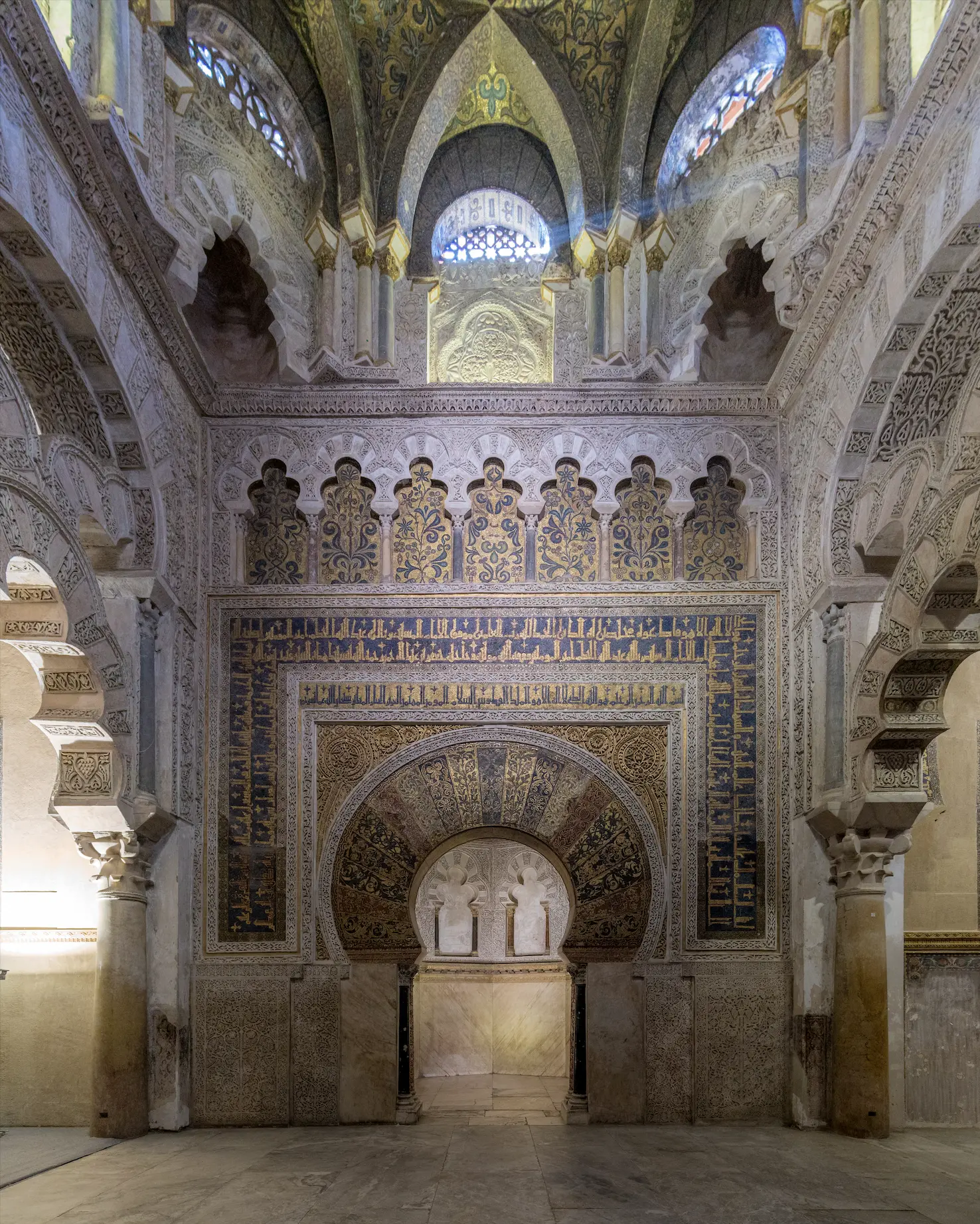
Muhammad ibn Abi Amir, who took the title al-Mansur — "the victorious" — and is known in Spanish and Latin tradition as Almanzor, governed al-Andalus from 981 until his death in 1002. He was never caliph. He held the office of hajib, chamberlain, and exercised in that capacity an authority more complete than any Andalusi ruler before him, while the caliph Hisham II lived out his reign in ceremonial seclusion.
His career is the most striking case of political ascent in Andalusi history. He arrived in Córdoba claiming Arab descent from a family settled at Algeciras since early in the Muslim conquest, of no particular distinction until his own generation, and rose through service in the caliphal administration to eliminate every rival, subordinate the caliph, and build his own palace-city on the outskirts of the capital that Abd al-Rahman III had made great. He then spent two decades demonstrating that mastery in the field, mounting more than fifty campaigns against the Christian kingdoms of the north, and — on the account of the Arabic chronicles — never losing one.
The assessment of that record has always been double-edged, and the article returns to it below. Under al-Mansur, Cordoba reached the furthest extent of its military reach: Barcelona was sacked in 985, and the shrine of Santiago de Compostela destroyed in 997. Within seven years of his death the caliphate had begun to disintegrate, and within thirty it was gone. Whether the second fact follows from the first is the central question about him.
Origins
Muhammad ibn Abi Amir was born around 938, according to the Arabic sources used by Hugh Kennedy's political history of the period, into a family settled at Algeciras that maintained what Kennedy describes as a modest and undistinguished prosperity, ignored by the chroniclers until his own rise. The family claimed Arab origin and asserted that an ancestor had taken part in the original conquest of al-Andalus in 711, alongside Tariq ibn Ziyad — a claim, if accepted, that would have let the family present itself as established in the peninsula for longer than the Umayyads themselves, though such genealogies were commonly asserted by Andalusi families of middling status and are not independently verifiable.
Opportunities for Arabs of his background in the military were limited, and according to the Arabic sources he determined early to make himself the most powerful figure in al-Andalus by another route. He went to Cordoba and acquired a grounding in religious law, the standard training that qualified a man for administrative or judicial employment, and the sources describe him beginning his career drafting petitions for litigants outside the palace — the ordinary entry point for an educated man with no patron.
The Climb
The decisive connection, in circumstances Kennedy notes gave rise to gossip among al-Mansur's later enemies, was with Subh, a concubine of the caliph al-Hakam II al-Mustansir and mother of the heir apparent Hisham. Subh was of Basque origin, and as mother of the heir she commanded the resources of the caliph's household. Ibn Abi Amir became manager of her wealth and that of the young prince, and the patronage that followed led to further promotion: in 973 he was appointed qadi over the Umayyad-held territories of Morocco, in effect a political officer working alongside the military commander Ghalib, and became the principal link between the Berber chiefs of that region and Cordoba.
Al-Hakam II died on the night of 1 October 976. He had made Hisham heir apparent in 970, at the age of eight, but had given the boy none of the political or military grounding a caliph's son traditionally received, and Hisham was only fourteen or fifteen at his father's death, with no political standing of his own. In the vacuum that followed, two senior saqaliba officials of the palace — Fa'iq, in charge of the textile factory and post, and Jaw'dhar, responsible for the jewels and falcons — moved to keep the caliph's death secret while they attempted to set the boy Hisham aside in favour of his adult uncle, al-Mughira ibn al-Nasir. They summoned the hajib al-Mushafi to draw him into the plan; al-Mushafi agreed to their faces but immediately alerted Hisham's supporters, Ibn Abi Amir among them. Acting with speed, Ibn Abi Amir mobilised Berber troops and led the party that confronted al-Mughira. According to Kennedy's account of the episode, al-Mughira readily agreed to acknowledge Hisham and Ibn Abi Amir would have spared him, but al-Mushafi insisted on his immediate execution, and he was strangled in his own house in front of his family. The saqaliba leaders who had planned the coup were themselves purged: Jaw'dhar was murdered and Fa'iq exiled to the Balearic Islands, where he died.
The episode set the terms of everything that followed. A child caliph, kept from independent power, was the foundation of Ibn Abi Amir's career, and he had defended that foundation without hesitation from his very first appearance at the centre of events.
He then removed his allies one by one. Al-Mushafi, the senior figure of the new regime, retained no independent power base of his own — his rise had alienated the established families of the Cordoban bureaucracy, who accordingly gave Ibn Abi Amir a free hand against him. Against al-Mushafi, Ibn Abi Amir had allied himself with Ghalib ibn Abd al-Rahman, an elderly and highly respected general promoted a generation earlier under Abd al-Rahman III, and the alliance was very nearly cemented by a marriage between al-Mushafi's son and Ghalib's daughter Asma — until Ghalib broke off that engagement and promised Asma to Ibn Abi Amir instead. In March 978 al-Mushafi was arrested and imprisoned, and he died in confinement five years later.
Ibn Abi Amir's rise had by this point made him strong enough for a direct trial of strength with Ghalib himself. In the summer of 981 he assembled an army that combined old North African contacts, Christian mercenaries, and troops from the Upper March, and marched north. Against him Ghalib could muster only his own loyal following and a Castilian contingent under Count Garci Fernandez — a coalition that Kennedy notes shows how thoroughly the civil war had blurred any straightforward religious dividing line. The armies met near Atienza in July 981; Ghalib was killed in the fighting and his army broke up. Soon afterward Ibn Abi Amir turned on the allies who had helped him win that victory, and had them killed in turn, leaving him — in the words of the Arabic chronicler Ibn Idhari, as quoted by Kennedy — "unique and unrivalled."
It was after that victory that Muhammad ibn Abi Amir took the title al-Mansur, a title earlier held by one of the great Abbasid caliphs, and from 981 he was the unchallenged ruler of al-Andalus.
Hisham II and the Hollowing of the Caliphate
The arrangement al-Mansur then constructed was more radical than a regency and more conservative than a usurpation, and Kennedy records that al-Mansur is said to have taken as his model the Buyid dynasty of Iran, who had kept the Abbasid caliphs of Baghdad in luxurious confinement as powerless figureheads while ruling in their name.
Hisham II remained caliph in name and in the Friday sermon, and al-Mansur was careful, in the assessment of an eleventh-century Berber prince who wrote about him from personal family experience, to maintain a screen of constitutional legality throughout — proclaiming allegiance to the caliph, appearing to submit to him, and holding the offices of hajib and wazir rather than seizing the throne outright. But Hisham was kept apart from the business of government behind the walls of the old Alcazar, and it was put about that he wished to devote himself entirely to religion. From 979 al-Mansur built himself a new palace-city east of Cordoba, Madinat al-Zahira, and moved the central administration into it — a name deliberately echoing the caliphal Madinat al-Zahra built by Abd al-Rahman III to the west of the old city, which by this time had itself fallen into disuse. The government of al-Andalus physically left the caliph's residence.
Why al-Mansur stopped short of the caliphal title is the most revealing thing about him. As the Berber prince Abd Allah ibn Buluggin later reflected, drawing on family memory of the period, al-Mansur had no right by birth to inherit the kingdom and was excluded by the accident of his origins from ever claiming the caliphate itself; his achievement rested entirely on shrewdness, on courting the common people, and on maintaining the appearance of submission to the very authority he had emptied of power. Preserving the caliph as a legitimising symbol was the cheaper and safer course, and it worked for twenty-one years — though the arrangement was not wholly unchallenged even in al-Mansur's lifetime. In 989 a conspiracy backed by a disaffected Umayyad claimant, the lord of Zaragoza, and al-Mansur's own son Abd Allah, planned to divide al-Andalus between them; it was uncovered while al-Mansur was on campaign, and his own son was surrendered to him by the Count of Castile and executed. In 996 Hisham's mother Subh, by then estranged from the man she had first patronised, attempted to secure her son's restoration to real power, and this too was detected and suppressed.
To secure the acquiescence of the religious establishment al-Mansur was careful and public in his piety. Kennedy records that he carried a Qur'an copied in his own hand on campaign, together with a linen winding-sheet woven by his own daughters from flax grown on his inherited land, in case of his death in battle; that dust collected from enemy territory on each expedition was mixed into the water used to wash his body; and that he undertook the largest single enlargement of the Great Mosque of Córdoba for the benefit of the Berber troops he had brought into the city. He also took vigorous measures against any hint of unorthodoxy, purging al-Hakam II's library of works that might trouble conservative opinion and publicly crucifying a scholar accused of Mu'tazilite views.
The Reform of the Army
The military reorganisation al-Mansur carried out was the foundation of his power, and it continued a process under way since the reign of Abd al-Rahman III: the dismantling of the old Syrian tribal jund system and its replacement by a professional force recruited from saqaliba and, on an unprecedented scale under al-Mansur, from Berber tribal contingents brought over from North Africa.
Al-Mansur recruited Berber chieftains and their followings directly, by tribal group rather than as individuals, so that the new troops retained their tribal cohesion, spoke little Arabic, and remained largely unassimilated to Andalusi urban life. The largest single group came from Zirid Tunisia: after a succession dispute among the Zirid rulers of Ifriqiya in 996, two of the defeated claimants, Zawi and Maksan, brought their Sanhaja followers into al-Mansur's service, unable to return home and so obliged to make al-Andalus their permanent base.
The fiscal mechanism behind this reorganisation is described from two opposing sides in the sources Kennedy examines. A jurist writing a century later, reflecting the grievances of the old landed jund families, describes a shift from a system in which soldiers held land directly and cultivated it in partnership with the peasantry, to one in which al-Mansur required a cash tribute collected from the land to pay fixed monthly stipends to a standing professional army — a change this source blames for ruining cultivators, depopulating the countryside, and ultimately weakening the very army it funded. Abd Allah ibn Buluggin, writing from the Berber side that benefited from the new arrangement, describes the same change as a considered and legitimate response to a population unsuited to military service, who willingly accepted a fixed collective tax in exchange for being spared campaign duty. Both accounts agree that Andalusi jund families, whose ancestors had held land since the eighth-century Syrian settlements, were reduced to ordinary taxpayers while the military profession passed into the hands of outsiders.
The immediate results were what al-Mansur intended: a professional force capable of campaigning every year at long range, loyal to al-Mansur personally rather than to any tribe or region, so that no faction in Cordoba could challenge him because none commanded troops of its own. The longer consequence, as later Andalusi commentators recognised once the caliphate had collapsed, was a state whose only military force was an alien and largely unassimilated body of outsiders, and whose native population had been systematically demilitarised.
The Campaigns
The Arabic sources credit al-Mansur with more than fifty expeditions against the Christian kingdoms of the north in the course of his twenty-one years in power, ranging from small raids to major campaigns, and Kennedy notes that despite having no apparent prior military background, al-Mansur proved a consistently successful commander and organiser. No previous Andalusi ruler had pursued the annual jihad against the Christians as a sustained instrument of policy to the same degree; leadership of the Holy War had legitimised earlier rulers, but none had built a whole political system on it as al-Mansur did.
Three campaigns became especially notable. Barcelona was sacked in 985. Santiago de Compostela, the most important Christian pilgrimage site on the peninsula, was destroyed in 997; the bells of its cathedral were carried back to Cordoba by prisoners of war, a detail al-Mansur ensured was well publicised in the capital as propaganda for his rule. A near-disaster came at the very end of his life: in the summer of 1000 Count Sancho Garcia of Castile inflicted heavy losses on al-Mansur's forces and came close to a major victory, a reminder that Christian resistance, though repeatedly defeated, was never broken.
Despite the scale and frequency of these campaigns, Kennedy's assessment is that in strictly military terms they achieved comparatively little beyond the sack of individual cities: an attempt to hold a permanent garrison at Zamora in 999 was abortive, and no sustained effort was made to advance the actual frontier of Muslim settlement. Their real function was political — to justify, in the eyes of Muslim opinion, both al-Mansur's seizure of power and the new taxation that paid for the army which secured it — which is why the public reporting of each campaign, real, exaggerated, or invented, mattered as much to him as its outcome.
The warfare coexisted, without apparent contradiction in the sources, with dynastic ties across the same frontier. Al-Mansur married Abda, daughter of King Sancho Abarca of Navarre, who bore him a son known as Sanchuelo ("little Sancho," after his grandfather); in 993 he is said to have taken a daughter of King Vermudo II of Leon as a concubine and subsequently married her.
Death, Succession, and the Collapse of the Caliphate
Al-Mansur died in 1002 (392 AH), having ruled al-Andalus in fact, though never in name, for two decades.
His son Abd al-Malik succeeded him with the title al-Muzaffar and held the position until his own death in 1008. For later Arab writers, composing after the disasters that followed, al-Muzaffar's six years took on the appearance of a final calm before catastrophe. Kennedy's reading of the same sources is more qualified: al-Muzaffar was a competent soldier with little interest in day-to-day administration, given to heavy drinking, and his negligence allowed two separate officials — Tarafa in 1003, and the chief minister Isa ibn Sa'id in 1006 — to attempt to seize control of the government for themselves; both plots were detected and their leaders executed, the second having aimed at restoring a genuine Umayyad claimant to real power under the minister's own tutelage. Al-Muzaffar continued the annual campaigns against the Christians with only modest results in fact, though his letters reporting them, read from the pulpit at Friday prayers in Cordoba, sustained the public impression of unbroken success.
It broke at the next step. Al-Muzaffar's half-brother Abd al-Rahman — the son of the Navarrese princess, known as Sanchuelo — took the office in 1008 and abandoned the caution both his father and his half-brother had maintained. In November 1008 he had the caliph Hisham formally name him heir to the caliphate itself, in a public letter that strained to justify the choice by appeal to an alleged saying of the Prophet, since Sunni opinion required a caliph to belong to the Prophet's own tribe of Quraysh and the Amirid family did not. He also began openly favouring his Berber supporters over the other elements of the army al-Mansur had taken such care to balance, going so far as to have his court appear in Berber dress at a public ceremony in February 1009.
The demand for the caliphate destroyed the fiction on which the whole Amirid system rested: if the office could pass to a family with no claim to Umayyad or even Quraysh descent, there was no principled reason for anyone to accept the arrangement at all. Sanchuelo's opponents, led by a fugitive member of the Umayyad house, Muhammad ibn Hisham ibn Abd al-Jabbar, struck while Sanchuelo was away on a mid-winter campaign against the Christians in February 1009: they seized the Alcazar, forced Hisham II to abdicate, sacked and pillaged Madinat al-Zahira, and proclaimed Muhammad caliph under the title al-Mahdi. Sanchuelo, returning against advice, was arrested and executed at a monastery outside the city — the last of the Amirids, with no attempt ever made to revive the family's fortunes afterward.
There followed more than two decades of civil war, the fitna, in which the very Berber and saqaliba factions al-Mansur had built now fought each other and a succession of rival claimants for control of a disintegrating state. Al-Mahdi's attempt to build a popular Andalusi militia against the Berbers ended in his own execution within the year; the Berbers besieged and sacked Cordoba itself between 1010 and 1013, a catastrophe in which numerous scholars died, including the historian Ibn al-Faradi; Hisham II disappeared during this period and was probably murdered, though impostors claiming to be him appeared for years afterward; and a family of Berber claimants descended, through the Idrisids, from the Prophet's own family — the Hammudids — made the most sustained attempt to restore central authority in the 1010s and 1020s, without lasting success. In 1031 the leading notables of Cordoba judged the caliphate no longer worth the trouble of maintaining it, and abolished the office outright. Al-Andalus dissolved into the taifas, the petty successor kingdoms that were individually too weak to resist the Christian kingdoms of the north, a process that culminated centuries later at Granada.
Historiographical Note
Kennedy's account draws its narrative chiefly from the eleventh-century chronicler Ibn Idhari, supplemented by other early Arabic historians, and by a uniquely valuable outside perspective: the memoir of Abd Allah ibn Buluggin, the last Zirid ruler of Granada, whose own family had been among the Berber chiefs al-Mansur brought into al-Andalus, and who set down what he understood of al-Mansur's methods a century later from within that same Berber political tradition. Kennedy is explicit that the surviving Arabic sources for this period carry a divided verdict on al-Mansur: admiration for his military success and personal piety sits alongside an awareness, sharpened by hindsight, that his concentration of power and his reliance on Berber troops undermined the Umayyad legitimacy that had held al-Andalus together, and that the saqaliba and Berber leaders he promoted are recorded by name and deed to a degree that eclipses almost everyone else active in the state during his ascendancy — itself, as Kennedy observes, a symptom of how completely al-Mansur had come to monopolise both power and its record.
The devotional Urdu history History of Islam, also consulted for this article, presents the same events in a more summary and more explicitly moralising register, closing its account of the Umayyad collapse in Spain with the judgement that hereditary rule was itself a departure from Islamic norms and the cause of the dynasty's fall. That interpretive conclusion is not repeated here; the source's chronological and factual detail on the succession from al-Mansur through al-Muzaffar and Sanchuelo to the fitna and the abolition of the caliphate in 1031 corroborates Kennedy's account and has been used for that narrative content alone.
Assessment
Al-Mansur was the most effective ruler al-Andalus produced and one of the principal causes of its political collapse, and both statements are defensible on the same evidence.
The case for his competence is strong and not seriously disputed by the sources. He mastered a complex state's fiscal and administrative machinery from a position of no inherited standing, eliminated every rival with speed and precision, and built a professional army capable of campaigning at long range for two decades without a serious reverse. He extracted submission and destruction from the Christian powers of the north while building a Great Mosque enlargement that still stands, and he financed all of it through a reorganisation of taxation and military service that, on the evidence available, worked exactly as he intended for as long as he was alive to run it.
The case concerning what followed his death rests on the structure he built rather than on any single decision. By reducing Hisham II to a secluded symbol while governing in his name for two decades, al-Mansur demonstrated that the Umayyad caliphate could be separated from actual authority — a demonstration that made the office available as a prize to be seized by whoever next controlled the palace, which is exactly what happened from 1009. By recruiting Berber tribal contingents on an unprecedented scale, and by demilitarising the settled Andalusi population in the process, he built the very force that turned on the state once the personal authority holding the arrangement together was gone. Neither of these was necessarily foreseeable in its consequences at the time he made it, and his own son Abd al-Malik held the same system together for six further years — the strongest evidence that al-Mansur had built something more than a merely personal ascendancy. It was Sanchuelo's specific demand to be named heir to the caliphate itself, breaking the one restraint both his predecessors had observed, that brought the structure down in a matter of months.
References and Further Reading
Primary Islamic Sources
- Ibn Idhari al-Marrakushi. Al-Bayan al-Mughrib fi Akhbar al-Andalus wal-Maghrib, as quoted and summarised in Kennedy, Hugh, Muslim Spain and Portugal. — the principal Arabic chronicle source for al-Mansur's rise and the fitna that followed his death
- Ibn al-Khatib. A'mal al-A'lam, as cited in Kennedy, Muslim Spain and Portugal.
- Abd Allah ibn Buluggin al-Ziri al-Sanhaji. Al-Tibyan, translated by A.T. Tibi (Leiden: Brill, 1986), as quoted at length in Kennedy, Muslim Spain and Portugal — the memoir of the last Zirid ruler of Granada, an unusually direct Berber-perspective source on al-Mansur's methods and the reforms of the army
Classical Islamic Sources
- Al-Turtushi, Abu Bakr, as quoted in Kennedy, Muslim Spain and Portugal — a twelfth-century jurist's account of the fiscal changes al-Mansur introduced, reflecting the grievance of the displaced jund families
- Najeebabadi, Akbar Shah Khan. History of Islam, Volume Three. [approved PDF library:
sources/study/] — an independent narrative confirmation of the succession from al-Mansur through the fitna to the abolition of the caliphate in 1031
Academic and Scholarly Sources
- Kennedy, Hugh. Muslim Spain and Portugal: A Political History of al-Andalus. London: Longman, 1996. [approved PDF library:
sources/study/] — the principal source for this article's account of al-Mansur's rise, reign, and the collapse that followed
Further Reading
- Fletcher, Richard. Moorish Spain. Berkeley: University of California Press, 1992.
- Wasserstein, David J. The Rise and Fall of the Party-Kings. Princeton: Princeton University Press, 1985. — on the taifa states that emerged from the caliphate's collapse
Mentioned In
4 articles reference this topic