Aurangzeb Alamgir: The Last Great Mughal Emperor
Aurangzeb Alamgir (1618-1707 CE) was the sixth Mughal emperor, ruling nearly fifty years over the empire at its greatest extent. He commissioned the Fatawa-i Alamgiri, annexed Bijapur and Golconda, and spent his last decades campaigning in the Deccan.
Introduction
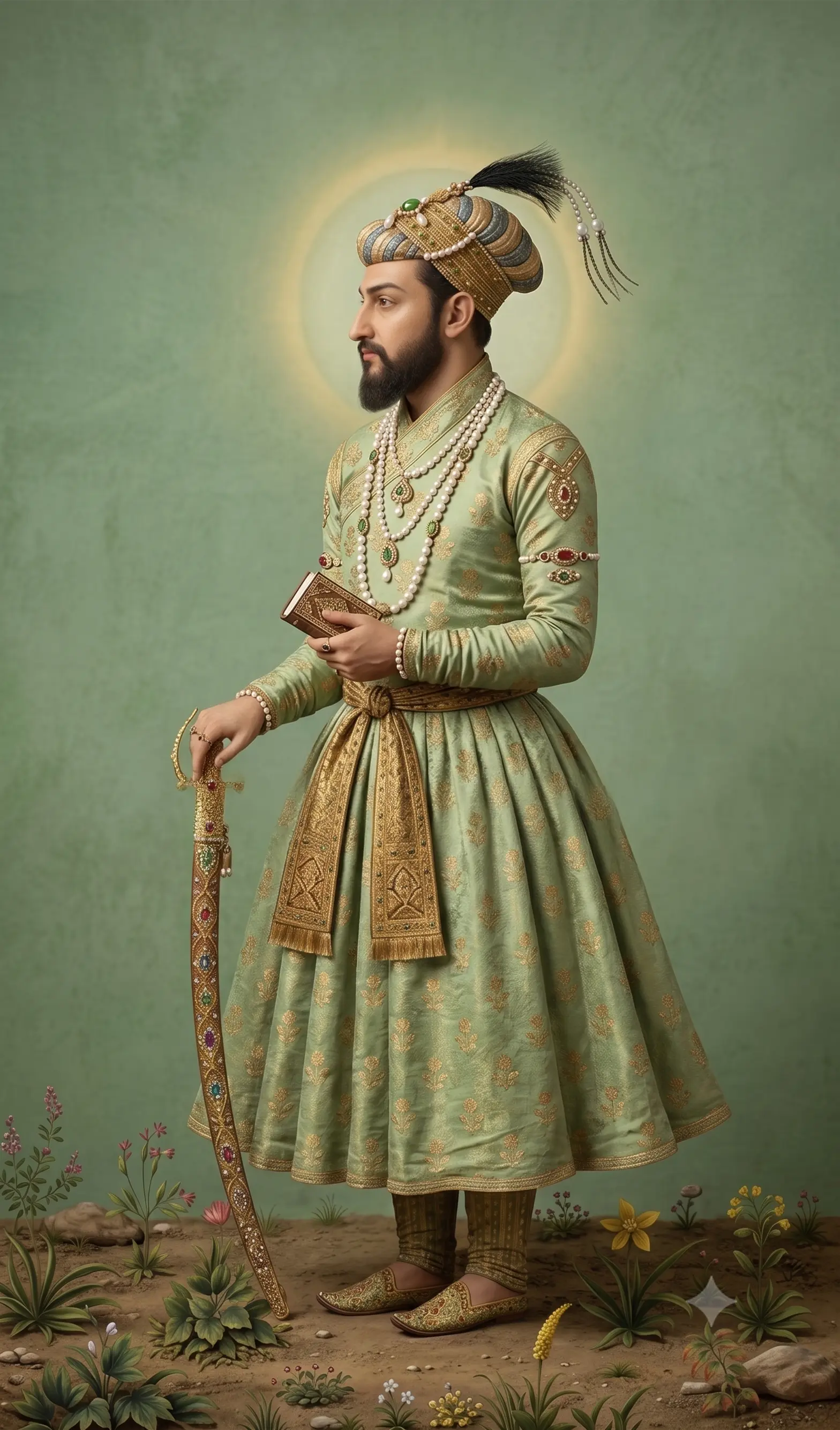
Muhi al-Din Muhammad Aurangzeb (3 November 1618 – 3 March 1707 CE), who took the regnal title Alamgir on his accession to the Mughal throne in 1658, was the sixth emperor of the Mughal dynasty and, in Barbara Metcalf's phrase, the last "Great Mogul." His reign of nearly forty-nine years was the longest of any Mughal sovereign, and under him, as the Encyclopaedia Britannica puts it, the empire reached its greatest extent — from Kabul in the north-west to the edge of the Tamil country in the south, and eastward into what is now Bangladesh.
The reign has been read in sharply opposed ways, and the opposition is itself part of the subject. Assessments written in the colonial period, in the nationalist historiography that followed, and in the state historiographies of India and Pakistan have each drawn on the same body of evidence to reach conclusions that cannot be reconciled with one another. This article does not adopt any of those registers. It sets out what the sources available to it establish, attributes contested material to the authority that carries it, and says where the evidence does not settle the question. The Historiographical Note at the end of the article states which sources were used, which were not, and what follows from that.
Modern academic work, particularly since the late twentieth century, has moved towards assessments that situate Aurangzeb within the political culture of his own time. Of that literature, three works were available for this article with the owner's express authorisation — John F. Richards's The Mughal Empire, Audrey Truschke's Aurangzeb, and Jadunath Sarkar's five-volume History of Aurangzib — and the authorisation is recorded in the references. Alongside them, two studies in the project's own source library carry substantial material on the reign's most durable institutional legacy, the legal compendium known as the Fatawa-i Alamgiri: Muhammad Qasim Zaman's The Ulama in Contemporary Islam and Barbara Metcalf's Islamic Revival in British India.
Early Life and Education
Birth and Family Context
Abul Muzaffar Muhi al-Din Muhammad Aurangzeb was born on 3 November 1618 CE (14 Dhul Qa'dah 1027 AH) at Dahod in Gujarat, the third surviving son of Prince Khurram (the future Emperor Shah Jahan) and his principal wife Mumtaz Mahal (Arjumand Banu Begum) — the woman for whom the Taj Mahal was afterwards built. The Encyclopaedia Britannica gives the birthplace differently, as Dhod in Malwa, and the discrepancy has not been resolved here. His birth occurred during a period of political turmoil — his father was then in revolt against Emperor Jahangir, and the family lived in conditions of uncertainty and occasional hardship during the prince's years of rebellion between 1622 and 1627.
The young Aurangzeb grew up in a court environment shaped by the architectural grandeur and cultural refinement of Shah Jahan's reign — a period often described as the golden age of Mughal aesthetics. His elder brothers were Dara Shikoh (born 1615) and Shah Shuja (born 1616); his younger brother Murad Bakhsh was born in 1624. Among his sisters, Jahanara Begum and Roshanara Begum would later play significant political roles. The early death of Mumtaz Mahal in 1631, when Aurangzeb was twelve, profoundly affected the family dynamics; Shah Jahan's grief was legendary, and the children were thereafter raised under the supervision of various court women and tutors.
Education and Intellectual Formation
Aurangzeb received the comprehensive education expected of a Mughal prince, combining Islamic religious sciences with the administrative and military training necessary for governance. His tutors included distinguished scholars of the period. His early education was supervised by Mir Muhammad Hashim, and later he studied under various ulama attached to the Mughal court.
His curriculum encompassed the Quran, which the sources agree he committed to memory in full — a distinction rare among Mughal emperors — together with hadith, fiqh (Islamic jurisprudence, particularly of the Hanafi school), Arabic and Persian literature, calligraphy, history, mathematics, and the arts of war. Unlike his elder brother Dara Shikoh, who gravitated toward Sufi metaphysics and comparative theology, Aurangzeb from an early age displayed an inclination toward orthodox Islamic scholarship and the practical sciences of governance.
The contrast between the two brothers has often been overstated in historical narratives — reduced to a simplistic dichotomy of "liberal Dara" versus "orthodox Aurangzeb." More recent scholarship, particularly Munis Faruqui's work The Princes of the Mughal Empire, 1504–1719 (2012), emphasizes that princely identities were partly strategic constructions designed to attract different constituencies in the competitive Mughal succession system, where there was no fixed law of primogeniture and all princes were potential heirs.
Early Military Experience
Aurangzeb's martial education began early. Mughal princes were expected to demonstrate military capability, and the young prince showed both physical courage and tactical aptitude. A well-known incident from his youth — his confrontation with a war elephant during a court spectacle in 1633, when he was approximately fourteen years old — is recorded in the court chronicles, which have his composure impressing Shah Jahan and the assembled nobles. In that account the young prince stood his ground as the elephant charged, striking at it with a lance. While the historicity and precise details vary across sources, the incident — whether fully accurate or partly legendary — became part of the foundation narrative of Aurangzeb's martial identity.
His early military training included horsemanship, archery, swordsmanship, and the study of siege craft and battlefield tactics. He participated in his first military actions while still a teenager, accompanying more experienced commanders during Shah Jahan's Deccan campaigns. These formative experiences gave him a practical understanding of Indian warfare — the combination of heavy cavalry, elephant corps, artillery, and fortress operations that characterized Mughal military practice — that would serve him throughout his career.
Relationship with Shah Jahan
Aurangzeb's relationship with his father was complex and often strained. Shah Jahan's affection clearly favored Dara Shikoh, the eldest surviving prince, whom he kept close to the throne and groomed openly as heir. Aurangzeb, by contrast, was consistently assigned to distant and difficult postings — a pattern that served both to test his abilities and to keep him away from the center of power.
The correspondence between father and son reveals a relationship marked by formal respect but underlying tension. Aurangzeb felt undervalued and insufficiently supported in his military assignments; Shah Jahan, for his part, seemed wary of the third son's growing competence and ambition. The dynamics of this relationship — the perceived favoritism toward Dara, the resentments accumulated during years of distant service — were crucial factors in Aurangzeb's decision to challenge for the throne in 1657.
Princely Career
First Governorship of the Deccan (1636–1644)
At the age of eighteen, Aurangzeb received his first major administrative appointment as governor (subahdar) of the Deccan provinces, with his seat at Aurangabad (then called Khirki, later renamed in his honor). This was a challenging assignment — the Deccan was a frontier zone where Mughal authority was contested by the remnants of the Sultanates of Bijapur and Golconda, by local Maratha chieftains, and by the difficult terrain itself.
During this first Deccan tenure, Aurangzeb gained practical experience in revenue administration, military command, and the management of relationships with subordinate rulers. He led campaigns against local fortresses and conducted negotiations with the Sultanate of Bijapur. However, his aggressive approach sometimes conflicted with Shah Jahan's more cautious Deccan policy, and tensions arose over resource allocation and strategic direction.
Central Asian Campaigns (1647)
In 1647, Aurangzeb was reassigned to the northwestern frontier and tasked with the recovery of Balkh and Badakhshan — the ancestral Timurid territories in Central Asia that the Mughals periodically attempted to reclaim. The campaign proved costly and ultimately unsuccessful. The harsh climate, extended supply lines, and the effective resistance of Uzbek forces under the Turani chiefs made sustained occupation untenable.
The Balkh campaign was significant not for its military outcomes but for the political lessons it taught Aurangzeb about imperial overextension and the limits of Mughal power in Central Asia — lessons he would later apply in his own reign's strategic calculations. The campaign also deepened his resentment toward Shah Jahan and the court faction around Dara Shikoh, whom he believed had deliberately assigned him to an impossible task while keeping the favored elder prince close to the throne.
Governorship of Gujarat and Return to the Deccan
Following the Central Asian debacle, Aurangzeb served briefly as governor of Gujarat (1645) and then of Multan and Sindh (1648–1652), before returning to the Deccan for a second governorship (1652–1658). This second Deccan tenure was more consequential. He besieged Bijapur in 1657 and pressed for its outright annexation — a policy Shah Jahan initially approved but then countermanded, to Aurangzeb's deep frustration.
During these years, Aurangzeb also encountered and briefly engaged with the rising Maratha power under Shivaji Bhonsle. The complex Mughal-Maratha relationship that would dominate the latter half of his reign had its first intimations during this period.
Administrative Philosophy
Throughout his princely career, Aurangzeb developed a governing style distinct from that of his father and brothers. Where Shah Jahan's court emphasized ceremonial grandeur, architectural patronage, and aesthetic cultivation, Aurangzeb increasingly cultivated an image of fiscal discipline, religious observance, and military efficiency. He maintained detailed personal accounts, corresponded extensively with subordinates, and developed a network of intelligence and patronage that would serve him during the succession struggle.
War of Succession (1657–1659)
Shah Jahan's Illness and the Succession Crisis
In September 1657, Shah Jahan fell seriously ill at Agra — so ill that rumors of his death spread across the empire. The Mughal system of succession, which lacked primogeniture and effectively required princes to compete for the throne through political alliance-building and military force, immediately activated. All four princes — Dara Shikoh (the designated heir, who held court at Delhi and Agra), Shah Shuja (governor of Bengal), Aurangzeb (governor of the Deccan), and Murad Bakhsh (governor of Gujarat) — began preparations for the inevitable conflict.
Shah Jahan recovered from his illness, but by then events had acquired their own momentum — by the time of the recovery, as Britannica puts it, matters had gone too far for either of the two leading princes to retreat. Dara Shikoh, as the prince nearest the imperial center and the one most favored by Shah Jahan, initially held the strongest position. He controlled the treasury, the major arsenals, and the apparatus of central government. However, his political skills were questionable — he had alienated many senior nobles through arrogance and had accumulated enemies among both the military aristocracy and the ulama.
The Alliance Against Dara Shikoh
Aurangzeb demonstrated superior political acumen by forming an alliance with Murad Bakhsh, promising him sovereignty over Punjab, Sindh, Afghanistan, and Kashmir in exchange for military cooperation. This alliance gave Aurangzeb's campaign crucial additional forces and political legitimacy — it was no longer one prince against another but a coalition against Dara's perceived monopoly of power.
The historiographical tradition, particularly in later Mughal chronicles, often frames this conflict in religious terms — Dara as the champion of syncretism and tolerance versus Aurangzeb as the representative of orthodoxy. Modern scholars have complicated this picture considerably. Truschke's study, which was available for this article under the owner's authorisation, reads the succession war as primarily a political struggle for power, with religious identity serving as one instrument among several for mobilising support. Dara's religious heterodoxy (his Majma al-Bahrain and translation of the Upanishads) did alienate some orthodox opinion, but his political failures — his inability to manage nobles, his military inexperience, and his poor judgment of character — were equally decisive.
The Military Campaign
The decisive engagements came in rapid succession. Shah Shuja was defeated in Bengal and eventually fled to Arakan, where he disappeared from history. Aurangzeb and Murad's combined forces defeated Dara Shikoh's army at the Battle of Dharmat (15 April 1658) and then again at the critical Battle of Samugarh (29 May 1658) near Agra. Dara fled westward and then northward, gathering forces for a counter-attack that never materialized effectively.
Aurangzeb entered Agra in June 1658, confined the ailing Shah Jahan to the fort (where he would remain until his death in 1666), and proclaimed himself emperor with the title Alamgir on 31 July 1658. Murad Bakhsh, having served his purpose, was arrested on charges of murder (of a diwan in Gujarat) and eventually executed in 1661. Dara Shikoh was captured in 1659, tried on charges of heresy and apostasy by a council of nobles — not, as is sometimes assumed, by the ulama — and executed. Britannica summarises the outcome of the whole contest plainly: in consolidating his power Aurangzeb caused one brother's death and had two other brothers, a son, and a nephew executed. The Mughal succession was a contest without rules of primogeniture, and it was normal for it to end in the elimination of the losing claimants; that context explains the pattern without softening the fact, and the executions of 1659 to 1661 have been debated ever since.
Assessment of the Succession War
The fratricidal nature of the succession war was not unusual by Mughal standards — Akbar, Jahangir, and Shah Jahan had all come to power through similar conflicts. However, the execution of Dara Shikoh, a popular prince, created lasting resentment in certain quarters. Aurangzeb's defenders argue that Dara's theological heterodoxy made him a genuine threat to Islamic governance; his critics argue that the heresy charges were a transparent political cover for fratricide. The truth likely encompasses elements of both — sincere religious conviction instrumentalized for political purposes, a pattern common across pre-modern polities.
Early Reign and Consolidation (1658–1680)
Establishing Authority
The first two decades of Aurangzeb's rule were devoted to consolidating the empire's administrative structure, securing its frontiers, and implementing his vision of governance. Having come to power through force rather than smooth succession, Aurangzeb needed to demonstrate both competence and legitimacy. He did so through a combination of military success, administrative reform, and the cultivation of an image as a just and pious ruler.
Aurangzeb's court deliberately departed from the ceremonial extravagance of his predecessors. He discontinued the practice of jharokha darshan (public viewing of the emperor from a palace balcony), discouraged court music, and reduced expenditure on luxury goods and architectural projects. These decisions reflected both personal temperament and political calculation — they distinguished his regime from Shah Jahan's and aligned him with a constituency of religious scholars, soldiers, and administrators who valued frugality over display.
The Fatawa-i Alamgiri
The most durable undertaking of Aurangzeb's early reign was the compilation of the al-Fatawa al-Hindiyya, better known in South Asia as the Fatawa-i Alamgiriyya — a compendium of Hanafi jurisprudence in six volumes, assembled by a committee of scholars under the emperor's direction over roughly the years 1664 to 1672.
Muhammad Qasim Zaman, who examines the work in The Ulama in Contemporary Islam, notes that the compilation "scarcely needed any justification except that" Aurangzeb had willed it — and that the justification actually offered in the preface was nevertheless a technical one. What the compilers stated as their purpose was the need to make judicial practice less varied and more firmly grounded in the opinions of the best and most widely accepted authorities of the Hanafi school. They claimed to have confined themselves for the most part to the zahir al-riwaya, the school's core transmitted doctrine, turning to the nawadir and the dirayat only where the core texts gave no answer.
Zaman's finding is that the work did not do what its preface announced, and the discrepancy is more interesting than either the claim or the commission. Differing opinions are recorded routinely throughout the compilation, which left judges and muftis considerable choice in the cases brought before them; and the work relies far more on the writings of the muta'akhkhirun, the latter-day scholars, than on the founders of the school. Its own instruction to judges makes the latitude explicit. In the section of the "Book of the Judge's Etiquette" headed "The Sequence of Proofs according to Which the Judge Is to Act," the Fatawa directs that where clear guidance from Abu Hanifa and his two principal disciples, Abu Yusuf and Muhammad al-Shaybani, is unavailable, and where the latter-day scholars disagree, the judge is to choose among their conflicting views himself; and where even the latter-day scholars are silent, he is to exercise ijtihad, provided that he understands the precepts of the law and has consulted other jurists. A compendium commissioned to reduce the fluidity of legal opinion thus documents, and authorises, a working flexibility in the practice of the sharia in pre-colonial India.
Something can also be said about who compiled it. Barbara Metcalf's study of the Deoband movement records two of the participating families. Qutb al-Din of the Farangi Mahall lineage of Lucknow was at the Delhi court and took part in the collection together with his sons. Shaikh 'Abd al-Rahim (1644–1718), the father of Shah Wali Allah, was called on to assist in the compilation, disliked life at court, and withdrew to found his own college, the Madrasah-i Rahimiyyah — the school Shah Wali Allah afterwards directed, and from which much of the subsequent history of Indian Islamic scholarship descends. The imperial legal project and the independent madrasa tradition that would eventually define religious authority in India without reference to any court thus begin at the same table.
The compilation has been read as an assertion of state authority as much as of legal order, and Zaman cites Radhika Singha's suggestion that the emperor may have been using it in that way — an effort, she argues, that was taken up again in the Anglo-Muhammadan law developed in the East India Company's criminal courts. That afterlife is well documented. The Fatawa-i Alamgiriyya became one of the small number of works that British legal scholars and judicial officials in India treated as authoritative, alongside the twelfth-century Hidaya, which Sir William Jones had translated, and the Durr al-Mukhtar of 'Ala al-Din al-Haskafi (d. 1677). Metcalf records the further stage: when Deoband's Dar al-Ifta began keeping a register of all its fatwas from 1911 and publishing volumes of decisions, the model it consciously aspired to was a collection as definitive as the emperor's. By the end of its first century the school counted 269,215 fatwas issued.
The compilation has accordingly been claimed for opposed accounts of the reign — as evidence of an Islamising programme, or as an administrative measure to standardise legal practice across a very large state, comparable to codification projects elsewhere in the early modern world. What the approved sources establish is narrower and firmer than either reading: the emperor willed it; its stated aim was uniformity; its actual contents preserved diversity; and its influence outlasted the empire by two centuries, in courts run by people who had no interest in the reign at all.
The Emperor and the Ulama
The relationship between the throne and the religious scholars is one of the places where the standard contrast between Aurangzeb and his great-grandfather Akbar breaks down. Metcalf sets the two side by side precisely because they are usually treated as opposites, and observes that both sought to enhance the royal position at the expense of the ulama, and that leading ulama resigned from the court of each. Akbar did it by claiming a religious role for himself. Aurangzeb, she writes, "known for his dedication to the religious Law, seems to have emphasized the perfect ordering of his own moral life as example and as cause of order in the political life of the kingdom," and had little interest in sharing authority with the scholars.
That reading fits the evidence of the Fatawa project better than a picture of an emperor governed by his ulama. The compilation was commissioned by the emperor, executed by scholars he selected, and issued in his name; one of the scholars invited to work on it left rather than remain at court. Aurangzeb's piety, in this account, functioned as a claim to authority rather than as a submission to those who held religious authority — which is a different proposition from either the devotional or the hostile version of his reign, and one grounded in a study within the approved source base.
Administrative Reforms
Aurangzeb inherited a mature administrative system — the mansabdari system of ranked officeholders, the revenue assessment mechanisms refined under Akbar and Shah Jahan, and the provincial governance structure. His reforms were generally conservative in character, aimed at efficiency and fiscal discipline rather than structural transformation.
Key administrative measures included stricter enforcement of revenue collection, reduction of unnecessary court expenditure, periodic audits of provincial accounts, and efforts to curb corruption among local officials. He maintained and expanded the intelligence network (waqi'a-nawis system) that provided him with information about conditions across the empire. His personal attention to administrative detail was remarkable — his surviving letters (ruq'at) reveal a ruler who concerned himself with minute aspects of governance, from the pricing of grain to the conduct of individual officials.
The mansabdari system, however, came under increasing strain during his reign. The steady expansion of the empire, particularly the Deccan conquests after 1680, required the creation of new mansabs to reward military commanders and incorporate defeated local rulers. This inflationary pressure on the system — more mansabdars competing for a finite (or only slowly growing) pool of revenue assignments (jagirs) — contributed to what historians have termed the "jagirdari crisis," a structural problem that weakened the empire in its final decades.
Relations with Regional Powers
During the early reign, Aurangzeb managed relationships with the major regional powers of the subcontinent with varying degrees of success. The Rajput kingdoms, which had been crucial allies of the Mughal state since Akbar's reign, initially maintained their cooperative relationship. Maharaja Jaswant Singh of Jodhpur (Marwar) served as a senior Mughal commander, and many Rajput chiefs continued to hold mansabs and governorships.
The relationship with the Marathas proved more intractable. Shivaji Bhonsle's growing power in the western Deccan was a military problem and a problem of prestige at once: he plundered the great port of Surat twice, in 1664 and again in 1670. Aurangzeb's response in these years followed the method Britannica attributes to Akbar and describes Aurangzeb as applying — defeat an adversary, reconcile him, and place him in imperial service. Shivaji was defeated, called to Agra for reconciliation in 1666, and given an imperial rank; his escape from the court that year became a celebrated episode. The arrangement then broke down: Shivaji returned to the Deccan and died in 1680 as the ruler of an independent Maratha kingdom. Aurangzeb tried military campaigns, diplomatic overtures, and the co-option of individual Maratha chiefs through this period, without lasting result.
Deccan Campaigns (1680–1707)
Strategic Decision to Move South
In 1681, Aurangzeb made the fateful decision to personally lead campaigns in the Deccan — a decision from which he would never return north. He established his mobile court at Aurangabad and then moved it progressively deeper into the peninsula. He was seventy-three years old when he died still in the Deccan, having spent the last twenty-six years of his reign in a grinding, exhausting series of campaigns that ultimately failed to achieve their objectives of permanent pacification.
The immediate triggers for the Deccan campaign included the rebellion of his son Prince Akbar (who briefly allied with the Marathas before fleeing to Persia), the continued resistance of the Sultanates of Bijapur and Golconda, and the ongoing Maratha challenge. But the deeper motivation was Aurangzeb's ambition to complete the territorial unification of the subcontinent under Mughal rule — a goal that had eluded his predecessors.
Conquest of Bijapur and Golconda
The Sultanates of Bijapur (Adil Shahi dynasty) and Golconda (Qutb Shahi dynasty) had maintained a precarious independence as tributary states for decades. Aurangzeb resolved to end the ambiguity, and came south to do it in person: he reached Bijapur himself in 1685, where the forces opposing him included the sons of Randaulah Khan, the late Bijapur governor of the Carnatic. Bijapur was besieged and fell in September 1686 after a prolonged siege; Sultan Sikandar Adil Shah surrendered and was imprisoned. Golconda followed in October 1687, after the fortress of its capital, at modern Hyderabad, was taken by assault; the chronicles also report that the defence was compromised from within. Sultan Abul Hasan Qutb Shah was captured and spent his remaining years in captivity at Daulatabad.
The annexation of these two sultanates — both significant Muslim polities with rich cultural traditions — represented a major territorial gain. It also generated controversy, as many within the Mughal establishment questioned the wisdom and legitimacy of conquering fellow Muslim states. The destruction of these courts dispersed their administrative and military personnel into Maratha service or independent freebootery, inadvertently strengthening the very forces Aurangzeb sought to suppress.
The Maratha Wars
The Maratha conflict dominated the final quarter-century of Aurangzeb's reign and ultimately proved insoluble through military means alone. After Shivaji's death in 1680, the Maratha state initially weakened due to succession disputes between his sons Sambhaji and Rajaram. Aurangzeb captured Sambhaji in 1689 and executed him — a decision that, while eliminating an active enemy, transformed Sambhaji into a martyr and intensified Maratha resistance.
The nature of Maratha warfare — decentralized, based on light cavalry and guerrilla tactics, exploiting the difficult terrain of the Western Ghats and the Deccan plateau — made it peculiarly difficult for the Mughal army to counter. The Mughals could take forts (and did so, systematically, numbering over a hundred), but could not hold them securely against determined local resistance. The Maratha commanders — Rajaram (who maintained resistance from Jinji in the far south until his death in 1700), his wife Tarabai, and numerous sardars operating independently — kept the empire's forces perpetually stretched.
The financial cost was immense. The Deccan campaigns consumed revenue that might have maintained the empire's northern provinces in better order. The constant need for reinforcements drew troops away from other frontiers. The imperial camp itself — a mobile city of hundreds of thousands of people — was logistically staggering to maintain. Scholars like Richards and Sarkar have identified the Deccan campaigns as a primary cause of the empire's subsequent disintegration, though debate continues about whether alternative strategies might have succeeded.
The Mughal South: The Subah of Sira and the Mysore Alliance
The southward advance of 1685–1687 did not consist only of sieges, and the arrangements Aurangzeb made behind the front line are documented in local records and inscriptions that the narrative histories of the reign tend to pass over. They are worth setting out, because they show the Deccan campaign as an administrative operation as much as a military one, and because they record a working alliance with a Hindu kingdom running through the very years usually taken to define the reign's religious character.
After Bijapur, Aurangzeb marched down and took Sira, in what is now southern Karnataka, in 1687. A new province, the Subah of Sira, was constituted in that year with the town as its capital, made up of seven parganas — Basvapatna, Budihal, Sira, Penugonda, Dod Ballapur, Hoskote, and Kolar. Six neighbouring states, among them Mysore, were taken under protection as tributaries. Aurangzeb's first military governor of the new province was Khasim Khan, and one of his earliest acts illustrates how the frontier actually worked: the commercially important town of Bengaluru was still held by the Maratha Venkoji, who was in the process of selling it to Mysore; Khasim Khan seized it and sold it to the Mysore ruler himself for three lakh rupees. The fort of Doddaballapur was taken in 1689, according to a Persian inscription of 1691.
The Mysore ruler was Chikkadevaraja Wodeyar, who had come to the throne in 1672 and is generally reckoned the most successful of his dynasty. Through Khasim Khan he established friendly relations with the Mughal emperor, and the alliance served both parties against the Marathas, who had raided Mysore repeatedly — Shivaji is reported to have attacked its capital Srirangapatna in August 1677. The stability the arrangement produced allowed Mysore to expand in directions away from the Mughal frontier, south to Palni and north to Midgeshi. After Khasim Khan's death in action against the Maratha commander Santaji Ghorpade during the siege of Ginjee, Chikkadevaraja renewed the connection directly, sending an embassy to the imperial camp at Ahmednagar in 1699. It returned in 1700 with the emperor's authority for him to sit on an ivory throne and an official seal styling him Jaga Deva Raja, "king of the world."
What Mysore then did with the connection is the detail that carries furthest. A year after the embassy returned, Chikkadevaraja reorganised his administration on a Mughal model, creating the Athra Kacheri, the eighteen departments or chavadis. One of them, the Benne Chavadi, was a department of animal husbandry concerned with indigenous cattle; it outlasted its founder by more than a century, passing to Haidar Ali and then to Tipu Sultan, who developed it further and renamed it the Amrut Mahal. Through the same years Chikkadevaraja built or restored a considerable number of Hindu temples across his kingdom, among them the two Narasimha Swamy temples at Devarayanadurga, the Kote Venkataramana temple at Bangalore, and the Shvetha Varaha Swamy temple near Mysore, and a body of literature in Kannada and Sanskrit was produced under his patronage. He died in 1704, three years before Aurangzeb.
The Mughal presence at Sira has its own physical record. The province was governed after Khasim Khan by a succession of subedars — Atish Khan from 1694, Kurad Manur Khan from 1697, Dhakta Manur Khan from 1704, Pudad Ulla Khan from 1706, and Dawud Khan Panni in 1707 — and the Mughals built there, including a large Eidgah, the Jumma Masjid, and the Barqi Masjid; a Persian inscription inside the Jumma Masjid gives 1686. Local tradition holds that Aurangzeb was accompanied on this campaign by a young daughter, Gauhar Taj, who died at the age of seven and is buried in a small roofless mausoleum in the burial ground surrounding the tomb of Mallik Rehan, the Abyssinian commander who had held Sira for Bijapur.
The siege of Ginjee, begun by Aurangzeb's son Kam Baksh in 1691, ran for six years before the fort fell in 1697. At that point Mughal authority, exercised directly or through allied kingdoms, reached from Vellore in the far south to Kabul in the north and to the Bengal delta in the east — the widest extent the empire ever attained, and the position from which it began to contract.
Assessment of the Deccan Policy
Aurangzeb's Deccan campaigns present a paradox: they achieved the greatest territorial extent in Mughal history while simultaneously exhausting the resources and administrative capacity needed to maintain that extent. The conquests of Bijapur and Golconda were complete, but the pacification of the Marathas was never achieved. By the time of Aurangzeb's death in 1707, the Marathas remained undefeated, and within two decades of his death they would become the dominant military power of the subcontinent.
Whether the Deccan campaigns represented strategic overreach or an understandable attempt to secure the empire's southern frontier remains debated. Some historians argue that Aurangzeb had no choice — that the Marathas, if left unchecked, would have threatened the empire's core territories regardless. Others contend that a policy of containment and diplomacy might have preserved imperial resources while achieving acceptable security. The question cannot be definitively resolved, as it involves counterfactual reasoning about alternative paths not taken.
Religious Policies and Controversies
Historiographical Context
No aspect of Aurangzeb's reign has generated more controversy or more divergent interpretations than his religious policies. Traditional historiography, shaped significantly by colonial-era British historians and later Indian nationalist writers, portrayed Aurangzeb as a fanatical Muslim ruler who systematically persecuted Hindus, destroyed temples, and imposed Islam by force. Pakistani historiography often presented the mirror image — Aurangzeb as a hero of Islamic governance who restored the faith's proper place in the state. Both narratives served ideological purposes beyond historical accuracy.
Academic work since the 1990s has complicated both of those accounts by returning to the documents — court records, provincial revenue papers, inscriptions, and local histories — rather than to the summaries. Of that literature, Truschke's study was available for this article under the owner's authorisation; the rest is listed in the Further Reading as material not used. The direction of the revision, so far as it can be reported from the sources here, is that the religious measures of the reign were neither uniform in application nor separable from the ordinary business of holding a very large state together, and that they are better read within the political practice of the period than through categories drawn from later ones.
The Jizya Reimposition (1679)
The most symbolically charged of Aurangzeb's religious measures was the reimposition of the jizya — a tax on non-Muslim subjects that had been abolished by Akbar approximately a century earlier. The reimposition, announced in April 1679, applied to Hindu, Jain, and other non-Muslim male subjects of the empire, though with significant exemptions: women, children, the elderly, the disabled, religious mendicants, and those below a certain income threshold were excluded. The tax was graduated by wealth into three rates.
The jizya was a standard institution of Islamic governance, rooted in Quranic injunction (Quran 9:29) and elaborated extensively in classical fiqh literature. From the perspective of Islamic jurisprudence, its imposition was not aberrant but normative — it was Akbar's abolition, rather than Aurangzeb's reimposition, that represented a departure from traditional practice. Aurangzeb's defenders argue that reimposing it was a legitimate exercise of Islamic governance and a matter of religious conscience.
The motives for the reimposition are debated and the sources do not settle them. Three readings are current in the literature: that the measure was principally fiscal, meeting the revenue needs of a state entering a long phase of military expansion; that it was principally political, establishing the regime's credentials with the religious scholars and marking it off from its predecessors; and that it answered particular circumstances of the moment. The chronology is at least suggestive on the third point: Britannica records the reimposition as the first overt sign of a change of policy, announced in 1679, and the Rajput revolt of 1680–81 — in which Aurangzeb's third son Akbar took the rebels' side — following directly upon it. Which way the causation ran between the tax and the revolt is not established by the sources used here.
The practical impact of the jizya also remains debated. Some accounts describe protests and resistance, particularly among urban merchant communities; others suggest that enforcement was uneven and that many localities found ways to mitigate its burden. What is clear is that the reimposition damaged the symbolic compact between the Mughal state and its Hindu subjects — the understanding, dating from Akbar's reign, that Hindus were full participants in the imperial system rather than merely tolerated subordinates.
Temple Policies
The question of temple destruction under Aurangzeb has been perhaps the most politically charged aspect of his legacy. The traditional narrative, derived from both colonial and nationalist sources, asserts that Aurangzeb engaged in widespread, systematic destruction of Hindu temples as a matter of religious policy.
The specialist scholarship that established the documentary basis for this question is not among the sources available for this article, and it is named in the Further Reading rather than relied on here. What can be reported is the shape the debate has taken. One line of argument, which the revisionist literature of the past three decades has developed, holds that the documented cases are far fewer than polemical writing asserts, and that they cluster in identifiable political situations — the suppression of a rebellion, the punishment of a subordinate who had broken faith, the assertion of sovereignty over newly taken territory — rather than following from a general programme of iconoclasm. The counter-argument holds that the surviving record captures only a fraction of what occurred, and that in a polity where religion and politics were not separate spheres the distinction between a political and a religious motive may not be a real one.
This article does not adjudicate between them, and it does not reproduce a count. Britannica, which is on the project's approved register, states that Hindu idols, temples, and shrines were often destroyed; it cites no source for the statement, and under the project's own rules a page of that kind cannot by itself establish a contested claim of this weight.
What is documented with reasonable confidence includes: the destruction of the Vishwanath temple at Varanasi (1669), the Keshava Deo temple at Mathura (1670), and the Somnath temple in Gujarat, among others. In each case, specific political circumstances were involved — rebellion, perceived disloyalty, or the assertion of sovereignty over contested territory. Whether these circumstances constituted legitimate reasons, and whether the destructions would have occurred absent the religious dimension, remains a matter of scholarly and political debate.
Set against the destructions are grants of the opposite kind. Aurangzeb issued farmans protecting Hindu and Jain temples, endowing religious institutions, and confirming the traditional privileges of Hindu religious establishments, several of which Truschke's study documents. The provincial record adds a further instance from the years usually taken to define the reign's religious character: in the tributary kingdom of Mysore, allied to Aurangzeb through his governor at Sira from 1687 onwards, Chikkadevaraja Wodeyar built or restored temples across his territory and patronised Sanskrit and Kannada letters throughout the period of the alliance. Destruction and protection thus both belong to the same reign, and any account that reports only one of them is incomplete.
Relations with Hindu Subjects and Administrators
Despite the controversies surrounding specific religious measures, Hindus continued to serve in significant numbers within the Mughal administration throughout Aurangzeb's reign. Recent scholarship has demonstrated that the proportion of Hindus among senior mansabdars was actually higher under Aurangzeb than under his predecessors in some periods — a finding that complicates the narrative of systematic exclusion.
Rajput kings continued to hold important military commands. Hindu merchants and bankers remained central to the empire's economic life. The Zamindar class — overwhelmingly Hindu in much of northern India — retained their positions. The picture that emerges from administrative records is not one of wholesale religious persecution but of a complex, uneven, and sometimes contradictory set of policies that affected different communities differently depending on their political relationship with the imperial center.
This finding does not negate the real impact of specific discriminatory measures — the jizya, restrictions on temple construction, the imposition of sumptuary regulations — which affected Hindu communities materially and symbolically. Rather, it suggests that Aurangzeb's religious policies operated within a framework of pragmatic governance that could accommodate religious ideology alongside political calculation.
Policies Toward Muslims and Islamic Practice
Aurangzeb's religious policies were not directed solely at non-Muslims. He also sought to regulate Islamic practice according to his understanding of orthodoxy. He appointed muhtasibs (market inspectors with religious regulatory functions) in major cities, discouraged or prohibited practices he considered un-Islamic (including certain Sufi rituals, the celebration of Muharram with elaborate processions, and the consumption of intoxicants), and patronized scholars of the Naqshbandi Sufi order while maintaining more cautious relations with other tariqas.
His relationship with the Shia community was complex. While the Mughal court had long included Shia nobles and administrators — reflecting the empire's origins in a Timurid-Persian cultural world — Aurangzeb's personal Sunni orthodoxy created tensions. Nevertheless, Shia nobles continued to serve in high positions, and his policies toward Shia practice were not uniformly repressive.
Administration and Governance
Revenue Administration
The Mughal revenue system under Aurangzeb continued to function through the basic mechanisms established by Akbar's minister Todar Mal — assessment of agricultural land according to measured productivity, collection through a hierarchy of officials, and assignment of revenue to mansabdars as jagirs in lieu of cash salaries. Aurangzeb's contribution was primarily in the direction of stricter enforcement, more regular assessment, and attempts to prevent the exploitation of cultivators by intermediate revenue collectors.
Provincial administration was conducted through a structure of subahs (provinces), sarkars (districts), and parganas (sub-districts), each with its complement of officials responsible for revenue, justice, and military affairs. The empire during Aurangzeb's reign comprised approximately twenty-one subahs at its greatest extent, including the newly conquered Deccan territories.
Aurangzeb's surviving correspondence reveals a ruler intensely concerned with the details of revenue administration. He issued repeated instructions to provincial governors regarding fair assessment, the protection of cultivators from excessive demands, and the maintenance of irrigation infrastructure. Whether these instructions were consistently followed across the vast empire is another matter — the gap between imperial intention and local implementation was a perennial challenge of Mughal governance.
Judicial System
The judicial system under Aurangzeb aimed at providing accessible justice according to Islamic law. Qadis were appointed in major cities and towns, with the Qadi al-Qudat (chief judge) at the apex of the hierarchy. The Fatawa Alamgiri provided the standard reference for judicial decisions, promoting consistency across the empire.
In practice, the judicial system was pluralistic. Hindu personal law continued to govern Hindu communities in matters of marriage, inheritance, and religious practice. Village-level disputes were typically resolved through local panchayats and customary law rather than formal Islamic courts. The imperial justice system operated primarily in urban areas and for cases involving imperial subjects or inter-communal disputes.
Aurangzeb's reputation as a just ruler in matters of law — a reputation acknowledged even by some of his critics — rested on his personal accessibility to petitioners and his willingness to discipline officials, including senior nobles, who violated their duties. The historical record contains numerous accounts of the emperor personally hearing cases and delivering judgments, though the extent to which this reflected systemic justice rather than exceptional individual intervention is debatable.
Provincial Governance
The management of the empire's provinces represented one of Aurangzeb's greatest administrative challenges, particularly as the empire expanded into the Deccan. The Mughal system required frequent rotation of provincial governors to prevent the development of local power bases — but this rotation also prevented governors from developing deep knowledge of their provinces and building effective administration.
The incorporation of the Deccan sultanates' territories after 1686–1687 presented particular difficulties. These regions had their own administrative traditions, local elites, and revenue systems that did not map neatly onto Mughal structures. The integration process was incomplete at the time of Aurangzeb's death and contributed significantly to post-imperial fragmentation.
Military Campaigns and Territorial Expansion
The Rajput Conflicts
Relations with the Rajput states, which had been a cornerstone of Mughal political stability since Akbar's reign, deteriorated significantly under Aurangzeb. The crisis was triggered by the death of Maharaja Jaswant Singh of Marwar in 1678 while on campaign in the northwest. Aurangzeb's attempt to control the succession in Marwar — and his insistence on the conversion of Jaswant Singh's infant heir — provoked armed resistance from the Rathore clan.
The Marwar succession crisis drew in Mewar (the other major Rajput kingdom under the Sisodia dynasty), creating a broad Rajput rebellion that tied down Mughal forces in Rajasthan for several years. The conflict was eventually resolved through a combination of military pressure and diplomatic accommodation — Ajit Singh was eventually recognized as ruler of Marwar — but the damage to the Mughal-Rajput alliance was lasting. The Rajput kingdoms, while nominally remaining within the Mughal system, became increasingly autonomous and less reliable as military allies.
Scholars debate whether Aurangzeb's Rajput policies reflected religious motivations (a desire to convert or subordinate Hindu rulers) or political calculations (a desire to prevent the consolidation of autonomous power on the empire's western flank). The evidence supports a mixture of both — religious ideology providing the language and legitimation for what were ultimately political objectives.
The Afghan Frontier
The northwestern frontier, encompassing modern Afghanistan and Pakistan's tribal areas, remained a constant military concern. Aurangzeb maintained Mughal authority over Kabul, Peshawar, and the major communication routes, but the tribal territories beyond direct Mughal control were never fully pacified.
The most significant frontier challenge came from the Afridi and other Pashtun tribal confederations, which periodically disrupted communications between the Mughal heartland and Kabul. Major punitive expeditions were launched in 1672 and subsequent years, with varying degrees of success. The frontier policy consumed military resources without achieving permanent solutions — a pattern familiar to every power that has attempted to control this region.
Northeastern Campaigns
In the northeast, the Mughal Empire under Aurangzeb conducted campaigns against the Ahom kingdom of Assam. Mughal forces under Mir Jumla had invaded Assam in 1662, briefly occupying the Ahom capital at Garhgaon, but the difficult terrain, monsoon climate, and determined Ahom resistance forced a withdrawal. Subsequent attempts to establish lasting Mughal authority in the region were unsuccessful, and the Treaty of Ghilajharighat (1663) and later agreements effectively recognized Ahom sovereignty over Upper Assam.
Naval and Coastal Affairs
Aurangzeb's reign also witnessed challenges on the maritime frontier. The growing presence of European trading companies — English, Dutch, French, and Portuguese — created new dynamics in coastal regions. Relations with these powers oscillated between cooperation (they were useful trading partners and occasional naval auxiliaries) and conflict (particularly over piracy and interference with the Hajj traffic).
The Child's War (1686–1690) represented one of the most significant confrontations between the Mughal Empire and the English East India Company. Sir Josiah Child, the Company's governor, attempted to use military force to extract greater trading concessions from the Mughals. Aurangzeb responded decisively — Mughal forces besieged the English factory at Surat, and the Company was forced to surrender, pay reparations, and send envoys to beg the emperor's pardon. The episode demonstrated that the Mughals remained the dominant power in the Indian Ocean littoral during this period, though the English would learn from their humiliation.
The issue of piracy was a recurring irritant in Mughal-European relations. European pirates — and occasionally European trading company ships acting as pirates — attacked Indian merchant vessels, including those carrying pilgrims to Mecca. The seizure of the Ganj-i-Sawai, a large Mughal ship returning from pilgrimage, by the English pirate Henry Every in 1695 caused a major diplomatic crisis. Aurangzeb held the East India Company responsible and imposed punitive measures on their factories until satisfaction was provided.
The Mughal Empire under Aurangzeb lacked a significant naval force of its own — a strategic gap that would have long-term consequences. The empire relied on Indian merchant shipping and occasionally pressed European companies into naval service. The Siddi admirals of Janjira, who held the Mughal naval command on the western coast, provided some maritime capability but were insufficient to control the coastline against determined European or Maratha naval forces. This maritime weakness, insignificant during Aurangzeb's lifetime when Mughal land power remained overwhelming, would become critical in subsequent generations.
Personal Character and Piety
Religious Devotion
Aurangzeb's personal piety was exceptional among Mughal emperors and acknowledged by virtually all contemporary and later sources, including those critical of his political conduct. He committed the whole Quran to memory — which made him one of the few Indian Muslim rulers to have done so — and maintained a rigorous schedule of prayer, recitation, and religious study throughout his life, including during military campaigns.
His personal habits were austere by the standards of Mughal royalty. He wore simple clothing, ate sparingly, avoided luxury in his personal quarters, and, according to the accounts of his household, supported himself in later life partly through income from copying the Quran and sewing prayer caps, declining to charge his personal expenses to the state. While the extent of this asceticism may be hagiographically embellished, the basic character of his personal frugality is well-attested across multiple sources.
Aurangzeb's religiosity was not merely performative. His private letters to family members and close associates reveal genuine spiritual concern, introspection, and anxiety about his standing before God. His famous deathbed letter — in which he expressed regret for his failures and uncertainty about his fate in the hereafter — suggests a man of sincere, even tortured, religious conscience. "I came alone and I go as a stranger" is the line most often quoted from the deathbed letters attributed to him. "I know not who I am, nor what has been my labor."
Calligraphy and Learning
Aurangzeb was accomplished in calligraphy and produced copies of the Quran during his lifetime, some of which he gave away or dedicated to mosques and religious institutions. His skill in naskh script was noted by contemporaries. He maintained a genuine interest in Islamic learning, corresponding with scholars and occasionally engaging in theological discussions.
His intellectual interests were primarily juridical and devotional rather than philosophical or metaphysical. Unlike his great-grandfather Akbar (who explored comparative religion) or his brother Dara Shikoh (who pursued Sufi metaphysics and Hindu-Muslim theological synthesis), Aurangzeb's intellectual world was centered on Hanafi fiqh, hadith scholarship, and the practical requirements of Islamic governance.
Personal Relationships
Aurangzeb's family relationships were marked by a combination of political calculation and personal affection — as was typical of Mughal royal life. His marriage to Dilras Banu Begum (d. 1657), his principal wife and the mother of his five children, is described in the sources as close, and she died early in his reign. The tomb he constructed for her at Aurangabad — the Bibi Ka Maqbara, often compared (usually unfavorably) to the Taj Mahal — represents one of his few major architectural patronages and an expression of personal grief.
His relationships with his sons deteriorated as they grew older and became potential rivals — a pattern almost universal in Mughal political culture. Prince Akbar's rebellion in 1681, Prince Muhammad Sultan's defection to the Marathas, and the growing ambitions of his surviving sons Mu'azzam, Azam, and Kam Bakhsh during his final years repeated the cycle of Mughal succession conflict that had brought Aurangzeb himself to power.
Character Assessment
Contemporary accounts, even those written by officials who served him loyally, suggest a personality that was disciplined, methodical, suspicious, and intensely private. Aurangzeb lacked the charismatic warmth of his ancestor Akbar or the cultural refinement of Shah Jahan. He inspired respect and fear rather than love. His administrative correspondence reveals a mind of considerable precision, with an attention to detail that sometimes bordered on micromanagement.
His austerity has been read in opposite ways: as a screen for political calculation, and as evidence of genuine religious commitment. Neither reading is required by the evidence, which records the practices and not the state of mind behind them. Personal devotion and hard political calculation are not mutually exclusive in a ruler, and Metcalf's reading — that Aurangzeb presented the ordering of his own moral life as both the example for and the cause of order in the kingdom — treats the piety as part of the politics rather than as a contradiction of it. The pattern is not peculiar to Aurangzeb but common among rulers who have wielded power in the name of religious principle.
Economic and Cultural Dimensions
Economic Conditions
The Mughal economy under Aurangzeb remained one of the largest and most productive in the world. Indian textile exports — cotton cloth, silk, muslin — dominated global trade networks. The subcontinent absorbed vast quantities of New World silver flowing through European trading companies, making it one of the largest silver sinks in the global economy. Agricultural productivity in the Gangetic plain and other fertile regions supported a large population.
However, the economic picture was not uniformly positive. The prolonged Deccan campaigns imposed heavy fiscal burdens on the empire's revenue base. The jagirdari crisis — the growing imbalance between the number of mansabdars requiring revenue assignments and the available productive land — created systemic stress. Some scholars, following the work of Irfan Habib (The Agrarian System of Mughal India, 1963), have argued that the Mughal revenue demand was inherently exploitative of the peasantry and that agrarian crisis was a structural feature of the system rather than a consequence of any particular emperor's policies.
Other scholars, including Najaf Haider and Farhat Hasan, have challenged Habib's thesis, arguing that the Mughal economy was more dynamic and less exploitative than the "agrarian crisis" narrative suggests. The debate remains unresolved and involves questions about the reliability of revenue statistics, the relationship between assessed and actual revenue demand, and the extent to which market integration and commercial agriculture mitigated peasant distress.
Trade and Commerce
India's position in global trade networks remained strong throughout Aurangzeb's reign. The Mughal Empire's major ports — Surat, Masulipatnam, Hugli, Cambay — handled enormous volumes of trade with Southeast Asia, the Middle East, East Africa, and Europe. Indian textiles, spices, indigo, and saltpeter were major export commodities; gold, silver, horses, and luxury goods flowed in.
The relationship between the Mughal state and European trading companies was complex. Aurangzeb's government sought to regulate and tax foreign trade while benefiting from the customs revenue and military technology that Europeans brought. The English and Dutch companies operated under Mughal farmans (imperial grants) that gave them trading privileges in exchange for customs payments and good behavior. Conflicts arose periodically when these companies overstepped their bounds, engaged in piracy, or interfered with Indian shipping — particularly the annual Hajj fleet from Surat.
Architecture and the Arts
Aurangzeb's reputation as a philistine who killed Mughal artistic culture is partially deserved but significantly oversimplified. He did reduce court patronage of music and painting — the two art forms most associated with Mughal cultural glory. Court musicians lost their official positions, and the imperial painting atelier declined (though it did not disappear entirely). These decisions reflected both personal religious conviction (opposition to figural representation and musical performance as distractions from worship) and fiscal priorities (redirecting resources to military expenditure).
However, Aurangzeb was not entirely without cultural patronage. He constructed or expanded several mosques, including the Badshahi Mosque in Lahore (completed 1673) — one of the largest mosques in the world and a masterpiece of Mughal religious architecture. He also built the Moti Masjid (Pearl Mosque) within the Red Fort of Delhi. The Bibi Ka Maqbara in Aurangabad, whatever its aesthetic limitations compared to the Taj Mahal, is nonetheless a significant architectural monument.
Literary production in Persian and Urdu continued during his reign, even if court patronage diminished. The Maasir-i-Alamgiri of Saqi Mustad Khan, the Muntakhab al-Lubab of Khafi Khan, and other historical works were produced during or shortly after his reign. Religious scholarship, as noted, flourished under his patronage.
The argument that Aurangzeb "killed" Mughal culture oversimplifies a complex situation in which cultural production was diversifying away from the court to regional centers and private patronage. The cultural vibrancy of eighteenth-century Lucknow, Hyderabad, and other successor-state courts suggests that artistic traditions continued to develop even as imperial patronage shifted.
Coinage and Numismatics
Aurangzeb's coinage continued the Mughal standard established by Akbar, with the mohur (gold), rupee (silver), and dam (copper) forming the basis of the monetary system. His coins bore Islamic formulae — the kalima (Islamic declaration of faith) — departing from the practice of his father Shah Jahan who had used a couplet praising the four Rashidun caliphs. The coinage provides material evidence of both the empire's continuing economic health and Aurangzeb's Islamic self-presentation.
Decline and Final Years
The Weight of Overextension
By the 1690s, the structural problems accumulating within the Mughal Empire were becoming increasingly apparent. The Deccan campaigns continued without decisive resolution. Maratha power, far from being suppressed, was metastasizing — Maratha cavalry raiders penetrated deep into Mughal territories, disrupting revenue collection and administration far from the main theaters of war. The jagirdari crisis worsened as new conquests produced diminishing returns relative to the costs of maintaining them.
Provincial governors in distant regions — particularly Bengal, Awadh, and Hyderabad — exercised increasingly autonomous authority, anticipating the formal independence they would claim after Aurangzeb's death. In the north-west, the Sikh community in the Punjab was in open opposition. Britannica records the sequence: in 1675 Aurangzeb arrested and executed the Guru, Tegh Bahadur, who had refused to accept Islam, and his successor Guru Gobind Singh was in rebellion for the remainder of the reign. Other agrarian revolts of the period, such as those of the Jats, were not religious in character.
The Emperor in Old Age
Aurangzeb spent his final years as an increasingly frail old man managing an empire that was slipping beyond effective central control. His camp moved between Deccan cities — Aurangabad, Bijapur, Ahmednagar — maintaining the fiction of active campaigning even as his health declined. His letters from this period reveal exhaustion, regret, and religious anxiety in equal measure.
He remained mentally acute into extreme old age, continuing to conduct correspondence, issue orders, and manage the complex politics of the imperial succession. But physical infirmity increasingly limited his ability to exercise authority in person — and in the Mughal system, where personal imperial presence was the ultimate guarantor of obedience, this physical limitation had political consequences.
Succession Concerns
Aurangzeb's surviving sons — Mu'azzam (Bahadur Shah), Azam, and Kam Bakhsh — were already maneuvering for position well before their father's death. The emperor, aware of this dynamic from his own experience, attempted to manage the succession through a combination of keeping his sons at arm's length and assigning them to distant provinces. But he proved unable to resolve the fundamental structural problem of Mughal succession — the absence of a clear legal mechanism for peaceful transfer of power.
In his final years Aurangzeb made no explicit nomination of a successor, keeping to Mughal practice, which had never established a rule of designation. The letters attributed to him from this period divide the empire between his sons rather than settling it on one of them. His indecision — or deliberate neutrality — on the succession question ensured that the cycle of fratricidal war would repeat itself upon his death, as it had upon the deaths of so many of his predecessors.
The aging emperor also confronted the growing challenge of the Sikh community in Punjab. The execution of Guru Tegh Bahadur in 1675 — whose precise circumstances and motivations remain debated, though political factors appear to have been intertwined with religious ones — had transformed the Sikh community under the subsequent leadership of Guru Gobind Singh into a militarized force. The Khalsa, established by Guru Gobind Singh in 1699, represented a new and potent military challenge on the empire's northwestern frontier. Aurangzeb conducted campaigns against the Sikh forces in his final years, adding yet another theater of conflict to an already overstretched empire.
Death at Ahmednagar
Aurangzeb died on 3 March 1707 CE (28 Dhul Qa'dah 1118 AH) at Ahmednagar in the Deccan, at approximately eighty-eight years of age. In accordance with his wishes for simplicity, he was buried in an unmarked grave (later given a simple open-air enclosure) at Khuldabad, near the shrine of the Sufi saint Burhan al-Din Gharib, outside Aurangabad. The contrast between the grandeur of the Mughal tombs at Delhi and Agra and the stark simplicity of Aurangzeb's grave encapsulates something essential about the man and his self-image.
Britannica's summary of what he left is measured: after a reign of nearly forty-nine years he bequeathed an empire "not yet moribund but confronted with a number of menacing problems." The Maratha war had drained the treasury for a quarter of a century; the Sikhs and the Jats were in arms in the north; and the pressure of revenue assignments on the land had strained the administrative framework that made the assignments work.
His death was followed immediately by the expected succession war. Mu'azzam defeated Azam at the Battle of Jajau (1707) and ascended the throne as Bahadur Shah I, but his reign lasted only five years. The rapid succession of weak emperors after 1707 — and the effective dismemberment of the empire by its own governors and military commanders — confirmed that whatever had held the Mughal state together during Aurangzeb's lifetime was not institutional strength but the personal authority of the emperor himself.
Legacy and Historiographical Debate
The Immediate Aftermath
Within a generation of Aurangzeb's death the Mughal Empire had ceased to function as a centralised state. Metcalf describes the process in two movements: after 1707 the empire grew steadily weaker, buffeted by invasions from outside and undermined from within by the increasing autonomy of old provinces and by new confederacies, among them those of the Sikhs and the Marathas; and by the middle of the century the successor states of Bengal, Oudh, the Punjab, and the Nizam's territories of Hyderabad were established in fact. The Marathas expanded to dominate central India, the Rajput kingdoms resumed full independence, and the European trading companies — the British East India Company above all — began the passage from commerce to conquest. Britannica locates the decisive failure not in Aurangzeb's reign but immediately after it: it was the inability of the Mughals to cope with these problems after the reign of his son Bahadur Shah I that led to the collapse of the empire in the middle of the eighteenth century.
How much of this collapse should be attributed to Aurangzeb personally remains one of the central questions of Indian historiography. His defenders argue that the empire's problems were structural — rooted in the inherent contradictions of the mansabdari system, the ungovernable scale of the subcontinent, and forces of regional autonomy that no emperor could have permanently contained. His critics argue that his specific policies — the alienation of Hindu communities, the exhausting Deccan campaigns, the failure to build institutional capacity independent of personal rule — accelerated a decline that might otherwise have been gradual.
Colonial Historiography
British colonial historians, writing in the eighteenth and nineteenth centuries, constructed a narrative of Aurangzeb as a fanatical ruler whose intolerance destroyed the harmonious Hindu-Muslim coexistence of the earlier Mughal period. This narrative served colonial purposes — it justified British rule as a neutral arbiter between warring religious communities and presented Indian Muslims as inherently despotic. Writers such as James Mill, H.M. Elliot, and John Dowson established this framework, which proved remarkably durable.
The colonial narrative was not entirely without foundation — Aurangzeb's religious measures were real and their impact was felt. But it exaggerated the degree of tolerance under earlier emperors, underestimated the political dimensions of conflict, and imposed a communal framework on a period when identities were more fluid and political alliances more complex than a simple Hindu-Muslim binary would suggest.
Indian Nationalist and Hindu Nationalist Perspectives
The Indian nationalist movement, and subsequently Hindu nationalist ideology, largely inherited and intensified the colonial narrative. In this framework, Aurangzeb became the archetype of Muslim tyranny in India — proof of the fundamental incompatibility of Islamic rule with Hindu civilization. This narrative has proved politically powerful in modern India, where Aurangzeb's name has become a symbol in debates over secularism, minority rights, and the nature of Indian identity.
The renaming of Aurangzeb Road in Delhi to A.P.J. Abdul Kalam Road in 2015, and similar gestures in other Indian cities, illustrates how Aurangzeb continues to function as a political symbol in contemporary India — often divorced from any detailed knowledge of his actual reign.
Pakistani and Islamic Perspectives
In Pakistan and among some Indian Muslim communities, Aurangzeb has been venerated as a champion of Islamic governance — a ruler who maintained religious principle despite political pressure, compiled a great work of Islamic jurisprudence, and governed with personal piety and administrative efficiency. This narrative tends to minimize or justify his controversial measures and to celebrate his military achievements and religious devotion.
This perspective, like its Indian nationalist counterpart, involves selective reading of the historical record. It tends to ignore or excuse the political violence of the succession war, the strategic failures of the Deccan campaigns, and the genuine impact of discriminatory measures on non-Muslim subjects.
Modern Academic Revisionism
Since the late twentieth century academic historians have moved beyond the partisan frameworks towards contextual, document-based assessments. Three of those works were available for this article, with the owner's express authorisation, and the account above rests on them where it rests on modern scholarship at all:
- John F. Richards, The Mughal Empire (1993) — situates Aurangzeb within the longer trajectory of Mughal state-building and emphasises structural factors over individual character.
- Jadunath Sarkar, History of Aurangzib, five volumes (1912–1924) — the most detailed narrative history of the reign built from primary sources. Its interpretive frame belongs to its period, but the factual reconstruction remains the fullest available.
- Audrey Truschke, Aurangzeb: The Life and Legacy of India's Most Controversial King (2017) — argues against both hagiography and demonisation and for reading the reign's policies in their political context.
A further body of scholarship bears directly on the questions this article raises — on temple desecration as a practice of Indian political culture, on the structural dynamics of Mughal succession, on the agrarian order, on the crisis of the eighteenth-century successor states, and on whether music was in fact suppressed at Aurangzeb's court. None of it was used here. It is listed in the Further Reading, and readers should treat this article's treatment of those questions as provisional against it.
The Question of "Greatness"
The question of whether Aurangzeb was a "great" ruler turns entirely on the criterion chosen, which is a reason for treating it with care. By territorial extent, by length of rule, and by the volume of business he transacted personally, the reign was among the most substantial in Indian history. By its consequences it was followed within four decades by the effective end of the empire. By the standards of personal conduct that his own age applied to sovereigns — observance, discipline, frugality — he satisfied them. By political judgement, the decisions to prosecute the Deccan war to the end and to alter the terms on which non-Muslim subjects and Rajput allies stood in the imperial system are the ones on which he is most often faulted.
Modern historiography increasingly resists the question itself, arguing that the evaluation of pre-modern rulers by abstract moral or political standards reveals more about the evaluator's own assumptions than about the historical subject. The more productive question is not whether Aurangzeb was "good" or "bad" but how his specific decisions, in their specific contexts, produced the outcomes they did — and what those outcomes reveal about the dynamics of early modern South Asian polities.
Continuing Relevance
Aurangzeb remains politically relevant in twenty-first century South Asia in ways that no other pre-modern ruler does — with the possible exception of Tipu Sultan. His name is invoked in debates about secularism, Hindu-Muslim relations, the legacy of Muslim rule in India, and the relationship between religion and governance. This continuing relevance ensures that scholarship about him will remain contested and politically charged, regardless of academic efforts toward objectivity.
The challenge for historical understanding is to acknowledge this political dimension without being captured by it — to treat Aurangzeb as a historical actor operating within particular constraints and opportunities, whose reign cannot be reduced to a single narrative in either direction.
Historiographical Note
This article rests on a narrower evidence base than its subject deserves, and the reader is entitled to know where the limits fall.
What the project's own source library carries. The library was searched for this article under the spellings Aurangzeb, Awrangzeb, Aurangzib, Alamgir, Awrangzib, Fatawa-i-Alamgiri, Fatawa Alamgiri, Dara Shikoh, Dara Shukoh, Shah Jahan, and Shahjahan. The reign itself is not the subject of any book in it. What the library does carry is substantial treatment of the reign's legal legacy, in two studies of later Indian Islam: Muhammad Qasim Zaman's The Ulama in Contemporary Islam, which analyses the Fatawa-i Alamgiriyya — its commissioning, its stated purpose, its actual contents, and its passage into Anglo-Muhammadan law — and Barbara Metcalf's Islamic Revival in British India, which records who compiled it, what the emperor's relation to the ulama was, and what happened to the empire after 1707. Jawaharlal Nehru's The Discovery of India contributes incidental material. The account of the Fatawa and of the emperor's dealings with the scholars above is drawn from these, and is the best-grounded part of the article.
A caution about one of them. Zaman's text gives Aurangzeb's reign as 1685–1707. Metcalf and Britannica both give 1658–1707, which is the date used here. A discrepancy of that size in an otherwise careful study is a reminder that a source's general standing does not transfer to every statement in it, and that dates need checking against a second authority even inside a good book.
What the approved websites supply. Two were usable. The Encyclopaedia Britannica article on Aurangzeb provides the outline of the reign, and the dates for the jizya of 1679, the Rajput revolt of 1680–81, the conquests of Bijapur and Golconda in 1686–87, the capture and execution of Sambhaji in 1689, the Surat raids of 1664 and 1670, and the execution of Guru Tegh Bahadur in 1675. It carries no source citations of its own, which limits what it can be used to establish: it is relied on here for chronology and outline, and expressly not relied on for the contested question of temple destruction. A referenced essay on historyofislam.com by Ameen Ahmed supplied the whole account of the subah of Sira and the Mysore alliance, drawing on the Mysore Gazetteer, the Imperial Gazetteer, Wilks's Historical Sketches of the South of India, Epigraphia Carnatica, the Letters of Aurangzeb, and local Persian inscriptions. Britannica's pages for the Delhi sultanate's earlier dynasties could not be retrieved during this work; the Aurangzeb page could.
What was authorised from outside. Richards, Truschke, and Sarkar were authorised by the owner on 9 September 2026 for use on this article, and the authorisation is recorded in the references. The article relies on them for the narrative of the reign.
What was not used, and what follows from it. The specialist literature that established the documentary basis for the temple question, for the mechanics of Mughal succession, for the agrarian order, for the eighteenth-century crisis, and for the question of music at court was not available. Those sections of the article therefore describe the shape of scholarly debate rather than resolving it, and the works are listed in the Further Reading so that a reader can go to them directly. Where this article gives a count, a proportion, or a share of world output, it does so only where an available source states it — which is why several figures commonly quoted for this reign, including the size of the imperial population and the empire's share of global production, do not appear above.
On register. No figure in South Asian history is written about in more heated terms, in either direction. This article reports acts and attributes judgements to whoever made them. It does not characterise the emperor, and where a source supplies the characterisation along with the fact, the fact has been taken and the characterisation left where it was found.
References and Further Reading
Primary Islamic Sources
- Quran, Surah al-Tawbah (9:29) — the Quranic basis of the jizya on non-Muslim subjects under Islamic governance, cited in the discussion of the 1679 reimposition.
- Al-Fatawa al-Hindiyya / Fatawa-i Alamgiriyya. Compiled under Aurangzeb's direction, c. 1664–1672. 6 volumes. — The compendium of Hanafi jurisprudence commissioned by the emperor; its preface, its "Kitab adab al-qadi," and its reliance on the latter-day authorities are described above from Zaman's analysis of it.
- Ruq'at-i Alamgiri (Letters of Aurangzeb) — the emperor's personal and official correspondence; the English version by J. H. Bilimoria (1908) is among the sources cited in the historyofislam.com essay used for the Deccan material.
- Saqi Mustad Khan. Maasir-i Alamgiri. Completed c. 1710; translated by Jadunath Sarkar (Royal Asiatic Society of Bengal, 1947). — The official chronicle of the reign, written by a court historian with access to the records, and cited by Zaman alongside the Fatawa's preface.
- Adab-i Alamgiri — collection of the emperor's moral precepts and administrative instructions.
Classical Islamic Sources
- Saqi Mustad Khan. Maasir-i-Alamgiri. Completed c. 1710. Translated by Jadunath Sarkar (1947). — The official chronicle of Aurangzeb's reign, written by a court historian with access to official records; the primary narrative source for the reign
- Khafi Khan (Muhammad Hashim). Muntakhab al-Lubab. Early 18th century. — A critical and detailed history covering the Mughal period from Babur through the early eighteenth century; valuable for its independence from official court propaganda
- Ishwardas Nagar. Futuhat-i-Alamgiri. — Chronicle of Aurangzeb's military campaigns, particularly useful for the Rajput wars
- Bhimsen Saxena. Nuskha-i-Dilkusha (Tarikh-i-Dilkusha). — Memoir of a Hindu Mughal official who served during Aurangzeb's Deccan campaigns; provides a non-Muslim insider perspective
- Muhammad Kazim. Alamgirnama. — Official history covering the first ten years of Aurangzeb's reign (1657–1668), the last official court history of the reign; none was commissioned thereafter
- Sujan Rai Bhandari. Khulasat al-Tawarikh. 1695–1696. — Historical geography of Mughal India during Aurangzeb's reign
Academic and Scholarly Sources
The first two works below are in the project's own source library and were consulted directly for this article. The three that follow sit outside the approved source base; the owner authorised them for this article under §4A.3 on 9 September 2026, and the authorisation is recorded here so that it remains auditable.
- Zaman, Muhammad Qasim. The Ulama in Contemporary Islam: Custodians of Change. [approved PDF library:
sources/study/] — the source for the account of the Fatawa-i Alamgiriyya: its commissioning, its stated purpose, its treatment of divergent opinion, its instructions to judges, and its afterlife in colonial legal practice. - Metcalf, Barbara Daly. Islamic Revival in British India: Deoband, 1860–1900. [approved PDF library:
sources/study/] — the source for the compilers of the Fatawa, for the comparison with Akbar in the matter of the ulama, and for the sequence by which the empire broke up after 1707. - Nehru, Jawaharlal. The Discovery of India. [approved PDF library:
sources/study/] - Encyclopaedia Britannica. "Aurangzeb." https://www.britannica.com/biography/Aurangzeb [approved external web source, §4A.1a] — used for the chronology and outline of the reign, and expressly not used to establish contested claims, since the article carries no citations of its own.
- Ahmed, Ameen. "Aurangzeb's friendly relations with Mysore Kingdom's most successful Hindu King Chikkadevaraja Wodeyar." historyofislam.com, 14 December 2020. https://historyofislam.com/2020/12/14/aurangzebs-friendly-relations-with-mysore-kingdoms-most-successful-hindu-king-chikkadevaraja-wodeyar/ [approved external web source, §4A.1a] — the source for the subah of Sira, the Mysore alliance, and the Ginjee campaign; itself referenced to the Mysore and Imperial Gazetteers, Wilks, Epigraphia Carnatica, Bilimoria's Letters of Aurangzeb, and local Persian inscriptions.
- Richards, John F. The Mughal Empire. The New Cambridge History of India, vol. I.5. Cambridge: Cambridge University Press, 1993. [external source, authorised by the owner on 9 September 2026 under §4A.3]
- Truschke, Audrey. Aurangzeb: The Life and Legacy of India's Most Controversial King. Stanford: Stanford University Press, 2017. [external source, authorised by the owner on 9 September 2026 under §4A.3]
- Sarkar, Jadunath. History of Aurangzib. 5 volumes. Calcutta: M.C. Sarkar & Sons, 1912–1924. [external source, authorised by the owner on 9 September 2026 under §4A.3]
Further Reading
The works below were not used in writing this article, and no statement above rests on them. They are listed for readers who wish to pursue the questions the article leaves open — in several cases, they are where those questions were settled.
- Eaton, Richard M. Essays on Islam and Indian History. New Delhi: Oxford University Press, 2000. — contains the essay on temple desecration in pre-modern India that established the documentary basis for that debate.
- Eaton, Richard M. India in the Persianate Age, 1000–1765. London: Allen Lane, 2019.
- Faruqui, Munis D. The Princes of the Mughal Empire, 1504–1719. Cambridge: Cambridge University Press, 2012. — on the structural dynamics of Mughal succession.
- Habib, Irfan. The Agrarian System of Mughal India, 1556–1707. Revised edition. New Delhi: Oxford University Press, 1999.
- Alam, Muzaffar. The Crisis of Empire in Mughal North India: Awadh and the Punjab, 1707–48. New Delhi: Oxford University Press, 1986.
- Brown, Katherine Butler. "Did Aurangzeb Ban Music? Questions for the Historiography of His Reign." Modern Asian Studies 41, no. 1 (2007): 77–120.
- Chandra, Satish. Parties and Politics at the Mughal Court, 1707–1740. New Delhi: Oxford University Press, 2002.
- Gordon, Stewart. The Marathas 1600–1818. The New Cambridge History of India, vol. II.4. Cambridge: Cambridge University Press, 1993.
- Kinra, Rajeev. Writing Self, Writing Empire: Chandar Bhan Brahman and the Cultural World of the Indo-Persian State Secretary. Oakland: University of California Press, 2015.
- Mukhia, Harbans. The Mughals of India. Oxford: Blackwell Publishing, 2004.
- Asher, Catherine B., and Cynthia Talbot. India Before Europe. Cambridge: Cambridge University Press, 2006.
- Rice, B. L. Mysore: A Gazetteer Compiled for Government. 1897. — one of the underlying authorities for the Sira and Mysore material summarised above.
Mentioned In
8 articles reference this topic