Alauddin Khalji: The Most Powerful Sultan of Delhi
Alauddin Khalji (r. 1296-1316 CE) was the most powerful ruler of the Delhi Sultanate. His reign saw repeated Mongol invasions repulsed, Gujarat, Rajasthan, Malwa and much of peninsular India brought under Delhi, sweeping market regulation, and a centralised administration.
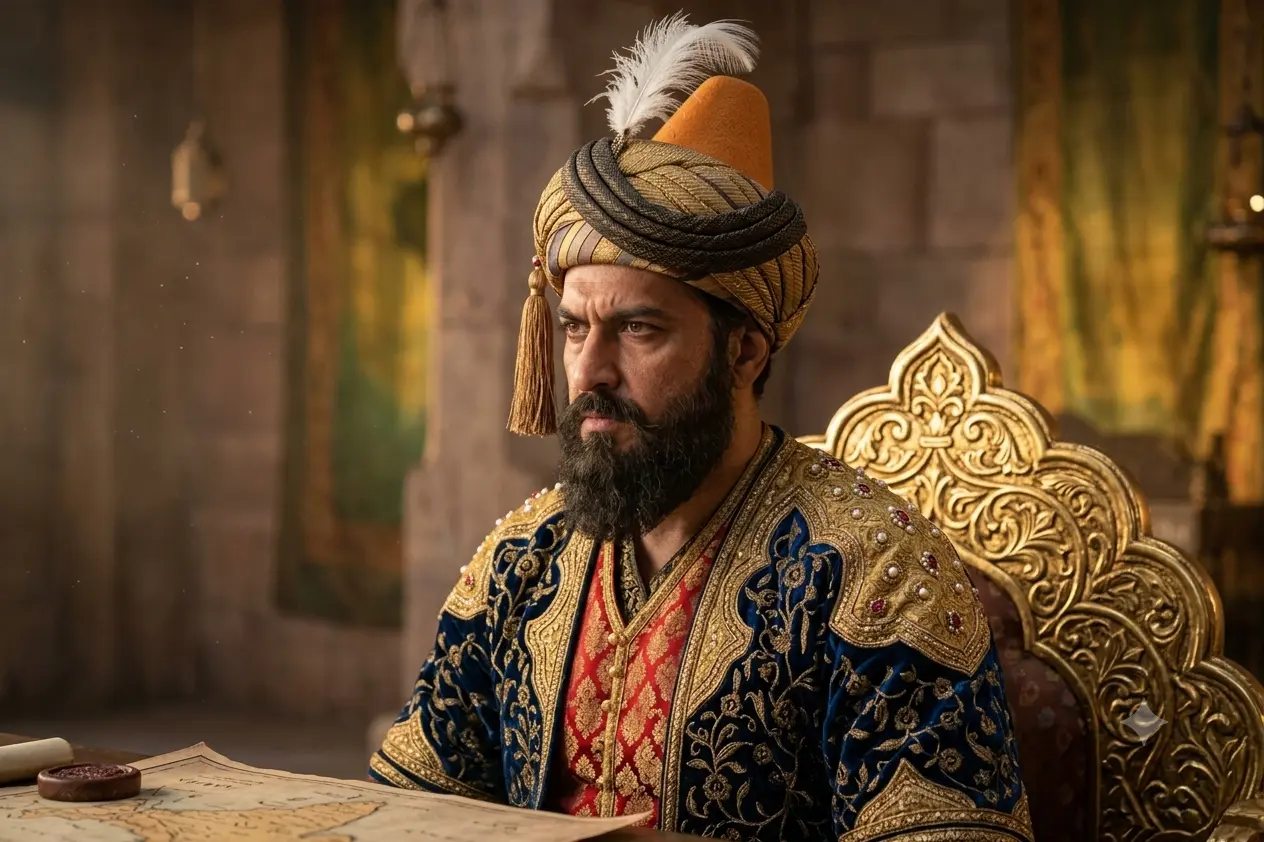
Ala al-Din Muhammad Khalji (c. 1266–1316 CE / c. 664–716 AH), known as Alauddin Khalji, was the second and most powerful ruler of the Khalji dynasty of the Delhi Sultanate. He reigned for twenty years, from 1296 to 1316 CE, and under him, in the Encyclopaedia Britannica's formulation, the sultanate briefly assumed the status of an empire: its territory reached from the Himalayan foothills to the far south of the peninsula, repeated Mongol invasions were turned back on the north-western frontier, the market and revenue systems were reorganised on lines without precedent in the medieval subcontinent, and central control over the nobility and the provinces was carried further than any earlier Indian state had attempted. Britannica identifies what the programme required of him — money, a nobility that would not resist, and an army under his own direct control — and much of what follows is the story of how each of those three was secured. He came to the throne by killing his uncle and predecessor, Jalal al-Din Firuz Khalji, who had himself been the senior military commander of the preceding Mamluk dynasty; the reign and its assessment in the sources have turned on that fact ever since.
The Khalji Revolution and Background
The Khalji Turks
The Khalji (also spelled Khilji) were a Turkic people who had settled in the Helmand region of Afghanistan (an area historically called "Khalj" or "Ghilji") for several generations before their involvement in Indian affairs. Their long residence in Afghanistan—intermingling with local populations over approximately two centuries—had given them a partially Afghanized cultural character, and the older Ilbari Turkish aristocracy of the Delhi Sultanate looked down on them as socially inferior. The Ilbari nobles regarded themselves as "pure" Turks—direct descendants of the Central Asian Turkic military elite that had founded the sultanate—and viewed the Khaljis as socially contaminated by their Afghan associations.
This social prejudice was not merely snobbery but had significant political consequences. Despite distinguished military service to the sultanate—it was a Khalji officer, Bakhtiyar Khalji, who had conquered Bengal for Muhammad of Ghor, one of the most spectacular military achievements of the early conquest period—the Khaljis were systematically excluded from the highest positions of power during the Mamluk period (1206-1290 CE). They served as soldiers and frontier commanders, performing essential military functions, but were denied the governorships, court positions, and revenue assignments (iqtas) that the Ilbari Turkish elite monopolized.
The resentment generated by this exclusion—a sense of being treated as second-class despite equal or superior military contribution—accumulated over decades and fueled the political revolution that brought the Khaljis to power. The Khalji rise was not merely a change of dynasty but a social revolution, breaking the Ilbari Turkish monopoly on the sultanate's ruling class and opening positions of power to a broader range of military groups. It demonstrated that the sultanate's political system, while often presented as ethnically exclusive, could be reshaped by determined military force.
Jalal al-Din Khalji's Reign
Jalal al-Din Khalji (r. 1290–1296 CE), Alauddin's uncle and father-in-law, was an elderly and moderate ruler who gained the throne in 1290 CE through the support of disillusioned military commanders who had overthrown the last Mamluk sultan, Kaiqubad. Jalal al-Din was already approximately seventy years old when he became sultan—an unusual age for a new sovereign in a political culture that valued military vigor. His reign was characterized by a conciliatory, even paternal approach—he sought to win acceptance from the established Turkish elite through gentleness and magnanimity rather than compel obedience through force or terror.
The policy of conciliation was consistently applied: Jalal al-Din preferred negotiation to coercion and pardoned opponents whom his predecessors would have removed. In a political order where authority rested on military force and on the perception of it, that preference was read by his own nobles as an inability to act. Nobles who had initially supported him began to doubt his ability to maintain order, and ambitious subordinates—including his nephew Alauddin—recognized that a ruler perceived as weak could be displaced.
Jalal al-Din's most notable military achievement was his defeat of a Mongol invasion in 1292 CE near Sunam in Punjab. Rather than executing the captured Mongol soldiers as most rulers would have done, he converted many to Islam and settled them near Delhi—a group that became known as the "New Muslims" (Nau-Musalman). This magnanimous policy, while demonstrating Islamic ideals of mercy and conversion, drew sharp criticism from hawks who argued that mercy toward Mongols—the destroyers of Islamic civilization from Baghdad to Bukhara—endangered the state. The New Muslims would later prove problematic, with some being implicated in conspiracies and rebellions.
Alauddin served under his uncle as governor of Kara (in modern Uttar Pradesh) and the adjoining territory of Awadh—a substantial and wealthy jurisdiction that gave him both revenue and military resources. In this capacity, he demonstrated exceptional military talent and ambition, conducting unauthorized expeditions that expanded his personal power base and reputation beyond what his position as a provincial governor warranted. His unauthorized raid on Devagiri in 1296 CE—conducted without the sultan's permission—was the most dramatic expression of this independent ambition.
The Seizure of Power
The Devagiri Raid and Its Consequences
In 1296 CE, Alauddin conducted an unauthorized expedition against Devagiri, the capital of the Yadava kingdom in the Deccan—an act of extraordinary military audacity and political ambition that would ultimately change the course of Indian history. This campaign was remarkable on multiple levels: it was conducted without the sultan's knowledge or permission, through territory never before penetrated by sultanate armies, against a wealthy and powerful kingdom that had no reason to expect attack.
Alauddin carefully concealed his intentions even from his own officers until the expedition was underway. He assembled his forces at Kara under the pretext of a routine frontier campaign, then turned south—away from the expected direction of operations. His relatively small force (perhaps 8,000 cavalry according to modern estimates) marched rapidly through central India, covering hundreds of miles through territory controlled by various independent Hindu kingdoms whose rulers, unprepared for Muslim military presence so far south, offered no resistance.
The Yadava king Ramachandra of Devagiri was caught completely unprepared. His army was dispersed—his son Singhana was away on campaign in the south—and the city's defenses were not organized for sudden attack. Alauddin's forces struck before the Yadavas could concentrate their military strength, capturing the outer city and besieging the fortified inner citadel. After a brief siege, Ramachandra—recognizing the impossibility of his position with his army scattered—agreed to pay an enormous tribute in gold, precious stones, silk, and elephants.
The plunder was staggering: contemporary accounts mention quantities of gold and precious stones that made Alauddin's previous raids seem modest. The exact figures vary between sources but consistently indicate that the Devagiri campaign yielded wealth sufficient to transform a provincial governor into a potential sultan. This was precisely Alauddin's intention—the campaign's primary purpose was not territorial but political: to acquire the financial resources needed to purchase the loyalty of sufficient military forces to overthrow his uncle.
The Devagiri expedition served multiple additional purposes beyond mere enrichment. It demonstrated Alauddin's military capabilities to potential supporters—showing that he was a commander capable of achieving the extraordinary, not merely a competent provincial administrator. It established a precedent for sultanate military operations in the Deccan—proving that the wealthy southern kingdoms were accessible to Delhi's forces and opening an entire new strategic horizon. And it revealed Alauddin's willingness to act independently of authority—a double-edged quality that attracted ambitious followers while alarming those who valued stability and legitimate order.
The Death of Jalal al-Din at Kara
Returning from Devagiri with the treasure, Alauddin did not bring it to Delhi. He invited Jalal al-Din to come to him at Kara instead, ostensibly to receive the plunder and his nephew's homage, and sent gifts and assurances of submission ahead of the invitation. Several courtiers urged the sultan not to go, arguing that a subordinate who had gained that degree of independent success would not willingly return to subordination. Jalal al-Din travelled to Kara with a small escort.
On 19 July 1296 CE (17 Ramadan 695 AH), at the riverside camp, the sultan came forward to embrace his nephew and was struck down by armed men who had been placed in concealment. His entourage was overwhelmed before it could organise resistance. Alauddin had the head displayed on a spear, which both established the death beyond dispute and announced the change of ruler.
The event is central to the historiography of the reign as well as to its chronology. Zia al-Din Barani, whose Tarikh-i Firuz Shahi is the fullest account of Alauddin's rule, wrote some forty years afterwards and organised his narrative around the manner of the accession; every later assessment of the reign, favourable or hostile, has had to take a position on it. Two circumstances are recorded and are not in dispute: the man killed was the sultan's nephew's uncle and sovereign, who had advanced him, and the killing fell in Ramadan.
Consolidation in Delhi
The march from Kara to Delhi was financed by Devagiri. Gold was distributed to the troops at every halt, commanders were promised double their existing revenues, and every soldier who came over received an immediate payment. Many of Jalal al-Din's commanders transferred their allegiance, calculating that resistance against those resources would fail, and within weeks Alauddin was established at Delhi as sultan.
The position was not yet secure. Jalal al-Din's sons and his surviving supporters were at large in several parts of the sultanate and could serve as rallying points; a number of the older Khalji nobles who had been his men remained in place; and the manner of the accession had set a precedent that others could follow.
Alauddin's response was the systematic removal of possible rivals. Suspected opponents were blinded — a medieval penalty that disqualified a man from rule without killing him — imprisoned, or put to death, and their families were frequently imprisoned or exiled with them. Jalal al-Din's sons were pursued and his senior supporters arrested or killed, and anyone with a claim through the previous line was removed from the field.
These measures achieved what they were intended to achieve: no noble conspiracy succeeded against Alauddin in twenty years of rule. They also left the political order dependent on the person of the sultan rather than on any arrangement between him and his nobility, and the consequences of that dependence became visible immediately after his death.
The Mongol Invasions and Their Repulsion
The Scale of the Mongol Threat
The Mongol Empire—the largest contiguous land empire in human history—had been pressing on India's northwestern frontier since the time of Iltutmish. However, the threat reached its peak during Alauddin's reign. Between 1297 and 1308 CE, the Chagatai Mongols launched no fewer than six major invasions of northern India, some penetrating as far as the outskirts of Delhi itself. These were not mere border raids but full-scale military invasions involving tens of thousands of warriors—campaigns that, had they succeeded, would have subjected India to the same devastation that had destroyed the Islamic civilizations of Central Asia, Iran, and Iraq.
The Chagatai Khanate, ruling the Central Asian territories assigned to Genghis Khan's son Chagatai, had its capital at Almaliq and controlled the lands from Transoxiana to the borders of China. By the late thirteenth century, internal divisions within the khanate combined with the economic logic of plundering wealthy India drew successive Mongol commanders toward the sultanate's frontier.
The Invasion of 1297–1298 CE
The first major Mongol invasion of Alauddin's reign came in 1297 CE, when a substantial Mongol force under the command of Kadar (also rendered as Qadar) crossed the northwestern frontier and advanced deep into Punjab, threatening the heartland of the sultanate. This was not a mere border raid but a full-scale military incursion with the apparent intent of seizing territory and plunder. The speed and depth of the Mongol advance caught the sultanate's frontier defenses partially unprepared—the Chagatai Mongols exploited gaps in the defensive perimeter that Alauddin had not yet had time to strengthen.
Alauddin dispatched his brother Ulugh Khan and the formidable general Zafar Khan to meet the invaders. Zafar Khan was perhaps the most talented military commander of the early Khalji period—a warrior of exceptional personal courage and tactical skill who had proven himself in previous campaigns. The Battle of Jalandhar (1297 CE) was a significant engagement in which the sultanate forces demonstrated their ability to face Mongol cavalry in open battle—a capability that few other Muslim armies of the period possessed.
The battle resulted in a decisive sultanate victory—the Mongol force was defeated and pushed back across the frontier with heavy casualties. This initial success demonstrated two important facts: first, that the sultanate possessed military capabilities sufficient to resist Mongol attacks when properly led and motivated; and second, that the Mongol armies, while formidable, were not invincible—they could be defeated by a professional force of comparable quality fighting with determination. However, this was only the beginning of a prolonged series of invasions that would test the sultanate's resources and resolve to their limits.
The Invasion of 1299 CE: The Battle of Kili
A far more serious incursion came in 1299 CE, when a massive Mongol army—estimated by contemporary chroniclers at 200,000 men, though this figure almost certainly represents significant exaggeration—advanced under the command of Qutlugh Khwaja through Punjab and reached the outskirts of Delhi itself. This was an existential crisis: the Mongol army encamped at Kili, within sight of the city walls. Delhi expected to be taken, and to share the fate of Baghdad, which the Mongols had completely destroyed in 1258 CE.
The strategic situation was dire. The Mongol force vastly outnumbered the army Alauddin could immediately concentrate at Delhi. Reinforcements from distant provinces could not arrive in time. The defensive options—cowering behind Delhi's walls and hoping the Mongols would withdraw—were unpalatable to Alauddin, who understood that showing weakness would only invite future invasions. He chose to take the field, accepting battle despite numerical inferiority.
The Battle of Kili (1299 CE) was fought near Delhi under circumstances of desperate urgency. Alauddin took the field personally, demonstrating the physical courage that characterized his early reign. The battle was fiercely contested, with both sides fighting with determination—the Mongols because they scented plunder, the sultanate forces because they were defending their homes and families. Zafar Khan again distinguished himself with extraordinary personal valor, leading repeated charges into the Mongol formations that disrupted their cohesion.
The fighting continued for most of a day before the Mongol army eventually withdrew—not destroyed but sufficiently battered to abandon its immediate objective. The victory at Kili was narrow—it was not the overwhelming triumph of later propaganda but a hard-fought defensive success that preserved the capital. However, its significance was immense. Had Delhi fallen to the Mongols in 1299, the consequences for Indian civilization—both Hindu and Muslim—would have been catastrophic beyond calculation. The Mongol treatment of conquered cities—wholesale massacre, systematic destruction of infrastructure, deliberate elimination of cultural and intellectual life—left no doubt about what defeat would have meant.
The Battle of Amroha (1305 CE)
In 1305 CE, yet another Mongol invasion penetrated deep into the sultanate, demonstrating the persistence of the Chagatai threat and the need for permanent military readiness rather than temporary mobilization. A substantial force under the joint command of Taraghai and Ali Beg advanced into the Doab—the fertile region between the Ganges and Yamuna rivers that formed the agricultural heartland of the sultanate. The penetration to the Doab was deeply alarming, as it demonstrated that the Mongols could bypass frontier defenses and strike at the sultanate's economic core.
Alauddin sent his general Malik Nayak (also known as Malik Kafur in some sources, though the identification is debated) to intercept the invaders. The Battle of Amroha was a significant engagement fought in the vicinity of the modern city of the same name in western Uttar Pradesh. The sultanate forces, by this point highly experienced in anti-Mongol warfare and equipped with tactical doctrines specifically designed for the purpose, won a decisive victory. The Mongol force was defeated, its leadership captured, and its remnants scattered.
Ali Beg, Taraghai, and other Mongol leaders were brought to Delhi in chains and executed publicly—a deliberate message of deterrence directed at future potential invaders. The public execution of captured Mongol commanders—a violation of the norms of ransom and negotiation that typically governed the treatment of captured military leaders—reflected both the existential nature of the Mongol threat and Alauddin's calculated strategy of making invasion so costly in terms of leadership casualties that it would cease to be attractive.
The Battle of Ravi (1306 CE)
The final major Mongol invasion of Alauddin's reign came in 1306 CE, when a large force under the Chagatai commander Kebek (or Kopek) advanced into Punjab. By this point, Alauddin's military reforms had created a frontier defense system of considerable sophistication, and the invasion was met with rapid and effective response. Alauddin dispatched Malik Kafur—by now his most trusted and capable general—who intercepted the Mongol force at the Ravi River in Punjab.
The Battle of the Ravi was another sultanate victory, with the Mongol force defeated and driven back across the frontier with heavy losses. This victory effectively ended the Mongol threat to Delhi for the remainder of Alauddin's reign and indeed for decades afterward. The cumulative effect of repeated defeats, captured and executed commanders, and the increasingly effective frontier defenses convinced the Chagatai Mongols that invading India was too costly to be worthwhile. The Mongol threat would resurface in later decades, but never again with the intensity and frequency that characterized the 1297-1306 period.
Strategic Response to the Mongol Threat
Alauddin's response to the Mongol invasions was not merely tactical—responding to each invasion individually—but strategic, creating a comprehensive defensive system designed to prevent invasions from succeeding and to deter them from being attempted. His measures included multiple reinforcing elements that together constituted the most effective anti-Mongol defense in the contemporary Islamic world.
Military reforms: He greatly expanded the standing army, so that it could meet a Mongol invasion force and campaign in southern India at the same time. Barani gives its strength as 475,000 men. The figure is his, and it almost certainly counts every category of military personnel on the rolls rather than the troops available for a field engagement; it should be read as an order of magnitude reported by the chronicler, not a return from a muster.
Frontier fortification: He strengthened the chain of frontier forts in Punjab and the northwest, garrisoning them with permanent forces and appointing aggressive commanders tasked with active defense.
Intelligence system: He developed an extensive intelligence network along the frontier, providing early warning of Mongol movements and allowing the sultanate to concentrate forces before invasions reached critical mass.
Economic measures: His revolutionary economic reforms (discussed below) were partly motivated by the need to maintain the enormous army required for Mongol defense without bankrupting the state.
The successful repulsion of multiple Mongol invasions—when virtually every other Muslim state had failed—represents perhaps Alauddin's greatest achievement. It preserved India from the devastation that consumed Central Asia, Iran, and Iraq, and allowed the continuation of both Hindu and Islamic civilizational development in the subcontinent.
Territorial Expansion: Gujarat, Rajasthan, Malwa and the South
Strategic Rationale
While defending against Mongols in the north, Alauddin simultaneously pursued an aggressive policy of southern expansion that brought virtually all of peninsular India under sultanate influence. This two-front strategy was enabled by his military reforms and economic policies, which generated the resources necessary to sustain massive military operations on both frontiers simultaneously.
The southern campaigns served multiple purposes. They brought enormous wealth into the sultanate treasury—wealth needed to fund the Mongol defense. They extended sultanate authority over wealthy kingdoms that had previously remained beyond Muslim political reach. They provided employment and plunder for a military class that might otherwise become restive. And they demonstrated the sultanate's power, deterring both potential rebels within and enemies without.
Malik Kafur: The Slave-General
The instrument of Alauddin's southern conquests was Malik Kafur, one of the most remarkable military figures of medieval Indian history. Kafur's rise from obscurity to supreme military command is one of the most extraordinary personal trajectories in sultanate history—a narrative that combines the themes of talent, patronage, and the controversies surrounding power in medieval court culture.
Kafur was originally a Hindu convert to Islam—captured as a young man during the Gujarat campaign of 1299 CE; the chronicles place him in the household of a merchant of Khambhat (Cambay). Alauddin bought him, and the price the sources give — one thousand dinars — attached to him as an epithet, Hazar-Dinari, the thousand-dinar man. He was brought into the royal household where his remarkable abilities quickly became apparent.
Kafur rose rapidly through the ranks of the sultanate's military hierarchy—from personal slave to royal companion, from companion to military officer, from officer to general, and ultimately to the supreme military command as Malik Naib (Deputy Sultan). This trajectory, accomplished within approximately a decade, was possible because of a combination of demonstrated ability, Alauddin's personal patronage, and the character of the sultanate's military system that valued demonstrated ability over birth or ethnicity.
Kafur's close relationship with Alauddin attracted unfavorable comment from contemporary chroniclers, particularly Zia al-Din Barani, who hints at improper physical intimacy between the sultan and his slave-general. Whether these insinuations reflect historical reality or merely the prejudice of chroniclers hostile to a low-born convert exercising supreme military power over the old aristocracy is a question that cannot be definitively resolved. The allegations may represent the displaced resentment of a Turkish military elite that could not openly challenge the sultan's appointments but could delegitimize them through innuendo. What is beyond dispute is Kafur's extraordinary military ability—his campaigns in the Deccan and South India demonstrate tactical and operational competence of the highest order.
The Gujarat Campaign (1299 CE)
Alauddin's southern campaigns began with the conquest of Gujarat in 1299 CE. Gujarat was one of the wealthiest regions of India—its prosperity built upon centuries of maritime trade with the Arabian Sea world, connecting India commercially with East Africa, Arabia, Persia, and Southeast Asia. The Gujarati ports of Cambay (Khambhat), Bharuch, and Surat were among the greatest commercial centers of the Indian Ocean world, handling trade in textiles, spices, precious stones, horses, and metals.
Ulugh Khan and Nusrat Khan led the expedition, which defeated the Vaghela king Karna (also known as Rai Karan) and sacked the wealthy port cities. The Vaghela kingdom collapsed rapidly—Karna fled without offering effective resistance—and Gujarat's accumulated wealth fell into sultanate hands. The plunder was enormous: gold, silver, precious stones, fine textiles, horses, and slaves.
The Gujarat campaign's targeting of Somnath—the same temple that Mahmud of Ghazni had famously raided in 1026 CE—held powerful symbolic significance, connecting Alauddin's campaigns to the earlier tradition of Islamic expansion in India. The temple had been rebuilt after Mahmud's raid (as it had been rebuilt after earlier depredations), and its renewed destruction served both to assert the sultanate's power and to invoke the ghazi tradition that legitimized military campaigns against Hindu polities.
Rajasthan and Malwa (1301–1305 CE)
Between the Gujarat expedition and the first Deccan campaign, Alauddin reduced the fortified kingdoms lying between Delhi and the western coast. The Encyclopaedia Britannica dates the three principal captures: Ranthambhor in 1301, Chitor — Chittaurgarh, in what is now Rajasthan — in 1303, and Mandu, the great hill capital of Malwa, in 1305. The annexation of Devagiri belongs to the same sequence of conquests.
These were sieges rather than field battles, and they were conducted against precisely the kind of adversary that had defeated earlier sultans: hill and desert fortresses, well provisioned, held by dynasties with deep local support and no interest in a negotiated submission. Their reduction did three things at once. It removed the possibility of a hostile power in Alauddin's rear while his armies were engaged in the far south or on the Mongol frontier. It brought under Delhi's control the routes running from the Gangetic plain to the Gujarat ports, and with them the customs revenue of the western sea trade. And it supplied, in the fortresses themselves, a chain of garrisoned strongpoints from which the peninsular campaigns of 1307 onwards could be supported.
Chitor was the most consequential of the three politically, since it was the seat of the senior Rajput house of Mewar, and a considerable later literature grew up around its fall — material that belongs to the history of Rajput and Persian court literature rather than to the events of 1303, and that this article does not treat as evidence for them.
The First Deccan Campaign: Devagiri (1307 CE)
In 1307 CE, Malik Kafur led an army into the Deccan to punish the Yadava king Ramachandra of Devagiri, who had ceased paying the tribute imposed after Alauddin's earlier raid. The campaign was swift and decisive—Ramachandra was defeated, forced to submit, and required to resume tribute payments at an increased rate. However, Alauddin adopted a pragmatic approach: rather than annexing Devagiri outright, he accepted Ramachandra's vassalage and used the Yadava kingdom as a base for further southern expeditions.
The Warangal Campaign (1309 CE)
In 1309 CE, Malik Kafur struck further south, targeting the Kakatiya kingdom of Warangal in modern-day Telangana—one of the most powerful and wealthy states of peninsular India. The Kakatiya kingdom, ruled by Prataparudra II from the formidable fortress of Warangal, commanded extensive territories in the eastern Deccan and controlled lucrative trade routes connecting the interior with the Coromandel coast. The Kakatiyas had built a sophisticated administrative system, a prosperous economy based on agriculture and trade, and a military establishment that had successfully resisted challenges from neighboring powers for generations.
Kafur led a large expedition from Delhi, marching through the Yadava domains (whose submission facilitated transit) into Kakatiya territory. The fortress of Warangal presented a formidable challenge—it consisted of multiple concentric defensive rings, including an outer earthen rampart, an inner stone wall, and a central citadel, surrounded by a wide moat. The garrison was large and well-supplied.
After establishing his siege lines and demonstrating overwhelming force, Kafur pressed the attack with characteristic determination. The siege lasted several weeks—the exact duration is disputed—before Prataparudra, recognizing that relief was impossible and that continued resistance would bring destruction, agreed to submit. The terms of submission were generous but extractive: Prataparudra acknowledged sultanate overlordship, agreed to pay an enormous annual tribute, and surrendered vast quantities of accumulated treasure—gold, silver, precious stones, elephants, and horses. According to some traditions, the famous Koh-i-Noor diamond was among the treasures extracted from Warangal, though this attribution is debated by historians.
The Dvarasamudra and Madurai Campaign (1310–1311 CE)
Malik Kafur's most ambitious and far-reaching expedition came in 1310–1311 CE, when he led a sultanate army to the extreme south of the Indian peninsula—further south than any Muslim army had previously penetrated, reaching territories that even the most ambitious previous Muslim commanders had never approached. This campaign combined strategic planning of the highest order with operational execution over distances that strained the logistical capabilities of the medieval world.
From his base in the Deccan (secured through the Yadava and Kakatiya submissions), Kafur advanced into the Hoysala kingdom centered on Dvarasamudra (modern Halebidu in Karnataka). The Hoysala king Vira Ballala III, recognizing the overwhelming strength of the invading force and lacking allies who might assist him, submitted without prolonged resistance—agreeing to tribute payments and the surrender of treasure. The Hoysala kingdom, famous for its extraordinary architectural achievements (the temples of Belur and Halebidu represent the zenith of South Indian temple architecture), was reduced to tributary status.
Kafur then continued south into the Tamil country, targeting the Pandya kingdom of Madurai—one of the most ancient dynasties of India, with a royal lineage stretching back over a millennium. The Pandya kingdom was fortunately (from Kafur's perspective) in the midst of a bitter succession dispute between rival claimants—Sundara Pandya and Vira Pandya—which had divided the kingdom's military resources and prevented unified resistance to the external threat.
Exploiting this division with characteristic tactical acuity, Kafur advanced rapidly into Pandya territory, capturing Madurai—the Pandya capital and a city of extraordinary religious and cultural significance, home to the great Meenakshi temple. The figures the chronicles give for the plunder taken from the Pandya kingdom are very large: 612 elephants, 20,000 horses, 96 maunds of gold, and quantities of precious stones and pearls. They are the chroniclers' figures and carry the usual caution. The poet Amir Khusrau, who accompanied the expedition as court chronicler, describes the return to Delhi with a treasure train that his account has taking days to pass through the city gates.
The Madurai campaign brought Kafur to the shores of the Indian Ocean, and the chronicles have sultanate detachments reaching Rameswaram at the southern tip of the peninsula. This represented the maximum territorial extent of Delhi Sultanate influence in the medieval period—from the Himalayan foothills to the Indian Ocean, a distance of over 2,500 kilometers. While this extent was nominal rather than administrative (no permanent governance structure was established in the deep south), it demonstrated the sultanate's military reach in the most dramatic possible terms.
Assessment of the Southern Campaigns
The Deccan and South Indian campaigns achieved their immediate objectives: they brought enormous wealth to Delhi, demonstrated sultanate military power across the entire subcontinent, and established at least nominal sultanate suzerainty over peninsular India. However, they did not create permanent territorial administration in the deep south. The distances involved, the difficulty of communications, and the limited Muslim military presence meant that sultanate authority in the far south remained superficial—dependent on periodic military demonstrations rather than sustained governance.
The campaigns' long-term legacy was mixed. They initiated Muslim political engagement with peninsular India—a process that would eventually produce the Bahmani and subsequent Deccan sultanates. They brought vast wealth to Delhi but also created economic disruption in the affected regions. They demonstrated the sultanate's military reach but also overextended its resources. After Alauddin's death, the southern territories quickly reasserted independence, and permanent Muslim governance in the Deccan would require fresh campaigns by later sultans.
Economic Reforms and Market Regulation
The Problem: Financing the State
Alauddin's most innovative and controversial policies were his economic reforms—particularly his system of price controls and market regulation. These policies were driven by a specific problem: the need to maintain an enormous standing army (necessary for Mongol defense) without overburdening the population with taxes that would provoke rebellion.
The cost of maintaining approximately 475,000 soldiers (the figure given by contemporary sources) at fixed salaries was astronomical. Alauddin's solution was twofold: reduce the cost of living for soldiers (through price controls that kept food, clothing, and other necessities cheap), and increase state revenue (through aggressive taxation and the elimination of private wealth accumulation among the nobility).
The Market Control System
Alauddin established a system of controlled markets (mandis) in Delhi where prices for essential commodities—grain, cloth, horses, cattle, and slaves—were fixed by imperial decree. This was not merely a statement of desired prices but a comprehensive regulatory apparatus backed by severe penalties and constant surveillance. Each category of goods had a dedicated market with specific regulations, designated officials, and enforcement mechanisms:
The grain market was the most important, as food prices directly affected the cost of maintaining the army. Prices for wheat, barley, rice, and other staples were fixed at levels significantly below what free-market conditions would have produced. The price of wheat was fixed at 7.5 jitals per man—a level that contemporary sources indicate was roughly half the previous market price. Merchants and farmers were required to sell at these prices, with severe penalties (including death, dismemberment, or imprisonment) for violations. Hoarding was prohibited and punished with extraordinary severity—merchants caught concealing grain could have their entire stocks confiscated and face corporal punishment.
A network of informants and inspectors—the intelligence system (barid) repurposed for economic surveillance—monitored compliance. Secret agents posed as buyers to test merchants' honesty. Market inspectors (shahna) conducted regular checks of weights and measures. Farmers attempting to bypass the market system by selling directly to consumers at higher prices were punished. The result was a system of total economic surveillance in which every transaction in grain was monitored and regulated by the state.
To ensure supply, Alauddin required that all grain from the surrounding agricultural districts be sold through the controlled market rather than being stored or consumed locally. Farmers were required to pay a portion of their taxes in grain, which was stored in state granaries and released to the market to maintain supply at the fixed prices. This ensured that the controlled market had adequate stocks to meet demand, preventing the shortages that price controls typically create when supply mechanisms are not simultaneously managed.
The cloth market regulated the prices of textiles—essential for both civilian clothing and military uniforms. The sultanate's army required vast quantities of cloth for uniforms, tents, and equipment, and controlling textile prices directly reduced military costs. Merchants were required to register with the state, maintain fixed premises, and sell at regulated prices. Quality standards were imposed and enforced—cloth of specified types was required to meet minimum quality thresholds to prevent merchants from maintaining nominal prices while reducing quality.
The horse and cattle market controlled the prices of animals essential for military and agricultural purposes. Since the sultanate's army was primarily cavalry, the cost of horses was a major military expense, and controlling horse prices directly reduced the cost of maintaining the military establishment. Horses of specified quality and breed were assigned maximum prices, and dealers were registered and monitored. The cattle market ensured that agricultural animals remained affordable for farmers, preventing the disruption of food production through livestock price inflation.
Enforcement Mechanisms
The enforcement of Alauddin's price controls rested on bureaucratic oversight backed by severe and publicly applied penalties. A dedicated official, the Shahna-i Mandi (Market Controller), oversaw the entire system with quasi-judicial authority. Below him were a hierarchy of inspectors, informants, and agents who formed a surveillance network of remarkable density. The entire city of Delhi—every market, every shop, every transaction—was subject to monitoring.
Punishments were designed to be both severe and public, maximizing deterrent effect. Merchants found cheating on weights or violating price controls faced a graduated scale of punishment: first offense might result in fines; second offense in public humiliation or beating; persistent violation in cutting off of hands, blinding, or execution. The chronicler Barani—who is our primary source for these reforms and who observed them firsthand—describes cases of merchants being flayed alive for persistent cheating, their skins stuffed with straw and displayed in the market as warnings.
These extreme punishments—horrifying by any standard—achieved their immediate objective: compliance. Merchants learned that the risks of violation exceeded any possible profit from cheating. The market system operated with remarkable discipline during Alauddin's reign, with prices remaining stable at the mandated levels for approximately two decades. Whether this represents administrative genius or merely systematic terrorism is a question that historians have answered differently depending on their interpretive frameworks.
Revenue Reforms
Alongside market controls, Alauddin imposed heavy taxation on the agricultural sector. He increased the land tax (kharaj) to fifty percent of produce—a rate unprecedented in Indian history—and additionally imposed grazing taxes and house taxes on the rural Hindu population. He also confiscated the excess wealth (zakhira) of nobles, preventing the accumulation of private resources that might fund rebellion.
These revenue measures were deliberately designed to prevent three developments that Alauddin identified as threats to royal authority: private wealth accumulation (which could fund conspiracies), excessive leisure among the nobility (which led to plotting), and popular prosperity (which, in Alauddin's calculation, bred insubordination). The chronicler Barani records Alauddin's explicit reasoning: "I am an unlettered man, but I have seen much. Be assured that the Hindus will never become submissive and obedient until they are reduced to poverty."
Assessment of Economic Policies
Alauddin's economic reforms have been assessed very differently by different historians. Some have seen them as an early example of planned economy—a medieval anticipation of state control over market forces motivated by rational policy objectives. Others have viewed them as brutal exploitation dressed in administrative language—the extraction of maximum resources from a subject population for the benefit of a military elite.
The most balanced assessment recognizes both dimensions. The price control system did achieve its immediate objective: it enabled the maintenance of a massive army at tolerable cost and provided Delhi's population with affordable necessities. For the two decades of its operation, it kept prices stable and prevented the famines that would otherwise have resulted from the disruption of multiple military campaigns.
However, the system relied entirely on coercion and did not address underlying economic fundamentals. It suppressed market mechanisms without creating alternative incentives for production. It imposed enormous hardship on farmers and merchants, who bore the cost of cheap prices for urban consumers and soldiers. And it collapsed immediately upon Alauddin's death—demonstrating that it depended entirely on one ruler's iron will rather than on sustainable institutional design.
The heavy taxation of the Hindu rural population raises particular questions about religious and economic justice. Alauddin framed the measures in terms of state security rather than in religious terms, and the demand fell on the cultivating population, which in the affected regions was overwhelmingly Hindu. Whether the effect amounted to religious discrimination, or reflected the ordinary practice of medieval conquest states, which everywhere taxed subject populations heavily, is debated, but the human cost is not.
Military Reforms
The Standing Army
Alauddin's military reforms were as revolutionary as his economic policies and equally unprecedented in Indian history. He created what was arguably the largest and most professional standing army in the contemporary world—a force estimated by the chronicler Barani at approximately 475,000 men. While this figure likely includes all categories of military personnel (active combat troops, garrison forces, support staff, and provincial levies) rather than just field army strength, the scale of Alauddin's military establishment was nonetheless extraordinary by any standard of the period.
The creation and maintenance of such a force required solving several interconnected problems: recruitment, training, equipping, paying, and disciplining an enormous number of men while simultaneously preventing the accumulation of military power in any hands other than the sultan's. Alauddin's solutions to these problems constituted a comprehensive system of military administration that represented a significant advance over previous sultanate practice.
Key elements of his military system included:
The branding system (dagh): Every horse in the military was branded with a distinctive state mark, and detailed registers were maintained recording each horse's breed, color, distinguishing features, and assigned rider. This prevented the endemic corruption of previous regimes, in which officers claimed payment for non-existent troops and horses—inflating their paper strength to receive larger revenue allocations while maintaining only skeleton forces. The branding system ensured that every horse for which the state paid actually existed and met minimum quality standards.
The descriptive roll (huliya): Every soldier was individually described in official registers—his physical appearance, distinguishing features, weapons, and equipment recorded in detail. This prevented the practice of hiring substitutes for musters—officers had previously collected pay for trained soldiers while presenting untrained peasants during periodic inspections. Combined with the branding system, this created an accountability framework that ensured the army's actual fighting strength matched its administrative records. For the first time in sultanate history, the sultan could know with reasonable confidence how many effective soldiers he actually possessed.
Cash salaries: Soldiers were paid fixed cash salaries directly from the royal treasury rather than being supported through iqta grants administered by their immediate commanders. This revolutionary change centralized military finances in the sultan's hands and severed the personal loyalty bonds between soldiers and their iqta-holding commanders. Under the previous system, soldiers' primary loyalty was often to the local commander who paid them; under Alauddin's system, every soldier was paid by and therefore owed loyalty directly to the sultan.
Prohibition of private wealth: Military officers were prohibited from accumulating private wealth beyond specified limits, consuming alcohol (which Alauddin associated with conspiracy-breeding social gatherings), or engaging in social activities that might facilitate political plotting. These extraordinary restrictions—enforced by the pervasive intelligence system—created a military class entirely dependent on and subservient to the sultan. Officers could not accumulate the resources that might enable rebellion, could not form the social bonds that might produce conspiracy, and lived under constant surveillance that detected any deviation from absolute obedience.
Intelligence System
Alauddin developed perhaps the most elaborate intelligence system in medieval Indian history. His network of spies (barids) and secret agents penetrated every level of society—the market, the military, the nobility, even the domestic quarters of his own officials. The historian Barani describes this system with a combination of admiration for its effectiveness and horror at its intrusiveness.
The intelligence system served both internal security and external defense purposes. Internally, it detected conspiracies, identified corrupt officials, and monitored the economic reforms' implementation. Externally, it provided early warning of Mongol movements and intelligence about conditions in potential target kingdoms.
The reach of this surveillance was itself a deterrent, and contemporaries describe its effect on ordinary social conduct: gatherings were avoided, and information about neighbours had a value. Compliance was obtained; the cost was paid in the confidence people could place in one another. The chronicler Barani—himself a member of the old aristocracy that suffered under these policies—provides vivid descriptions of the terror that Alauddin's intelligence system inspired.
Assessment of Military Reforms
Alauddin's military reforms must be assessed against their primary objective: creating a force capable of defending the sultanate against existential threats while projecting power across the subcontinent. By this measure, they were remarkably successful. The sultanate under Alauddin was the only major Muslim state to successfully repel Mongol invasions repeatedly—an achievement that required military capabilities far exceeding those of most contemporary states.
However, the system's dependence on one ruler's personal authority was its fundamental weakness. The extreme centralization that made the army effective also made it vulnerable to the disruption that inevitably accompanied Alauddin's death. When the controlling personality was removed, the system's coercive foundations crumbled rapidly.
Administrative Centralization
Control of the Nobility
A central theme of Alauddin's governance was the subordination of the nobility to the crown. The Turkish military aristocracy — the Chahalgani of the earlier sultanate and their successors — had been the main source of political instability in the sultanate's history: factional conflict among the nobles had produced repeated coups, and their accumulated wealth and retinues gave them the means to act.
Alauddin's measures went to those means directly. Noble wealth was confiscated. Social gatherings at which conspiracy might be arranged were prohibited, as was wine. Noble households were kept under continuous observation. Marriage between noble families, which had been the ordinary way of building alliance networks, required the sultan's permission. The effect was to reduce powerful households to isolated dependents of the crown, holding office at the sultan's discretion and possessing little that could be mobilised without him.
The policy met its immediate objective. It also removed from the political system the one group with the resources and standing to carry on government if the crown weakened, and when the crown did weaken after 1316 there was nothing in place to take up the work. That sequence — a nobility deliberately stripped of independent capacity, followed by a rapid collapse when central authority failed — is one of the most frequently drawn lessons of the reign.
Provincial Administration
Alauddin reformed provincial administration to increase central control. Provincial governors were subject to closer supervision, more frequent transfers, and tighter financial accountability. Revenue collection was standardized and monitored by central officials, reducing the opportunities for provincial autonomy.
The intelligence system extended into provincial administration—governors knew they were watched, and this knowledge constrained their behavior. While this produced more compliant governors, it also reduced administrative initiative and flexibility at the provincial level, creating a system that was efficient when the center was strong but brittle when it weakened.
Relationship with Religion and the Ulama
Pragmatic Approach to Islamic Authority
Alauddin's relationship with Islamic religious authority was complex and revealing. He was publicly orthodox in his religious observance, maintaining the forms of Islamic piety—prayer, fasting, mosque-building, patronage of scholars—that legitimized Muslim sovereignty. However, his actual governance was driven by pragmatic calculation rather than religious principle, and he was notably willing to override religious opinion when it conflicted with political necessity.
The chronicler Barani records a revealing exchange in which Alauddin, confronted by the ulama's opposition to some of his policies, effectively dismissed their political relevance: "I do not know what is lawful or what is unlawful. I command what I conceive to be for the good of the state." This statement—whether historically accurate or Barani's literary construction—captures the essentially secular character of Alauddin's governance beneath its Islamic surface.
Conflicts with Religious Scholars
Alauddin's economic reforms—particularly the heavy taxation that reduced Hindu subjects to poverty and the price controls that disrupted normal commercial ethics—drew criticism from some ulama who found them inconsistent with Islamic principles of justice and proper governance. His intelligence system's intrusion into private life also conflicted with Islamic principles of personal privacy and the inviolability of the household.
However, Alauddin's ability to present himself as a defender of Islam against the Mongol threat—the greatest enemy Islam had faced since the Crusades—provided powerful counterargument against religious criticism. His military victories served as their own justification, and critics found it difficult to challenge a ruler who was demonstrably protecting the faith from existential destruction.
The Question of Islamic Law
Alauddin did not consult the ulama on matters of state policy as Islamic political theory technically required. His market regulations, taxation policies, and security measures were imposed by administrative decree rather than derived from juridical consultation. This approach—governance by administrative fiat rather than shariah-based legislation—was controversial but effective, and it established a precedent for the secular exercise of sovereign power within an Islamic framework that later sultans would continue.
Architectural Patronage
The Alai Darwaza
Alauddin's most significant surviving architectural monument is the Alai Darwaza (1311 CE)—a gateway to the Qutb complex in Delhi that represents a masterpiece of early Indo-Islamic architecture. The Alai Darwaza is notable for introducing true arches and domes to Indian Islamic architecture—techniques derived from Central Asian building traditions that replaced the earlier corbelled arches borrowed from Hindu temple architecture.
The building's sophisticated construction, elegant proportions, and rich decoration in red sandstone and white marble represent a significant advance in Indo-Islamic architectural technique. Its horseshoe arches, pointed domes, and geometric decoration established aesthetic principles that would influence Delhi Sultanate architecture for generations.
The Siri Fort
Alauddin constructed the Siri Fort (1303 CE) as a new fortified city to the northeast of old Delhi, designed specifically to accommodate his enlarged military establishment. Siri was a planned military city—its construction reflected both the security concerns of a ruler who feared both Mongol attack and internal conspiracy, and the practical need to house the enormous army his reforms had created.
The Siri Fort represented one of the largest construction projects in medieval Delhi. Its walls enclosed a substantial urban area with markets, residences, and administrative buildings. Though little of it survives today, it demonstrated the scale of Alauddin's ambitions and the resources available to him.
Planned but Incomplete Projects
Alauddin planned even more ambitious architectural projects, including an expansion of the Qutb mosque that would have dwarfed the existing structure and a second minar (the Alai Minar) intended to be twice the height of the existing Qutb Minar. The foundations of this uncompleted tower—massive in scale—can still be seen in the Qutb complex. Work was abandoned at Alauddin's death, and the stump of the Alai Minar remains the largest unfinished structure of the sultanate period. His own tomb at Delhi also survives, and Sayyid Mahboob Rizvi's history of the Dar al-Ulum Deoband names it among the royal tombs still standing whose structural design shows cloisters and rooms attached to a tomb for use as a madrasa — an early instance in India of the tomb-and-college complex that later dynasties built on a much larger scale.
Personal Character and the Sources
Sources and Their Biases
Our primary source for Alauddin's character is the chronicler Zia al-Din Barani, who wrote his history approximately forty years after Alauddin's death. Barani was a member of the old Turkish aristocracy that Alauddin had systematically suppressed, and his account must be read with awareness of this bias. He admires Alauddin's achievements while condemning his methods—a combination that makes his portrayal complex and often contradictory.
Other sources include Amir Khusrau, the celebrated poet who served at Alauddin's court and whose works provide a more sympathetic (though also self-interested) perspective. The later historian Isami offers yet another viewpoint. No single source provides an unbiased portrait, and reconstructing Alauddin's actual character requires careful triangulation among competing accounts.
What the Sources Record of Him
What the sources allow is a set of observed capacities and dispositions rather than a rounded portrait, and the following is offered on that basis.
He was unlettered by his own admission, and nonetheless the author of the most analytically demanding programme of government attempted in the sultanate: the market regulations alone required a working grasp of the relation between supply, transport cost, hoarding, and price. He fought in person, particularly in the earlier part of the reign, and took risks in the field. He rewarded service that satisfied him on a very large scale and removed service that did not. He acted without regard to the counsel of the religious scholars where their counsel would have limited him, and said so.
He also governed under a standing expectation of attack. Attempts on his life are recorded, and the elaborate apparatus of guards, informants, and restrictions on assembly that he maintained answered a real hazard as well as a preference for control. Where the sources describe his temper or his motives they are describing them at second hand and with an interest, and this article does not carry those descriptions further than the acts they were written to explain.
Assessing the Reign
The reign has been assessed in flatly opposed ways for six hundred years, and the disagreement is worth stating as a disagreement rather than resolved by choosing a side.
The case made for it rests on outcomes. Between 1297 and 1306 the sultanate turned back a series of Mongol invasions at a time when no other Muslim state on the Mongols' line of advance had managed it, and the subcontinent was spared what had happened to Transoxiana, Iran, and Iraq. The frontier was fortified and garrisoned; the army was enlarged and paid; the revenue and market systems were rebuilt to fund it; the territory under Delhi's authority reached its greatest extent; and for twenty years there was no successful conspiracy against the throne.
The case made against it rests on method and on cost. Power was taken by killing the reigning sultan; opponents and their families were removed by blinding, imprisonment, and execution; the nobility was stripped of independent resources; assembly and marriage were placed under licence; the revenue demand was set at a level that bore very heavily on the cultivating population; and the political order that resulted could not survive the man who built it.
Both accounts describe the same reign, and neither is a misreading of it. Medieval Islamic political writing did not regard the two as contradictory: it generally held that firm rule, even harsh rule, was preferable to disorder, and allowed the sultan wide discretion in maintaining the state. What that framework will not do is settle a modern reader's question, and this article does not attempt to settle it either. It sets out what was done, at what cost, and with what result, and leaves the evaluation to the reader.
Decline, Death, and Aftermath
The Later Years
Alauddin's final years were marked by physical decline and political deterioration. He suffered from an unspecified chronic illness (possibly dropsy or edema) that increasingly incapacitated him. As his health failed, power shifted toward Malik Kafur, who manipulated the ailing sultan and began eliminating potential rivals—including Alauddin's own sons—to position himself for the succession.
In his last illness the sultan was dependent on Malik Kafur and unable to protect his own sons, whose treatment at the hands of the court is described in the chronicles. The personal authority on which the whole system rested did not survive his physical incapacity, and the system began to come apart before he died.
Death (January 1316 CE)
Alauddin Khalji died on January 4, 1316 CE (2 Shawwal 715 AH) in Delhi after months of declining health. He was approximately fifty years old and had reigned for twenty years. Barani's account places Malik Kafur at the centre of the court in the sultan's last weeks, controlling access to him and the care he received. Barani wrote from the standpoint of the nobility Kafur had displaced, and the charge cannot be checked against an independent source.
The Post-Alauddin Collapse
The collapse that followed Alauddin's death was swift and catastrophic, demonstrating the fundamental fragility of his hyper-centralized system with perfect clarity. The system had been designed around one man's will—when that will was removed, nothing remained to hold the structure together.
Malik Kafur attempted to seize power immediately, blinding Alauddin's eldest surviving son Khizr Khan and his second son Mubarak Shah, and placing a young child (Alauddin's infant son Shihabuddin) on the throne as a puppet. Kafur's regency lasted barely five weeks before he was murdered by a group of loyal bodyguards who refused to accept a former slave's usurpation of sovereign authority. His brief period of power had demonstrated both the personal ambition that Alauddin's centralization had suppressed during his lifetime and the chaos that erupted when it was released.
A succession of brief, chaotic reigns followed. Mubarak Shah—whose blinding by Kafur the chronicles describe as incomplete—eventually seized the throne and ruled with some competence for four years (1316-1320 CE) before being murdered by his own favorite, the Hindu convert Khusrau Khan. Khusrau Khan's brief usurpation (1320 CE) ended the Khalji dynasty entirely and inaugurated yet another succession crisis resolved by Ghiyath al-Din Tughlaq's seizure of power—establishing the Tughlaq dynasty that would rule for the next century.
The speed of this collapse vindicated the critics who had argued that Alauddin's system, while impressively effective in the short term, was fundamentally unsustainable without his personal force driving it. The price controls collapsed immediately—within days of Alauddin's death, merchants raised prices to market levels, and the elaborate enforcement system simply evaporated as officials recognized that no one remained to punish non-compliance. The military discipline that had made the army invincible deteriorated rapidly as officers realized that the surveillance system was no longer functioning. The frontier defenses weakened as commanders diverted resources to factional competition rather than border security. Southern tributaries declared independence the moment they learned of Alauddin's death. Everything Alauddin had built through twenty years of iron will, systematic terror, and extraordinary administrative genius dissolved within months—a sobering testament to the fundamental limits of personal autocracy as a system of governance, however gifted the autocrat.
The contrast with Iltutmish's legacy is instructive. Iltutmish built institutions—however imperfect—that survived his death and sustained the sultanate through decades of weak rulers. Alauddin built an apparatus that was far more powerful in his lifetime and that depended on him entirely, and it did not outlast him. The lesson—that institutional governance outlasts personal governance—was available to contemporaries but difficult to implement in a political culture that valued individual strength above institutional restraint.
Legacy and Historical Assessment
In Military History
Alauddin's military achievements—particularly the repeated repulsion of Mongol invasions—secure his place among the most significant military commanders of medieval history. He was the only Muslim ruler of his era to successfully defend against the Mongols on multiple occasions—an achievement unmatched by any contemporary Islamic state, from the Mamluks of Egypt (who defeated the Mongols once at Ain Jalut) to the various Persian dynasties that were swept away. The strategic innovations he developed—large standing armies funded by controlled prices, systematic frontier defense combining fortification with active patrols, combined arms tactics integrating cavalry with intelligence systems, and the creation of a military logistics infrastructure capable of sustaining simultaneous operations on multiple fronts—represented genuine advances in military organization that were ahead of their time.
In Economic History
His market control system, while ultimately unsustainable beyond his personal reign, represents one of the most ambitious and comprehensive attempts at economic planning in the pre-modern world. Whether viewed as visionary state intervention that anticipated modern planned economies or as brutal exploitation of producers and merchants dressed in administrative language, it demonstrated that conscious human agency could—at least temporarily—override market forces for political purposes. Modern economic historians have studied his system as an early and remarkably sophisticated example of command economy principles, analyzing its successes, failures, and the conditions that made it temporarily viable.
In Political History
Alauddin's reign represents the Delhi Sultanate at its most powerful and its most centralised. The instruments he used—concentration of authority, surveillance, the licensing of assembly, and direct control of prices and revenue—together formed a system of government that later writers have compared, with varying degrees of aptness, to both earlier autocracies and modern command states. His explicit subordination of religious authority to state power—declaring that governance was his domain regardless of scholarly opinion—anticipated later secularizing tendencies in Islamic governance and remains a reference point in debates about the relationship between religious authority and political power in Muslim societies.
The Reign in Later Memory
Alauddin is among the most contested figures in Indian historical memory, and the positions taken on him have followed the wider arguments of the periods in which they were written rather than any change in the evidence.
One line of memory holds the Mongol defence to be the reign's defining achievement — a service whose benefit fell on every community in the subcontinent, since what was prevented was the destruction of everything then standing in it — and reads the military and administrative record as evidence of the sultanate's capability. Another emphasises the weight of the revenue demand on the cultivating population, the destruction that accompanied the campaigns, and the concentration of authority in a single person. Hindu nationalist historiography from the twentieth century onwards has drawn particularly on Barani's reports of the sultan's policy towards his Hindu subjects; historiography written from within the Islamic tradition has been divided, acknowledging the achievements while unwilling to pass over the accession or the sultan's treatment of religious counsel.
The evidentiary difficulty common to all of these is that they draw on the same narrow set of texts, and chiefly on one hostile witness. Against the general picture of a reign organised along confessional lines, the approved source base offers at least one documented complication: Jawaharlal Nehru's The Discovery of India records that Alauddin himself married a Hindu woman, as did his son — part of the wider process of Indianisation by which, in Nehru's account, the ruling group that had arrived from Afghanistan came to marry into the country it governed. It is a single fact and it settles nothing on its own; it does indicate that the categories the later arguments use were not the categories the reign was actually conducted in.
Scholarship at its most careful has moved away from both the celebratory and the condemnatory frames towards accounts that treat the reign as a problem in the government of a large medieval state. That is the approach followed here.
Historiographical Note
This article rests on an unusually narrow evidence base, and the reason should be stated plainly rather than left to be inferred from the reference list.
The project's source library carries almost nothing on this subject. It was searched for this article under the spellings Alauddin Khalji, Alauddin Khilji, Ala al-Din Khalji, Ala-ud-din Khalji, Ala-ud-Din Muhammad Shah, Khalji, Khilji, Khaljf, Sikandar-i-Sani, Chitor, Chittor, Devagiri, Deogir, and Malik Kafur. The result is a genuine negative. Three books yield anything at all: Jawaharlal Nehru's The Discovery of India, which contains a single sentence about his marriage and his son's, and an index entry; Sayyid Mahboob Rizvi's history of the Dar al-Ulum Deoband, which mentions his tomb at Delhi in a discussion of tomb-and-madrasa complexes; and History of Islam, Volume 2, which names the Khalji dynasty only in a list of the dynasties that ruled at Delhi. Several apparent hits are other people: the Khalj of the Tabaqat-i Nasiri are the tribe, not the dynasty; Muhammad Bakhtiyar Khalji, who took Bengal, is a different man of an earlier generation; and the Ibrahim Khilji of History of Islam is a ninth-century figure in Egypt.
The approved external websites supplied less than they should have. The Encyclopaedia Britannica is on the project's approved register and carries three relevant articles — on Alauddin himself, on the Khalji dynasty, and on the Khaljis within its history of India. None of the three could be retrieved during this work; the site returned an access refusal on each attempt. What was obtainable was the indexed summary of each page, and those summaries are the authority for the dates of Ranthambhor, Chitor, and Mandu, for the twenty-year reign, for Jalal al-Din's previous position as senior commander of the Mamluk dynasty, for the observation that the sultanate briefly became an empire, and for the three requirements of the programme quoted in the opening section. Where the full text of a Britannica article would have carried further detail, this article does not have it. The other approved site with substantial Indian material, historyofislam.com, has no article on Alauddin; its chronology gives him two lines.
The article therefore rests on the three works the owner authorised. Peter Jackson's The Delhi Sultanate, K. S. Lal's History of the Khaljis, and Barani's Tarikh-i Firuz Shahi were authorised on 9 September 2026 under §4A.3, and the authorisation is recorded in the references. That dependence is not concealed anywhere above, and it has a specific consequence: a reader who wants the reign checked against the wider modern literature on the sultanate's economy, on its Turkish elites, or on its relation to the Persianate world will find those works in the Further Reading, listed as material this article did not use.
One witness dominates the sources. Barani wrote roughly forty years after Alauddin's death and belonged to the class of old Turkish nobility whose independent position Alauddin had dismantled. He admires the achievements and condemns the methods, and the two verdicts sit side by side in his text without being reconciled. Nearly every distinctive claim about the reign — the size of the army, the mechanics of the market regulations, the sultan's exchanges with the religious scholars, his statements of policy — comes through him. Amir Khusrau, who served at the court, is a contemporary but a panegyrist; Isami, writing later, provides a third position. There is no source for this reign that is both close to it and disinterested, and the confidence of any statement about it should be adjusted accordingly.
What has been left out. Figures for casualties, for revenue yields, and for the populations affected by the campaigns are not given above where no available source states them. The extensive later literature attached to the fall of Chitor is identified as literature and not used as evidence. And the characterisations of the sultan's temperament that fill the chronicles and much of the writing derived from them are reported as what the sources say rather than adopted as findings.
References and Further Reading
Primary Islamic Sources
- Amir Khusrau. Khazain al-Futuh (Treasures of Victory). c. 1311 CE — contemporary account of Alauddin's campaigns, written by a poet in his service; panegyric in form and to be read as such.
- Amir Khusrau. Tarikh-i Alai. c. 1311 CE — court history of the reign by the same author.
- Barani, Zia al-Din. Tarikh-i Firuz Shahi. c. 1357 CE — the fullest source for the reign, written some forty years after Alauddin's death by a member of the nobility whose position he had reduced. [external source, authorised by the owner on 9 September 2026 under §4A.3]
- Isami, Abd al-Malik. Futuh al-Salatin. c. 1350 CE — verse history offering a third contemporary-to-near-contemporary position.
Classical Islamic Sources
- Juzjani, Minhaj al-Siraj. Tabaqat-i Nasiri. Translated by H. G. Raverty. [approved PDF library:
sources/study/] — written before Alauddin's reign and therefore not a source for it; used here only for the background of the Khalj and of the earlier sultanate, and cited because the search of the library for Khalji material ran through it. - Firishta, Muhammad Qasim. Tarikh-i Firishta. c. 1606 CE — comprehensive later history of the Indian sultanates.
- Ibn Battuta. Rihla. c. 1355 CE — records how Alauddin was remembered at Delhi a generation after his death.
- Sirhindi, Yahya ibn Ahmad. Tarikh-i Mubarak Shahi. c. 1434 CE — later sultanate history carrying Khalji material.
Academic and Scholarly Sources
The first three entries are within the project's approved source base. The two that follow sit outside it; the owner authorised them for this article under §4A.3 on 9 September 2026, and the authorisation is recorded here so that it remains auditable. The article's narrative rests on those two together with Barani.
- Nehru, Jawaharlal. The Discovery of India. [approved PDF library:
sources/study/] — the source for Alauddin's marriage and his son's, cited in the discussion of later memory. - Rizvi, Sayyid Mahboob. History of the Dar al-Ulum Deoband, Volume 1. [approved PDF library:
sources/study/] — cited for the surviving tomb at Delhi and the tomb-and-madrasa form. - Encyclopaedia Britannica. "Khalji dynasty" and "Ala al-Din Khalji." https://www.britannica.com/topic/Khalji-dynasty [approved external web source, §4A.1a] — the authority for the dates of Ranthambhor (1301), Chitor (1303), and Mandu (1305), for the length of the reign, for Jalal al-Din's earlier position, and for the characterisation of the sultanate as briefly an empire. The full text of these pages was not retrievable during this work; see the Historiographical Note.
- Jackson, Peter. The Delhi Sultanate: A Political and Military History. Cambridge: Cambridge University Press, 1999. [external source, authorised by the owner on 9 September 2026 under §4A.3]
- Lal, K. S. History of the Khaljis, A.D. 1290–1320. Allahabad: Indian Press, 1950. [external source, authorised by the owner on 9 September 2026 under §4A.3]
Further Reading
The works below were not used in writing this article, and no statement above rests on them. They are listed for readers who wish to test its account against the wider literature — particularly on the economy of the reign, on the sultanate's Turkish elites, and on its place in the Persianate world.
- Habib, Mohammad. "The Economic Policy of Alauddin Khalji." In Politics and Society during the Early Medieval Period: Collected Works of Professor Mohammad Habib, Vol. 2. New Delhi: People's Publishing House, 1981.
- Siddiqi, I. H. "The Economy under Alauddin Khalji." Indian History Congress Proceedings 45 (1984): 216–230.
- Kumar, Sunil. The Emergence of the Delhi Sultanate, 1192–1286. New Delhi: Permanent Black, 2007.
- Wink, André. Al-Hind: The Making of the Indo-Islamic World. Volume 2. Leiden: Brill, 1997.
- Nizami, K. A. Some Aspects of Religion and Politics in India during the Thirteenth Century. Delhi: Oxford University Press, 1961.
- Eaton, Richard M. India in the Persianate Age: 1000–1765. London: Allen Lane, 2019.
- Schimmel, Annemarie. Islam in the Indian Subcontinent. Leiden: Brill, 1980.
- Digby, Simon. War-Horse and Elephant in the Delhi Sultanate. Oxford: Orient Monographs, 1971.
- Chandra, Satish. History of Medieval India. New Delhi: Orient BlackSwan, 2007.
- Flood, Finbarr Barry. Objects of Translation: Material Culture and Medieval "Hindu-Muslim" Encounter. Princeton: Princeton University Press, 2009.
Mentioned In
4 articles reference this topic