Muhammad of Ghor: Founder of Muslim Rule in India
Mu'izz al-Din Muhammad ibn Sam (1149–1206 CE), known as Muhammad of Ghor, was the Ghurid sultan whose conquests in northern India laid the foundations of the Delhi Sultanate. His victory at the Second Battle of Tarain (1192) established a permanent Muslim presence in the subcontinent.
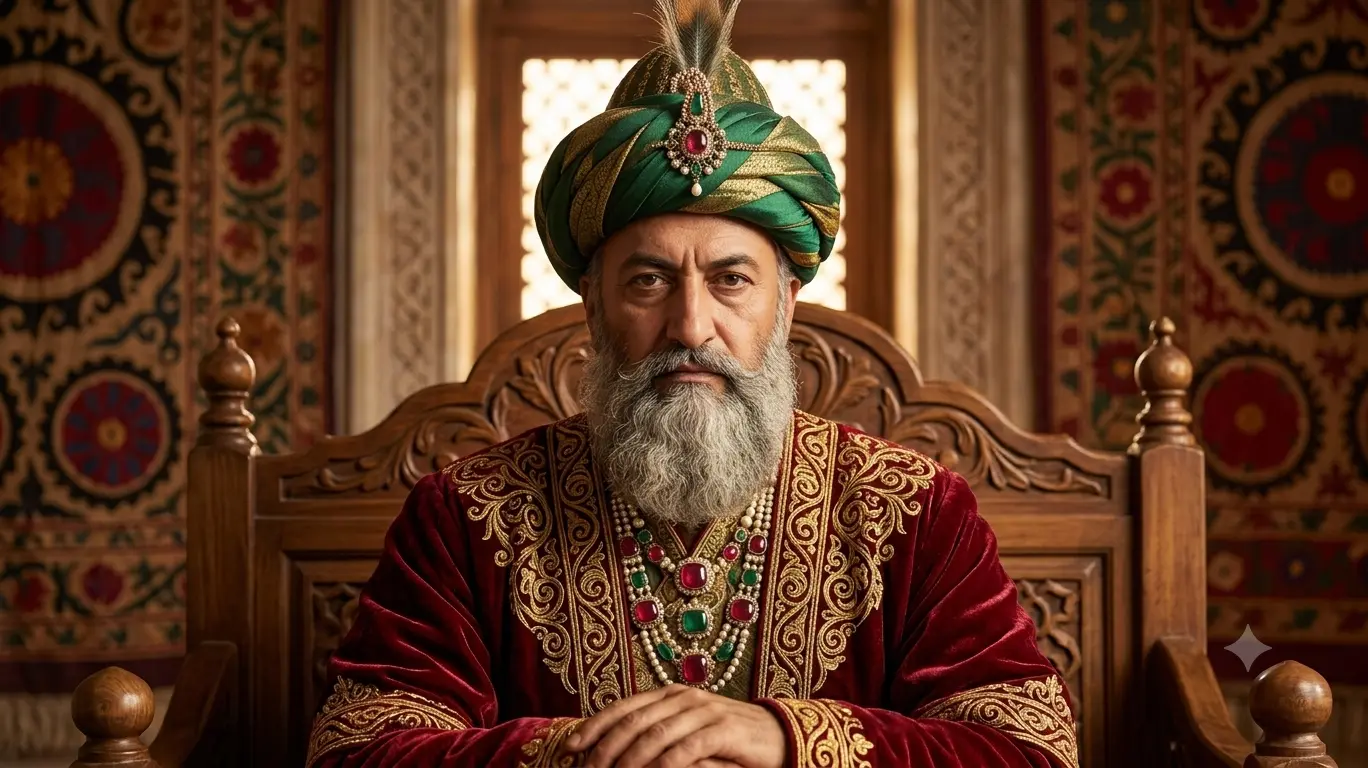
Mu'izz al-Din Muhammad ibn Sam (1149–1206 CE / 544–602 AH), commonly known as Muhammad of Ghor or Shihab al-Din Muhammad Ghuri, was the Ghurid sultan whose military campaigns in northern India fundamentally altered the political landscape of the subcontinent. Unlike his predecessor Mahmud of Ghazni, who had raided India for plunder without establishing permanent governance, Muhammad of Ghor pursued a deliberate policy of territorial conquest and administrative consolidation. His victory at the Second Battle of Tara'in in 1192 CE destroyed the last major Rajput barrier to Muslim advance into the Gangetic plain, and his appointment of capable Turkish slave-generals to govern the conquered territories laid the institutional foundations for the Delhi Sultanate—the first permanent Muslim state in India.
A Note on the Name
The name by which this sultan is known in English is a scholarly accident, and it is worth clearing up before the narrative begins, because almost every form in common use is wrong in some particular.
His titles changed during his life. Shihab al-Din was his title while his elder brother was still merely a prince; the brother's was Shams al-Din. Soon after that brother succeeded to the sovereignty of Ghor, both titles were altered: the brother became Ghiyath al-Din, and he became Mu'izz al-Din. H. G. Raverty, editing and translating the Tabaqat-i Nasiri, sets this out and adds the decisive evidence — no coin of his bears the title Shihab al-Din. Many later authors, unaware of the change, went on calling him Shihab al-Din; some reversed the sequence and supposed Mu'izz al-Din was the earlier title. Raverty notes that Firishta uses both indifferently, and candidly corrects his own earlier notes, where he had slipped into the same error.
The familiar English form has a separate and more curious origin. Alexander Dow, translating Firishta in the eighteenth century, rendered the name "Mahommed Ghori" as though Ghori were part of his personal name. It is not: the terminal -i is the ya-i-nisbat, the Persian and Arabic suffix of relation, which turns a place into an adjective of origin — Hind into Hindi, Kabul into Kabuli. "Ghuri" means no more than "of Ghor". Raverty observed that compilers of histories of India had "re-echoed the name of Mahommed Ghori down to the present day", and that is the line of descent by which the form reached modern English usage, including the title of this article.
This article uses Mu'izz al-Din Muhammad ibn Sam for the man and retains Muhammad of Ghor as the name a reader will be looking for.
The Ghurid Dynasty: Origins and Context
Geographic and Ethnic Background
The Ghurids originated from the mountainous region of Ghor, a remote and rugged territory in central Afghanistan between Herat and Ghazni. Unlike the Ghaznavids, who were of Turkic slave-soldier origin, the Ghurids were of eastern Iranian (Tajik) ethnicity, speaking a Persian dialect and claiming ancient Iranian royal lineage. Their homeland—a region of deep valleys, precipitous mountains, and isolated communities—had long remained on the periphery of the major Central Asian empires, maintaining a fierce independence that resisted outside control.
The inhabitants of Ghor had converted to Islam relatively late compared to the lowland populations of Khorasan and Transoxiana. According to historical traditions, the region was Islamized gradually between the ninth and eleventh centuries, with pockets of pre-Islamic practice persisting into the Ghaznavid period. Mahmud of Ghazni reportedly conducted a punitive expedition against Ghor early in his reign, subjugating the region and imposing tributary status. This Ghaznavid domination was resented by the Ghurid chiefs, and the eventual Ghurid destruction of Ghazni in 1151 CE—when Ala al-Din Husayn earned the epithet "Jahan-soz" (World-Burner) by burning the Ghaznavid capital—was partly an act of revenge for earlier humiliations.
The Rise of Ghurid Power
The Ghurid dynasty's ascent from obscure mountain chiefs to masters of a vast empire was gradual but accelerating, driven by the same dynamic that had produced many Central Asian military dynasties: ambitious warriors exploiting the decline of existing powers to carve out new dominions.
The earliest Ghurid rulers were petty chieftains whose authority extended little beyond their immediate mountain valleys. Their power grew incrementally through the eleventh and twelfth centuries as they accumulated military resources, formed alliances with neighboring groups, and exploited opportunities created by the conflicts of larger powers. The key turning point came with the weakening of the Ghaznavid Empire following its loss of Central Asian territories to the Seljuk Turks at the Battle of Dandanaqan (1040 CE). As Ghaznavid power contracted, the Ghurids gained increasing room for expansion.
The key figure in transforming the Ghurids from mountain chieftains into a significant regional power was Ala al-Din Husayn (r. 1149–1161 CE), who sacked the Ghaznavid capital of Ghazni and acquired the epithet "Jahan-soz," the World-Burner. Juzjani records that he also demolished the Ghaznavid palaces at Bust, which had been the residence of the house of Mahmud. The occasion was the death of his brother Saif al-Din: the Ghaznavid sultan Bahram Shah had taken him captive, paraded him through Ghazni on a bullock, and put him to death, and Ala al-Din marched to avenge him. The sources disagree over the year, Fasihi placing the sack immediately after Bahram Shah's death in 523 AH while other authorities date that death, and the sack with it, to 532, 544, 547, or 552 AH. The campaign established the Ghurids as a power capable of challenging the existing order. The destruction of Ghazni was so complete that the city never fully recovered its former grandeur, and the psychological impact on the region's political calculations was immense.
However, Ala al-Din's empire was unstable, dependent on his personal military prowess rather than institutional foundations. After his death, the dynasty experienced a period of fragmentation and internal conflict as different branches of the family competed for supremacy. This turbulence was characteristic of steppe and mountain political systems, where succession was typically determined by force rather than established constitutional rules.
The decisive consolidation came under two brothers whose complementary abilities and remarkable mutual loyalty created a partnership unique in Ghurid history: Ghiyath al-Din Muhammad (r. 1163–1202 CE) and his younger brother Mu'izz al-Din Muhammad (the subject of this article). This fraternal partnership—with Ghiyath al-Din ruling from the Ghurid capital of Firuzkuh as the senior sultan and Mu'izz al-Din operating as his subordinate commanding the eastern campaigns—proved remarkably effective and durable. The elder brother provided political stability, managed western affairs and diplomacy, and handled the complex internal politics of the Ghurid homeland, while the younger brother directed his formidable military energies toward India and the eastern frontier. Their partnership endured without serious friction for nearly four decades—an extraordinary achievement in a political culture where fraternal rivalry was the norm.
The Ghurid-Ghaznavid Rivalry
The Ghurids and Ghaznavids were bitter historical rivals whose enmity stretched back generations. The Ghaznavid sultan Mahmud had subjected the Ghurid homeland to military humiliation early in his reign, imposing tributary status and demonstrating the power differential between the mighty Ghaznavid Empire and the minor Ghurid chieftains. This humiliation festered through the generations, and when Ghurid power eventually surpassed Ghaznavid, the reversal was pursued with the thoroughness of long-nursed vengeance.
The Ghaznavids, reduced to their eastern domains in Punjab after losing their Central Asian and Iranian territories to the Seljuk Turks at Dandanaqan (1040 CE), represented both a historical enemy whose subjugation would satisfy dynastic honor and a practical obstacle to Ghurid expansion toward India. The remnant Ghaznavid state, ruling from Lahore, still controlled the crucial gateway between Afghanistan and the Indian subcontinent—the Punjab, with its agricultural wealth and strategic position.
In 1186 CE, Muhammad of Ghor captured Lahore, the last Ghaznavid capital, and deposed the final Ghaznavid sultan, Khusrau Malik. The capture was accomplished through a combination of military pressure and political manipulation—sources suggest that Khusrau Malik was lured out under promise of safe conduct and then seized. The Ghaznavid dynasty, which had ruled for over two centuries since the time of Mahmud and had once been the most powerful state in the eastern Islamic world, was finally extinguished—a humiliating end that satisfied Ghurid historical grievances while simultaneously serving strategic imperatives.
This conquest gave Muhammad control of the Punjab—the same base from which Mahmud had launched his raids into India nearly two centuries earlier—and positioned him for deeper penetration into the Indian heartland. Unlike Mahmud, however, Muhammad did not intend merely to raid and return; his strategic objective was permanent territorial expansion and the establishment of lasting Muslim political authority in India. The Punjab provided both the logistical base and the strategic depth necessary for this more ambitious enterprise.
Early Career and Rise to Power
Youth and Formation
Muhammad ibn Sam was born in 1149 CE in the Ghurid heartland of central Afghanistan, amid the rugged mountain landscapes that had shaped his people's character for generations. As the younger brother of the ruling sultan Ghiyath al-Din, he was raised in the martial traditions of the Ghurid mountain aristocracy—a culture that valued physical courage, endurance, military skill, and personal loyalty above all else. The rugged terrain of Ghor—with its deep valleys, precipitous passes, and harsh winters—produced hardy warriors accustomed to difficult conditions, and Muhammad's early training prepared him well for the extraordinary physical demands of his later campaigns across deserts, mountains, and plains.
From an early age, Muhammad demonstrated exceptional military ability and personal courage. He was appointed governor of the strategic city of Ghazni—symbolic given the Ghurid-Ghaznavid rivalry—and used it as his base for eastern operations. The relationship between the two brothers was characterized by mutual loyalty and complementary strengths: Ghiyath al-Din was the administrator and diplomat, Muhammad the warrior and conqueror.
Early Military Campaigns
Muhammad's first military experiences included campaigns within Afghanistan and against neighboring powers. He participated in Ghurid operations against the Khwarazmians to the north and against various Afghan tribal groups who resisted Ghurid authority. These early campaigns honed his tactical skills and gave him experience in managing diverse military forces composed of Tajik mountaineers, Turkic cavalry, and tribal levies.
His first forays toward India came in the 1170s and 1180s, initially probing the defenses of the Indian borderlands and testing the capabilities of the principalities that lay between Afghanistan and the Gangetic heartland. In 1175 CE, Muhammad led an expedition against Multan and the Ismaili state in southern Punjab, capturing both and eliminating the Ismaili presence in the region. The Ismailis—adherents of the Fatimid Caliphate's branch of Shia Islam—had maintained an independent political presence in the lower Punjab for decades. Their elimination served both religious purposes (suppressing what Sunni Islam considered heterodoxy) and strategic ones (removing a potentially hostile power from Muhammad's intended line of advance).
In 1178 CE, Muhammad attempted an ambitious campaign against Gujarat, approaching via Sind and the Thar Desert. The objective was the wealthy Chaulukya (Solanki) kingdom, whose prosperity from maritime trade made it an attractive target. However, the campaign ended in a severe defeat at the hands of the Chaulukya ruler Mularaja II (or his regent) near Mount Abu. The Indian forces, fighting on familiar terrain and defending their homeland, overwhelmed Muhammad's army, which had been weakened by the long desert march and supply difficulties.
The Gujarat defeat was a formative experience that profoundly shaped Muhammad's subsequent strategic thinking. It taught him several lessons: the dangers of overextending lines of communication across hostile terrain; the necessity of securing flanks and rear before advancing deep into enemy territory; the importance of adequate logistical preparation; and the reality that Indian armies, when fighting on favorable terrain with adequate preparation, could inflict serious defeats on Muslim forces. These lessons were absorbed and applied to his later, more successful campaigns.
Following this setback, Muhammad adopted a fundamentally more methodical approach to Indian expansion. Rather than attempting deep penetration raids in the manner of Mahmud of Ghazni—high-risk ventures through hostile territory aimed at distant targets—he pursued a systematic strategy of territorial consolidation, moving step by step from Punjab toward the Gangetic plain. Each conquered territory was secured and garrisoned before the next advance was attempted, creating a solid base that could not be cut off.
Between 1179 and 1190 CE, Muhammad methodically secured the northwestern approaches to India. He captured Peshawar (1179 CE), establishing control over the eastern end of the Khyber Pass. He took Sialkot (1185 CE), a major fortress controlling routes into the Punjab. And he captured Lahore (1186 CE), eliminating the last Ghaznavid ruler and gaining control of the most important city in the Punjab—the gateway to India proper.
The capture of Lahore was the strategic culmination of this patient approach. With Lahore in his hands, Muhammad controlled the entire Punjab—a wealthy agricultural region that could support a substantial military establishment and serve as a forward base for operations deeper into India. From Lahore, the Gangetic plain was accessible through well-established routes, and the Rajput kingdoms that stood between Punjab and Delhi were now directly exposed to Ghurid military pressure.
The Battles of Tarain
The First Battle of Tarain (1191 CE)
The encounter that would define Muhammad's career—and determine the political future of northern India—came at Tarain (modern Taraori, near Karnal in Haryana), approximately 150 kilometers north of Delhi. The immediate cause was Muhammad's capture of the fortress of Bhatinda (Tabarhindah), which lay within the domains of the Chahamana (Chauhan) kingdom ruled by Prithviraj III, one of the most powerful Rajput rulers of the era.
Prithviraj III, who ruled from Ajmer and Delhi, was a formidable warrior-king celebrated in later Rajput legend for his personal valor and military prowess. His kingdom—the Chahamana (Chauhan) realm—was one of the largest and most powerful in northern India, stretching from Ajmer in Rajasthan to Delhi in the Gangetic plain. He commanded the loyalty of numerous subordinate Rajput chiefs, and his court was renowned for its martial culture, poetic patronage, and courtly magnificence. The later epic poem Prithviraj Raso, composed by his court poet Chand Bardai, celebrates him as the foremost Hindu warrior-king of his age—though the historical reliability of this text in its surviving form is debated by scholars.
Upon learning of Bhatinda's fall to the Ghurids—an act of aggression against his sovereign territory—Prithviraj assembled a large army and marched north to confront Muhammad. He drew upon the military resources of his own domains and called upon allied and subordinate Rajput chiefs to contribute forces, creating a confederate army of considerable size. The mobilization demonstrated both the strength of the Rajput military system—its ability to field large forces quickly—and its inherent weakness: the army was composed of contingents from multiple kingdoms, each under its own chief, united by personal loyalty rather than institutional command structures.
The two forces met at Tara'in in 1191 CE (587 AH). The place-name is itself unsettled in the English literature: Raverty records that the form was corrupted by translators into "Narain" and "Nardin", that Dow gave it as "Styauri upon the banks of the Sirsutty" and Briggs as "Narain", and he states flatly that no places of those names exist. Tara'in is the form his manuscripts support, and the one used here.
The first battle was a defeat for Muhammad, and the Tabaqat-i Nasiri is direct about it: the Sultan was beaten by Rae Pithora — the Chauhan ruler of Ajmer, Prithviraj — and severely wounded in the fighting. The Rajput cavalry, on familiar ground and in superior numbers, pressed the Ghurid forces hard. Later accounts add that the wound would have been fatal had a bodyguard not carried him from the field; that detail is an elaboration rather than something Juzjani supplies. The Ghurid army withdrew in disorder and Muhammad returned to Ghazni to recover and rebuild.
This defeat was significant for several reasons. It demonstrated that Indian armies were capable of inflicting serious defeats on Muslim invaders—contrary to the triumphalist narrative of some later chronicles. It revealed the tactical limitations of Muhammad's approach against determined resistance. And it set the stage for the dramatic reversal that would follow a year later.
According to some Indian sources (particularly the later Prithviraj Raso), Prithviraj's failure to pursue the retreating Ghurids was a critical strategic error motivated by misplaced chivalric ideals. Whether historically accurate or a later literary construction, the notion that Prithviraj allowed Muhammad to escape and regroup has become a prominent element of Indian historical memory of this period.
The Second Battle of Tarain (1192 CE)
Muhammad spent the intervening year preparing meticulously for a return campaign. The defeat of 1191 CE had been a humiliation that demanded redress—not merely for personal honor but for the political credibility of the Ghurid state. Muhammad's response demonstrated the qualities that distinguished him from lesser commanders: rather than rushing back with the same approach that had failed, he spent months analyzing his defeat, identifying its causes, and developing a completely new tactical doctrine designed specifically to counter the strengths that had overwhelmed him.
He assembled a larger army—estimates vary significantly between sources, but modern historians suggest approximately 120,000 cavalry. Crucially, this army was not merely bigger but differently organized and equipped. Muhammad recruited additional mounted archers from Central Asian Turkic tribes—specialists in the hit-and-run warfare of the steppe that would form the core of his new tactical approach. He also ensured that his forces were organized into clearly defined divisions with designated commanders, enabling the complex coordinated maneuvers he planned.
Muhammad reportedly sent a diplomatic message to Prithviraj before the battle, offering to withdraw if the Rajput king would acknowledge Ghurid suzerainty and pay tribute. Whether this was a genuine peace overture or a tactical deception designed to lull the enemy is debated—but Prithviraj rejected any submission, and both sides prepared for battle.
Prithviraj, for his part, assembled a coalition of Rajput rulers—according to some sources, as many as 150 Rajput chiefs contributed forces to his army, making it the largest military assemblage in northern India's recent history. The confederation included forces from the Chahamana heartland, allied Rajput kingdoms from Rajasthan and the Gangetic plain, and levies from subordinate chiefs. However, the coalition suffered from the typical weakness of confederate armies: lack of unified command, rivalries between component rulers, different military traditions and equipment, and difficulty coordinating diverse forces into cohesive battlefield formations.
Muhammad's tactical innovation at the Second Battle of Tarain was decisive and represented a fundamental departure from conventional Central Asian military practice of the period. Rather than meeting the Rajput cavalry charge head-on—which had proven disastrous the previous year—he adopted a strategy combining mounted archery with feigned retreats, division rotation, and concentrated counterattack. He divided his army into four (some sources say five) divisions and deployed them in a rotation system: fresh divisions engaged the enemy while tired ones withdrew to rest, water their horses, and reform. This maintained continuous pressure on the enemy while preventing the exhaustion that had doomed his first attempt.
The battle unfolded over a full day of relentless fighting. Muhammad opened with harassing attacks by mounted archers, who rode forward in waves, discharged their arrows at the Rajput formations, and withdrew before the heavy cavalry could engage them. This provoked the Rajput cavalry into pursuit—exactly as Muhammad intended. As the Indian forces charged, the Ghurid divisions performed controlled withdrawals, drawing the enemy forward while continuing to rain arrows on them. The pursuing Rajput cavalry, encumbered by heavier armor and larger horses than the Turkic mounts, exhausted themselves in repeated charges that failed to come to grips with the elusive Ghurid horse archers.
This phase of the battle lasted for hours, with the Rajput army gradually becoming disordered and exhausted from repeated fruitless charges. The confederate nature of the army exacerbated this problem—different contingents pursued at different speeds and in different directions, losing their cohesion as a unified force. The coordination that the Rajput army had maintained in the initial deployment gradually dissolved under the stress of continuous harassment without the satisfaction of actual combat.
When Muhammad judged that the Rajput forces were sufficiently disordered, exhausted, and separated from each other, he committed his reserve—fresh, heavily armed cavalry that had been held back throughout the day. This reserve struck in a concentrated mass against the now-disorganized Rajput center, achieving devastating impact against troops that were already physically exhausted and psychologically demoralized by hours of fruitless pursuit.
The result was devastating. The Rajput coalition army broke under the impact of the fresh reserve cavalry, and the rout was complete—once the center broke, the individual contingents lacked the command structure to reorganize. Prithviraj III was captured fleeing the battlefield (or shortly after, according to varying accounts). The fate of Prithviraj after capture is debated—some sources say he was taken to Ghazni and eventually executed after attempting revolt, others that he was killed shortly after the battle, and still others that he was initially treated with some dignity before his execution. What is certain is that the Chahamana kingdom—the most powerful Rajput state of the era—was destroyed as an independent political force, and its fall opened the gates to the conquest of northern India.
Significance of Tarain
The Second Battle of Tarain (1192 CE) is widely regarded as one of the most consequential battles in Indian history—a turning point comparable in significance to the Battle of Yarmouk (636 CE) for the Byzantine Empire or the Battle of Hastings (1066 CE) for England. It opened the Gangetic plain—the demographic and economic heartland of northern India, home to its largest populations, most fertile agricultural lands, and wealthiest cities—to Muslim conquest. The rapid collapse of Hindu political resistance after Tarain suggests that the existing political system, characterized by fragmented kingdoms, personal lordships, and the absence of mechanisms for coordinated defense, was incapable of organizing effective large-scale resistance against a determined and professionally organized military force operating under unified command.
The military lessons of Tarain were significant for both sides, though only one side survived to apply them. For the Ghurids and their successors, the battle confirmed the effectiveness of combined-arms tactics—the integration of mounted archery, heavy cavalry, and sophisticated maneuvering—against opponents who relied primarily on the mass cavalry charge. These lessons were incorporated into the military doctrine of the Delhi Sultanate and applied with consistent success against Indian opponents for the next century.
For Indian military culture, Tarain exposed fatal structural weaknesses: the absence of standing armies capable of sustained campaigning; the reliance on confederate forces that could not match the coordination of professional armies; the lack of tactical flexibility in a military tradition that emphasized frontal assault over maneuver; and the vulnerability of personalized political systems to decapitation—the removal of the paramount leader causing complete organizational collapse. These weaknesses would persist, contributing to subsequent Indian military defeats against professional forces, until eventually Indian military systems adapted and evolved in response.
However, it is important to note that the battle did not represent a simple "Hindu vs. Muslim" civilizational clash, despite frequent framing in those terms by later nationalist historiographies on both sides. The military systems on both sides were complex, and both armies included diverse ethnic and religious components. Muhammad's forces included Indian auxiliaries and Hindu administrators, while Prithviraj's coalition was weakened by rivalries among its Rajput components that had nothing to do with religion. The outcome reflected military-organizational superiority—the Ghurid professional army versus the loosely organized Rajput confederacy—as much as any other factor.
The Conquest of Northern India
The Immediate Aftermath of Tarain
The victory at Tarain opened the floodgates of conquest. Within months of the battle, Muhammad's forces swept across the Gangetic plain with remarkable speed, encountering minimal organized resistance. The destruction of the Chahamana kingdom—the strongest Rajput power—removed the last significant barrier to Muslim advance into the Indian heartland. Delhi fell immediately after Tarain, as did Ajmer (Prithviraj's capital). The major Rajput kingdoms, deprived of their most powerful champion and shocked by the completeness of his defeat, were unable to organize effective resistance individually.
The speed of the post-Tarain conquests requires explanation. It reflects several factors: the highly personalized nature of Indian political authority (the capture or death of a king often caused the complete collapse of his kingdom's resistance), the absence of institutional mechanisms for collective defense among Indian kingdoms, the psychological impact of Prithviraj's defeat on other rulers who had regarded him as their protector, and the military superiority of the Ghurid professional army over hastily assembled feudal levies.
The territories that fell in the immediate aftermath included not only the Chahamana domains but also neighboring principalities whose rulers calculated that submission was preferable to destruction. Many local Hindu chiefs—particularly those of lower rank—chose to acknowledge Muslim overlordship and continue governing their territories as tributaries rather than risk annihilation in futile resistance. This pragmatic accommodation by local elites was essential for the establishment of Muslim governance, as the conquerors lacked the manpower to directly administer the vast territories they were nominally claiming.
Muhammad did not personally remain in India to oversee the detailed conquest and its administrative consolidation. Instead, he entrusted this critical task to his most capable slave-general, Qutb al-Din Aibak, who had proven himself in earlier campaigns and whom Muhammad trusted absolutely. This delegation of authority was a defining characteristic of Muhammad's approach—and one of his most significant contributions to Indian history, as it created the military-administrative class that would form the ruling elite of the Delhi Sultanate.
Muhammad's decision to return to Afghanistan rather than remain in India reflected his strategic priorities. The Central Asian frontier—where the Khwarazmian Empire was expanding aggressively—demanded his personal attention, and the practical difficulties of governing a vast new territory while simultaneously managing Central Asian affairs made delegation unavoidable. However, this distance also meant that the Indian conquests developed their own momentum and eventually their own institutional logic, laying the groundwork for the independent sultanate that would emerge after Muhammad's death.
Qutb al-Din Aibak and the Extension of Conquest
Qutb al-Din Aibak, a Turkish slave who had risen through Muhammad's military household to become his most trusted commander, proved an exceptional choice as viceroy in India. Operating from Delhi as his base, Aibak systematically extended Muslim control across northern India between 1192 and 1206 CE. He captured Meerut, Kol (Aligarh), Bulandshahr, and other fortresses in the Delhi region, establishing garrisons and administrative structures as he went.
Aibak's campaigns were characterized by strategic pragmatism combined with military efficiency. Where possible, he accepted the submission of local rulers, incorporating them as tributaries rather than displacing them entirely. This approach conserved military resources and provided a framework for governance that utilized existing administrative structures. Where resistance was offered, he responded with decisive military force that demonstrated the consequences of defiance. This combination of coercion and accommodation proved effective in establishing control over a vast territory with relatively limited military resources.
Aibak also demonstrated administrative and cultural ambitions beyond mere military occupation. He began the construction of the Quwwat al-Islam mosque in Delhi and the Qutb Minar—projects that symbolized the permanence of Muslim rule and the cultural confidence of the new regime. He established a court in Delhi that attracted scholars, poets, and administrators from across the Islamic world, creating the institutional nucleus of what would become the sultanate's governing apparatus.
The relationship between Muhammad and Aibak was a model of trust and delegation. Muhammad provided strategic direction, military reinforcement when needed, and legitimizing authority. Aibak provided operational command, administrative implementation, and detailed knowledge of Indian conditions. This partnership—between an Afghan emperor and his Indian-based slave-general—created the template for the Delhi Sultanate's later governance structure, in which distant political authority was exercised through locally empowered military commanders.
Aibak's loyalty to Muhammad remained constant throughout—he never attempted to declare independence during his master's lifetime, despite controlling resources and territory that would have made such a declaration feasible. This loyalty reflected both the personal bonds of the mamluk system and Aibak's pragmatic recognition that Muhammad's Central Asian power provided a strategic depth that India alone could not offer. Only after Muhammad's assassination in 1206 CE did Aibak assume independent sovereign status—a transition that Muhammad's death made inevitable rather than a betrayal of their relationship.
Bakhtiyar Khalji and the Conquest of Bengal and Bihar
While Aibak consolidated the western Gangetic plain, another of Muhammad's officers—Ikhtiyar al-Din Muhammad Bakhtiyar Khalji—conducted an independent campaign that brought Bengal and Bihar under Muslim control. Bakhtiyar Khalji was a minor Khalji Turk officer who, frustrated by lack of advancement in Aibak's service (his small physical stature reportedly led to repeated rejection when he presented himself for military enrollment), struck out on his own toward the east with a small band of followers.
Operating initially from the frontier region of Bihar, Bakhtiyar conducted a series of escalating raids that demonstrated his boldness and tactical skill. Beginning with small-scale plundering expeditions that yielded enough wealth to attract additional followers, he gradually built a force capable of more ambitious operations. His success attracted other adventurers and soldiers of fortune, creating a growing warband that operated semi-independently on the eastern frontier of the expanding Muslim territory.
His first major military achievement was the attack on the Bihar region in approximately 1193 CE, during which his forces overwhelmed the major Buddhist monastery-university complexes of the region—including the great institutions of Nalanda, Odantapuri, and Vikramashila. These monasteries had been among the greatest centers of learning in Asia, with traditions stretching back many centuries. They housed vast libraries, maintained centuries of scholarly tradition, and served as educational centers drawing students from across the Buddhist world—from Tibet to Southeast Asia.
The destruction of these institutions represents one of the most controversial and consequential aspects of the Ghurid conquests. The nature and extent of the destruction has been debated. Some sources suggest that Bakhtiyar's soldiers, encountering fortified compounds filled with shaven-headed men in robes, initially mistook the monasteries for military fortresses—a claim that, if true, would suggest the destruction was partly inadvertent rather than deliberately targeted at Buddhist learning. Other sources indicate more deliberate destruction. Regardless of intent, the consequences for Buddhist institutional life in eastern India were catastrophic and permanent—Buddhism, which had already been declining in India for several centuries, was effectively eliminated as an organized institutional presence in its homeland.
Bakhtiyar's subsequent conquest of the wealthy Bengali capital of Nabadwip (Nadia) in 1204 CE, achieved through a bold surprise attack with merely eighteen horsemen at the vanguard (the main force following behind), brought the rich and populous Bengal region under Muslim political authority. The Sena king Lakshmanasena, aged and unprepared, fled without offering resistance, and the wealthy city fell with minimal fighting. This exploit—taking a major capital with a handful of cavalry through sheer audacity—became legendary in the annals of Muslim India and exemplified the opportunistic boldness that characterized the frontier phase of Muslim expansion.
Muhammad's Continuing Role
Despite delegating operational command to his generals, Muhammad continued to involve himself directly in Indian affairs through periodic return visits and strategic oversight. He made multiple return journeys to India to campaign personally and to oversee the political arrangements of the conquered territories—ensuring that his generals remained subordinate and that the overall direction of conquest aligned with his strategic vision.
In 1194 CE, Muhammad personally led a campaign that defeated Jayachandra, the Gahadavala ruler of Kanauj and Varanasi—the last major Hindu kingdom of the upper Gangetic plain. Jayachandra's kingdom controlled the holy city of Varanasi (Benares) and the ancient capital of Kanauj, making it both economically important and symbolically significant. According to some sources, Jayachandra had remained neutral during the Second Battle of Tarain—perhaps hoping that Prithviraj's defeat would remove a rival—only to find himself the next target of Ghurid expansion. The battle was fought near Chandawar on the Yamuna River, and Jayachandra was killed in the fighting. The fall of the Gahadavala kingdom—historically regarded as the paramount power of the central Gangetic plain—confirmed the completeness of the Ghurid conquest of northern India.
Muhammad also handled the political incorporation of conquered territories, receiving the submission of defeated rulers, appointing governors, establishing revenue systems, and arbitrating disputes among his generals. His administrative approach combined elements from Persian-Islamic governance traditions—bureaucratic record-keeping, formalized taxation, Islamic law for Muslim populations—with pragmatic accommodation of existing Indian administrative structures where these continued to function effectively.
Central Asian Campaigns and the Struggle for Khorasan
The Khwarazmian Challenge
Muhammad's ambitions were not limited to India. Following his brother Ghiyath al-Din's death in 1202 CE, Muhammad became the sole ruler of the entire Ghurid Empire and inherited responsibility for its Central Asian and western frontiers. Here he faced a far more dangerous opponent than any Indian kingdom: the rising Khwarazmian Empire under Ala al-Din Muhammad Khwarazmshah.
The Khwarazmians, based in present-day Uzbekistan and Turkmenistan, were rapidly expanding their power across Central Asia and Iran, absorbing territories that had previously been under Seljuk, Qarakhanid, or local dynastic control. Their military strength was formidable—they commanded large armies of Turkic cavalry supplemented by Kipchak mercenaries from the northern steppes. Their ambitions clashed directly with Ghurid interests in Khorasan, the wealthy eastern Iranian province that the Ghurids had controlled since the 1190s. Control of Khorasan—with its great cities of Nishapur, Herat, and Merv, its sophisticated administrative traditions, and its position on major trade routes—was the primary point of contention.
The Ghurid-Khwarazmian rivalry reflected broader structural forces: both were expansionary military states seeking to dominate the same strategic space, and the decline of the Seljuk Empire had created a power vacuum that both sought to fill. Diplomatic attempts to resolve the conflict—including the proposed marriage of Ghiyath al-Din's daughter to the Khwarazmshah—had failed, and by the early thirteenth century, the confrontation had become inevitable.
The Battle of Andkhud (1204 CE)
In 1204 CE, Muhammad suffered a major defeat at the Battle of Andkhud in northern Afghanistan, where his forces were overwhelmed by a Khwarazmian army. The battle was fought in the context of Muhammad's attempt to reassert Ghurid authority over territories in Khorasan that the Khwarazmians were encroaching upon. The exact circumstances are debated—some sources suggest Muhammad was overconfident after his Indian victories and underestimated the Khwarazmian threat—but the result was clear: a decisive Ghurid defeat that shattered Muhammad's aura of military invincibility.
This defeat was significant in multiple ways. It demonstrated that Muhammad's military machine, optimized for Indian warfare against poorly organized resistance, was less effective against the professional armies of Central Asian Muslim states that employed similar tactics and equipment. It shook Ghurid prestige and encouraged challenges to Muhammad's authority from various quarters—governors and commanders who had been held in check by the threat of overwhelming force now calculated that the sultan's power might not be so overwhelming after all. And it forced Muhammad to divert military resources from India to defend his Afghan heartland, weakening the sultanate's eastern expansion at a critical moment.
Attempts at Recovery
Muhammad attempted to recover his position through both military action and diplomatic maneuvering. He rebuilt his forces, drawing on the wealth of his Indian provinces to recruit new soldiers and purchase equipment. He launched counter-offensives against Khwarazmian positions, with mixed results—some skirmishes went in his favor, but the overall strategic balance had shifted against the Ghurids.
His diplomatic efforts included attempts to secure alliances with other Central Asian powers threatened by Khwarazmian expansion—particularly the Abbasid Caliphate and the Qarakhanid remnants. However, the fundamental strategic problem remained: the Ghurid Empire lacked the demographic and economic resources to simultaneously maintain its Indian conquests and compete with the Khwarazmians for Central Asian hegemony. The Ghurids were a mountain people ruling over a relatively small population base, while the Khwarazmians commanded the wealthy and populous lands of Transoxiana.
This strategic overextension—the impossibility of maintaining dominance on two fronts against enemies of comparable military capability—would ultimately prove fatal not to the empire immediately (it would survive in India as the Delhi Sultanate), but to the Ghurid dynasty's unity and to Muhammad personally. His assassination in 1206 CE can be partly attributed to the political destabilization that followed Andkhud—a weakened ruler attracted the attention of enemies both foreign and domestic.
Administration and Governance
The Military Slave System
Muhammad's most significant institutional contribution was the development of the military slave (mamluk/ghulam) system as a tool of imperial governance. He purchased, trained, and promoted Turkic slave-warriors of exceptional ability, binding them to himself through personal loyalty, shared military experience, and the bonds of the master-slave relationship as understood in medieval Islamic culture.
The mamluk system, as practiced by Muhammad, involved the systematic recruitment of young Turkic boys—usually acquired through purchase from slave markets in Central Asia, where the constant tribal warfare of the steppes produced a steady supply of captives. These boys were removed from their natal families and cultures, converted to Islam (if not already Muslim), given new names, and subjected to a rigorous program of military and administrative education. This education encompassed horsemanship, weapons training (sword, lance, bow), military tactics, Islamic religious education, Persian literacy, and administrative skills.
The system's genius—morally ambiguous as it was—lay in its creation of an elite whose loyalty was directed entirely toward their master rather than toward kinship groups, tribal affiliations, or territorial interests. A mamluk commander's power derived solely from his master's favor; he had no independent base of support to fall back on. This made mamluks both absolutely loyal (in theory) and absolutely dependent—the ideal combination for a ruler seeking reliable instruments of governance in a turbulent political environment.
This system produced a remarkable cadre of military leaders. Qutb al-Din Aibak, Taj al-Din Yildiz, Nasir al-Din Qubacha, and others were all products of this system—men of slave origin who rose through demonstrated ability to command armies and govern provinces. The quality of these commanders speaks to Muhammad's skill as a judge of talent and his effectiveness as a trainer of military leaders. His ability to identify potential in raw recruits and nurture it through appropriate training and graduated responsibility was perhaps his most underappreciated gift.
The slave-military system served multiple functions beyond providing loyal commanders. It provided Muhammad with absolutely loyal commanders whose power derived entirely from his favor—unlike tribal chieftains or hereditary nobles, slave-generals had no independent power base and depended entirely on their master for status, wealth, and authority. It created a meritocratic pathway for advancement, rewarding ability regardless of birth—in a world where hereditary aristocracy was the norm, this opened paths to power for talented individuals who would otherwise have remained obscure. And it provided institutional continuity: when Muhammad died without a direct heir capable of inheriting, his slave-generals were positioned to continue his work independently, preserving the conquests he had made even though his dynasty could not.
Governance of Conquered India
The administrative system Muhammad established in India was necessarily improvised and experimental—he was conquering territories at a pace that outstripped his ability to create permanent institutions, and the challenge of governing a predominantly Hindu population through Islamic political structures had no exact precedent. The basic approach was to appoint military governors (iqtadars) over major cities and regions, supported by garrisons of Turkish cavalry. These governors were responsible for maintaining order, collecting revenue, defending against local resistance, and administering justice (at least for the Muslim population).
Revenue collection in the newly conquered territories combined pre-existing Indian fiscal systems with Islamic taxation principles. The kharaj (land tax) was imposed on agricultural territories, assessed on the basis of productive capacity—a system that required maintaining existing administrative records and employing knowledgeable local officials. Urban populations contributed through various commercial levies on trade and manufacture. Hindu subjects were classified as dhimmis (protected non-Muslims) and required to pay the jizya (poll tax) in exchange for protection and the right to practice their religion undisturbed.
The practical implementation of these systems depended heavily on Hindu cooperation. Muslim conquerors lacked the linguistic knowledge, cultural familiarity, and sheer numbers necessary to administer India directly at all levels. Hindu revenue officials (patwaris, kanungos) continued to maintain land records and assess taxes at the village level. Hindu merchants continued to dominate internal trade. Hindu chiefs maintained local authority under the overall umbrella of Muslim sovereignty. This accommodation was not ideological tolerance but practical necessity—without Hindu administrative cooperation, the revenue system that funded the military establishment would have collapsed.
Muhammad's administration was pragmatic rather than ideologically rigid. Hindu administrators continued to function at local levels, existing revenue systems were maintained where practical, and wholesale forced conversion was not policy—indeed, it would have been counterproductive, since converting the Hindu population to Islam would have eliminated the legal basis for the jizya, reducing state revenue. The objective was stable revenue extraction and political submission rather than social or religious transformation—a pragmatic approach that his successors in the Delhi Sultanate would largely continue.
Religious Policy
Muhammad was a Sunni Muslim who maintained orthodox religious credentials, but his religious policy in India was characterized more by pragmatism than zealotry. Mosques were constructed in conquered cities—both as places of worship and as symbols of political authority—but the Hindu population was generally left to practice its religion under the dhimmi framework.
The destruction of Hindu temples that accompanied the conquests was driven by a combination of religious ideology (the prohibition of idol worship in Islam), political symbolism (the replacement of one sovereign authority with another), and economic motivation (temple treasuries were often the richest targets in a captured city). However, once a territory was securely held, the policy toward remaining temples was generally tolerant—existing temples were usually allowed to continue functioning, even if no new ones were permitted.
This pragmatic approach reflected both political necessity (Muslims were a tiny minority ruling over a vast Hindu population) and the norms of Islamic governance, which provided established frameworks for managing religiously diverse populations. The later evolution of these policies under the Delhi Sultanate would show considerable variation, from relatively tolerant regimes to more restrictive ones, but Muhammad's initial approach established a basically accommodationist baseline.
The Assassination and Its Aftermath
The Circumstances of Death
Muhammad of Ghor was assassinated on March 15, 1206 CE (3 Shaban 602 AH) while encamped on the banks of the Jhelum River near the town of Dhamiak, during a return journey from Lahore where he had been conducting military operations against rebellious Khokhar tribesmen. The circumstances of his death have been debated by historians, and multiple accounts exist that differ in significant details.
The most widely accepted account holds that Muhammad was killed by a group of assassins who infiltrated his camp during the evening. He was attacked during or immediately after the evening prayer (isha)—a time when he would have been in a state of ritual devotion and relatively unguarded. The assassins struck quickly and fatally, stabbing Muhammad to death before his bodyguards could intervene. The attack was clearly premeditated and well-planned, suggesting insider knowledge of the camp's security arrangements and the sultan's personal routine.
The identity of the assassins has been attributed to several groups by different sources. The most common attribution is to Ismaili assassins (the fidais of the Nizari Ismaili sect, famous throughout the Islamic world for their targeted political killings), possibly in retaliation for Muhammad's suppression of Ismaili communities in Punjab and Sind earlier in his career. The Ismailis had a well-documented tradition of political assassination, and their network of agents was capable of infiltrating even heavily guarded camps.
An alternative attribution names the Khokhars—a powerful Punjabi tribal group that had recently been subjected to severe punitive campaigns by Muhammad's forces. The Khokhars had been in rebellion, and Muhammad's presence in the Punjab at the time of his death was partly motivated by the need to suppress their resistance. Revenge by aggrieved tribesmen whose communities had been devastated by military reprisals is a plausible alternative motivation.
Some historians have suggested that the assassination may have been facilitated by disaffected elements within Muhammad's own military establishment—officers who had grown resentful of his demands or who saw opportunity in his removal. The political instability following the Andkhud defeat (1204 CE) had weakened bonds of loyalty, and the succession vacuum that Muhammad's lack of a capable heir created may have encouraged ambitious subordinates to facilitate his removal.
Regardless of the precise identity and motivation of the assassins, the consequences of Muhammad's death were immediate, profound, and permanent. He died without a clear successor—he had no adult sons capable of inheriting—and his empire fragmented rapidly among his competing slave-generals, each commanding significant military forces and controlling major territories.
The Succession Crisis and the Birth of the Delhi Sultanate
Muhammad's death created an immediate power vacuum that could not be filled by any single individual. The absence of a designated heir—the fundamental weakness of military systems that depend on personal charisma rather than institutional succession mechanisms—meant that power devolved to whoever could seize it. His slave-generals—each commanding significant military forces and controlling major territories—competed for supremacy in a scramble that rapidly dissolved the unified Ghurid Empire into separate entities.
The main contenders were:
- Qutb al-Din Aibak in Delhi and northern India—Muhammad's most trusted commander and the architect of the Indian conquests
- Taj al-Din Yildiz in Ghazni and Afghanistan—who claimed the Ghurid heartland and with it, nominal supremacy over all Muhammad's former domains
- Nasir al-Din Qubacha in Sind and Multan—controlling the vital lower Indus region
Additionally, the Ghurid homeland itself was contested by Muhammad's nephew Ghiyath al-Din Mahmud and other family members, while the Khwarazmians—the same power that had defeated Muhammad at Andkhud—pressed in from the west, ultimately overrunning the Ghurid territories in Afghanistan and Khorasan.
This fragmentation effectively ended the unified Ghurid Empire as a political entity. However, it simultaneously gave birth to the Delhi Sultanate—one of the most significant states in Indian history. Qutb al-Din Aibak, Muhammad's most trusted commander in India, established himself as sovereign at Lahore, founding the line that would rule from Delhi for nearly a century.
The date of that accession is worth pausing on, because it turns on a point of law rather than of chronology. Juzjani has Aibak assume sovereignty at Lahore in Dhu al-Qa'da of 602 AH, three months after the assassination. Raverty argues that the correct year must be 605 AH, and his reasoning is precise: Aibak received his manumission from Sultan Mahmud only in that year, and an unmanumitted slave could not assume sovereignty at all. He allows a way of reconciling the two — that Ala al-Din Muhammad, made sultan of Ghor on Ghiyath al-Din's death, may have sent Aibak the investiture of Hindustan in 602, before being ousted by his rival Mahmud, from whom Aibak then sought and obtained his manumission.
The distinction matters beyond the dating. It shows that the transition from Ghurid province to independent sultanate was not a single act of usurpation on the news of a sultan's death, but a process that had to be made legally as well as militarily — and that a slave commander's first requirement, before sovereignty, was to stop being a slave.
This transition—from the province of a Central Asian empire to an independent Indian sultanate—was one of the most consequential political transformations in South Asian history, creating a state that would endure in various forms for over three centuries and fundamentally reshape the subcontinent's political, cultural, and demographic landscape.
Military Organization and Tactics
Army Composition
Muhammad's military forces combined several traditions. The core consisted of Turkic ghulam (slave-soldier) cavalry—professional warriors trained from youth in horsemanship, archery, and close combat. These elite cavalry, equipped with composite bows, lances, and mail armor, formed the decisive arm in battle. Their disciplined formations and ability to execute complex tactical maneuvers—particularly the feigned retreat combined with mounted archery—gave them significant advantages over the less professionally organized Indian armies.
The Ghurid army also included Tajik and Afghan infantry from the mountainous homeland, cavalry contingents from subject Turkic tribes, and—increasingly as the Indian conquests progressed—Indian auxiliaries including both Muslims and Hindus. War elephants captured in Indian campaigns were incorporated into the army, providing both a psychological weapon and mobile fighting platforms.
Tactical Innovations
Muhammad's military success in India rested on several tactical advantages. The Turkic composite bow, shot from horseback, gave his cavalry a ranged capability that Indian armies largely lacked. The ability to maintain formation discipline during withdrawal—essential for the feigned retreat tactic—required a level of professional training that was difficult for confederate armies of feudal levies to match.
The combination of mobility, firepower, and discipline was the key formula. The Second Battle of Tarain illustrated this perfectly: rather than meeting the Rajput heavy cavalry charge head-on, Muhammad used his mobile horse archers to harass, exhaust, and disorder the enemy before committing his heavy cavalry in a decisive stroke. This approach—adapted from Central Asian steppe warfare traditions—proved devastatingly effective against Indian military systems that emphasized mass frontal charges.
However, it should be noted that this tactical superiority was not absolute. The First Battle of Tarain showed that Indian armies could defeat Ghurid forces, particularly when fighting on favorable terrain with numerical superiority. Muhammad's defeat in Gujarat (1178 CE) further demonstrated that the Ghurid military machine was not invincible. Victory required not only tactical skill but also intelligence, logistics, and careful preparation—qualities in which Muhammad excelled but which required learning from initial failures.
Fortification and Garrison Strategy
Beyond battlefield tactics, Muhammad's approach to holding conquered territory was significant. Rather than attempting to garrison every village and town—an impossibility given his limited manpower—he focused on controlling key fortress cities that dominated communication routes and river crossings. Garrisons in Delhi, Kol, Badaun, and other strategic points created a network of Muslim military strongholds that could support each other and project power over the surrounding countryside.
This approach accepted that direct Muslim control would be limited to urban centers and major communication routes, while the vast countryside remained under the authority of local Hindu landholders who submitted (at least nominally) to Ghurid overlordship. This realistic accommodation of demographic reality—Muslims constituting perhaps less than one percent of the population they governed—was essential for the viability of Muslim rule and continued as the basic pattern of the Delhi Sultanate.
Personal Character and Historical Assessment
Character as Portrayed in Sources
Persian chronicles portray Muhammad as a warrior of extraordinary personal courage—a man who led from the front and shared the hardships of campaign life with his soldiers. His recovery from the devastating defeat at Tarain in 1191 CE—returning within a year with a larger army and a better plan—demonstrates remarkable resilience and determination. The willingness to learn from defeat and adapt tactics accordingly marks him as a more thoughtful military leader than a mere berserker.
Sources also emphasize Muhammad's generosity toward his followers and his ability to inspire loyalty. The fact that his slave-generals—men who owed everything to him—mourned his death and honored his memory suggests genuine personal bonds beyond mere political obligation. The military household he built functioned as an extended family bound by shared experience, mutual obligation, and personal devotion.
The conduct of his campaigns is recorded in the same sources and belongs in the same account. Prisoners were sometimes put to death, collective penalties were sometimes imposed on populations, and the territories taken experienced the ordinary violence of twelfth-century warfare. These actions must be understood within the context of twelfth-century military norms, which did not share modern sensibilities about the treatment of defeated populations, but they should not be airbrushed from the historical record.
Comparison with Mahmud of Ghazni
The comparison between Muhammad of Ghor and Mahmud of Ghazni is instructive. Both were Muslim rulers from Afghanistan who conducted major campaigns in India. However, their approaches and legacies differ fundamentally:
Mahmud raided India for plunder, returning each time to his Central Asian capital and making little effort to establish permanent governance in most of India. Muhammad, by contrast, pursued deliberate territorial conquest, establishing administrative structures intended to last. Mahmud's impact on India was primarily destructive and extractive; Muhammad's was transformative, creating new political realities that endured for centuries.
Mahmud was the greater patron of culture—his court hosted some of the finest intellects of the age. Muhammad, while not uncultured, was primarily a soldier rather than a patron of learning. His contribution was institutional rather than cultural: the military-administrative system he created outlasted him and provided the framework for the Delhi Sultanate.
In terms of military ability, Muhammad showed greater adaptability. His willingness to learn from defeat at Tarain and completely redesign his tactical approach demonstrates a flexibility that Mahmud—who rarely faced equivalent challenges—was never required to display.
Neutrality and the Question of Conquest
Any assessment of Muhammad of Ghor must navigate between two distorting tendencies in the historiography. One tradition—common in traditional Islamic historiography—celebrates him as a ghazi (warrior for the faith) who brought the light of Islam to India, portraying conquest as an unambiguously positive religious achievement. The other—common in Hindu nationalist historiography—portrays him as a barbaric invader who destroyed a flourishing civilization, reducing a complex historical process to a simplistic narrative of victimhood.
Historical scholarship requires rejecting both extremes. Muhammad was a medieval conqueror operating within the norms and values of his time—norms that accepted military conquest as a legitimate means of political expansion, that viewed religious war as meritorious, and that did not share modern concepts of national sovereignty or human rights. His campaigns brought genuine suffering to affected populations—displacement, death, economic disruption, and cultural destruction were real consequences of conquest. At the same time, the political system he inadvertently founded—the Delhi Sultanate—created new cultural syntheses, economic networks, and social structures that enriched the subcontinent's civilizational heritage.
Legacy and Historical Significance
Founder of Muslim India
Muhammad of Ghor's most significant legacy is his role as the effective founder of permanent Muslim political presence in the Indian subcontinent. While Mahmud of Ghazni had conducted spectacular raids, these did not produce lasting political change in most of India. Muhammad's conquests, by contrast, created institutional realities—military garrisons, administrative structures, revenue systems—that formed the basis for three centuries of sultanate rule followed by three centuries of Mughal rule. The Muslim political presence in India that Muhammad established lasted, in various forms, until 1857.
The Slave-General Tradition
Muhammad's development of the military slave system created one of the most distinctive features of the early Delhi Sultanate. The first three "dynasties" of the sultanate (if they can properly be called dynasties) were all composed of military slaves and their descendants. Qutb al-Din Aibak, Iltutmish, Razia Sultana, and Balban were all products of the slave-military system that Muhammad pioneered in its Indian context. This system—for all its moral complexities—produced a remarkable succession of capable rulers drawn from a meritocratic rather than hereditary selection process.
The Establishment of Delhi as a Capital
One of the most enduring consequences of Muhammad's conquests was the establishment of Delhi as the paramount city of northern India—a status it has maintained, with brief interruptions, for over eight centuries. Before the Ghurid conquest, Delhi was a significant but not exceptional fortress-city among many in the Indo-Gangetic plain. Muhammad's selection of Delhi as the administrative center for his Indian conquests—a decision implemented by Aibak—transformed it into the political heart of the subcontinent.
Delhi's advantages were primarily strategic: its location at the junction of the Punjab and the Gangetic plain gave it access to both the northwestern passes (essential for communication with Afghanistan and Central Asia) and the wealthy eastern territories. It was easily defensible, with the Aravalli hills providing natural protection and the Yamuna River offering a water supply and transportation route. These strategic advantages made it the natural choice for a power whose military strength lay in cavalry from the northwest.
The Beginning of Indo-Islamic Architecture
The Ghurid conquests initiated the development of Indo-Islamic architecture—one of the great architectural traditions of world civilization. The earliest Islamic buildings in India, constructed in the immediate aftermath of the conquests, necessarily employed existing Indian building techniques and craftsmen. Hindu and Jain temples were sometimes repurposed, and their architectural elements—particularly carved columns and decorative panels—were incorporated into new mosque construction.
The Quwwat al-Islam mosque in Delhi (begun 1193 CE), constructed partly from the materials of twenty-seven demolished temples, exemplifies this early phase of architectural synthesis. Its prayer hall, composed of reused Hindu/Jain columns supporting corbelled arches, represents neither purely Islamic nor purely Indian architecture but something new—a hybrid that would develop over subsequent centuries into increasingly sophisticated and distinctive forms.
Persian as the Language of Power
Muhammad's conquests established Persian as the language of government, diplomacy, and high culture in India—a status it would maintain until the nineteenth century. The Ghurid administrative class used Persian for official correspondence, legal documents, and historical writing, and this practice was inherited and expanded by the Delhi Sultanate and later by the Mughal Empire.
The introduction of Persian had profound cultural consequences. It created a new literary tradition—Indo-Persian literature—that would produce some of the finest poetry and prose in the Persian language. It established a linguistic bridge between Indian and Central Asian/Iranian civilizations, facilitating the exchange of ideas, artistic traditions, and religious thought. And it contributed eventually to the development of Urdu—a language born from the interaction of Persian with local Indian languages—which became one of the great literary languages of South Asia.
The Transformation of Indian Political Culture
Muhammad's conquests initiated a fundamental transformation of Indian political culture. The arrival of a new ruling class with different language (Persian), religion (Islam), and political traditions (Central Asian Turkic) introduced a cultural dynamism that would characterize Indian civilization for centuries. The fusion of Central Asian, Persian, and Indian traditions that developed under sultanate rule produced extraordinary achievements in architecture (the Qutb Minar, begun by Aibak), literature (the emergence of Urdu), music, and cuisine.
The Ghurid conquests introduced new models of political organization that would profoundly influence Indian political culture. The concepts of the sultanate—centralized monarchy supported by a professional military and bureaucratic class—represented a fundamentally different model from the decentralized, kinship-based political structures that had characterized most of pre-Islamic India. While Indian kingdoms had certainly maintained courts, armies, and administrative systems, the Ghurid/Delhi Sultanate model introduced higher degrees of centralization, professionalization, and institutional complexity.
These institutional innovations did not simply replace Indian political traditions—they interacted with them, creating hybrid forms that characterized the sultanate period. Hindu administrative practices continued at local levels, Rajput military traditions were partially absorbed into sultanate warfare, and Indian fiscal systems provided the revenue base for the new state. The resulting synthesis—neither purely Central Asian nor purely Indian—gave the Delhi Sultanate its distinctive character.
At the same time, this transformation was accompanied by significant cultural disruptions. The destruction of Buddhist institutions in eastern India, the displacement of Brahmanical political elites, the disruption of Hindu temple economies, and the imposition of new taxation systems represented real losses and hardships for affected populations. Historical honesty requires acknowledging both the creative and destructive dimensions of this transformative process.
Impact on Islamic Civilization
Within the broader Islamic world, Muhammad's conquests opened a vast new frontier for Islamic civilization. India's enormous population, agricultural wealth, and cultural sophistication made it one of the most important regions of the Muslim world. Over the following centuries, South Asian Islam would develop distinctive cultural forms—in architecture, literature, music, and religious practice—that enriched the global Islamic heritage. The India that Muhammad opened to Muslim political influence would produce such cultural achievements as the Taj Mahal, the Urdu literary tradition, and the Mughal artistic school.
In Modern Memory
In modern South Asian politics, Muhammad of Ghor remains a contested figure. In Pakistan, he is often celebrated as a founder of Muslim civilization in the subcontinent—a precursor to the creation of Pakistan itself. Streets, institutions, and military installations bear his name, and his military achievements are taught with pride in school curricula. In Indian nationalist discourse, he is frequently cast as a destructive invader whose conquests inaugurated centuries of oppression. In scholarly discourse, he is understood as a complex historical actor whose legacy encompasses both destruction and creation, and whose significance lies primarily in the institutional and political transformations his conquests initiated rather than in any simple moral valuation of his character.
The contest over Muhammad's memory illustrates broader tensions in South Asian historical consciousness—tensions between Hindu and Muslim perspectives, between nationalist narratives and scholarly complexity, and between moral judgment and historical understanding. A mature historical perspective recognizes that Muhammad was neither the saintly warrior of Pakistani textbooks nor the barbaric destroyer of Hindu nationalist polemic, but a medieval conqueror whose actions had consequences—both creative and destructive—that continue to shape South Asian civilization to this day.
Historiographical Note
The contemporary authority for this reign is the Tabaqat-i Nasiri of Minhaj al-Siraj Juzjani, who devotes Section XIX of his history to the Ghurid sultans of Ghaznin. Juzjani wrote at the Delhi court a generation later, under the patronage of Iltutmish's son, and his account of Mu'izz al-Din is therefore the record of the dynasty that inherited the conquest rather than of the conqueror's own chancery.
Two features of that source shape this article.
Juzjani gives almost no dates. Raverty draws out one consequence: between the killing of Saif al-Din Suri and Mu'izz al-Din's establishment at Ghaznin as his brother's lieutenant, twenty-six years elapsed, yet the narrative runs the two together so that an unwary reader takes the second to follow closely on the first. Where this article gives years for events in the Ghurid heartland, they rest on the modern reconstructions rather than on the chronicle.
The English tradition has accumulated errors of name and place, and Raverty's notes are the means of identifying them. Three are corrected above: the persistence of the title Shihab al-Din after it had been superseded by Mu'izz al-Din, which no coin of his supports; the form "Mahommed Ghori", which originates in Dow misreading a suffix of origin as part of a personal name; and the battle site, corrupted into "Narain" and "Nardin", names Raverty states correspond to no actual places.
A third point concerns what the sources are silent about. The identity of the Sultan's assassins is given differently by different writers, and the attributions to Isma'ili agents and to aggrieved Khokhars rest on later report rather than on the contemporary chronicle. This article names both traditions as traditions and does not choose between them; the date, 3 Sha'ban 602 AH, is Juzjani's and is not in doubt.
The two modern works used here, Jackson's The Delhi Sultanate and Wink's Al-Hind, were authorised by the owner as external sources under §4A.3. Both rest substantially on Juzjani, which is why the chronicle is treated as the primary authority and they as its interpreters. One work previously declared for this article, Mohammad Habib's Sultan Mahmud of Ghaznin, has been removed: it is a monograph on a different ruler, roughly a century and a half earlier, and its presence here appears to have been a mis-citation.
References and Further Reading
Primary Islamic Sources
- Quran, Surah Al-Hajj (22:39-40) — on permission for warfare, cited in Ghurid legitimation discourse
- Quran, Surah Al-Fath (48:1-3) — on victory, referenced in victory proclamations
- Sahih al-Bukhari, Book of Jihad — general framework for military campaigns in Islamic tradition
- Sahih Muslim, Book of Government and Leadership — principles of Islamic governance referenced in Ghurid administration
- Hasan Nizami. Taj al-Ma'athir. c. 1217 CE — the earliest chronicle of the Ghurid conquests in India
- Fakhr-i Mudabbir. Tarikh-i Fakhr al-Din Mubarak Shah. c. 1206 CE — contemporary account of Ghurid military organization
Classical Islamic Sources
- Juzjani, Minhaj al-Siraj. Tabaqat-i Nasiri. 1260 CE — the most comprehensive early history of the Ghurid conquests and Delhi Sultanate
- Ibn al-Athir. Al-Kamil fi al-Tarikh. 13th century CE — comprehensive Islamic history with coverage of Ghurid campaigns
- Firishta, Muhammad Qasim Hindu Shah. Tarikh-i Firishta. c. 1606 CE — later comprehensive history of Muslim India
- Barani, Zia al-Din. Tarikh-i Firuz Shahi. c. 1357 CE — history of the Delhi Sultanate with retrospective Ghurid material
- Isami, Abd al-Malik. Futuh al-Salatin. c. 1350 CE — poetic history of Muslim conquests in India
Academic and Scholarly Sources
- Juzjani, Minhaj al-Siraj. Tabaqat-i Nasiri, translated with notes by H. G. Raverty, 2 vols — the primary chronicle for this reign and the principal source for the corrections made in this article: the sequence of his titles and the numismatic evidence bearing on them; the origin of the English form of his name in Dow's translation of Firishta; the twenty-six-year gap that Juzjani's undated narrative conceals; the form Tara'in; the Sultan's defeat and wounding by Rae Pithora at the first battle; the date of the assassination; and Raverty's argument on the year of Qutb al-Din Aibak's accession
- Jackson, Peter. The Delhi Sultanate: A Political and Military History. Cambridge: Cambridge University Press, 1999 — the political and military framework of the conquest. An external source, authorised by the owner on 9 September 2026 under §4A.3
- Wink, André. Al-Hind: The Making of the Indo-Islamic World. Volume 2: The Slave Kings and the Islamic Conquest, 11th-13th Centuries. Leiden: Brill, 1997 — the wider setting of the Ghurid advance into India. An external source, authorised by the owner on 9 September 2026 under §4A.3
Further Reading
- Iltutmish and Razia Sultana — the sultans who consolidated what his commanders began
- Mahmud of Ghazni — the earlier Ghaznavid campaigns with which his own are usually contrasted
- The following were not used for this article and lie outside the project's approved source base; they are named for the reader, and no statement above rests on them: Sunil Kumar, The Emergence of the Delhi Sultanate, 1192-1286; Mohammad Habib and K. A. Nizami (eds.), A Comprehensive History of India, Vol. 5; Finbarr Barry Flood, Objects of Translation; K. A. Nizami, Some Aspects of Religion and Politics in India during the Thirteenth Century; C. Edmund Bosworth, "The Political and Dynastic History of the Iranian World (A.D. 1000-1217)", in The Cambridge History of Iran, Vol. 5; B. N. Puri, The History of the Gurjara-Pratiharas; Richard M. Eaton, India in the Persianate Age: 1000-1765; Brajadulal Chattopadhyaya, Representing the Other? Sanskrit Sources and the Muslims; Romila Thapar, Early India; Catherine Asher and Cynthia Talbot, India Before Europe; and Simon Digby, War-Horse and Elephant in the Delhi Sultanate
Mentioned In
9 articles reference this topic