Mahmud of Ghazni: Conqueror and Patron of Learning
Sultan Mahmud of Ghazni (361-421 AH / 971-1030 CE) was the most powerful Ghaznavid ruler, campaigning into the Indian subcontinent for nearly thirty years and making Ghazni a centre of Persian culture and Islamic learning. He was the first sovereign of Islam styled Sultan by the caliphs of Baghdad.
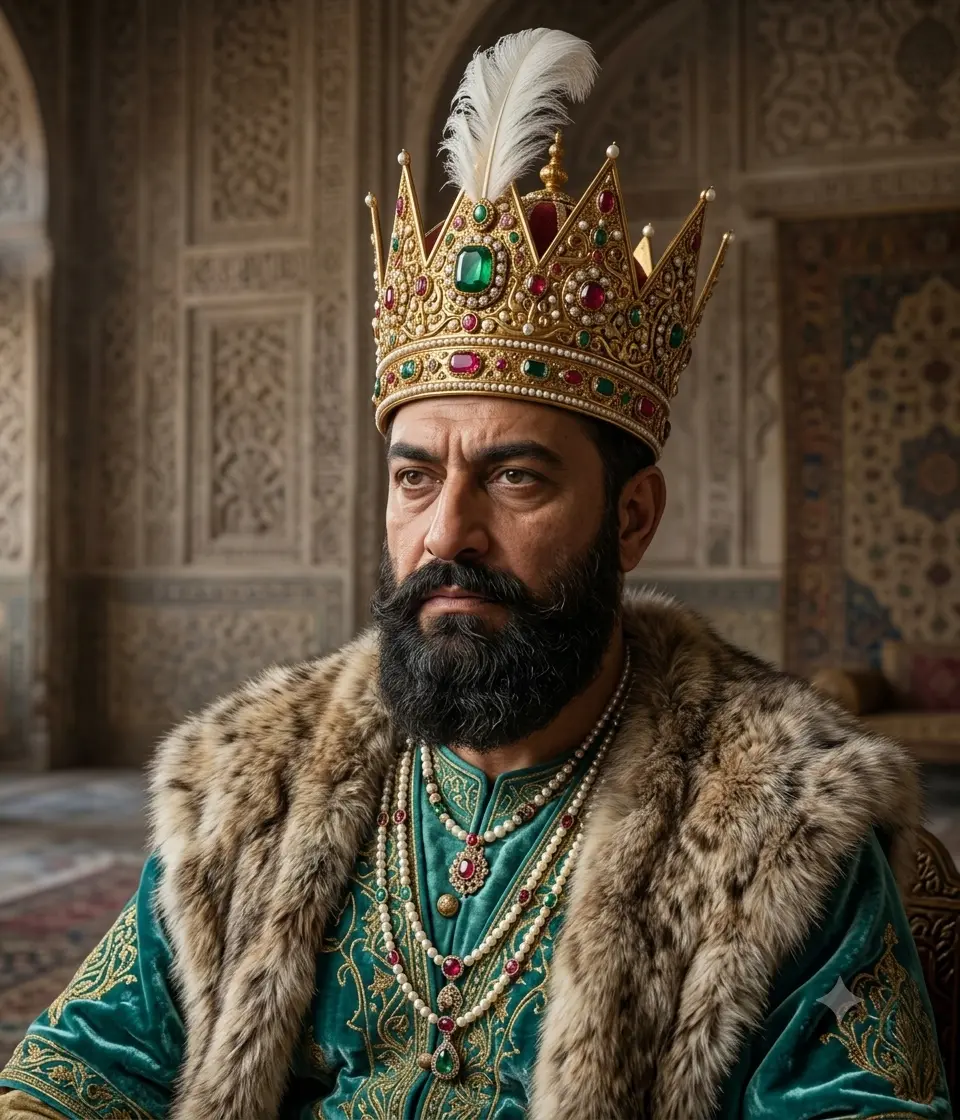
Al-Sultan al-A'zam Yamin al-Dawla Nizam al-Din Abu al-Qasim Mahmud ibn Sebuktigin (361–421 AH / 971–1030 CE), known to history as Sultan Mahmud of Ghazni, was the most powerful ruler of the Ghaznavid Empire. From his capital at Ghazni in present-day Afghanistan he built one of the most formidable military states of the medieval Islamic world, campaigning into the Indian subcontinent repeatedly between 390 and 417 AH, and he was, in the words of the thirteenth-century historian Minhaj al-Siraj Juzjani, "the first among the sovereigns of Islam, who was styled Sultan by the Court of the Khalifahs of Baghdad." At the same time he made his court a centre of Persian literary culture and Islamic scholarship, drawing to it some of the most considerable scholars of the age, al-Biruni among them. His reign marks both the beginning of sustained Muslim political engagement with the Indian subcontinent and the establishment of New Persian as a language of high culture and administration.
Origins and the Rise of the Ghaznavid Dynasty
The Samanid Context
To understand Mahmud's rise, one must first examine the political world from which his dynasty emerged. The Samanid dynasty (819–999 CE), ruling from Bukhara, presided over a vast Central Asian empire that encompassed much of Transoxiana, Khorasan, and eastern Iran. The Samanids were instrumental in the revival of Persian culture within an Islamic framework, and their court nurtured a remarkable literary and intellectual flowering. However, by the mid-tenth century, the Samanid state was in decline, weakened by internal factional struggles, the growing power of Turkic military commanders, and the pressure of nomadic Turkic peoples on its northeastern frontiers.
It was within this context of Samanid decline that Turkic slave-soldiers (ghulams) rose to positions of extraordinary power. Among them was Alptigin, who held high command in Samanid service and who, according to the annals H. G. Raverty assembles in his translation of Juzjani's Tabaqat-i Nasiri, took Ghazni in 322 AH, the town's own chief Abu Bakr Lawik being driven out. Ghazni was a fortress town commanding the passes between Central Asia and the Indian subcontinent, and its seizure laid the foundation of what became the Ghaznavid state. It did not, however, detach the town from Bukhara. Raverty is emphatic on the point, objecting to the numismatists of his own day who wrote of Alptigin and his successors as reigning princes: they were the Samanids' subordinate governors at Ghazni, and the province remained an integral part of the Samanid empire.
Juzjani himself tells the story without dates, saying only that Alptigin died eight years after taking Ghazni. Raverty, who prefers the annalists, points out that from 322 to 352 AH is a period of thirty years, and observes that his author "generally eschews dates." The remark is worth registering at the outset, because the chronology of this dynasty has to be built from the chronicles Raverty gathered in his notes rather than from the narrative he was translating.
The Governors of Ghazni
The government of Ghazni passed through a short series of hands before it reached Mahmud's family, and it is in that sequence that his father first appears in the record. Alptigin, who had been entrusted with the government of Herat in 346 AH while still administering Ghazni, died at Ghazni in 352 AH; Fasihi and others place his birth in 267 AH. His son Is-haq succeeded him and held the government about four years. In 353 AH Is-haq left Ghazni for Bukhara to obtain the Samanid sovereign's investiture, attended by Sebuktigin, his father's slave, who is mentioned here for the first time in the chronicle Raverty follows. Lawik returned to Ghazni in his absence; Is-haq came back in 354 AH, fought him, and drove him out again.
On Is-haq's death the government passed, by order of the Samanid Amir Nuh, to Balka-Tigin, another of Alptigin's slaves and the commander of the Turkish troops, in whose service Sebuktigin then stood. Balka-Tigin held Ghazni for eight years and died in 362 AH. Juzjani's manuscripts give his term variously as two years, four, and ten, which is a fair sample of the textual difficulty running through this whole section of the Tabaqat. Pirey, also of Alptigin's household, succeeded him and governed for five years.
It was in Pirey's time that Sebuktigin made his name. In 363 AH he helped Pirey defeat a force that had advanced out of Hind against the town. Some years later a party at Ghazni wrote to Abu 'Ali Lawik inviting him to come, and he came, bringing with him the son of the Shah of Kabul. As they approached Charkh, a place on one of the roads between Kabul and Ghazni, Sebuktigin fell on them suddenly with five hundred Turks, broke them, took prisoners, and carried ten captured elephants back to Ghazni. On the strength of that success the men of Ghazni raised him, with one accord, to the direction of affairs. Juzjani dates his investiture to Friday 27 Sha'ban 366 AH, when he came down from the citadel with a scarlet canopy held over him, attended by a large following with standards, and proceeded to the Jami' Masjid, where the government and sovereignty of the province were settled upon him. Fasihi places the event a year later, in 367 AH, and the annals record Pirey's deposition in that year. Sebuktigin was confirmed by the Samanid ruler and appointed Abu al-'Abbas al-Fazl ibn Ahmad al-Isfaraini as his wazir — a title that at this stage still meant the chief officer of a governor rather than of a sovereign prince, since Sebuktigin was not yet independent.
Sebuktigin: Mahmud's Father
Sebuktigin — Sabuk-Tigin in Raverty's transliteration — had reached Ghazni as a slave. Baihaqi records that during the reign of the Samanid 'Abd al-Malik ibn Nuh a merchant named Nasr, called the Haji, bought him and brought him to Bukhara, where Alptigin, then Amir-i-Hajib or Lord Chamberlain, saw signs of capacity in his face and purchased him. He followed his master to Tukharistan and then to Khorasan, and so to Ghazni. Other accounts differ over how he was taken: one says that the descendants of a certain Kara Firuz dwelt in Turkistan until 335 AH, when Alptigin raided the country and carried off three thousand captives, Sebuktigin among them; another says Alptigin bought him at Nishapur while commanding the Samanid forces there.
Around that plain beginning the dynasty's own historians built a genealogy. Juzjani reproduces from Baihaqi's chronicle a pedigree tracing Sebuktigin through five generations to Yazdegerd son of Shahriyar, the last of the Sasanian kings of Persia, and with it the account that when Yazdegerd was killed in the mill in the territory of Marw during the caliphate of 'Uthman, his family and dependents fled the armies of Islam into Turkistan, settled in a frontier district there, married into the local population, and "after two or three generations had passed away, they became Turks." Juzjani adds that their palaces were still standing in that country in his own day. He also passes on a tradition that Baihaqi says he had from Mahmud himself, who had it from his father: that Sebuktigin's father was known as Kara Bah-kam, his proper name being Juk, and that the phrase means the Black Tatar Bull.
Once in power, Sebuktigin extended his authority over Bust, the district of Dawar, Kusdar, Bamian, the whole of Tukharistan, and Ghur. On the Indian side he came up against Jai-pal, the Hindu Shahi king whose domains ran from Kabul towards the Punjab, and these encounters are dated in the annals rather than in Juzjani's text. In 369 AH Jai-pal marched an army towards Ghazni; an accommodation was reached and he withdrew. In 376 AH Sebuktigin raided the Indian frontier districts and took possession of Kusdar. In 378 AH he met Jai-pal again, routed him, and pursued him, and the peace that followed was made on the terms that Jai-pal should cede four of the Indian fortresses on the Ghazni side together with a hundred elephants. Raverty is careful about the geography of these campaigns: the country west of the Indus, between the Safid Koh in the west and the Salt Range in the east, and the Hindu Kush as far west as Kabul, was still under Hindu rule at this date, and the Afghans had not yet spread north of the Kurram river.
The Samanid connection meanwhile turned to Sebuktigin's advantage. In 382 AH he attended the Samanid Amir Nuh ibn Mansur to Herat and helped defeat Abu 'Ali Simjur; in 384 AH Nuh conferred the government of Khorasan upon him. In Shawwal of that same year his son Mahmud was made captain-general of the forces of Khorasan and received the title Saif al-Dawla, while Sebuktigin himself received Nasir al-Din Allah. The record is here more precise than the familiar summaries: the governorship of Khorasan went to the father, and the son's first great office was the command of its army. In 385 AH Sebuktigin defeated Abu 'Ali Simjur and Fayiq at Tus.
Sebuktigin died in 387 AH on the frontier of Balkh, at a village whose name the manuscripts write as Madri-mue, Barmal-Madrie, Madriwi, and in one copy Tirmaz. He had ruled for twenty years and was fifty-six years old. Baihaqi places his tomb at Afghan-Shal; another account has a building raised on the spot where he died and named Sabl-abad. Juzjani's summing-up of him — valour and intrepidity, justice and piety, fidelity to his word, no coveting of other men's goods, compassion towards his people — is the formal panegyric his Tabaqat supplies for every ruler of whom it approves, and is best read as such. His sons were Isma'il, Nasr, Mahmud, Husain, Hasan, and Yusuf.
Birth and Early Life
Juzjani dates Mahmud's birth to the night of 'Ashura, the tenth of Muharram, in the year 361 AH — the autumn of 971 CE — at Ghazni, in the seventh year of the government of Amir Balka-Tigin. Fasihi gives the same day in 360 AH. The two datings are the first of many small divergences that run through this reign, and it is worth noting that Balka-Tigin held Ghazni from 355 to 362 AH, so that the seventh year of his government agrees with the earlier of the two.
Two portents attach to the birth in Juzjani's telling, and both belong to the literature about Mahmud rather than to the events of his life. About an hour before the child was born, he writes, Sebuktigin dreamt that a tree began to grow out of the chafing-dish that stood in the middle of his room — the brazier used in those countries in place of a fireplace in the wall — and rose until the whole world was overshadowed by it. He woke pondering the interpretation when a messenger arrived with news that a son had been born to him, at which he said: "I have given him the name of Mahmud." The name is the passive participle of the Arabic verb, meaning praised or laudable. On the same night, Juzjani continues, the idol-temple of Wahind, on the confines of Barshabir on the bank of the Indus, split asunder. Juzjani states further that the same predominant star stood in the ascendant at Mahmud's birth as had stood there at the dawn of Islam; Raverty notes that the sentence is obscure in every copy and may instead mean only that his appearance was propitious to the ascendancy of Islam.
The temple notice is a good illustration of how little of this material can be taken at face value. Raverty collated thirteen manuscripts of the passage and found the name of the place written three different ways and the river written differently again: six copies have Wahind or Wahand, two have Bahind or Bahand, and six place the temple not on the Indus but on the bank of the Sudarah, an old name of the Chenab. He canvasses identifications running from the temple ruins at Takht-i-Bahi north-east of Peshawar, which he had visited in 1849, to Bhatindah in the Lakhi jungle, and concludes only that the place cannot be fixed. He reserves particular objection for the way the sentence had been rendered in H. M. Elliot's compilation of the Persian historians of India, where the qualifications vanish and the temple simply falls: "There is nothing like giving a bold translation."
Of Mahmud's upbringing the approved record says little, and the circumstantial detail that fills the gap in later accounts is better left out. What the annals do supply is one episode that most writers pass over: in 380 AH Mahmud was imprisoned in the fortress of Ghazni by his father's orders, and remained there until the following year. No reason is recorded. Four years later, in Shawwal 384 AH, he was made captain-general of the forces of Khorasan with the title Saif al-Dawla, at about twenty-three years of age. It was a command of the first importance: Khorasan was the wealthiest and most sophisticated province his father had acquired, and holding it required both competence in the field and the management of an Iranian administrative class with traditions older than the dynasty. That command, and the following it gave him, decided the succession three years later.
Succession and the Consolidation of Power
The Succession Crisis
Sebuktigin died in 387 AH, and what followed is one of the places where Juzjani's silence is itself the historical problem. His Tabaqat moves directly from Sebuktigin to Mahmud, treating Mahmud as his father's successor. Raverty corrects him flatly: "Isma'il succeeded his father; but our author ignores him as a sovereign, which is not correct."
The annals Raverty assembles give the sequence. Isma'il, one of Sebuktigin's six sons, held the throne, and was dethroned only in 389 AH — two years after his father's death — by Mahmud, who sent him to the fortress of Kalinjar, "now known as Talwarah" according to Fasihi; the same authority adds that some say he was confined in the fortress of Juzjanan. Fanakati differs on both dates, making Mahmud's accession 388 AH and Isma'il's confinement 389 AH. Baghawi, taking a third view, treats Mahmud rather than Sebuktigin as the first sovereign of the dynasty altogether. What the record therefore establishes is a contested succession resolved in Mahmud's favour over roughly two years, not the swift months of the familiar account, and a brother whose place of confinement is disputed between two fortresses.
In the same year that he overcame his brother, 389 AH, Mahmud fought a battle against the Samanid 'Abd al-Malik ibn Nuh, and the Samanid dynasty came to an end. Raverty dates Mahmud's independence from that moment. In the same year Mahmud made Balkh the capital of his dominions and appointed his brother Nasr commander of his army, while his general Arsalan Jazib engaged Abu al-Qasim Simjur and forced him back on Tabas.
His hold on Khorasan was not yet secure. In 390 AH he made a dash on Nishapur and took it, the Samanid slave-commander Bak-Tuzun withdrawing before him; in the same year his uncle Bughrajak was killed at Fughanj by Tahir, son of Khalaf of Sijistan, and Mahmud marched into Sijistan against Khalaf, who took shelter in the fortress of Tak and was besieged there. In 391 AH the last of the Samanids, Abu Ibrahim al-Muntasir — a ruler Juzjani does not so much as mention — retook Nishapur from Nasr with help from Qabus of Jurjan, before being driven out, defeated near Sarakhs, and forced to take refuge among the Ghuzz.
Seeking Legitimacy: The Abbasid Connection
Recognition from Baghdad came in the same year as independence. In 389 AH the Abbasid caliph al-Qadir Billah sent Mahmud a robe of honour together with the titles Yamin al-Dawla, the Right Hand of the State, and Amin al-Milla, Trustee of the Community. Juzjani marks the moment ceremonially rather than politically: Mahmud "ascended the throne of sovereignty, and donned the robe of honour which had been sent to him from the Dar al-Khilafat," the throne of the caliphs being then adorned by al-Qadir Billah. The gesture mattered because the caliphate, by this date politically weak and territorially reduced, retained the authority to make a Turkic commander into a lawful Muslim sovereign, and Mahmud used the standing it conferred consistently thereafter.
The fuller titulature the caliphs gave him is preserved in Raverty's notes: "The right hand of the empire, defender of orthodoxy, the guardian of the true religion and of the true believers, the regulator of the faith, the friend of the Lord of the Faithful." Baihaqi records that the same titles were afterwards bestowed on Mahmud's son Mas'ud, which is a useful reminder that such formulas were instruments of the chancery rather than personal distinctions.
The distinction Juzjani does claim for him is the title Sultan. Mahmud, he writes, "was the first among the sovereigns of Islam, who was styled Sultan by the Court of the Khalifahs of Baghdad." The claim is contested within the same source. Raverty sets beside it a different account of how the title first attached to him: when Mahmud stormed the fortress of Tak in Sijistan and its ruler Khalaf was brought before him, Khalaf addressed him as Sultan, and this pleased him so much that he spared Khalaf's life. Whether the title reached Mahmud from the chancery of Baghdad or from a captive's address is therefore open. What is not in doubt is that it stayed with him, and that after him it became the ordinary style of independent Muslim sovereignty — political and military power claimed in full while the caliph's spiritual primacy was acknowledged.
Sovereignty was also asserted in the two ways that mattered locally: the Friday sermon and the coinage. When Mahmud received the submission of the Shar of Gharjistan, the khutbah was read in his name in that territory and the coin struck with his name and titles. In 393 AH the khutbah was read for him in Sijistan by Khalaf's own nobles and his titles impressed on the coins there, and in the following year the fortress of Tak fell and Khalaf was taken prisoner. Mahmud kept Sijistan for himself, assigning Khalaf the district of Juzjanan, to which Khalaf withdrew with his family; the province was afterwards given to Mahmud's brother Nasr, whose government of it was joined to the command of the forces of Khorasan.
Late in the reign the relationship with Baghdad produced one episode that Juzjani reports and no other authority confirms. Having entered Iraq and subdued it, Juzjani writes, Mahmud purposed going to the court of Baghdad to pay his respects in person, and turned back only on receiving a mandate to the contrary from the Lord of the Faithful. Raverty appends the shortest of his notes to it: "Not mentioned in other authors, and very doubtful."
The Indian Campaigns
Strategic Context
Mahmud's expeditions into the Indian subcontinent, which the annals date between 390 and 417 AH, are the most famous aspect of his reign and the most debated element of his legacy. Their number is itself a question the sources do not settle, and it is taken up in the Historiographical Note below. What can be said is that several distinct interests converged on the same ground, and that the evidence does not allow any one of them to be isolated as the single cause.
The first was wealth. The temple-kingdoms of northern India held treasuries accumulated over centuries through royal endowment, pilgrimage offering, and agricultural surplus, and the Gangetic plain was among the most productive agricultural zones in the world, supporting dense populations and prosperous trading cities. For a Central Asian military state that had to pay a large professional army in cash, this was a resource of a scale that nothing in Khorasan could match.
The second was the religious character the campaigns were given in the sources produced around Mahmud and after him. Juzjani's summary of the reign is framed entirely in these terms: Mahmud's illustrious deeds became manifest, he writes, when he converted so many thousands of idol-temples into masjids, captured so many of the cities of Hindustan, and subdued its Rais. Raverty, translating, inserted an exclamation mark after the round number, and the punctuation is itself a comment. How far this framing reflects what moved Mahmud, and how far it reflects what his chroniclers and their successors wanted recorded, is a question these texts cannot answer; they record acts, not motives.
The third was strategic. The Hindu Shahi kingdom on the north-western frontier had marched on Ghazni in Sebuktigin's time, and its reduction removed a neighbour capable of taking the initiative. Pushing the frontier into the Punjab secured the eastern approaches to the Ghaznavid heartland and brought the crossings of the Indus under Ghaznavid control.
The First Expeditions and the Fall of Jai-pal (390–392 AH / 1000–1002 CE)
The first expedition is placed in 390 AH, when according to the Tarikh-i Mirat-i Jahan Numa Mahmud set out for Hindustan, captured a frontier fortress its text calls Barjanid, and withdrew. In Shawwal 391 AH he set out again, reached Peshawar with ten thousand horse, and defeated Jai-pal, who was taken captive together with fifteen of his brothers and sons.
The engagement is dated 8 Muharram 392 AH in two independent notices, which disagree about the day of the week: the Mirat-i Jahan Numa makes it a Saturday, the chronicle Raverty draws on for the annals of the reign a Thursday. Its site is given as "in sight of Burshor of Hind," and Raverty doubts the usual identification with Peshawar, observing that down to the times of Babur and Akbar that city was generally called Bagram and is seldom named otherwise except by later writers.
The terms imposed on Jai-pal show how unstable the figures in this literature are. The chronicler Raverty follows fixes the ransom at two hundred thousand golden dinars and a hundred and fifty elephants, with the necklace taken from Jai-pal valued at a further two hundred thousand. Juzjani, describing the same event, says that Mahmud kept Jai-pal at Man-Yazid in Khorasan and commanded that he be ransomed for eighty dirams. Raverty prints the reading as he found it in the manuscripts and adds that the word "thousand" has probably dropped out — "if not, Mahmud did not set much value on his captive." A reader who meets the great sums of this reign quoted as established fact should keep the eighty dirams in view.
Jai-pal did not long survive his captivity. The chronicler records that he afterwards shaved his head, mounted a funeral pyre, and died, and explains the act by a custom he ascribes to Hindu rulers, that a Badshah taken captive by Muslims should abdicate in favour of another; his son, whose name the manuscripts write as Tand-Pal and whom Raverty reads as Anand-pal, succeeded him. The name Jai-pal, Raverty adds, "appears to be the title, not the actual name, of two or more princes" — a warning that matters, because the same name recurs in the annals of this reign twenty years later.
Multan and the Qarakhanid Interruption (396–398 AH / 1005–1007 CE)
In 396 AH Mahmud undertook an expedition against a chief whose name is written five different ways in five works — Bhiri Rae, Bajira, Bihrie, Bipra, and Rajah Bahturae — and whom Raverty takes to have been chief of the Biyir tribe. Bhiri Rae was killed and the fortress of Bhattah, not far from Multan, was taken. Mahmud returned to Ghazni, but in the same year moved against the ruler of Multan itself, Abu al-Fath, who abandoned the territory and fled. Multan had been the seat of a polity aligned with the Ismaili Fatimid caliphate in Egypt, the rival of the Sunni Abbasid order from which Mahmud drew his own titles, and its reduction removed that alignment from the Indian borderlands.
The Indian campaigns were not conducted in isolation from the northern frontier, and 397 AH showed what absence could cost. While Mahmud was in Hindustan, I-lak Khan broke the treaty concluded with him the previous year, invaded Khorasan, and penetrated as far as Herat, which he took. Mahmud returned to Ghazni, made his arrangements, and in the following year met him at Balkh and forced him to retire. It then emerged that Khalaf, the former ruler of Sijistan, had been in correspondence with the invader and had encouraged the invasion, and he was immured in the fortress of Juzdez of Kuhistan. The episode set the pattern for the rest of the reign: every deep expedition into India had to be paid for by a return to the Oxus.
The Punjab Fortresses (401–408 AH / 1010–1017 CE)
In 401 AH Mahmud advanced again into Hindustan, this time against the fortress the annals call Bhim, or Bhim-nagar, whose chief was Bhim Narayan. The next fortress campaign in the record is Nandanah in the Salt Range, which some works place in 404 AH; Fasihi, in the form in which the Jami' al-Tawarikh preserves him, records no expedition in this quarter against the place other writers call Nardin, and Raverty notes the discrepancy without resolving it. Nandanah commanded the approaches from the north-west into the plains, and Ghaznavid control of the greater Punjab dates from about this period. Its consolidation was administrative as well as military: governors were appointed, garrison towns established, and — as the coinage shows — a mint set up at Lahore.
The years that follow are taken up not with India but with Khwarazm and the Qarakhanid frontier, treated below, and with the arrangements Mahmud made in 408 AH for the succession. Only when those were settled did he turn back to the subcontinent, and the campaign he then mounted was the deepest of the reign.
Mathura, Kanauj and the Ganges (409–412 AH / 1018–1021 CE)
Raverty introduces the expedition of 409 AH with a warning to his readers: he will set out the account he has found "because the narrative will greatly differ from the accounts of other writers." In that year Mahmud moved against a ruler the manuscripts call Hardab, the Hardat of Bada'uni and the "Hirdat of Matharah" of the Jami' al-Tawarikh, and the place meant is Mathura.
The description of Mathura in this chronicle is the fullest inventory of an Indian temple city in the sources for the reign, and it is given in the register of wonder rather than of accountancy. There were nearly a thousand palaces of stone, and an idol-temple of such extent that "if a thousand times a thousand thousand dinars should be expended, and builders and workmen of the greatest activity and energy should be employed for two hundred years, they could not complete the like." Within it stood five idols of gold five gaz in height; the eyes of one were two rubies valued at fifty thousand gold dinars, the eyes of another two sapphires weighing four hundred miskals; from the lower parts of one idol four thousand four hundred miskals of pure gold were recovered. Two hundred further idols of silver stood in the same temple. All were broken up, and the temple was overthrown and burnt. These are the chronicle's figures, reported as such: the round thousands and the improbable weights are characteristic of the genre, and no independent check on them exists.
From Mathura the army moved on Kanauj on the Ganges, the historic seat of paramount sovereignty in the northern plain, and on a string of other places, among them Nardin, the fortress the text calls Brimah, and the towns of Manj and Tet. From the temple of the first of these a stone tablet was carried away inscribed, the chronicle says, with the statement that the temple had been founded forty thousand years before. The ruler of Kanauj — called Jai-pal here, the recurring title Raverty had warned about — fled across the Ganges, on whose bank the same account places ten thousand idol-temples in seven fortresses. At the capture of Asi, the ruler of that district, Chand-pal Bhur, was killed.
The following year, 410 AH, Mahmud entered Hindustan again and was, in the chronicler's phrase, detained there four years, during which many conquests were made. In 412 AH the Jai-pal of the annals — the last of the Shahi line Sebuktigin had first fought — was killed, and his son Bhim-pal succeeded to his sovereignty. Bhim-pal died in 416 AH, and with him ended the dynasty that had held the north-western frontier against Ghazni for two generations.
One notice from these years shows the machinery of the state rather than the army. In 411 AH Mahmud was dissatisfied with his brother Nasr's conduct of the Khorasan command, and in particular with the discipline of the troops under him, and sent his chief secretary, the Khwajah Abu Nasr Mishkan al-Zawzani, to speak to him about it. Nasr's reply satisfied him and he took the matter no further, remarking to the Khwajah only that his brother was a prudent and sagacious man. A sultan who could be reached in India by a report on the state of a garrison in Khorasan, and who answered it through his chancery rather than by removing the commander, was running a considerably more articulated state than the raiding narrative suggests.
The Last Indian Campaigns and the First Notice of the Afghans (414–416 AH / 1023–1025 CE)
In 414 AH Mahmud came to an accommodation in a distant part of Hind with a ruler the annals call Beda, and other works Nanda, on the latter's presenting a hundred and fifty elephants, after which he returned to Ghazni. The submission of the Chandella ruler of Bundelkhand, whose fortress of Kalinjar was among the strongest in India, is generally identified with this notice. What the record gives is a settlement bought with elephants rather than a siege carried to a conclusion — evidence of the limits of Ghaznavid power against the strongest hill fortresses, and of Mahmud's readiness to take tribute in place of a conquest he could not cheaply complete.
In the same year Mahmud raided the mountains inhabited by a people the manuscript calls the Afghanan, and in 416 AH raided them again from Balkh, falling on them at night. Raverty pauses over the first of these entries because of what it represents: "This is the first time they are mentioned in the history from which I have taken these accounts." The Afghans enter the written record of the region here, in the annals of Mahmud's reign, as the inhabitants of mountains lying between his two capitals.
Also in 416 AH, Jaghar Beg, son of Abu Suliman Da'ud of the house of Saljuq, rose and entered Khwarazm. The notice is a single line in the annals and passes without comment, but it is the first appearance in this history of the family that would take Khorasan from Mahmud's son within fifteen years.
The Somnath Expedition (417 AH / 1026 CE)
The expedition against Somnath is dated 417 AH. The temple stood on the coast of Gujarat, dedicated to Shiva as Soma-natha, the Lord of the Moon; it was among the wealthiest and most frequented shrines in India, and its position on the sea added the revenues of the Indian Ocean trade to those of pilgrimage. The annals record that in the same year a further portion of Hind was brought under submission — some districts by treaty and agreement to pay the jizyah, some by force of arms, and some through their people becoming Muslims. The march itself was the most demanding of the reign: Somnath lay hundreds of miles beyond the Ghaznavid frontier, across desert that no previous expedition from the north-west had crossed.
Juzjani's own account of the campaign is brief and is built around the idol. Mahmud led an army to Nahrwalah of Gujarat and brought away from Somnath the idol Juzjani calls Manat — a name Raverty glosses by noting that one of the three chief idols of the pagans of Mecca bore it, which tells the reader more about how the Persian tradition understood the shrine than about the shrine itself. The image was broken into four parts: one was set before the entrance of the great mosque at Ghazni, the second before the gateway of the Sultan's palace, and the third and fourth were sent to Mecca and Medina.
The court poet Unsuri commemorated the expedition in a qasida, of which Juzjani quotes two couplets:
When the potent sovereign made the expedition to Somnath,
He made the working of miracles his occupation.He staked the Chess of dominion with a thousand kings:
Each king he check-mated, in a separate game.
Raverty notes that the point of the lines lies chiefly in the play on the terms of chess, which is lost in translation, and that he has corrected the first two from Bada'uni.
The return march supplied the reign's best-known miracle story, and Juzjani tells it as one. Wishing to bring the army back out of Gujarat to Sindh and Mansurah by way of the desert — the Rann of Kachh — Mahmud called for guides, and a Hindu presented himself. After the army had marched a night and a day no water could be found anywhere, and when the guide was brought before the Sultan he said that he had devoted his life to the idol of Somnath and had led them into a desert where there was no water, so that they should all perish. The guide was put to death, the troops halted for the night, and Mahmud went out alone from the camp, knelt with his forehead to the ground, and prayed for deliverance. After a watch of the night a light appeared on the horizon; the army was put in motion towards it, and by daybreak had been brought to water. Juzjani presents this as one of several occasions on which Mahmud's greatness showed itself, and follows it with the statement that God had endowed him with a power of performing miraculous acts not bestowed on any other sovereign. The passage is good evidence of how Mahmud was written about two centuries after his death. It is not evidence of what happened in the Rann.
Two further details of the expedition survive in the notes rather than the narrative. Raverty records that fragments of broken idols could still be seen lying near the entrance to Mahmud's tomb at Ghazni in his own century. And an author quoting Baihaqi's chronicle relates that on the return from Somnath one of the Sultan's huntsmen killed an enormous serpent, thirty ells long and four broad, whose skin was hung up like a canopy in the citadel of Ghazni — Baihaqi adding that whoever doubted the account might go and see it for himself. The invitation is a reminder that these writers had their own tests of evidence, and that they did not always apply them.
Interpreting the Campaigns
The interpretation of Mahmud's Indian campaigns has been among the most contested questions in South Asian historiography, and the honest position is that the sources support more than one reading.
The religious reading holds that Mahmud was moved primarily by Islamic zeal. It draws its strength from the language of the Ghaznavid tradition itself and of the historians who continued it: Juzjani's notice of the reign is built on the conversion of temples into mosques and the subduing of the Rais of Hind, and the coin struck at Lahore in the seventh year of the reign names its owner "Breaker of Idols." The framing is unmistakable, and it was the framing Mahmud's own chancery chose.
The economic reading points to the fiscal logic. A standing army of Turkish ghulams paid in cash, a corps of elephants numbered in thousands, and a building programme at Ghazni all required revenue on a scale that Khorasan and Zabulistan could not supply, and the campaigns delivered it. The annals record ransoms, tribute in elephants, and temple treasuries; they also record Mahmud accepting a hundred and fifty elephants in place of taking Kalinjar, which is the behaviour of a ruler weighing cost against return.
The political and strategic reading notes that the Shahi kingdom had marched on Ghazni before Mahmud's accession, that the reduction of Multan removed a Fatimid-aligned neighbour, and that the Punjab, once annexed, gave the dynasty a defensible eastern frontier and a mint.
Against any single-cause account stands the plainest fact in the annals: Mahmud fought Muslim rulers — in Sijistan, in Khwarazm, in Transoxiana, and finally in Iraq — with the same persistence he showed in India, and settled frontiers by treaty and dynastic marriage as readily as by battle. He operated in a world in which religious duty, political advantage, and revenue were not felt as competing categories, and the attempt to isolate one of them as the true motive imposes a distinction his own age did not draw. Where this article describes an interpretation, it describes it as an interpretation.
Impact on the Indian Subcontinent
The campaigns did not result in the permanent conquest of most of India. Direct annexation was limited principally to the Punjab and parts of Sindh; after each expedition the army returned to Ghazni, and local political structures generally reasserted themselves in the regions through which it had passed.
The indirect effects were considerable. The campaigns weakened an already fragmented political order in northern India, disrupted established economic networks, and demonstrated that determined attack from the north-west could reach the Gangetic plain. The wealth carried to Ghazni was a corresponding loss to the regions it came from, and the destruction of major temple complexes disrupted not only religious life but the educational and economic functions those institutions performed.
The Punjab under Ghaznavid rule was, at the same time, a zone of accommodation as much as of confrontation. The annals for 417 AH describe submissions of three kinds — by treaty and agreement to pay the jizyah, by force of arms, and through the people becoming Muslims — and the record preserves at least one case in detail: Lakhi, son of Jindharah of the Bhati tribe, became a Muslim during one of Mahmud's invasions, received the title Rana Lakhi, and was settled with his tribe at Bhatindah, where the account describes them finding some three hundred and fifty or sixty towns and villages of consequence. Frontier society in the Punjab was being reorganised rather than simply plundered, and it was within that reorganisation — mosques, a mint, garrison towns, resident traders and scholars — that the long process of Islamisation in northern India began.
Central Asian Campaigns and Imperial Expansion
Wars Against the Qarakhanids
While the Indian campaigns dominate popular memory of Mahmud, the northern frontier absorbed as much of his attention and carried more risk. The Qarakhanids, a Turkic dynasty that had taken the Samanid heartland of Transoxiana, were a peer competitor: control of that region — with Bukhara and Samarkand, the irrigated lands of the Amu Darya and Syr Darya, and the Silk Road traffic — was the largest prize in Central Asia.
Mahmud's first attempt on the problem was diplomatic. In 396 AH he sent an envoy to I-lak Khan, son of Bughra Khan, proposing that the territory on the left bank of the Amu Darya, together with Khwarazm, should belong to Mahmud and everything beyond the river to I-lak Khan, and that neither should molest the other's lands. Baihaqi, writing in 451 AH, notes that the ruler later known as Kadr Khan was at that period called Bughra Khan — one of the identifications on which the chronology of this frontier turns.
The treaty lasted a year. In 397 AH, with Mahmud in Hindustan, I-lak Khan broke it, invaded Khorasan, and took Herat; in 398 AH Mahmud met him at Balkh and drove him back across the river. I-lak Khan died in Transoxiana in 403 AH.
Thereafter Mahmud worked the frontier by marriage as much as by arms. In 408 AH he asked the hand of I-lak Khan's daughter from her uncle Tughan Khan, who had succeeded him, for his son Mas'ud, whom he named as his heir and successor. Tughan Khan died in the same year and was succeeded by his brother Bughra Tigin, styled Arsalan Khan. When the bride reached Balkh the capital was illuminated; and soon afterwards Mahmud made over the government of Khorasan to Mas'ud with Herat as its seat, having first assembled the whole of his ulus, his tribe, to swear fealty to his son. Baihaqi gives a different account of the marriage, holding that the lady had been betrothed to Mas'ud's brother Muhammad and married Mas'ud only years afterwards, once Muhammad had been confined.
The last act on this frontier was again diplomatic. In 419 AH Mahmud went into Transoxiana and met Kadr Khan, sovereign of Turkistan, in person; the treaty between them was renewed and confirmed on the terms that a portion of Transoxiana should be held by Mahmud and a portion incorporated with Kadr Khan's dominions, and a fresh instrument was written out and signed. On his way back Mahmud gave audience to Isra'il, son of Beghu, son of Saljuq, and brought him along with him; Isra'il was in time immured in the fortress of Kalinjar, also called Talwarah, where he died.
Juzjani gathers the northern achievement into a single sentence: Mahmud threw a bridge over the Jihun, marched his forces into Turan, and the Khans and Khaqans of the Turks came and presented themselves before him and tendered their allegiance. That these campaigns were fought against fellow Muslims, with the same persistence Mahmud showed in India, is the plainest evidence available that his warfare followed the political logic of the region rather than a confessional one.
Iraq and the Buyids
Mahmud's last major campaign came in 420 AH, the year before his death, and was directed against the Buyids, the Shia Iranian dynasty that had held western Iran and Iraq — including Baghdad itself — since the middle of the tenth century. The annals record that Majd al-Dawla of the house of Buwaih was killed in battle with Mahmud, that Mahmud acquired sway over a portion of Iraq, that this branch of the Buyid dynasty was overthrown, and that the territory was added to the dominions already conferred on Mas'ud. Rayy, near modern Tehran, was among the greatest cities of the Islamic world and a major centre of trade and manufacture, and its acquisition brought the Ghaznavid frontier deep into western Iran.
Juzjani, characteristically, credits Mahmud with subduing Iraq outright, and the scale of the claim needs qualifying. Among Mahmud's dominions he lists the whole of Ajam, Khorasan and Khwarazm, Tabaristan, Iraq, the territory of Nimroz, Fars, the mountain districts of Ghur, and Tukharistan, adding that the rulers of Turkistan acknowledged his superiority. Raverty answers point by point: that Mahmud ruled "the whole" of Ajam and Tabaristan is an exaggeration; no writer of authority mentions his holding any part of Fars; and in Iraq "his sway was but partial over a portion." On Ghur he notes that the only notice in Fasihi for the whole of Mahmud's reign is the death of the son of Suri, Malik of Ghur, taken prisoner in an encounter with Mahmud, who ended his own life by sucking poison from a ring he wore — in 400 AH, or 401 AH by some accounts. It is a useful corrective to the map implied by a chronicler's list.
Khwarazm
Khwarazm, on the lower Oxus, was a wealthy and cultivated region whose capital Gurganj — modern Kunya-Urgench in Turkmenistan — was a centre of trade and scholarship; its court had patronised a circle of scholars that included al-Biruni and the physician and philosopher Ibn Sina. Mahmud's involvement there began not with conquest but with a marriage, and the sequence is worth setting out, because it complicates the story usually told about how al-Biruni came into his service.
In 387 AH — the year Sebuktigin died, and two years before Mahmud became ruler — Ma'mun ibn Muhammad al-Farighuni, ruler of Gurganj, died and was succeeded by his son Ali, who in that same year married a daughter of Mahmud. Ali died in 390 AH and was succeeded by his brother Abu al-'Abbas ibn Ma'mun. In 391 AH Abu al-'Abbas sent an envoy to Mahmud asking permission to marry his brother's widow, Mahmud's daughter; Mahmud sanctioned it and the marriage took place. The envoy on that occasion was Abu Rihan al-Biruni.
Mahmud's direct intervention came sixteen years later. In 407 AH Abu al-'Abbas, by then his son-in-law, was murdered by some of his own troops. Mahmud went into Khwarazm in person, defeated the insurgents, put the ringleader — named Nial-Tigin in the annals and Alb-Tigin by Baihaqi — and the murderers to death, reduced the territory under his own authority, and entrusted its government to Altun-Tash, his great chamberlain. Khwarazm was a Ghaznavid province thereafter, and it was in the years following the annexation that al-Biruni came to Ghazni.
Patronage of Learning and Culture
Ghazni as a Cultural Capital
Perhaps the most remarkable aspect of Mahmud's reign was his transformation of Ghazni from a frontier garrison town into one of the great cultural centers of the Islamic world. The wealth generated by his conquests—particularly the Indian campaigns—was invested not only in military power but also in architecture, literature, and scholarship. Contemporary visitors described Ghazni as rivaling Baghdad and Bukhara in its cultural splendor, with magnificent mosques, palaces, gardens, and educational institutions.
Mahmud consciously modeled his court on the cultural patterns of the great Samanid court at Bukhara, which had been the premier center of Persian literary culture in the tenth century. He recruited poets, scholars, and intellectuals from across the Islamic world, offering generous patronage and the prestige of association with the most powerful ruler of the age. This was not merely aesthetic indulgence—cultural patronage served political functions, legitimizing Mahmud's rule in the eyes of the Iranian bureaucratic and literary elite whose cooperation was essential for governing his vast domains.
Al-Biruni at the Ghaznavid Court
The most illustrious intellectual associated with Mahmud's court was Abu Rayhan al-Biruni (973–1048 CE), one of the most remarkable polymaths in the history of scholarship. He entered Ghaznavid service in the years after the annexation of Khwarazm in 407 AH, and his position there has often been described as that of a captive scholar pressed into work. The approved record complicates that description without settling it: sixteen years earlier, in 391 AH, al-Biruni had already come to Mahmud as the Khwarazmshah's envoy in the matter of his master's marriage to Mahmud's daughter. Whatever the terms on which he came to Ghazni, he came to a court he already knew, and to a ruler with whom he had previously negotiated on his own sovereign's behalf.
Al-Biruni made extraordinary use of the position. He accompanied Mahmud's armies to India and used the access for direct enquiry, and the result was his Kitab al-Hind, a systematic study of Indian civilisation — its philosophy, sciences, religion, geography, and social organisation. Completed around 1030 CE, it remains one of the most important medieval accounts of India, and is notable for its scholarly detachment and for its effort to understand Indian thought in its own terms rather than merely to condemn it.
He also produced major works on astronomy, mathematics, mineralogy, pharmacology, and history during his years at the Ghaznavid court. His Qanun al-Mas'udi, an encyclopaedic work of astronomy, was dedicated to Mahmud's son Mas'ud. His method — empirical, comparative, and rigorously analytical — represents the highest reach of the mathematical sciences in the medieval Islamic world.
The connection left traces in the historiography of the region as well. Al-Biruni's description of the rivers of Kabul and of their junction with the Indus, preserved through the Jami' al-Tawarikh, is the passage Raverty works over at length in trying to locate the temple said to have fallen on the night of Mahmud's birth, and it had become one of the standard authorities on the geography of the north-west for later writers. That his geographical work was still being argued over eight centuries afterwards is a measure of what the Ghaznavid patronage system, whatever its terms, made possible.
Ferdowsi and the Shahnameh
The most famous literary association of Mahmud's court is also the most problematic: his relationship with the great Persian poet Ferdowsi (940–1020 CE), author of the Shahnameh (Book of Kings). The Shahnameh is the national epic of the Persian-speaking world, a massive poetic work of approximately 50,000 couplets recounting the mythical and historical kings of Iran from the creation of the world to the Arab conquest.
Ferdowsi spent approximately thirty years composing the Shahnameh and dedicated the completed work to Mahmud, traveling to Ghazni to present it to the sultan. The traditional account holds that Mahmud, despite having initially promised generous payment, was dissatisfied with the work—either because he found it too focused on pre-Islamic Iranian culture, because factional enemies at court poisoned his mind against Ferdowsi, or because the payment offered was insultingly small (gold promised but silver given). Ferdowsi, bitterly disappointed, departed Ghazni and composed a famous satirical introduction denouncing Mahmud's ingratitude.
Juzjani, writing two centuries later, offers only one small notice bearing on the poem: he names the Tawarikh-i Ajam, a chronicle of the Persian kings, as the work from which the Shahnameh was taken. The historical accuracy of the quarrel is debated. Some scholars argue that the "quarrel" was literary convention rather than historical fact, or that it has been embellished over centuries of retelling. What is clear is that the Shahnameh was indeed composed and presented to Mahmud, and that the relationship between poet and patron was not entirely harmonious. The episode illustrates the tensions inherent in the Ghaznavid cultural project: Mahmud sought Persian literary prestige but was himself a Turk ruling over an Iranian cultural sphere, and works emphasizing pre-Islamic Iranian glory could sit uncomfortably with his Islamic legitimacy.
Poets, Historians and the Court Establishment
Beyond al-Biruni and Ferdowsi, Mahmud's court supported a considerable body of writers. Unsuri served as poet laureate, and it is his qasida on the Somnath expedition that Juzjani quotes two centuries later — evidence that the panegyric verse of this court was still doing service as history long after the reign had ended. Farrokhi Sistani produced some of the finest lyric poetry in Persian under Ghaznavid patronage, and Manuchihri contributed verse influenced by Arabic models.
The historians of the reign matter more for present purposes than its poets. Abu Nasr al-Utbi composed the Tarikh-i Yamini, the contemporary chronicle of Mahmud's reign, in Arabic; Raverty regarded it as a trustworthy and authentic history, while noting that it says nothing of Sebuktigin having been Alptigin's slave and passes over the government of Pirey altogether. Abu al-Fazl Baihaqi, whose great history covers the later Ghaznavid period, began his career in this administration, and it is from a work of his — the Maqamat of the 'Amid Abu Nasr — that the dated annals of Mahmud's reign used throughout this article ultimately derive.
The chief secretary of that administration, the Khwajah Abu Nasr Mishkan al-Zawzani, appears in the record twice at decisive moments: as the officer Mahmud sent to admonish his own brother over the Khorasan command, and, immediately after Mahmud's death, as the minister in whose presence and with whose concurrence the palace chamberlains agreed how the throne should be held until one of Mahmud's sons could take it. He was Baihaqi's own superior, which is a large part of the reason why the inner working of this court is better documented than that of most contemporary states.
In the religious sciences Mahmud patronised Sunni scholars and showed particular favour to the Hanafi school of jurisprudence. Juzjani's account of the dynasty is written from within that tradition and presents the Ghaznavids as its champions: the Tabaqat-i Nasiri credits Sebuktigin with ending Batini influence in Khorasan, and frames Mahmud's Indian campaigns as the conversion of temples into mosques. What the record establishes is the alignment — the dynasty's legitimacy came from the Sunni caliphate at Baghdad, its coinage and its Friday sermons said so, and the scholars it maintained were of that persuasion.
Administration and Military Organization
The Ghaznavid Military Machine
Mahmud's military success rested on a professional standing army built around Turkish ghulam cavalry — slave soldiers trained from childhood — mounted on Central Asian horses and armed with the composite bow, the lance, and the sword. Around this core served Afghan and other tribal levies, Tajik infantry, and auxiliaries from subject peoples. The whole was paid in cash, and that fact connects the army to the Indian expeditions more directly than any statement of motive.
Juzjani gives two figures for the establishment, and both are best reported as his. Mahmud possessed two thousand five hundred elephants, acquired through the Indian campaigns and serving at once as siege engines, shock troops, and emblems of sovereignty. His court was guarded by four thousand Turkish slave-youths who, on days of public audience, were drawn up on either side of the throne: two thousand on the right in caps ornamented with four feathers and carrying golden maces, and two thousand on the left in caps with two feathers carrying silver maces. Raverty adds a detail about the institution rather than the spectacle — as these youths reached manhood and their beards grew, they were transferred to a separate corps and were sometimes placed under the command of provincial governors. The palace guard was thus also the training establishment for the officer class, and the pattern would be repeated by every Turkish sultanate that followed it, down to the slave sultans of Delhi.
The maintenance of a force on this scale required revenue that the Ghaznavid provinces alone could not produce, which helps to explain the regularity of the Indian expeditions. Plunder from India funded the army, the army enabled further campaigns, and those campaigns produced more plunder — a self-reinforcing arrangement that sustained Ghaznavid power for as long as accessible targets remained.
Administrative Structure
The Ghaznavid state was administered through a combination of Persian bureaucratic traditions and Turkic military governance. The civil administration was largely staffed by Iranian officials trained in the Samanid bureaucratic tradition, while military command remained primarily in Turkic hands. This dual structure—Persian pens and Turkish swords—became a model for later Islamic states in the region.
The chief minister (wazir) headed the civil administration, managing taxation, correspondence, and provincial governance, and the chief secretary of the chancery — in Mahmud's later years the Khwajah Abu Nasr Mishkan al-Zawzani — handled the sultan's own correspondence and the delicate business of the court. The military was organized under commanders (sipahsalars) responsible for different corps and frontier regions. That reports on provincial administration travelled reliably, and were acted on through the chancery rather than by summary removal, is shown by the episode of 411 AH, when Mahmud, campaigning in India, learned of the state of discipline in his brother's command in Khorasan and sent Abu Nasr Mishkan to speak to him about it.
Provincial governance was managed through appointed governors, some of whom were members of the royal family while others were trusted commanders. The Punjab, as a frontier province, was typically governed by military commanders with significant autonomy. Revenue collection combined fixed taxation with irregular income from raiding and tribute extraction.
Coinage and Revenue
Mahmud's coinage is the most direct surviving statement of how he wished to be understood. One of the coins struck in his reign, recorded in the numismatic material Raverty cites, carries the legend: "The right hand of the empire, Mahmud Sultan, son of Nasir al-Din Sebuktigin, Breaker of Idols." It appears to have been struck at Lahore in the seventh year of his reign. Every element of the reading is deliberate — the caliphal title first, then descent from a father who had himself received a caliphal honorific, then the new style of Sultan, and finally a title earned in India, stamped on money minted in India.
The coinage also served the plainer purpose of asserting sovereignty where armies were not standing. When the Shar of Gharjistan submitted, the coin was struck with Mahmud's name and titles; when Khalaf's nobles in Sijistan transferred their allegiance in 393 AH, his titles were impressed on the coins there. Coin and khutbah together were the two recognised instruments by which submission was published, and the annals of the reign record them as consistently as they record battles.
The territorial claim the coinage supported was expansive. Juzjani's list of the countries included in Mahmud's empire runs from Ghazni and Zabulistan through Khorasan, Khwarazm, Chaghanian, Tabaristan, and Isfahan, and from Kabul as far as Kanauj, the country around Kalinjar, Multan as far as Nahrwalah of Gujarat, Somnath, the coast of Oman, Kusdar, and Sindh as far as Siwastan on the Kirman border, with Kij and Makran. Raverty's comment is the necessary corrective: "His authority in a good many of these must have been very nominal."
The Ghaznavid state benefited from its position astride the routes connecting Central Asia with India and Iran. Ghazni was itself a trading centre where goods from China, Central Asia, Iran, and India converged, and the empire's control of the passes through the mountains and of the major road networks generated substantial customs revenue. Investment in road maintenance and caravan protection followed from the same logic: thriving trade served both the treasury and the dynasty's standing.
Agricultural taxation, particularly in Khorasan and the Punjab, provided a stable base supplementing the irregular windfalls of military plunder. The Ghaznavid system in Khorasan followed established Samanid precedents — a land tax assessed on productivity, supplemented by commercial taxes and by the jizya on non-Muslim populations. In the Punjab, where administrative structures were less developed, collection was more irregular and depended heavily on the competence of local officials. The annals for 417 AH, recording submissions made by treaty and agreement to pay the jizyah alongside those made by force, show the fiscal settlement and the military one being made in the same season.
Architectural and Urban Legacy
Building Projects in Ghazni
Mahmud invested heavily in the physical transformation of his capital, deploying the vast wealth from his Indian campaigns to create a city worthy of a great Islamic sovereign. He built a magnificent mosque (the Arus al-Falak, "Bride of the Sky"), said to have been adorned with imported marbles, carved stucco, and painted decoration of extraordinary sophistication. A great palace complex, equipped with gardens, fountains, reception halls, and administrative offices, served as the center of government and ceremony. He established a university (madrasa) for Islamic learning, libraries to house manuscript collections, and public baths and markets that transformed Ghazni into a fully equipped Islamic metropolis.
The transformation was deliberate and ideological. Mahmud sought to create in Ghazni a city that could rival Baghdad, the Abbasid capital, or Bukhara, the former Samanid capital whose cultural prestige Mahmud consciously sought to appropriate. Travelers and diplomats visiting Ghazni during Mahmud's reign described it as one of the great cities of the Islamic world—a claim that would have seemed absurd just decades earlier when it was a dusty frontier garrison. This transformation from military outpost to cultural capital was one of Mahmud's most remarkable achievements, demonstrating that his vision extended beyond mere military power to encompass civilizational aspiration.
The building program also served economic functions. The construction projects employed thousands of workers—craftsmen, laborers, engineers, decorators—creating an urban economy that supplemented military and administrative employment. Many of the craftsmen were brought from India, where building traditions included sophisticated stone-carving and decorative arts that enriched the architectural vocabulary of Ghazni. This transfer of Indian craftsmanship to an Islamic context was an early example of the cultural cross-fertilization that would later characterize Indo-Islamic civilization.
Very little of Mahmud's Ghazni survives. The city was sacked by the Ghurid sultan Ala al-Din Husayn, called Jahan-soz, the World-Burner, who according to the Tabaqat-i Nasiri also demolished the palaces at Bust that had been the residence of the house of Mahmud. The sources differ over when: Fasihi places the plunder of Ghazni and the killing of its people immediately after the death of Bahram Shah in 523 AH, while other authorities date Bahram's death, and with it the sack, considerably later — to 532, 544, 547, or 552 AH. Further destruction followed under the Mongols in the thirteenth century and in the Afghan conflicts of later centuries. Archaeological excavations have revealed fragments of the grandeur described in literary sources, including marble architectural elements, decorative tilework, carved stucco fragments, and the foundations of major buildings, but the full extent of Mahmud's construction program can only be reconstructed from textual descriptions.
Two minarets from the Ghaznavid period do survive near Ghazni—ornate towers decorated with elaborate geometric and calligraphic patterns that testify to the sophistication of Ghaznavid architectural decoration. These are among the earliest surviving examples of the elaborately decorated minarets that would become characteristic of Islamic architecture in the eastern lands.
Religious Architecture
Mahmud's mosque-building program extended beyond Ghazni to encompass his entire empire. He constructed mosques and religious institutions across his domains, particularly in newly conquered territories where they served both religious and political functions—marking the landscape with symbols of Islamic sovereignty and providing gathering places for the growing Muslim communities that followed in the wake of conquest. The Friday mosque (jami masjid), where the sultan's name was proclaimed in the weekly sermon, served as a visible manifestation of sovereign authority in every major town.
In the Punjab, the earliest mosques date from the Ghaznavid period, representing the physical beginnings of Islamic architectural presence in the Indian subcontinent. While none of these early structures survive in their original form—most were rebuilt or replaced by later dynasties—they established the principle of Islamic sacred architecture in India and created the institutional infrastructure for Muslim communal life. These mosques served not merely as places of prayer but as community centers, educational institutions, and administrative focal points for the growing Muslim population.
Mahmud also patronized the construction of khanqahs (Sufi hospices), caravanserais along major trade routes, and bridges over important river crossings—infrastructure that served both pious and commercial purposes. The caravanserai system, in particular, facilitated the trade that generated much of the empire's non-military revenue, demonstrating how religious and economic motivations often aligned in Mahmud's building program. Each caravanserai included a mosque, providing travelers with both physical shelter and spiritual resources—a combination that reflected the integrated worldview of medieval Islamic civilization.
Personal Character and Religious Life
Piety and Religious Policy
The sources written from within the tradition present Mahmud as personally devout, and Juzjani's account is of a piece with them: the prayer in the desert on the return from Somnath is offered as the act of a ruler whose petitions were answered, and the reign as a whole is framed as service to Islam. Read as evidence, these passages establish how Mahmud was remembered in thirteenth-century Persian historiography rather than the interior life of the man, and the distinction is worth keeping.
What the record does establish is the alignment of his policy, and it can be read off the two instruments by which a medieval Muslim sovereign published where he stood. His titles came from the Sunni caliphate at Baghdad and were renewed there; his coinage and the Friday sermon named the caliph. The favour he showed to Hanafi jurisprudence and to scholars of the traditional Sunni disciplines was consistent with that alignment, and Juzjani, writing of Sebuktigin, credits the father with ending Batini influence in Khorasan and treats the family's whole record as one of orthodox consolidation. Where that alignment led in practice is set out below under the effects of the reign on the wider Islamic world.
How the Sources Present Him
The material bearing on Mahmud's character is almost entirely evaluative, and it divides according to where it was written. Juzjani's Tabaqat-i Nasiri gives him the standard virtues of the just sovereign and adds a claim of miraculous favour; the same work gives his father an almost identical list, which is a fair indication of how much individual observation the form carries. Raverty, translating six centuries later, punctuates the round numbers with exclamation marks, disputes the extent of the dominions, and observes of Juzjani's dedication to his own patron that it is "a very slight specimen of his slavish flattery of him, and of others."
Between the panegyric and the correction, what survives as description is thin, and it is drawn from what the annals record him doing rather than from what his historians say he was. He campaigned in almost every year of a reign of three decades. He settled frontiers by treaty and dynastic marriage as readily as by battle, and twice renewed a treaty with the same Turkish sovereign after it had been broken. He dealt with a brother's shortcomings in a provincial command by sending his chief secretary rather than by removing him, and accepted the reply. He spared a captive who addressed him as Sultan at Tak. He accepted a hundred and fifty elephants in place of a siege he judged too costly. And he assembled his whole tribe to swear fealty to his chosen heir twelve years before his death. That is the portrait of a working sovereign, and it is as much as the evidence carries.
The later reputations are a separate subject from the man. The Islamic historiographical tradition remembered him as a great ruler and a patron of learning; Indian historical memory, particularly as shaped from the nineteenth century onwards, remembered the campaigns. Both traditions are treated below.
Relationship with the Caliphate and Religious Policy
The Abbasid Connection in Practice
Mahmud's relationship with the Abbasid caliphate went beyond the initial grant of titles. Reports of his victories went to Baghdad, gifts from his conquests with them, and the caliphs renewed and extended his honorifics: the full formula preserved in Raverty's notes — right hand of the empire, defender of orthodoxy, guardian of the true religion and of the true believers, regulator of the faith, friend of the Lord of the Faithful — belongs to this continuing exchange rather than to a single occasion, and Baihaqi records the same titles being conferred afterwards on Mas'ud.
The arrangement suited both parties. The caliph acquired a powerful adherent in the east at no cost to himself; Mahmud acquired the standing that distinguished a sovereign from a commander, and with it a vocabulary in which his campaigns could be described as the work of a legitimate Muslim ruler.
Its limits appear in the one episode where the two came close to meeting in person. Juzjani records that Mahmud, having subdued Iraq, intended to go to Baghdad to pay his respects and turned back only on receiving a contrary instruction from the caliph. Raverty's note that this is mentioned by no other author and is "very doubtful" is a reminder that the relationship is documented almost entirely from the Ghaznavid side.
Religious Scholars at Court
Mahmud's court included scholars of the Qur'anic sciences, of hadith, of Hanafi jurisprudence, and of Sunni theology, who served both as legitimisers of his rule and as working intellectuals. They composed treatises on his campaigns, gave legal opinions on his administrative decisions, and educated the next generation of officials and religious functionaries.
The scholarship produced under this patronage was accordingly aligned with the dynasty's own account of itself. That is a general feature of court intellectual cultures rather than a peculiarity of this one, but it has a direct bearing on the present article, since the earliest sustained narrative of the reign available here — Juzjani's — was written by a man who held office under a later dynasty that claimed the Ghaznavid and Ghurid past as its own inheritance.
Effects on the Wider Islamic World
The campaigns had consequences beyond the frontier they were fought on. The removal of the Fatimid-aligned polity at Multan in 396 AH ended the eastward reach of Ismaili political authority into the Indian borderlands, and the overthrow of the Buyid branch in western Iran in 420 AH brought a portion of Iraq under a sovereign whose titles came from the Abbasid caliph. Across a very wide geography the effect was to consolidate the Sunni Abbasid order on which Mahmud's own legitimacy rested.
In India the process was slower and far less direct. Mass conversion was not a feature of the raids: the annals for 417 AH set submission through conversion alongside submission by treaty and by force, as one outcome among three rather than as the object of the campaign. What the Ghaznavid period created in the Punjab was the institutional conditions for Muslim communal life — mosques, a mint at Lahore, garrison towns, and resident traders and scholars — within which Islam spread over the following centuries, and within which the Sufi orders that became the principal agents of Islamisation in northern India found their first foothold.
Death and Succession
Final Years and Death
Mahmud's last campaign was the Iraq expedition of 420 AH, and he died the following year at Ghazni, having returned there from the west. The date is given precisely in the annals: Thursday, 14 Rabi' al-Thani 421 AH, about the middle of April 1030 CE, after which he was buried in the Firuzi Bagh, the Firuzi garden, of Ghazni. The same notice adds that some say he died in 420 AH.
The length of the reign and his age at death both come with variants, and the discrepancy between the Persian sources and modern summaries is largely a matter of how the counting is done. Juzjani's text has him dying at sixty-one after a reign of thirty-three years, and the annalist Raverty follows also gives thirty-three years. Reckoned in lunar years from the birth date Juzjani himself supplies — 10 Muharram 361 AH — sixty-one is the year he had entered rather than completed; reckoned from Fasihi's 360 AH it is a year more. Reckoned in solar years from 971 to 1030 CE the figure is fifty-eight or fifty-nine. Similarly, a reign of thirty-three years counts from Sebuktigin's death in 387 AH; counted from the dethronement of Isma'il in 389 AH, when Mahmud's authority was actually established, it is thirty-two.
His tomb at Ghazni remained a place of visitation, and something of the Somnath expedition remained beside it. Raverty, writing in the 1870s, records that fragments of broken idols could still be seen lying near its entrance a few years earlier, and that they were probably there still — the physical residue of the campaign surviving eight centuries later at the grave of the man who ordered it.
Juzjani names seven sons: Muhammad, Nasr, Mas'ud, Suliman, Isma'il, 'Abd al-Rashid — styled 'Izz al-Dawla, Amir of Ghazni — and Ibrahim, who had a son named Suliman. Three of them, Muhammad, Mas'ud and 'Abd al-Rashid, held the throne at Ghazni in their turn.
The Succession and the Loss of Khorasan
Whom Mahmud intended to succeed him is one of the genuinely unresolved questions of the reign, and the sources point two ways. The annals are explicit that in 408 AH he nominated Mas'ud as his heir and successor, arranged his marriage to the Qarakhanid princess, gave him the government of Khorasan with Herat as its seat, and assembled his whole tribe to swear fealty to him. Other writers hold that his will left the eastern parts of the empire, Ghazni among them, to his son Muhammad — the position Mas'ud himself is reported to have acknowledged when he wrote to his brother disclaiming any wish to interfere with that inheritance, and asking only that his own name should stand first in the Friday sermon. Juzjani, for his part, places Muhammad's reign before Mas'ud's; most authors reverse the order and date Muhammad's reign only from 432 AH, after Mas'ud had been deposed.
What the record agrees on is the mechanics. When Mahmud died Mas'ud was in Iraq — at Hamadan by one account, at Isfahan by another. At Ghazni the hajib Ali Khweshawand, a relative of the late sultan, and the hajib Bak-Taghdi, who commanded the mamluks of the palace, made a compact, in the presence and with the concurrence of the chief secretary Abu Nasr Mishkan, to act in concert and hold the palace until one of Mahmud's sons should take the throne. The nobles of the court then raised Muhammad at Ghazni in 421 AH. A party favouring Mas'ud sent to him in Iraq; the palace ghulams under Amir Iyaz took the best horses from the royal stables and rode to join him, meeting him at Nishapur as he advanced towards Ghazni by way of Herat. Muhammad was confined in the citadel of Tigin-abad, and died in the fortress of Kalinjar in 426 AH.
Mas'ud's reign saw the loss of the western and northern empire, and Juzjani identifies the decision that made it possible — a decision of Mahmud's own. At the request of the Turkish khans, Mahmud permitted the son of Saljuq to bring his kindred and dependents across the Jihun and settle in Khorasan. "The wisest and most sagacious men of that time," Juzjani writes, "considered the granting of this permission a grave error in the Sultan's policy; for they perceived therein danger to the empire of his sons and descendants." The judgement was made with hindsight, but the sequence bears it out. Jaghar Beg entered Khwarazm in 416 AH, in Mahmud's own lifetime, and took up his quarters at Marw in 426 AH; Tughril Beg assumed sovereignty at Nishapur in 429 AH, "and from that date their dynasty commenced"; and the battle that settled the fate of Khorasan was fought in the desert between Marw and Sarakhs, near a fort the manuscripts write as Dandankan or Dandanaqan — Raverty argues that all the variants are corruptions of Tal-kan — with the sources disagreeing over whether the year was 430, 431, or 432 AH. The Seljuks took Khorasan and Iran; the Ghaznavids kept Afghanistan and the Punjab.
The dynasty lasted a further century and a half in the east, ruling latterly from Lahore, and its end came at Ghurid hands. Juzjani records that Sultan Mu'izz al-Din Muhammad ibn Sam, known to history as Muhammad of Ghor, advanced yearly from Ghazni into Hind and Sindh until in 577 AH he appeared before the gate of Lahore and took from Khusrau Malik a son and an elephant; and that in 583 AH he brought an army against Lahore, reduced it, and induced Khusrau Malik to come out under the faith of a treaty, after which he was sent to Ghazni and then to the Ghurid capital of Firuz-koh, and immured in the fortress of Balarwan in Gharjistan. Fasihi and some others place the taking of Khusrau Malik in 581 or 582 AH. He was put to death in 598 AH together with his son Bahram Shah, and with them, in Juzjani's words, "the dominion and dynasty of Nasir al-Din Sebuktigin became obliterated."
Legacy and Historical Significance
In Islamic Historical Memory
In the Islamic historiographical tradition, Mahmud has generally been remembered as one of the great rulers of the medieval period. He is celebrated for his military prowess, his defense of Sunni orthodoxy, his patronage of learning, and his role in expanding the boundaries of the Islamic world. The title "Ghazi" (warrior for the faith) became permanently associated with his name, and later Islamic rulers in India consciously invoked his memory as a model and precedent.
The Ghaznavid cultural achievement—the establishment of Persian as the language of Islamic high culture in the eastern lands—outlasted the dynasty itself by centuries. The Persian literary tradition that Mahmud patronized became the dominant cultural idiom of the eastern Islamic world, from Anatolia to Bengal, and the model of the cultured Muslim sovereign combining military power with literary patronage that Mahmud exemplified remained influential for generations.
In Indian Historical Memory
In Indian historical consciousness, and particularly as that consciousness was shaped from the nineteenth century onwards, Mahmud is remembered above all for the campaigns, and the Somnath expedition became their emblem. The translations of the Persian chronicles assembled under Sir H. M. Elliot's name in the middle of the nineteenth century did much to fix the image, and it is worth noting how that compilation worked, because Raverty — who used it constantly and disagreed with it constantly — documents the process. Names of persons and places, he complains, were taken from modern translations rather than from the originals where the originals were available; the arrangement of the extracts "tends rather to confuse"; and the qualifications of the Persian texts sometimes disappear in the rendering, as when Juzjani's carefully hedged sentence about the temple that split on the night of Mahmud's birth becomes a flat assertion that an idol-temple in India fell down. "There is nothing like giving a bold translation," is Raverty's comment.
The point is not that the campaigns were less severe than the tradition holds. It is that the nineteenth-century compilations through which the Persian sources reached a wide readership were themselves a stage in the transmission, with their own losses and their own emphases, and that the medieval kingdoms Mahmud attacked were not organised along the confessional lines that later readings supplied. Resistance to the expeditions was mounted by rulers acting for their own states, in coalitions formed and dissolved for political reasons, and the accommodations recorded in the annals — tribute in elephants, agreements to pay the jizyah, a Bhati chief settled at Bhatindah with his tribe — belong to the same record as the sackings.
Reassessment
Modern scholarship on Mahmud has moved towards an assessment that holds together the destructive and the constructive dimensions of the reign, and away from accounts that select one and suppress the other. C. Edmund Bosworth's study The Ghaznavids (1963) set the framework for understanding the dynasty within the wider political and cultural history of the eastern Islamic world; André Wink's Al-Hind placed the Ghaznavid impact on India within the longer history of Indian Ocean trade and cross-cultural exchange; and Muhammad Nazim's earlier study remains the standard reconstruction of the campaigns. These three works were used for this article with the owner's express authorisation, and that authorisation is recorded in the references below.
Read against the approved primary record, what emerges is a ruler whose motives cannot be reduced to a single principle, whose administration was pragmatic where ideology would have been costly, whose cultural patronage was substantial and had consequences far beyond his own court, and whose campaigns inflicted real destruction on the regions they reached. A historically honest assessment holds these together rather than choosing among them, and it declines to smooth over the places where the sources themselves do not agree.
Long-term Impact
Mahmud's long-term historical significance lies in several areas that extended far beyond his own lifetime and shaped the trajectories of multiple civilizations.
First, his campaigns initiated sustained Muslim political engagement with the Indian subcontinent, setting the stage for the later establishment of permanent Muslim rule under the Delhi Sultanate. While Mahmud himself did not establish permanent governance over most of India, his campaigns weakened the political structures that might have resisted later Muslim conquest and demonstrated the viability of military operations deep into the subcontinent. The Punjab, which he incorporated into the Ghaznavid state as a permanent province, served as the launching pad for Muhammad of Ghor's conquests a century and a half later.
The military asymmetry the campaigns revealed was structural rather than incidental. Mahmud commanded a standing professional army, paid in cash and available to march in any season, against a political landscape of many separate kingdoms whose forces were raised for particular occasions. The annals show the consequence plainly: coalitions were attempted and dissolved, and individual rulers repeatedly chose accommodation — tribute, elephants, an agreement to pay the jizyah — over combined resistance, because each was negotiating for its own state. The same asymmetry persisted after Mahmud's time and shaped the conditions in which later conquerors from the north-west operated.
Second, the Ghaznavid cultural model—combining Turkic military power with Persian administrative and literary culture under the umbrella of Islamic legitimacy—became the template for subsequent Islamic states in the region, from the Seljuks to the Mughals. This cultural synthesis, first fully articulated under Mahmud's patronage, shaped the civilization of the eastern Islamic world for centuries. The "Persianate" world—the vast region from Anatolia to Bengal where Persian served as the language of administration, literature, and high culture—owed its existence in large part to the pattern established at Mahmud's court.
The political ideology that Mahmud developed—the Turkic sultan as military protector of Islamic orthodoxy, patron of Persian culture, and acknowledged servant of the Abbasid caliph—provided a constitutional framework that later dynasties adopted and adapted. The Seljuks, the Ghurids, the Delhi Sultans, and ultimately the Mughals all operated within variations of this basic political model.
Third, the reign established the pattern by which military slavery became a route to sovereignty. Mahmud was the son of a man bought by a merchant and sold to a chamberlain, and Juzjani's own section records the whole line at Ghazni before Sebuktigin — Alptigin, Balka-Tigin, Pirey — as slaves of the same household who governed in turn. The palace corps of four thousand ghulam youths, transferred as they came of age to a separate corps and thence to provincial commands, was the institution that made this possible, and the arrangement was reproduced by the Seljuks, the Ghurids, and most directly by the slave sultans of Delhi, among them Iltutmish, who reached the throne by the same route.
Fourth, Mahmud's patronage of al-Biruni had extraordinary long-term consequences for the history of knowledge. Al-Biruni's Kitab al-Hind—made possible by his access to India through Mahmud's campaigns—preserved invaluable information about Indian civilization that might otherwise have been lost, and established a model of cross-cultural scholarly inquiry that remains influential. The irony that this masterpiece of intercultural understanding was produced within the context of military conquest illustrates the complex and often contradictory ways in which power and knowledge interact in human history.
Historiographical Note
The evidence for Mahmud's reign is uneven in specific and identifiable ways, and a reader is better served by knowing how it is uneven than by an account that smooths the unevenness over.
The principal source used here. The Tabaqat-i Nasiri of Minhaj al-Siraj Juzjani, completed in the middle of the thirteenth century, devotes its eleventh section to "the dynasty of the Yaminiah, al-Mahmudiah sovereigns of the race of Sebuktigin," and its notice of Mahmud is the earliest sustained account of the reign available in the source library used for this encyclopaedia. It is not a contemporary source. Juzjani wrote more than two hundred years after Mahmud's death, in India, under a dynasty that claimed the Ghaznavid and Ghurid past as its own inheritance, and his section on the dynasty is short, largely undated, and frankly celebratory. H. G. Raverty, who translated it in the 1870s, called the account "too curt" after Sir H. M. Elliot, and said he had been compelled to make his notes far longer than he liked. Those notes — drawn chiefly from Fasihi, from the Maqamat of the 'Amid Abu Nasr by Abu al-Fazl Baihaqi, and from Fanakati, the Jami' al-Tawarikh, the Tarikh-i Mirat-i Jahan Numa, the Tazkirat al-Muluk, and Bada'uni — supply nearly all the dates used in this article. Where a year in AH is given above, the authority is normally Raverty's apparatus rather than Juzjani's narrative.
What Juzjani leaves out. The clearest instance is the succession. Juzjani passes straight from Sebuktigin to Mahmud and never treats Isma'il as a sovereign; Raverty says plainly that this "is not correct," and the annals give Isma'il two years on the throne before his dethronement in 389 AH. Baghawi, going further in the other direction, treats Mahmud rather than Sebuktigin as the founder of the dynasty. An account resting on Juzjani alone would lose a contested two-year succession entirely, and would also lose the last of the Samanids, Abu Ibrahim al-Muntasir, whom Juzjani does not mention at all although he retook Nishapur from Mahmud's brother.
The figures. Almost every quantity in this literature is a round number in a register of wonder, and this article reports such numbers as the chronicles' figures rather than as measurements. The clearest demonstration is Jai-pal's ransom, which one chronicle sets at two hundred thousand golden dinars and a hundred and fifty elephants while Juzjani's manuscripts read eighty dirams — Raverty suspecting a dropped "thousand," and remarking that otherwise "Mahmud did not set much value on his captive." The same caution applies to the ten thousand temples said to stand on the bank of the Ganges, the temple tablet dated forty thousand years, the two hundred silver idols at Mathura, and the thousands of temples said to have been converted into mosques, at which Raverty inserted an exclamation mark.
The number of expeditions. The familiar total of seventeen Indian campaigns is an editorial construct rather than a figure given by the early chronicles. The dated notices Raverty assembles run from 390 to 417 AH and do not amount to that total, and where the campaigns are numbered at all it is in nineteenth-century compilations: Raverty refers in passing to Elliot's arrangement numbering a fourteenth expedition. Any total depends on decisions the sources do not make — whether the two movements of 396 AH are one campaign or two, and how to treat the four years after 410 AH in which the army is simply said to have been detained in Hindustan.
Places and names. The identification of places in this material is genuinely unsettled, and Raverty's collation of thirteen manuscripts shows why: readings differ, the vowel points are absent, and the same consonantal skeleton yields several plausible names. The temple said to have fallen on the night of Mahmud's birth is Wahind in six copies and Bahind in two, and stands on the Indus in some copies and on the Chenab in others; Raverty canvasses Takht-i-Bahi, Ohind, and Bhatindah and reaches no conclusion. The site of the battle in which Jai-pal was captured is "Burshor of Hind," which Raverty declines to identify with Peshawar on the ground that the city was generally called Bagram down to the sixteenth century. The chief adversary of 396 AH is written five different ways in five works. The fort where Khorasan was lost to the Seljuks is written as Dandankan and half a dozen other ways, and Raverty argues that all of them are corruptions of Tal-kan. Raverty also warns that Jai-pal "appears to be the title, not the actual name, of two or more princes," which is why the same name appears in the annals of 392 and of 412 AH.
Motive. The three readings of the Indian campaigns set out above are readings, and the sources do not decide between them. Juzjani frames the campaigns religiously throughout; the same annals record Mahmud fighting Muslim rulers in Sijistan, Khwarazm, Transoxiana, and Iraq with equal persistence, settling frontiers by treaty and dynastic marriage, and accepting elephants in place of a siege. The evidence records acts; the acts support more than one account of what drove them.
What has been left out. Several claims commonly attached to this reign do not appear above, because they cannot be traced within the source base on which this article rests: the flight of Ibn Sina from Khwarazm ahead of Mahmud's army; the deathbed scene in which the dying sultan is said to have wept over his treasury; the illnesses of his last years; the number of scholars maintained at his court; the detail of the outward desert crossing to Somnath; and the elephant said to have bolted and decided the battle against Anandapala. Their absence here is not a finding that they are false. It is a statement that the evidence for them lies outside what this article was written from.
References and Further Reading
Primary Islamic Sources
- Juzjani, Minhaj al-Siraj. Tabaqat-i Nasiri. Translated from the Persian by Major H. G. Raverty. [approved PDF library:
sources/study/] — Section XI, "The Dynasty of the Yaminiah, Al-Mahmudiah Sovereigns of the Race of Sebuktigin." The principal source for this article, used together with Raverty's critical notes, which carry the dated annals of the reign. - Baihaqi, Abu al-Fazl. Maqamat of the 'Amid Abu Nasr — the work from which the dated annals of Mahmud's reign quoted in the Tabaqat-i Nasiri notes are taken, including the notice of his death and of his burial in the Firuzi Bagh at Ghazni.
- Al-Utbi, Abu Nasr. Tarikh-i Yamini (Kitab-i Yamini), c. 1021 CE — the contemporary Arabic chronicle of Mahmud's reign, described by Raverty as a trustworthy and authentic history.
- Al-Biruni, Abu Rayhan. Kitab al-Hind, c. 1030 CE — composed in Ghaznavid service; its account of the rivers of the north-west is the passage Raverty works over in his notes to this section.
- Unsuri. Qasida on the Somnath expedition, two couplets of which are quoted in the Tabaqat-i Nasiri.
Classical Islamic Sources
- Fasihi (Fasih-i Khwafi). Chronicle, as cited throughout Raverty's notes — the source of most of the AH dates used above, including Sebuktigin's death, Isma'il's confinement, and the caliphal grant of Yamin al-Dawla and Amin al-Milla.
- Fanakati. Historical compendium, as cited by Raverty — gives Mahmud's accession in 388 AH against Fasihi's 389 AH.
- Rashid al-Din. Jami' al-Tawarikh, early 14th century CE — quoted by Raverty for al-Biruni's geography of the Kabul river and for the Mathura campaign.
- Muhammad Baka. Tarikh-i Mirat-i Jahan Numa — quoted by Raverty for the expeditions of 390 and 391 AH and for the capture of Jai-pal.
- Bada'uni, 'Abd al-Qadir. Muntakhab al-Tawarikh — used by Raverty to correct the text of Unsuri's couplets and cited for the Mathura campaign.
- Abu al-Fazl. A'in-i Akbari — quoted by Raverty on the reliability of the early accounts of India.
- Bayhaqi, Abu al-Fazl. Tarikh-i Bayhaqi, c. 1059 CE — the history of the later Ghaznavid period, with retrospective material on Mahmud.
- Gardizi, Abu Said. Zayn al-Akhbar, c. 1049 CE — early history including Ghaznavid material.
- Ibn al-Athir. Al-Kamil fi al-Tarikh, 13th century CE — comprehensive Islamic history with substantial Ghaznavid coverage.
- Nizam al-Mulk. Siyasatnama, c. 1091 CE — references to Ghaznavid administrative practice.
- Ferdowsi. Shahnameh, c. 1010 CE — the Persian epic dedicated to Mahmud; Juzjani names the Tawarikh-i Ajam as the chronicle from which it was drawn.
Academic and Scholarly Sources
The three works below sit outside the project's approved source base. The owner authorised them for this article under §4A.3 on 9 September 2026, and the authorisation is recorded here so that it remains auditable.
- Bosworth, C. Edmund. The Ghaznavids: Their Empire in Afghanistan and Eastern Iran, 994–1040. Edinburgh: Edinburgh University Press, 1963. [external source, authorised by the owner on 9 September 2026 under §4A.3]
- Nazim, Muhammad. The Life and Times of Sultan Mahmud of Ghazna. Cambridge: Cambridge University Press, 1931. [external source, authorised by the owner on 9 September 2026 under §4A.3]
- Wink, André. Al-Hind: The Making of the Indo-Islamic World. Volume 2: The Slave Kings and the Islamic Conquest. Leiden: Brill, 1997. [external source, authorised by the owner on 9 September 2026 under §4A.3]
Further Reading
The works below were not used in writing this article, and no statement above rests on them. They are listed for readers who wish to pursue the subject further.
- Habib, Muhammad. Sultan Mahmud of Ghaznin. Delhi: S. Chand, 1951.
- Thapar, Romila. Somanatha: The Many Voices of a History. London: Verso, 2005.
- Flood, Finbarr Barry. Objects of Translation: Material Culture and Medieval "Hindu-Muslim" Encounter. Princeton: Princeton University Press, 2009.
- Meisami, Julie Scott. Persian Historiography to the End of the Twelfth Century. Edinburgh: Edinburgh University Press, 1999.
- Bosworth, C. Edmund. The Later Ghaznavids: Splendour and Decay. Edinburgh: Edinburgh University Press, 1977.
- Sachau, Edward C. (trans.). Alberuni's India. London: Kegan Paul, 1910. Reprint: New Delhi: Low Price Publications, 1993.
- Davis, Dick. Shahnameh: The Persian Book of Kings (translation). New York: Penguin, 2006.
- Sharma, Sunil. Persian Poetry at the Indian Frontier: Mas'ud Sa'd Salman of Lahore. Delhi: Permanent Black, 2000.
- Eaton, Richard M. India in the Persianate Age: 1000–1765. London: Allen Lane, 2019.
Mentioned In
18 articles reference this topic
and 6 more articles