Al-Khwarizmi
Muhammad ibn Musa al-Khwarizmi (c. 780–850 CE) was a mathematician and astronomer at Baghdad's House of Wisdom whose treatise gave algebra its name, who introduced Hindu numerals to the Islamic world, and whose Latinized name became the root of the word algorithm.
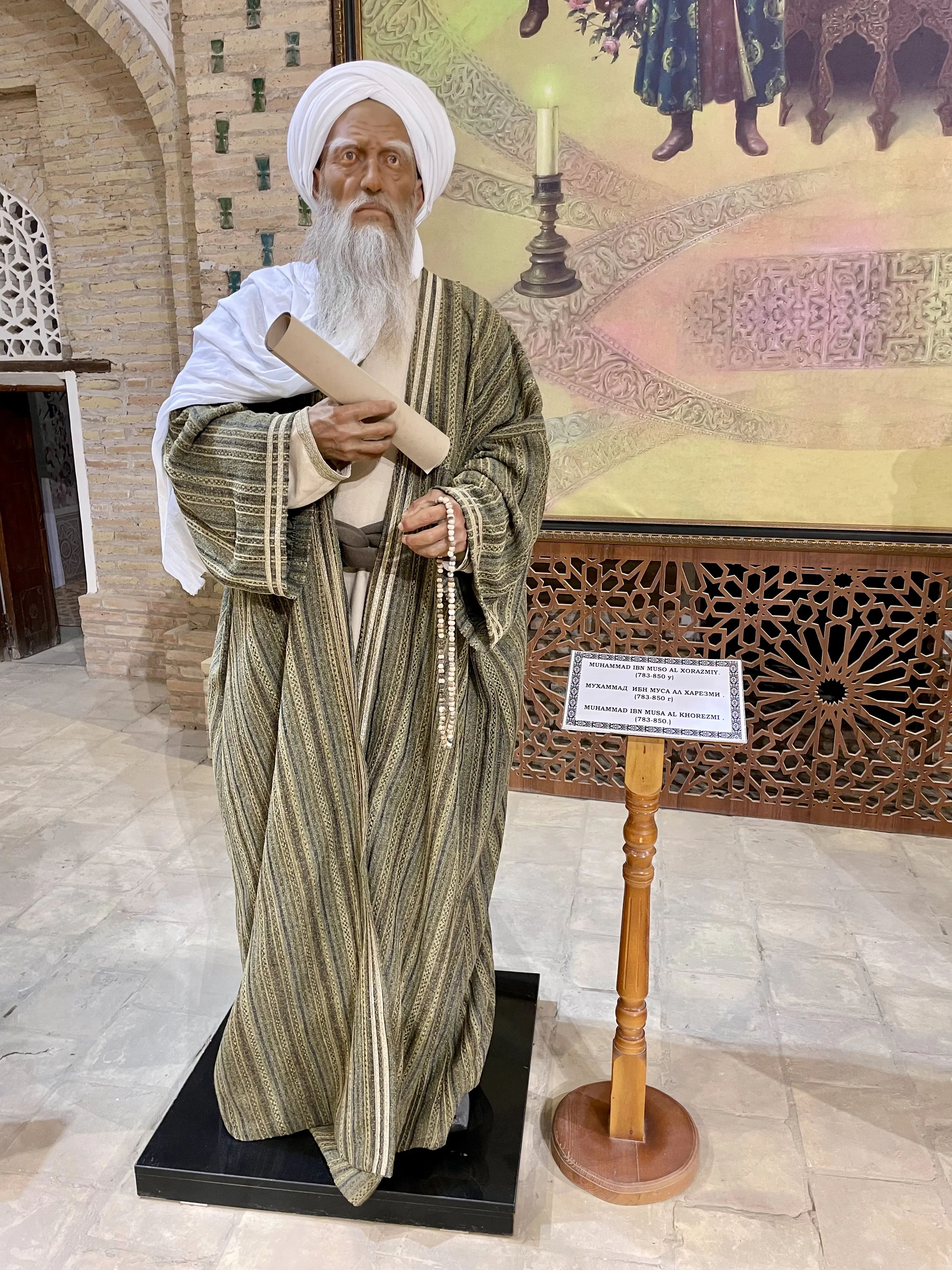
Muhammad ibn Musa al-Khwarizmi (c. 780--850 CE) was a mathematician, astronomer, and geographer who worked at the House of Wisdom in Baghdad during the reign of the Abbasid caliph al-Ma'mun. His treatise on calculation by completion and balancing gave the discipline of algebra its name; his account of Hindu numerals introduced positional arithmetic to the Islamic world and, through Latin translation, to medieval Europe; and his revision of Ptolemy's geography produced the most accurate map of the known world compiled under Islamic patronage. His Latinized name, Algoritmi, became in medieval European usage the word "algorithm" -- a term that now describes the computational procedures underlying every digital system in the world.
The Abbasid Intellectual World
Al-Khwarizmi worked at one of the most intellectually productive moments in the history of the Islamic world. The Abbasid Caliphate under al-Ma'mun (reigned 813--833 CE) had made the translation and development of knowledge a state project. The House of Wisdom in Baghdad -- part library, part research institution, part translation bureau -- was the institutional center of this project, and al-Ma'mun's patronage attracted scholars from across the Islamic world and beyond. Greek philosophical and scientific texts were being translated into Arabic on a large scale; Indian mathematical and astronomical works had already been partially absorbed; Persian administrative and astronomical traditions were being integrated into the developing Arabic scholarly culture. The result was an environment in which inherited knowledge from multiple traditions was simultaneously available, critically examined, and built upon.
This was not a passive reception of ancient learning. The scholars at the House of Wisdom and in the broader Baghdad intellectual community were active participants in a process of synthesis and original development. They identified the gaps and errors in what they had inherited, corrected them where they could, and extended the traditions they had received into new territory. Al-Khwarizmi's work is characteristic of this pattern: it draws on Greek, Indian, and Persian sources, but what he produced was not a summary of existing knowledge -- it was something new.
Origins in Khwarezm
Al-Khwarizmi's name identifies him with Khwarezm, the region of Central Asia centered on the lower Amu Darya river, in what is now northern Uzbekistan and Turkmenistan. The region had been a center of Persian culture and administration for centuries and had come under Islamic rule in the early eighth century CE. It had its own scholarly traditions, particularly in astronomy and mathematics, and it produced a remarkable concentration of major Islamic scholars -- among them al-Biruni, who was born in Khwarezm three centuries after al-Khwarizmi and who, like him, made fundamental contributions to mathematics and astronomy.
Almost nothing is known of al-Khwarizmi's early life, family, or education. The biographical sources are thin even by the standards of medieval Islamic biography, and most of what is claimed about his youth is inference from the intellectual context rather than documented fact. What is clear is that he arrived in Baghdad and entered the orbit of the House of Wisdom during al-Ma'mun's reign — Ibn al-Nadim states directly that he was attached to the Bayt al-Hikma, the caliphal library — and that by the time of his major works he was a scholar of sufficient standing to receive direct caliphal patronage.
Even the connection with Khwarezm is less secure than the name suggests, and the complication is worth setting out because it bears on how much weight a nisba can carry. The historian al-Tabari gives his name in a fuller form: Muhammad ibn Musa al-Khwarizmi al-Majusi al-Qutrubbulli. The last of those epithets associates him with Qutrubbul, a district between the Tigris and the Euphrates not far from Baghdad, which would mean either that he was himself from there or — the reading most historians prefer — that the Khwarezmian connection belonged to his ancestors rather than to him. A territorial nisba in this period could record a family's place of origin generations back as readily as a man's own birthplace.
The other epithet al-Tabari supplies, al-Majusi, would ordinarily denote a Zoroastrian rather than a Muslim. It is generally understood to point to the religion of his family rather than his own, since the preface to his own Algebra opens in conventionally Muslim terms, with the praise of God and the invocation of the Prophet that a Muslim author of the period would be expected to write. The most that can be said is that he may have come from a family of recent Zoroastrian background, which would be unremarkable in ninth-century Iraq or Khurasan, and that the evidence does not permit more.
The Book of Algebra
The work that established al-Khwarizmi's place in the history of mathematics is the Kitab al-mukhtasar fi hisab al-jabr wal-muqabala -- usually translated as The Compendious Book on Calculation by Completion and Balancing. The title's two key terms describe the two fundamental operations of the method: al-jabr (completion or restoration) refers to the operation of adding equal quantities to both sides of an equation to eliminate negative terms; al-muqabala (balancing or reduction) refers to the simplification of an equation by combining like terms. The word al-jabr passed directly into Latin as algebra, the name the discipline carries in every modern language.
The treatise opens with a statement of purpose that is practical rather than theoretical. Al-Khwarizmi explains that he has written the book to teach people what is most useful in calculation -- specifically, the kinds of calculation required in inheritance, legacies, partition of estates, lawsuits, trade, and land measurement. This is not false modesty about the work's scope; it reflects a genuine orientation toward application that runs throughout the text. Algebra in al-Khwarizmi's conception is a tool for solving the quantitative problems that arise in everyday legal and commercial life, and his exposition is structured accordingly.
The mathematical core of the treatise is the classification and solution of linear and quadratic equations. Al-Khwarizmi identifies six canonical forms -- three simple cases (squares equal roots, squares equal numbers, roots equal numbers) and three compound cases (squares and roots equal numbers, squares and numbers equal roots, roots and numbers equal squares) -- and provides a general method of solution for each. For the compound cases, the solution method involves completing the square, a procedure that al-Khwarizmi explains both algebraically and through geometric proof. The geometric proofs are not merely illustrative; they serve as the justification for the algebraic procedure, grounding the abstract manipulation of symbols in the visually demonstrable properties of areas and lengths.
The worked examples that follow the general solutions are drawn from inheritance law, commercial transactions, and geometric measurement. A representative problem asks: a square and ten of its roots equal thirty-nine dirhams -- what is the root? Al-Khwarizmi's solution is systematic: halve the coefficient of the roots (giving five), square the result (giving twenty-five), add this to thirty-nine (giving sixty-four), take the square root (giving eight), subtract the halved coefficient (giving three) -- the root is three. The procedure is presented step by step, with each operation justified by the geometric construction that underlies it. This combination of systematic procedure, geometric justification, and practical example established the pedagogical model that algebra textbooks would follow for centuries.
What the Algebra Was Not
Modern readers meeting al-Khwarizmi's six cases for the first time usually ask why there are six. The modern quadratic has one general form, ax² + bx + c = 0, and one formula solves it. Answering that question is the quickest way to see what al-Khwarizmi's algebra actually was, and it corrects an impression that the word "algebra" almost inevitably creates.
The first thing to understand is that there is no notation in the book at all. Al-Khwarizmi wrote every equation out in words. There is no x, no superscript for the square, no equals sign, no symbol for addition or subtraction; the unknown is "the root" or "the thing" (shay), its square is "the wealth" (mal), and the constant is "the number" or "the dirhams". The problem quoted above appears not as an equation but as a sentence: a square and ten of its roots equal thirty-nine dirhams. This manner of writing mathematics is called rhetorical algebra, and it remained the norm in both the Islamic world and Europe until symbolic notation was developed in the sixteenth and seventeenth centuries. What al-Khwarizmi possessed was not a symbolic apparatus but a systematic verbal procedure — which is precisely why the procedure had to be so carefully specified.
The second thing is that he had neither zero nor negative numbers available as coefficients or as solutions. This is the reason for the six cases. In modern notation the three compound forms x² + bx = c, x² + c = bx, and x² = bx + c are the same equation with terms moved across the equals sign and signs reversed. For al-Khwarizmi they were three different problems, because a quantity subtracted from nothing was not a quantity he could work with, and an equation had to be arranged so that every term appearing in it was positive. The operations named in his title are exactly the operations this constraint requires: al-jabr, restoring, moves a subtracted term to the other side so that it becomes an addition, and al-muqabala, balancing, cancels like terms on opposite sides. The whole apparatus exists to reduce any problem to one of the six admissible positive forms, each of which then has its own rule. A negative root was likewise not an answer; where the modern formula yields two solutions of opposite sign, al-Khwarizmi reports the positive one and passes over the other.
None of this is a criticism, and it is worth being clear why. The absence of symbols and of signed numbers was the state of mathematics everywhere in the ninth century, not a personal limitation; negative numbers were not fully accepted in European mathematics until the eighteenth. What al-Khwarizmi did within those constraints was to produce a complete and general treatment of every quadratic that could be posed at all, with a rule for each form and a geometric demonstration that the rule was sound. Recognising the constraints makes the achievement legible rather than diminishing it: the six cases are not a clumsy version of the quadratic formula but the form a general solution had to take before notation existed to state it more briefly.
Inheritance Law and Practical Mathematics
The second half of the algebra treatise is devoted to worked problems in Islamic inheritance law -- a domain that generated some of the most complex quantitative problems in medieval legal practice. The Quranic system of inheritance specifies fractional shares for a range of relatives, and when multiple heirs with different entitlements survive, the calculation of each heir's actual share can become technically demanding. Al-Khwarizmi's algebra provided precisely the systematic tool needed to handle these calculations.
The inheritance problems in the treatise are not simple. They involve multiple heirs of different classes, the interaction of Quranic shares with the rules for residuary heirs, and cases where the total of specified shares requires careful algebraic resolution. Al-Khwarizmi works through each class of problem methodically, showing how to set up the algebraic equation that represents the distribution, solve it, and verify the result. The practical utility of this work was considerable: it made the mathematics of inheritance accessible to legal practitioners who were not trained mathematicians, and it demonstrated that the abstract apparatus of algebra could solve real problems in Islamic jurisprudence.
This connection between mathematics and law is characteristic of the intellectual culture in which al-Khwarizmi worked. The House of Wisdom was not an isolated research institution; its scholars were engaged with the practical needs of the Abbasid state and its subjects, and mathematical knowledge was valued precisely because it was applicable to administration, commerce, and law.
Hindu Numerals and the Arithmetic Treatise
Alongside the algebra treatise, al-Khwarizmi wrote a work on calculation with Hindu numerals -- a text known today primarily through its twelfth-century Latin translation, which begins Dixit Algoritmi ("Thus spoke al-Khwarizmi"). The original Arabic text has not survived, but the Latin version transmitted both its content and its author's name to medieval Europe. It is from this Latin rendering of his name that the word "algorithm" derives: medieval European scholars referred to the method of calculation it described as algorismus, and over time the word generalized to refer to any systematic computational procedure.
The treatise explained the Hindu positional numeral system -- the system in which the value of a digit depends on its position in the number, with each position representing a power of ten -- and the methods of calculation it enables: addition, subtraction, multiplication, division, extraction of square roots. The key innovation that made this system transformative was the use of zero as a placeholder. Without a symbol for zero, a positional system cannot distinguish between 32 and 302; with it, any number however large can be represented using only ten symbols, and arithmetic operations on large numbers become routinely manageable rather than laborious.
The Hindu numeral system had been developed in India, probably by the fifth or sixth century CE, and had reached the Islamic world through earlier contact. What al-Khwarizmi provided was not the first encounter with these numerals but the definitive systematic exposition in Arabic: a clear, organized account of the system and its computational methods that became the standard reference through which Islamic scholars learned the positional system and through which Latin translators later transmitted it to Europe.
Astronomical Tables: The Zij al-Sindhind
Al-Khwarizmi's astronomical work is represented by his Zij -- a set of astronomical tables compiled under al-Ma'mun's patronage. The term zij refers to a genre of astronomical handbook that provides the data and methods needed to calculate the positions of the sun, moon, and planets at any given time. Al-Khwarizmi's Zij was one of the earliest major examples in the Arabic tradition and became one of the most influential.
The work draws on two distinct astronomical traditions: the Indian Siddhanta tradition, which al-Khwarizmi had access to through earlier translations, and the Ptolemaic tradition of Greek astronomy. This synthesis brought together the best available astronomical knowledge from East and West and subjected it to systematic organization and practical application. The tables provided methods for determining the positions of celestial bodies, calculating eclipses, and -- of immediate practical importance in Islamic religious observance -- finding the times of prayer and the direction of Mecca for any location.
A later revised version of al-Khwarizmi's Zij, adapted by Maslama al-Majriti in al-Andalus to use the meridian of Cordoba rather than Baghdad, was translated into Latin in the twelfth century, probably by Adelard of Bath. This was among the first Arabic astronomical works to reach medieval Europe, introducing European scholars to the mathematical methods of Islamic astronomy. The transmission illustrates a characteristic pattern of al-Khwarizmi's influence: works produced in Baghdad, revised and adapted in al-Andalus, and transmitted to Europe through the translation centers of the Iberian Peninsula.
The Zij was not his only astronomical work. Ibn al-Nadim's Fihrist lists four: the Zij al-Sindhind itself, a treatise on the sundial, and two separate works on the astrolabe. The subjects are not incidental to each other. A zij supplies the numbers, the astrolabe is the instrument for taking the observations and for solving problems of position and time by mechanical means, and the sundial is the fixed installation that converts the same geometry into a public timekeeper. Taken together the four works cover the whole practical chain from observation to instrument to table, and the applications that mattered most immediately to the community that used them — the times of the five daily prayers and the direction of prayer — depended on every link in it. This is worth registering because al-Khwarizmi is often presented as a pure mathematician whose work happened to be useful. The distribution of his output suggests something closer to the opposite: a scholar whose mathematics was developed in the course of solving the computational problems that administration, law, and religious observance actually presented.
The Geography: Correcting Ptolemy
Al-Khwarizmi's third major contribution was geographical. His Kitab surat al-ard (The Image of the Earth) was a systematic revision of Ptolemy's Geography, the second-century Greek work that had provided the standard geographical framework of the ancient world. Ptolemy's Geography gave coordinates -- latitude and longitude -- for several thousand locations across Europe, Africa, and Asia, along with instructions for constructing a world map. It was a foundational work, but it was also nearly seven centuries old and contained systematic errors accumulated through copying and through the limits of ancient geographical knowledge.
Al-Khwarizmi's revision drew on information available in ninth-century Baghdad -- reports from merchants, administrators, diplomats, and travelers who had direct knowledge of regions Ptolemy had known only imperfectly. He corrected the coordinates of approximately 2,400 locations, significantly revised the outline of Africa (which Ptolemy had depicted as curving eastward to enclose the Indian Ocean), shortened the length of the Mediterranean (which Ptolemy had overestimated by roughly twenty percent), and provided more accurate positions for cities and geographic features across the Islamic world. The work was produced in collaboration with other scholars -- later reports mention sixty-nine contributors -- and resulted in a world map that was the most accurate representation of the known world compiled under Islamic patronage to that date.
Al-Khwarizmi's approach to Ptolemy exemplifies the intellectual character of the House of Wisdom more broadly: deep familiarity with the classical heritage combined with willingness to identify and correct its errors on the basis of new evidence. The inherited text was a starting point, not a closed authority.
The Algorithmic Conception of Mathematics
The significance of al-Khwarizmi's work extends beyond the specific content of any individual treatise. His algebra treatise established a methodological model -- the systematic classification of problem types, the explicit procedure for solving each type, the geometric justification of algebraic operations, and the worked examples demonstrating application -- that defined what a mathematical treatise should look like for subsequent generations. Islamic mathematicians who followed him, from Abu Kamil in the ninth century to Omar Khayyam in the eleventh, worked within the framework he had established, extending it to more complex equations and more abstract settings while retaining its basic structure.
More broadly, al-Khwarizmi's work exemplifies what might be called the algorithmic conception of mathematics -- the idea that a mathematical method should be specifiable as a finite sequence of explicit operations that, applied to any problem of a given type, reliably produces the correct answer. The procedures in the algebra treatise are exactly this: step-by-step recipes for solving equations, justified by geometric argument but presented as operations that can be followed without requiring the solver to reconstruct the underlying reasoning each time. The medieval Latin term algorismus for his arithmetic method, and its eventual generalization to "algorithm" for any such procedure, captures something genuine about the character of his contribution.
This conception of mathematics as a collection of reliable, teachable procedures -- rather than a body of results accessible only to those who could reconstruct the proofs from first principles -- had enormous practical consequences. It made sophisticated mathematical methods available to administrators, merchants, legal scholars, and astronomers who were not themselves mathematicians, and it made mathematics teachable on a large scale. The pedagogical clarity that characterizes al-Khwarizmi's exposition was not incidental to his achievement; it was central to it.
Transmission to Latin Europe
The transmission of al-Khwarizmi's works to medieval Europe was part of the broader Arabic-to-Latin translation movement that transformed European intellectual life in the twelfth and thirteenth centuries. The main conduit was the Iberian Peninsula -- particularly Toledo, which had been a center of Islamic learning and became, after its reconquest by Castile in 1085 CE, a major translation center where Arabic manuscripts and Latin scholars converged.
The arithmetic treatise was translated in the twelfth century and circulated as Algoritmi de numero Indorum, introducing Hindu-Arabic numerals to European readers. The algebra treatise was translated by Robert of Chester around 1145 CE and by Gerard of Cremona somewhat later; both translations introduced systematic algebraic methods to Latin scholarship. Hindu-Arabic numerals faced initial resistance in Europe -- some Italian cities banned their use in official documents in the thirteenth century, fearing that the ease of altering digits made fraud easier -- but the computational advantages were decisive. The Pisan mathematician Leonardo Fibonacci, who had studied in North Africa and encountered the Hindu-Arabic system firsthand, championed it in his Liber Abaci of 1202 CE, crediting "Algoritmi" explicitly and demonstrating the system's superiority for commercial calculation. By the fifteenth century, Hindu-Arabic numerals had displaced Roman numerals for calculation throughout Europe.
Legacy
Al-Khwarizmi's legacy is embedded in language as well as in intellectual history. "Algebra" preserves the title of his treatise; "algorithm" preserves his name. These are not merely etymological curiosities -- they reflect the genuine historical primacy of his contributions to the disciplines they name.
In the history of Islamic science, al-Khwarizmi occupies a foundational position comparable to that of al-Kindi in philosophy or Ibn Sina in medicine -- a figure whose work defined the terms and methods of a discipline for subsequent generations. His influence on Islamic mathematics was direct and sustained: Abu Kamil extended his algebra to irrational numbers and more complex equations; al-Karaji applied algebraic methods to polynomial expressions; Omar Khayyam used geometric constructions to solve cubic equations that al-Khwarizmi's classification had left unresolved, while acknowledging the foundation al-Khwarizmi had laid. In geography, his corrections to Ptolemy set the standard for Arabic cartography for generations.
In the broader history of science, his significance lies in the synthesis he achieved at a specific historical moment. The Greek mathematical tradition, the Indian numerical and algebraic tradition, and the Persian astronomical tradition were available simultaneously in ninth-century Baghdad in a way they had never been before. Al-Khwarizmi drew on all three, combined them into something coherent and practically useful, and presented the result in a form that could be learned, applied, and extended. The words his name and his title left in every modern language are a measure of how thoroughly that synthesis took root.
References and Further Reading
Primary Islamic Sources
- Al-Khwarizmi, Muhammad ibn Musa. Al-Kitab al-Mukhtasar fi Hisab al-Jabr wa al-Muqabalah (The Compendious Book on Calculation by Completion and Balancing). Translated by Frederic Rosen. London: Oriental Translation Fund, 1831. [Original c. 820 CE]
- Al-Khwarizmi, Muhammad ibn Musa. Kitab al-Jam' wa al-Tafriq bi Hisab al-Hind (Book of Addition and Subtraction According to Hindu Calculation). [Original c. 825 CE]
- Al-Khwarizmi, Muhammad ibn Musa. Zij al-Sindhind (Astronomical Tables). [Original c. 830 CE]
- Al-Khwarizmi, Muhammad ibn Musa. Kitab Surat al-Ard (Book on the Configuration of the Earth — geography). [Original c. 833 CE]
Classical Islamic Sources
- Ibn al-Nadim. Kitab al-Fihrist, entry on al-Khwarizmi and his works. [Original c. 987 CE]. Records his attachment to the Bayt al-Hikma and lists four astronomical works: the Zij al-Sindhind, a treatise on the sundial, and two on the astrolabe.
- Al-Tabari, Muhammad ibn Jarir. Tarikh al-Rusul wa'l-Muluk. [Original early 10th century CE]. Gives his name in the fuller form Muhammad ibn Musa al-Khwarizmi al-Majusi al-Qutrubbulli, the source of the questions about his origin and family background discussed above.
- Al-Qifti, Ali ibn Yusuf. Tarikh al-Hukama, biography of al-Khwarizmi. [Original c. 1248 CE]
- Said al-Andalusi. Tabaqat al-Umam, on al-Khwarizmi's contributions. [Original c. 1068 CE]
- Ibn Khaldun, Abd al-Rahman. Al-Muqaddimah, references to al-Khwarizmi's foundational work. [Original c. 1377 CE]
Academic and Scholarly Sources
- Rashed, Roshdi. The Development of Arabic Mathematics: Between Arithmetic and Algebra. Dordrecht: Kluwer Academic Publishers, 1994.
- Toomer, G.J. "Al-Khwarizmi." In Dictionary of Scientific Biography, Vol. 7. New York: Scribner's, 1973. The standard scholarly biography, and the source of the assessment of the al-Qutrubbulli and al-Majusi epithets followed here.
- "Khwarizmi." In The Biographical Encyclopedia of Astronomers. New York: Springer. Reference treatment of his astronomical output and of the evidence for his position at the caliphal library.
- Berggren, J. Lennart. Episodes in the Mathematics of Medieval Islam. 2nd ed. New York: Springer, 2016.
- Joseph, George Gheverghese. The Crest of the Peacock. 3rd ed. Princeton: Princeton University Press, 2011.
- Saliba, George. Islamic Science and the Making of the European Renaissance. Cambridge: MIT Press, 2007.
- Gutas, Dimitri. Greek Thought, Arabic Culture. London: Routledge, 1998.
Further Reading
- Al-Daffa, Ali Abdullah. The Muslim Contribution to Mathematics. London: Croom Helm, 1977.
- Al-Khalili, Jim. The House of Wisdom. New York: Penguin Press, 2011.
- Sesiano, Jacques. An Introduction to the History of Algebra. Providence: American Mathematical Society, 2009.
- Boyer, Carl B., and Uta C. Merzbach. A History of Mathematics. 3rd ed. New York: Wiley, 2011.
Mentioned In
24 articles reference this topic
and 12 more articles