Battle of Nicopolis (1396 CE)
The Battle of Nicopolis, fought on 25 September 1396, was a decisive Ottoman victory over a combined Western European crusading army under Sigismund of Hungary. The last major crusade of the medieval period, its failure cemented Ottoman dominance over the Balkans.
Introduction
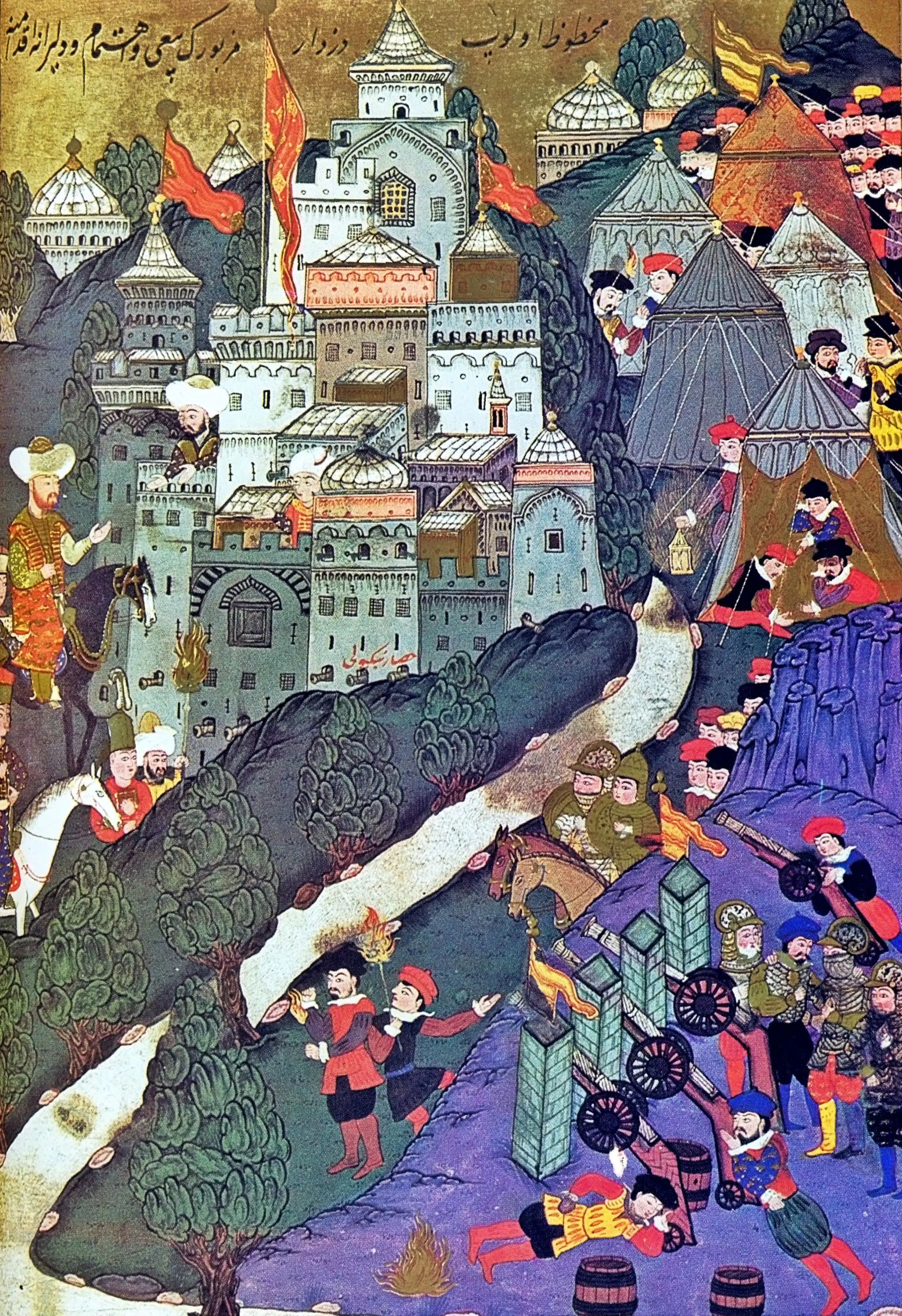
The Battle of Nicopolis, fought on 25 September 1396 CE (25 Dhul Hijjah 798 AH), stands as one of the most consequential military engagements of the late medieval period. Fought on the banks of the Danube near the Bulgarian fortress town of Nicopolis (modern Nikopol, Bulgaria), the battle pitted a multinational crusading army drawn from across Western and Central Europe against the forces of the Ottoman Empire under Sultan Bayezid I, known as Yıldırım ("the Thunderbolt"). The decisive Ottoman victory shattered the last serious attempt by Latin Christendom to halt Ottoman expansion into Europe through direct military confrontation, and its consequences reverberated across both the Islamic and Christian worlds for decades thereafter.
The crusade that culminated at Nicopolis was the product of decades of growing alarm in Western Europe over Ottoman conquests in the Balkans. Since the Ottoman crossing into Europe in the 1350s, successive sultans had methodically absorbed the Christian principalities of southeastern Europe — Serbia, Bulgaria, Macedonia, Thessaly, and much of Greece — into the Ottoman domain. By the 1390s, the Ottoman frontier had reached the Danube itself, and the Kingdom of Hungary, the last major Christian bulwark in the region, found itself directly threatened. The response was a crusade proclaimed by Pope Boniface IX, championed by King Sigismund of Hungary, and enthusiastically joined by the flower of Franco-Burgundian chivalry under Jean de Nevers, son of Philip the Bold, Duke of Burgundy.
The catastrophe that followed — a complete rout of the crusading forces, the capture of thousands of Christian knights, and the subsequent massacre and ransom negotiations — sent shockwaves through European courts. It confirmed Ottoman military supremacy in the Balkans and demonstrated that the Western European powers, despite their wealth and martial tradition, could not simply overwhelm the disciplined Ottoman military machine through courage alone. The battle marked the effective end of the medieval crusading movement against the Ottomans and established the framework within which Christian-Ottoman relations would be conducted for the following century, until the eventual conquest of Constantinople in 1453 CE rendered the question moot.
Historical Background and Context
Ottoman Expansion into Europe
The Ottoman state, founded in the late thirteenth century in northwestern Anatolia, had by the mid-fourteenth century transformed itself from a small frontier principality into a major regional power straddling both Asia and Europe. The Ottoman Empire first established a permanent foothold on European soil in 1354 CE, when Ottoman forces under Süleyman Pasha, son of Sultan Orhan, occupied the fortress of Gallipoli (Gelibolu) on the European shore of the Dardanelles. This crossing marked the beginning of a systematic Ottoman advance into the Balkans that would continue, with few interruptions, for the next three centuries.
Under Sultan Murad I (r. 1362–1389 CE), Ottoman expansion in Europe accelerated dramatically. The capture of Adrianople (Edirne) in 1369 CE provided the Ottomans with a European capital and a base from which to project power in all directions. The Battle of Maritsa (Chermanon) in 1371 CE destroyed a Serbian coalition army and opened Macedonia to Ottoman conquest. Over the following two decades, Murad reduced the Bulgarian tsardoms to vassal status, conquered much of Macedonia and Thessaly, and forced the Serbian principalities into tributary relationships. The climactic Battle of Kosovo in 1389 CE, though costly — Murad himself was killed — broke the remaining Serbian resistance and established Ottoman suzerainty over the region.
Sultan Bayezid I, who succeeded his father Murad on the battlefield of Kosovo, pursued an even more aggressive policy of expansion. Known as Yıldırım ("the Thunderbolt") for the speed of his military campaigns, Bayezid conducted simultaneous operations in both Anatolia and the Balkans with remarkable energy. In Anatolia, he absorbed the remaining Turkish beyliks (principalities) of western and central Asia Minor, extending Ottoman territory to the Euphrates. In Europe, he tightened Ottoman control over Bulgaria, reducing the remnant Bulgarian state to full annexation by 1393–1396 CE, and intensified pressure on Hungary and Wallachia.
The annexation of the Bulgarian Tsardom of Tarnovo in 1393 CE was a particularly significant development. Tsar Ivan Shishman of Bulgaria, who had maintained a precarious vassalage to the Ottomans, was deposed, and the Bulgarian capital of Tarnovo was stormed and sacked by Ottoman forces. The Vidin Tsardom, the last remnant of Bulgarian independence under Tsar Ivan Stratsimir, survived only as an Ottoman puppet. This extinction of Bulgarian sovereignty brought the Ottoman frontier directly to the Danube and placed it in immediate contact with the Kingdom of Hungary — the most powerful remaining Christian state in southeastern Europe.
The Hungarian Crisis
The Kingdom of Hungary under King Sigismund of Luxembourg (r. 1387–1437 CE) was a sprawling realm that encompassed modern Hungary, Croatia, Slovakia, and Transylvania, with claims to suzerainty over Wallachia, Moldavia, and Bosnia. Sigismund, who had secured the Hungarian throne through marriage to Queen Mary and subsequent political manoeuvring, was an ambitious and capable ruler, but his early reign was plagued by domestic opposition and baronial revolts that limited his ability to respond to the Ottoman threat.
The fall of Bulgaria in 1393–1396 CE transformed what had been a distant concern into an immediate strategic emergency. The Danube, which had historically served as a buffer zone, was now the front line. Ottoman raiding parties crossed into Hungarian territory with increasing frequency, threatening Transylvania and the Banat. The Hungarian border fortress system, while formidable, could not cover the entire length of the Danube, and Ottoman cavalry could penetrate deeply into Hungarian territory before organized resistance could be mustered.
Sigismund recognized that Hungary alone could not contain the Ottoman advance. The kingdom's military resources, while substantial, were insufficient to confront the full weight of Ottoman power, particularly given the internal divisions that weakened royal authority. Sigismund therefore turned to Western Europe, appealing to the papacy, the French crown, and the Burgundian court for a crusade that would combine the military resources of Latin Christendom against the Ottoman threat.
The Papal Call and Western European Response
The papacy, despite being embroiled in the Great Schism (1378–1417 CE) that divided Western Christendom between rival popes in Rome and Avignon, remained a critical institution for mobilizing crusading sentiment. Pope Boniface IX in Rome issued a crusading bull in 1394 CE, calling upon the Christian faithful to take up arms against the Ottoman Turks. The rival Avignon pope, Benedict XIII, also endorsed the expedition, and the French court — which recognized the Avignon obedience — treated the enterprise as a legitimate crusade.
The response from Western Europe was shaped by a confluence of factors beyond simple religious enthusiasm. The Franco-English Hundred Years' War had entered a period of truce following the Treaty of Leulinghem in 1389 CE, leaving a large class of French and Burgundian knights without military occupation. The culture of chivalry, with its emphasis on martial glory, adventure, and crusading as the highest expression of knightly virtue, created enormous pressure among the French and Burgundian aristocracy to participate. The crusade offered an opportunity for glory, honour, and the fulfilment of crusading vows that had been transmitted across generations since the earlier Crusades to the Holy Land.
Philip the Bold, Duke of Burgundy (r. 1363–1404 CE), the most powerful prince in France and effective ruler during the periodic incapacity of King Charles VI, seized upon the crusade as an opportunity to enhance Burgundian prestige. He committed his eldest son, Jean de Nevers (later Duke John the Fearless), then twenty-four years old, to lead the Burgundian contingent. Philip spared no expense in equipping the expedition, providing lavish supplies, magnificent armour, and a substantial treasury to fund the campaign. The Burgundian investment in the crusade was enormous — estimated by contemporaries at over 700,000 gold francs — reflecting both the duke's wealth and his determination that the expedition should reflect Burgundian magnificence.
The French crown, though represented primarily through the Burgundian connection, also contributed forces under several prominent nobles. The Admiral of France, Jean de Vienne, one of the most experienced military commanders in the kingdom, accompanied the expedition. The Constable of France, Philippe d'Artois, Count of Eu, joined as well. The Marshal of France, Jean Le Maingre (known as Boucicaut), a legendary figure of chivalric prowess, also took the cross. These were not minor figures — they represented the pinnacle of French military leadership and aristocratic society.
Beyond France and Burgundy, the crusade attracted participants from across Western Europe. Knights from the Holy Roman Empire, including contingents from Bavaria, Styria, Saxony, and the Rhineland, joined the expedition. The Hospitallers of Rhodes, the last major military order actively engaged in eastern warfare, sent a contingent under their Grand Master, Philibert de Naillac. Venetian and Genoese naval forces were deployed on the Danube to support the land army. Polish and Bohemian knights, Wallachian forces under Voivode Mircea the Elder, and various other participants swelled the ranks of what became the largest crusading army assembled since the thirteenth century.
Causes of the Crusade
Strategic Imperatives
The immediate cause of the Nicopolis Crusade was the Ottoman conquest of Bulgaria and the direct threat this posed to the Kingdom of Hungary. King Sigismund's appeals to Western Europe were framed in terms of existential urgency: if Hungary fell, the gates to Central Europe would be open, and the Ottoman armies could march on Vienna, the German lands, and ultimately all of Christendom. This strategic argument resonated particularly with the German princes, whose own territories would be threatened if Hungary collapsed, and with the papacy, which saw the defence of Christendom's eastern frontier as a sacred obligation.
The Ottoman siege of Constantinople, which Bayezid had initiated in 1394 CE and which would continue intermittently until 1402 CE, added urgency to the crusading appeal. The Byzantine Empire, reduced to little more than the city of Constantinople itself and a few scattered possessions, sent desperate appeals to the West. Emperor Manuel II Palaeologus personally wrote to Western rulers pleading for assistance. The potential fall of Constantinople — the ancient capital of Eastern Christendom and the symbolic heart of the Roman Empire — was a prospect that galvanized even those who were otherwise indifferent to Balkan affairs.
Religious and Ideological Motivations
The crusading ideology that motivated the expedition was a complex blend of religious obligation, chivalric culture, and political calculation. The papal bulls framing the expedition as a crusade granted participants the traditional spiritual benefits — remission of sins, crusading indulgences, and the spiritual prestige of fighting for the faith. For many participants, particularly the lower-ranking knights and men-at-arms, these religious motivations were genuine and powerful.
The chivalric dimension was equally significant, particularly for the Franco-Burgundian contingent. Late medieval French and Burgundian culture was saturated with crusading romance — the Chanson de Roland, the histories of Godfrey of Bouillon, the legends of the Templars and Hospitallers. The crusade offered an opportunity to live out these ideals, to win glory in combat against the infidel, and to demonstrate the martial superiority of Western chivalry. This chivalric enthusiasm, while a powerful motivating force, would prove disastrous on the battlefield, as the French knights' insistence on leading the charge regardless of tactical sense contributed directly to the catastrophe.
Ottoman Provocations
From the Ottoman perspective, the expansion into the Balkans and the pressure on Hungary were natural extensions of the gaza (holy war) ideology that legitimized Ottoman conquests, combined with the practical imperatives of a military state that required continuous expansion to reward its warriors and sustain its administrative apparatus. Bayezid's campaigns were not driven solely by religious motivation — political, economic, and strategic considerations were equally important — but the framework of gaza provided ideological coherence and legitimacy to Ottoman expansion.
Bayezid's aggressive posture toward both Hungary and the Byzantine Empire in the early 1390s was deliberate. The tightening siege of Constantinople, the annexation of Bulgaria, and the raids into Hungarian territory were all calculated to establish Ottoman dominance in the region and to demonstrate that resistance was futile. Whether Bayezid anticipated or desired a major Western crusade is debatable — some historians argue that he deliberately provoked the West to justify further conquest, while others suggest that he simply pursued his strategic objectives without particular concern for Western reaction.
The Crusading Army: Composition and Command
The Franco-Burgundian Contingent
The most celebrated — and ultimately the most consequential — component of the crusading army was the Franco-Burgundian force led by Jean de Nevers. This contingent represented the cream of the Burgundian and French aristocracy and was equipped with extraordinary lavishness. Philip the Bold had invested enormous resources in outfitting the expedition: the finest armour, magnificent banners and heraldic displays, vast quantities of provisions including wine and luxury goods, and a substantial war chest for expenses.
The principal commanders of the Franco-Burgundian force, in addition to Jean de Nevers himself, included:
Jean de Vienne, Admiral of France, was the most experienced military commander in the contingent. A veteran of decades of warfare against the English, he had also conducted naval campaigns in the Mediterranean and was familiar with Eastern Mediterranean affairs. His counsel, had it been heeded, might have altered the course of the battle.
Philippe d'Artois, Count of Eu and Constable of France, was one of the highest-ranking nobles in the French kingdom. His presence lent enormous prestige to the expedition and reflected the engagement of the French crown itself in the enterprise.
Jean Le Maingre, known as Marshal Boucicaut, was perhaps the most renowned individual warrior in the army. Famous throughout Europe for his martial prowess, his participation in tournaments, and his previous crusading experience — he had already fought the Ottomans in an earlier expedition — Boucicaut embodied the chivalric ideal that animated the crusade.
Enguerrand VII de Coucy, one of the wealthiest and most powerful barons in France, brought a substantial personal retinue. Coucy was an experienced diplomat and military commander who had served the French crown in numerous capacities.
Henri de Bar, Guy de la Trémoille, and Jean de Carrouges were among dozens of other prominent French and Burgundian nobles who participated, each bringing their own retinues of knights, squires, and men-at-arms.
The total strength of the Franco-Burgundian contingent is difficult to establish precisely. Contemporary chronicles, notorious for inflating numbers, provide wildly varying estimates. Modern historians generally estimate the French and Burgundian force at approximately 2,000–2,500 men-at-arms (fully armoured mounted knights and squires), with supporting infantry and servants bringing the total Franco-Burgundian presence to perhaps 6,000–10,000 men.
The Hungarian Forces
King Sigismund of Hungary commanded the largest single national contingent in the crusading army. The Hungarian force included the royal banderium (the king's personal military household), the banderia of the great Hungarian barons and prelates, contingents from the Croatian, Slavonian, and Transylvanian lands subject to the Hungarian crown, and mercenary forces hired for the campaign.
The Hungarian military system of the late fourteenth century was based on the banderial system, in which the great landholders — barons, prelates, and counties — were obligated to provide military contingents proportional to their wealth and landholdings. The king's own banderium formed the core of the army, supplemented by the contingents of palatines, voivodes, bans, and bishops who owed military service.
Sigismund's Hungarian forces are estimated by modern historians at approximately 15,000–16,000 men, making them the largest single component of the crusading army. However, the Hungarian troops were generally less heavily armoured than the Franco-Burgundian knights and included a substantial proportion of light cavalry and infantry. The Hungarian military tradition emphasized flexibility and speed over the heavy shock tactics favoured by Western European chivalry.
The Wallachian Contingent
Mircea the Elder (Mircea cel Bătrân), Voivode of Wallachia (r. 1386–1418 CE), contributed a force to the crusade, though his participation was complicated by his own precarious political position. Wallachia occupied a dangerous position between Hungary and the Ottoman Empire, and Mircea had alternated between Ottoman vassalage and Hungarian alliance depending on circumstances. His participation in the crusade represented a gamble that a Western victory would free Wallachia from Ottoman pressure.
The Wallachian force, estimated at 8,000–10,000 men, consisted primarily of light cavalry skilled in the hit-and-run tactics characteristic of Balkan and steppe warfare. These troops were experienced in fighting the Ottomans and familiar with Ottoman tactical methods — knowledge that would prove crucial during the battle.
The Hospitaller Contingent
The Knights Hospitaller of Rhodes, under Grand Master Philibert de Naillac, contributed a small but elite force to the crusade. The Hospitallers were the last of the great military orders still actively engaged in warfare against Muslim powers, maintaining their island fortress of Rhodes and conducting regular naval operations against Ottoman and other Muslim shipping in the eastern Mediterranean. Their experience in Eastern warfare and their familiarity with Ottoman methods made them a valuable addition to the crusading army.
German and Other Contingents
Various German princes and nobles contributed forces to the crusade, though the exact composition is difficult to determine from the surviving sources. The Elector Palatine Ruprecht Pipan, various Bavarian and Styrian nobles, and knights from across the Holy Roman Empire participated. Polish and Bohemian contingents also joined, though their numbers were relatively small.
Naval Forces
A Venetian and Genoese naval squadron operated on the Danube in support of the crusade. Venice, which maintained extensive commercial interests in the eastern Mediterranean and Black Sea regions, had strong motivation to oppose Ottoman expansion. The Venetian Republic provided a flotilla of galleys that sailed up the Danube to support the crusading army's advance. Genoese vessels, operating from their Black Sea colonies, supplemented the Venetian force. The Hospitaller order also contributed ships to the naval component of the expedition.
Total Strength of the Crusading Army
The total strength of the crusading army at Nicopolis has been the subject of considerable scholarly debate. Medieval chroniclers provided enormously inflated figures — some claimed 100,000 or more — that cannot be taken seriously. Modern historians, applying demographic and logistical analysis to the available evidence, generally estimate the total crusading force at between 12,000 and 16,000 combatants, with camp followers, servants, and non-combatants potentially doubling this number. Aziz Atiya, in his seminal study, suggested approximately 16,000 fighting men; other scholars have proposed lower figures of 12,000–15,000.
Whatever the precise numbers, the crusading army was substantial and represented a serious military force by the standards of the day. It included some of the finest heavy cavalry in Europe, experienced commanders, and adequate financial resources. Its weakness lay not in numbers or equipment but in divided command, cultural divisions between the Western European and Hungarian contingents, inadequate intelligence about Ottoman strength, and the catastrophic overconfidence of the Franco-Burgundian leadership.
Ottoman Forces and Strategy
The Ottoman Military System
The Ottoman army that Sultan Bayezid I brought to Nicopolis was the product of decades of military evolution and represented one of the most sophisticated fighting forces in the world at that time. The Ottoman military system combined elements drawn from the Turkic steppe tradition, Persian administrative practice, and innovations developed through decades of continuous warfare in both Anatolia and the Balkans.
The core of the Ottoman army consisted of several distinct components. The kapıkulu (household troops) included the emerging Janissary infantry corps, the sultan's personal cavalry (sipahi of the Porte), and various specialist units. The Janissaries, though still relatively small in number in the 1390s (perhaps 5,000–7,000 men), were highly trained professional soldiers equipped with bows and melee weapons, distinguished by their discipline and cohesion in battle.
The provincial cavalry, the tımarlı sipahi, formed the bulk of the Ottoman mounted force. These were feudal cavalrymen who held tımar (revenue grants from conquered land) in exchange for military service. Each sipahi was required to maintain himself, his horse, and depending on the size of his tımar, a number of armed retainers (cebelu). The provincial cavalry was organised by sancak (district) under the command of sancakbeyi (district governors), who in turn served under the beylerbey (governor-general) of each province.
The akıncı (raiders) formed the light cavalry screen of the Ottoman army. These frontier warriors, drawn from the Turkish tribal and semi-nomadic populations of the border regions, specialized in reconnaissance, raiding, and harassment. Fast-moving and experienced in guerrilla tactics, the akıncıs provided invaluable intelligence about enemy movements and served as a screening force ahead of the main army.
Additionally, Bayezid could call upon the military forces of his Christian vassals — most notably Stefan Lazarević of Serbia, whose heavy cavalry contingent would play a crucial role at Nicopolis.
Bayezid's Strategic Position
At the time the crusade was launched, Bayezid was engaged in the siege of Constantinople and in operations across Anatolia against the remaining Turkish beyliks. The sultan's military commitments were extensive, and the arrival of a major Western crusading army required him to rapidly concentrate his forces and march to meet the threat.
Bayezid's intelligence network, built upon the akıncı frontier system and the Ottoman diplomatic apparatus, provided early warning of the crusade's progress. The sultan was reportedly at Edirne (Adrianople) when he received definitive news that the crusading army had crossed the Danube and was advancing along the river toward Nicopolis. He immediately began concentrating his forces, summoning contingents from across his European and Anatolian territories.
The speed with which Bayezid assembled and moved his army was remarkable — indeed, it was precisely this capacity for rapid action that earned him the sobriquet Yıldırım. Ottoman sources and Western accounts agree that Bayezid's arrival at Nicopolis caught the crusaders by surprise; they had not expected the sultan to appear so quickly with his full strength.
Ottoman Numerical Strength
Like the crusading army, the Ottoman force at Nicopolis has been subject to wild exaggeration in the sources. Medieval chronicles claimed Ottoman armies of 200,000 or even 400,000 — figures that are logistically impossible. Modern scholarship suggests that Bayezid's force numbered approximately 15,000–20,000 men, giving the Ottomans a rough numerical parity with or slight superiority over the crusading force.
The Ottoman army's advantage lay not primarily in numbers but in unity of command, superior discipline, tactical flexibility, and intimate knowledge of the terrain. Bayezid had sole authority over his forces; there was no divided command, no competition between national contingents, and no debate about tactical dispositions. The Ottoman troops were veterans of continuous warfare, accustomed to fighting together and to the coordinated tactical methods that the Ottoman system demanded.
Ottoman Tactical Doctrine
Ottoman tactical doctrine at this period relied on a flexible combination of arms. The standard Ottoman battle formation employed a centre (typically held by the Janissary infantry behind field fortifications or stakes), two cavalry wings, and a reserve — often the sultan's household troops — positioned behind the centre. The akıncı light cavalry screened the front and flanks, serving both as a reconnaissance force and as a lure to draw enemy attacks into prepared positions.
A characteristic Ottoman tactic was the feigned retreat — a manoeuvre drawn from the steppe military tradition in which forward elements would engage the enemy, then deliberately fall back in apparent disorder, drawing the pursuing enemy into a trap where the main Ottoman force waited. This tactic required extraordinary discipline (troops must retreat without actually breaking) and coordination, but when successfully executed, it was devastating against opponents who lacked discipline in pursuit — precisely the weakness of Western European heavy cavalry, whose tactical repertoire was essentially limited to the headlong charge.
At Nicopolis, Bayezid appears to have employed a variation of this layered defence. He positioned his lighter troops — azab (irregular infantry) and possibly some akıncı cavalry — forward as a screening force designed to absorb and fragment the expected crusader charge. Behind them, concealed by the rolling terrain, he placed his main force of sipahi cavalry and Janissary infantry. Further back, a powerful reserve — including the Serbian heavy cavalry of Stefan Lazarević — remained hidden and ready to deliver the decisive blow.
The Campaign: March to Nicopolis
Assembly and Departure
The crusading army assembled at Buda, the Hungarian capital, during the spring and early summer of 1396 CE. The Franco-Burgundian contingent departed from Dijon in late April 1396 and marched overland through southern Germany, arriving at Buda in July. The journey itself was marked by the extravagant displays characteristic of the Burgundian expedition — lavish banquets, tournaments, and celebrations that consumed time and resources while communicating the wealth and prestige of the Burgundian court.
At Buda, the various crusading contingents gathered and the army was organized for the march south. Already at this stage, tensions between the Franco-Burgundian and Hungarian elements were evident. The French knights, supremely confident in their martial superiority, looked down upon the Hungarians and their Balkan allies as inferior warriors. Sigismund, experienced in Balkan warfare and familiar with Ottoman tactics, advocated caution and careful planning, but his advice was treated with barely concealed contempt by the French aristocrats, who saw the campaign as an opportunity for glory rather than a complex military operation requiring careful strategy.
The Advance Down the Danube
The crusading army departed Buda in late July or early August 1396 and advanced south along the Danube. The route followed the great river through Hungarian territory and into the conquered Bulgarian lands. The army moved slowly, burdened by its enormous baggage train and the logistics of supporting tens of thousands of men and horses in hostile territory.
The first significant military operation of the campaign was the capture of Vidin, the capital of the rump Bulgarian tsardom still nominally ruled by Tsar Ivan Stratsimir as an Ottoman vassal. The city fell relatively quickly to the crusaders, and its capture seemed to confirm the optimism of the French contingent. From Vidin, the army continued its advance downstream along the Danube, capturing the fortress of Oryahovo after a brief siege.
The march was accompanied by increasingly disturbing behaviour on the part of some crusading elements. Reports of atrocities committed against the local Bulgarian population — Christians, nominally, whom the crusade was supposed to be liberating — began to circulate. The cultural gulf between the Western European crusaders and the Orthodox Bulgarian population created friction, and the brutality with which some crusading forces treated the local inhabitants undermined any possibility of winning popular support.
Arrival at Nicopolis
The crusading army arrived before the fortress of Nicopolis in mid-September 1396. Nicopolis (the ancient Nikopolis ad Istrum, though the medieval fortress occupied a different site from the Roman city) was a strongly fortified position perched on heights overlooking the Danube. The fortress was held by an Ottoman garrison under the command of Doğan Bey, and its strategic position controlling a key crossing point on the Danube made it an important objective.
The crusaders invested the fortress and began siege operations. However, the siege was conducted with a lack of urgency that reflected the army's divided command and the French contingent's confidence that no serious relief force could arrive quickly enough to intervene. The crusaders had reportedly captured the Turkish-held fortress of Rahova (Oryahovo) during their march, where they had massacred the Ottoman garrison despite promises of quarter — an act that would have consequences after the battle.
The siege settled into a desultory investment. The fortress was strong, and the crusaders lacked adequate siege equipment for a rapid assault. More critically, intelligence about Bayezid's movements was contradictory and inadequate. Some reports suggested the sultan was far away in Anatolia; others indicated he was approaching with his full strength. Sigismund, who took the threat seriously and attempted to organize a defensive position, was overruled by the Franco-Burgundian leadership, who dismissed the reports and continued to treat the campaign as a leisurely military promenade.
The French and Burgundian knights spent the siege period in feasting, drinking, and gambling — behaviour that multiple chroniclers recorded with disapproval. The army's discipline deteriorated as the siege dragged on without result. No adequate reconnaissance was conducted to determine Bayezid's location or strength, and no defensive preparations were made against the possibility of a relief force arriving.
The Battle of Nicopolis
Eve of Battle
On 24 September 1396, definitive intelligence reached the crusading camp that Bayezid's army was approaching rapidly and would arrive the following day. The news threw the crusading leadership into frantic debate. Sigismund, who had been warning of this possibility, urged the French to allow the Hungarian forces to take the van, arguing that his light cavalry could screen the advance, probe the Ottoman dispositions, and draw the enemy forward before the heavy Franco-Burgundian cavalry delivered the decisive blow. This was tactically sound — it would have allowed the crusaders to identify Ottoman positions and exploit any weaknesses before committing their most powerful striking force.
The French rejected this plan with contemptuous fury. Jean de Nevers and the French commanders insisted that the honour of leading the charge belonged to them by right, and that to place the Hungarians in the van was an intolerable insult to French martial honour. The argument that erupted on the eve of battle was a defining moment — it exposed the fundamental dysfunction at the heart of the crusading army. Military effectiveness was sacrificed on the altar of chivalric pride, and the consequences would be catastrophic.
The compromise, if it can be called one, was that the Franco-Burgundian force would form the vanguard and deliver the initial attack, while Sigismund's Hungarians would form the second line. The Wallachians under Mircea would guard one flank. This arrangement placed the crusading army's most tactically inflexible force — the heavily armoured French knights, capable only of the headlong charge — at the front, while the more versatile Hungarian and Wallachian troops, better suited to screening and manoeuvre, were relegated to a supporting role where their capabilities were wasted.
The Terrain
The battlefield at Nicopolis presented significant tactical challenges that the crusaders largely failed to appreciate. The ground south of the fortress rose gradually from the Danube plain into a series of ridges and slopes that limited visibility and concealed movement behind the crests. Bayezid positioned his forces behind these ridges, making it impossible for the crusaders to see the full extent of Ottoman deployment.
The key terrain features were a relatively gentle slope leading from the crusading positions toward the first Ottoman line, followed by a steeper ascent to a second ridge behind which the main Ottoman force was concealed. This layered terrain perfectly suited the Ottoman defensive scheme: the crusaders would charge up the first slope, encounter and defeat the Ottoman screening force, and then — exhausted, disordered, and with blown horses — crest the second ridge to find the full weight of the Ottoman army arrayed against them.
The French Charge
On the morning of 25 September 1396, the Franco-Burgundian vanguard formed for the attack. The French and Burgundian knights, resplendent in their magnificent armour and heraldic surcoats, mounted their heavy warhorses and prepared to charge. The morale of the Franco-Burgundian force was high — supremely confident in their martial prowess, they expected to sweep the Turks before them through sheer weight of armour and horseflesh.
The French charge swept forward toward the first Ottoman line. Here, Bayezid had positioned his azab irregulars and a screen of light troops behind a line of sharpened stakes — a defensive measure designed to break up cavalry charges. The French encountered these stakes and the akıncı/azab line with considerable shock; the stakes impeded the charge and the light Ottoman infantry put up resistance sufficient to disorder the attacking cavalry. However, the sheer momentum and weight of the French heavy cavalry ultimately carried the position. The azab screen broke and fled, and the French knights swept over the first Ottoman line in what appeared to be a victorious charge.
This apparent victory was precisely what Bayezid had intended. The azab screen was expendable — its purpose was not to stop the French charge but to absorb its initial momentum, disorder the attacking formation, and tire both men and horses before they encountered the real Ottoman army. The French knights, flushed with their easy victory over the screening force, pressed forward up the slope, their horses blowing and their formation increasingly ragged.
The Ottoman Response
As the French crested the second ridge, they were confronted by a sight that transformed their triumph into horror. Before them was arrayed the main Ottoman army — the massed ranks of sipahi cavalry, the disciplined Janissary infantry, and the household troops of the sultan himself, all drawn up in battle order and waiting. The French knights, exhausted from their charge up the slope, their horses blown and their formation disordered, now faced fresh, disciplined troops in prepared positions.
The Ottoman response was devastating and coordinated. The Janissary archers unleashed volleys of arrows into the disordered French mass, targeting the horses to bring down the armoured riders. The sipahi cavalry, held in reserve during the initial phase, now swept forward from the flanks to envelop the stalled French attack. The French knights, unable to build momentum for another charge on their exhausted horses and hemmed in on all sides, were reduced to a desperate melee in which their individual martial skill could not compensate for their tactical disadvantage.
Some of the French knights dismounted and fought on foot — a desperate expedient that acknowledged the hopelessness of their mounted situation. The fighting was savage and prolonged. Jean de Vienne, the Admiral of France, was killed fighting on foot, his battle standard falling with him. Many other French nobles fell in this phase of the battle, overwhelmed by the Ottoman numbers and coordination despite their individual courage.
The Role of the Serbian Contingent
The decisive stroke of the battle was delivered by Stefan Lazarević's Serbian heavy cavalry. Stefan, the son of the Prince Lazar who had fallen at Kosovo in 1389, served Bayezid as a vassal and owed military service to the Ottoman sultan. His Serbian contingent, numbering perhaps 1,500–2,000 heavy cavalrymen, had been held in reserve behind the main Ottoman line, their presence unknown to the crusaders.
At the critical moment, when the French charge had been halted and the main engagement was fully joined, Bayezid committed the Serbian reserve. Lazarević's heavy cavalry struck the flank of the already-embattled French force with devastating effect. The impact was shattering — the French, already surrounded and fighting desperately, were now assailed from yet another direction by fresh, heavily armoured horsemen whose equipment and fighting style matched their own.
The intervention of the Serbian cavalry transformed a difficult situation for the French into a complete catastrophe. The Franco-Burgundian formation, such as it was, collapsed entirely. Knights who had been fighting on foot were ridden down; those still mounted were overwhelmed. The rout became general as the French survivors broke and fled back toward the crusading camp and the Danube.
The Collapse of the Crusading Army
The destruction of the Franco-Burgundian vanguard had immediate and catastrophic consequences for the rest of the crusading army. Sigismund's Hungarians, positioned in the second line, had not yet been fully engaged when the broken remnants of the French force came streaming back toward them in complete disorder. The sight of the invincible French chivalry in panicked flight shattered Hungarian morale before Sigismund could organize an effective response.
The Ottoman pursuit was swift and merciless. The akıncı light cavalry, perfectly suited to pursuing a broken enemy, swept after the fleeing crusaders, cutting down those who could not escape. The Ottoman sipahi followed, turning the retreat into a massacre. Sigismund attempted to rally the Hungarian forces for a stand, but the psychological shock of the French defeat was too great. The Hungarian formation broke apart, with some units attempting to fight and others streaming toward the Danube in hopes of reaching the Venetian ships anchored offshore.
The Wallachian contingent under Mircea the Elder appears to have conducted a more orderly withdrawal, possibly because Mircea's troops were positioned on a flank and could disengage before being overwhelmed. Some sources suggest that Mircea had already begun withdrawing before the general collapse, either because he recognized the battle was lost or because his position had become untenable. In any case, the Wallachian force survived the battle in relatively better condition than the Franco-Burgundian or Hungarian contingents.
King Sigismund himself barely escaped with his life. In the confusion of the rout, he was separated from the bulk of his army and made his way to the Danube, where he was taken aboard one of the Venetian galleys. The Venetian and Hospitaller ships, anchored in the river, provided the only avenue of escape for many of the crusading leaders. Sigismund's flight down the Danube, through the Black Sea, and eventually back to Hungary via Constantinople was a humiliating odyssey that underscored the completeness of the disaster.
Grand Master Philibert de Naillac of the Hospitallers also escaped by ship, as did a handful of other prominent survivors. The vast majority of the crusading army was not so fortunate — killed in the battle and pursuit, drowned attempting to cross the Danube, or captured by the Ottomans.
Aftermath: Massacre and Ransoms
The Massacre of Prisoners
The immediate aftermath of the battle was marked by one of the most notorious episodes of mass killing in crusading history. On the day following the battle (26 September 1396), Bayezid ordered the execution of the majority of the captured crusaders. The sources provide varying accounts of the massacre, but the broad outlines are consistent: thousands of captive crusaders — knights, men-at-arms, and common soldiers — were assembled and systematically killed in the presence of the sultan.
The motivation for the massacre was reportedly retaliatory. During their advance along the Danube, the crusaders had massacred the Ottoman garrison at Rahova (Oryahovo) after its surrender, despite promises of quarter. They had also committed atrocities against Muslim prisoners taken during the campaign. When Bayezid was shown the bodies of the Rahova garrison and informed of the treatment of Ottoman prisoners, he ordered reprisals against the captured crusaders.
The chronicler Johann Schiltberger, a Bavarian squire who was captured at Nicopolis and spent decades in Ottoman and then Timurid captivity, provided a firsthand account of the massacre. According to Schiltberger, the prisoners were brought before Bayezid in groups and beheaded. Schiltberger himself, then only sixteen years old, was spared due to his youth — Bayezid reportedly ordered that no one under twenty should be killed. The French chronicler Froissart, drawing on reports from survivors, described the scene in vivid detail, noting that the executions continued from early morning until mid-afternoon.
Modern historians estimate that between 3,000 and 10,000 prisoners were killed in the massacre, though precise figures are impossible to establish. The killing was eventually halted — some sources say at the urging of Bayezid's advisors, who pointed out the financial value of the remaining prisoners; others suggest that the sultan himself, sated by the bloodshed, ordered a halt. Whatever the cause, a number of high-ranking prisoners — those whose ransoms would be most valuable — were spared.
Ransoms and Negotiations
The surviving noble prisoners represented an enormous potential source of revenue, and Bayezid was fully aware of their value. The most important captives included Jean de Nevers himself, Marshal Boucicaut, Enguerrand de Coucy, Henri de Bar, Guy de la Trémoille, and numerous other French, Burgundian, and German nobles.
The ransom negotiations that followed were protracted, complex, and enormously expensive. Philip the Bold of Burgundy organized the collection of a massive ransom for his son and the other Burgundian prisoners. The total ransom demanded by Bayezid was reportedly 200,000 gold ducats — an astronomical sum that required Philip to levy special taxes across his domains and borrow heavily from Italian banking houses. The negotiations were conducted through intermediaries, including Venetian merchants with established contacts at the Ottoman court.
The captive nobles endured months of imprisonment before ransom arrangements were completed. They were held in various locations within the Ottoman Empire, generally treated according to their rank but subject to the humiliation of captivity and the constant reminder of their defeat. Jean de Nevers was eventually released in June 1397, approximately nine months after the battle, upon payment of the ransom. Marshal Boucicaut was released around the same time.
Not all prisoners survived to be ransomed. Enguerrand de Coucy died in captivity at Bursa in February 1397, before his ransom could be arranged — a loss deeply felt in France given his prominence and reputation. Henri de Bar also died in captivity. The Count of Eu died either during or shortly after the battle, though accounts vary.
The financial impact of the ransoms was staggering. Philip the Bold's expenditure on the crusade and its aftermath — including the outfitting of the expedition, the ransom, and the diplomatic costs — has been estimated at over one million gold francs, a sum that strained even Burgundian resources. The ransom of Nicopolis became a symbol of the catastrophic cost of the crusade and contributed to the financial difficulties of the Burgundian state in subsequent years.
The Return of the Survivors
The survivors of Nicopolis returned to Western Europe over the following months, bearing tales of disaster and shame. The returning knights were received with a mixture of sympathy and recrimination. Questions were raised about the leadership of the crusade, the tactical decisions that led to disaster, and the behaviour of the French vanguard whose impetuosity had precipitated the catastrophe.
Jean de Nevers, despite his youth and the impossibility of overruling the experienced commanders who had insisted on leading the charge, bore the primary blame in some accounts. Others directed their anger at the collective arrogance of the French aristocracy, whose refusal to heed Sigismund's counsel had doomed the enterprise. Marshal Boucicaut, characteristically, deflected criticism by emphasizing the martial valour of the French knights and attributing the defeat to overwhelming Ottoman numbers — a face-saving narrative that found ready acceptance in French chivalric culture.
Consequences for Europe
Immediate Military Consequences
The defeat at Nicopolis had profound and immediate military consequences for Christian Europe. The destruction of the crusading army removed the last serious obstacle to Ottoman expansion in the Balkans and demonstrated conclusively that Western European military intervention could not reverse Ottoman conquests. The frontier between Christendom and the Ottoman Empire stabilized roughly along the Danube, where it would remain for the next several decades.
Hungary, which bore the brunt of continued Ottoman pressure after Nicopolis, was forced to rely primarily on its own resources for defence. Sigismund, deeply affected by the disaster, devoted much of his remaining reign to organizing the defence of Hungary's southern frontier through a system of fortresses, buffer zones, and diplomatic arrangements. The Hungarian border defence system that emerged in the decades after Nicopolis — anchored on fortresses like Belgrade, Šabac, and Jajce — represented a pragmatic response to the reality that no further Western crusade would come to Hungary's rescue.
The Wallachian principality under Mircea the Elder found itself increasingly squeezed between Ottoman and Hungarian pressure after Nicopolis. Mircea maintained a precarious independence through a combination of military resistance, diplomatic manoeuvring, and intermittent submission to Ottoman suzerainty, but Wallachia's strategic position was permanently weakened by the crusading failure.
Political Consequences in Western Europe
The political reverberations of Nicopolis were felt across Western Europe. In France, the disaster contributed to the growing political crisis surrounding the insanity of King Charles VI and the intensifying rivalry between the Burgundian and Orléanist factions that would eventually plunge France into civil war. The enormous cost of the ransom and the humiliation of the defeat damaged Burgundian prestige, though Philip the Bold's skilful management of the aftermath limited the political fallout.
In the Holy Roman Empire, Nicopolis contributed to the sense of crisis that surrounded the Ottoman threat and influenced the politics of the imperial succession. Sigismund of Hungary, who was also King of Bohemia and would eventually become Holy Roman Emperor (1433), used his experience at Nicopolis to position himself as the champion of Christendom against the Ottoman threat — a role that served him politically even as it yielded few concrete military results.
The papacy, already weakened by the Great Schism, found its ability to mobilize crusading sentiment further diminished by the Nicopolis disaster. While subsequent popes continued to issue crusading bulls and calls to arms against the Ottomans, the practical response from Western rulers was minimal. The memory of Nicopolis — the enormous cost, the tactical disaster, the loss of noble lives — cast a long shadow over all subsequent crusading projects and made Western governments deeply reluctant to commit resources to eastern adventures.
The End of Medieval Crusading
Nicopolis is widely regarded by historians as the last major crusade of the medieval period — the final expression of the crusading movement that had begun with the First Crusade in 1095 CE. While crusading rhetoric and ideology continued to be deployed in subsequent centuries, and while smaller expeditions were organized (notably the Crusade of Varna in 1444, which ended in similar disaster), the Nicopolis campaign represented the last occasion on which a multinational Western army was assembled under crusading auspices to confront the principal Muslim military power of the era.
The failure of this last great crusade confirmed what had become increasingly apparent since the fall of Acre in 1291: the era of successful Western military expeditions to the East was over. The Ottoman Empire was simply too powerful, too well-organized, and too militarily sophisticated to be overcome by the fractious, poorly-coordinated forces that Western Christendom could assemble under crusading banners. The comparison with the earlier Crusades to the Holy Land is instructive — where the First Crusade had faced a divided Islamic world and achieved spectacular success, the Nicopolis crusaders confronted a unified, disciplined Ottoman state at the height of its military power.
The lesson of Nicopolis — that Ottoman expansion could not be reversed by Western military intervention — shaped European policy toward the Ottoman Empire for the following century. Subsequent responses to Ottoman expansion relied primarily on defensive strategies (the Hungarian border fortress system), diplomatic engagement (attempts to form anti-Ottoman coalitions), and the hope that internal Ottoman divisions or external threats (ultimately realized in the person of Timur) would weaken the empire from within.
Consequences for the Ottoman Empire
Consolidation of Balkan Dominance
For the Ottoman Empire, Nicopolis represented a triumph of the first order. The destruction of the crusading army eliminated the most serious external threat to Ottoman rule in the Balkans and confirmed Ottoman sovereignty over Bulgaria, Serbia, and the surrounding territories. The victory vindicated Bayezid's aggressive expansionist policy and demonstrated that the Ottoman military machine could defeat the best that Western Christendom could send against it.
The immediate strategic consequence was the tightening of the Ottoman grip on the Balkans. With no prospect of external intervention, the remaining Christian states of the region — Wallachia, the despotates of southern Greece, the remnants of Albanian resistance — were left to face Ottoman power alone. The process of Ottoman integration of the Balkans, already well advanced before Nicopolis, accelerated in the battle's aftermath.
The Siege of Constantinople Intensified
Bayezid's victory at Nicopolis freed his forces for renewed pressure on Constantinople. The Byzantine capital, already under intermittent siege since 1394, now faced the prospect of Ottoman assault without any hope of Western relief. Emperor Manuel II Palaeologus, who had placed his hopes in the crusade, was left in a desperate position.
In the years following Nicopolis, Bayezid tightened the siege of Constantinople and constructed the fortress of Anadoluhisarı on the Asian shore of the Bosphorus to control maritime traffic to the city. The fall of Constantinople appeared imminent — a prospect that might have been realized decades before it actually occurred had not an entirely unexpected intervention altered the course of history.
Bayezid's Overreach and the Timurid Threat
The confidence generated by Nicopolis contributed to Bayezid's increasingly aggressive posture in Anatolia, where his absorption of the Turkish beyliks brought him into conflict with Timur (Tamerlane), the great Central Asian conqueror who had built an empire stretching from India to the Mediterranean. The dispossessed beylik rulers fled to Timur's court and urged him to intervene against the Ottomans, while diplomatic provocations between Bayezid and Timur escalated throughout the late 1390s.
The collision between these two great powers — the Ottoman Empire at the height of its fourteenth-century expansion and the Timurid Empire at the apex of Timur's conquests — culminated in the Battle of Ankara on 20 July 1402 CE. Bayezid's catastrophic defeat and capture at Ankara shattered the Ottoman state and plunged it into a decade-long civil war (the Ottoman Interregnum, 1402–1413) that nearly destroyed the empire entirely. The irony was stark: the sultan who had triumphed so completely at Nicopolis met an even more devastating defeat only six years later at the hands of a Muslim adversary.
The Nicopolis victory, in this broader context, represented both the zenith of Bayezid's power and a contributing factor in his overreach. The confidence bred by victories over both Balkan Christians and Western crusaders may have encouraged Bayezid to underestimate the Timurid threat, with consequences that nearly proved fatal to the Ottoman state.
Impact on Ottoman Military Development
The experience of Nicopolis confirmed for Ottoman military planners the effectiveness of their tactical doctrine — the layered defence, the use of expendable screening forces, the devastating flanking attack by concealed reserves. These methods would continue to form the basis of Ottoman tactical practice in subsequent decades and centuries, refined and developed but fundamentally consistent with the approach that had proved so successful against the flower of Western chivalry.
The battle also demonstrated the value of the vassal system that Bayezid had cultivated in the Balkans. Stefan Lazarević's Serbian cavalry had delivered the decisive blow at Nicopolis, validating the Ottoman practice of incorporating Christian vassal forces into their military structure. This system would continue to serve the Ottoman Empire well in subsequent conflicts, providing additional military resources and binding Christian Balkan elites to the Ottoman state through bonds of military service and shared interest.
Diplomatic Fallout
Franco-Ottoman Relations
The battle and its aftermath inaugurated a complex diplomatic relationship between France and the Ottoman Empire that would have lasting consequences. The ransom negotiations required direct diplomatic contact between the French and Ottoman courts, establishing channels of communication that would be maintained and expanded in subsequent decades. Paradoxically, the catastrophe of Nicopolis laid the groundwork for the Franco-Ottoman diplomatic relationship that would eventually flower into the famous Franco-Ottoman alliance of the sixteenth century under Francis I and Suleiman the Magnificent.
The gifts exchanged during the ransom negotiations — Bayezid reportedly sent Jean de Nevers a collection of hunting hawks and fine textiles upon his release — established conventions of diplomatic courtesy between the two courts. Subsequent French diplomatic missions to the Ottoman Empire built upon these foundations, and the French developed a more nuanced understanding of Ottoman politics and society as a result of the contacts established through Nicopolis.
Hungarian-Ottoman Relations
For Hungary, the aftermath of Nicopolis required a fundamental reassessment of policy toward the Ottoman Empire. Sigismund, deeply marked by the experience, oscillated between continued confrontation and pragmatic accommodation with Ottoman power. His attempts to organize further crusading expeditions met with little success — Western rulers, mindful of the Nicopolis disaster, were reluctant to commit resources to another Balkan adventure.
Sigismund's long-term strategy evolved toward a defensive posture supported by diplomatic engagement. He sought to build coalitions among the Balkan states, maintained contacts with anti-Ottoman elements within the Ottoman system, and worked to strengthen the Hungarian border defences. The frontier system that emerged under Sigismund and his successors — a chain of fortresses along the Danube and Sava rivers, supported by a standing border garrison — proved more effective at containing Ottoman expansion than the offensive crusading approach had been.
Venetian and Genoese Responses
The Italian maritime republics, whose commercial interests in the eastern Mediterranean were directly threatened by Ottoman expansion, drew their own conclusions from Nicopolis. Venice, which had contributed naval forces to the crusade, continued to maintain commercial relations with the Ottoman Empire while simultaneously opposing Ottoman maritime expansion. The Venetian response to Nicopolis was characteristically pragmatic — they mourned the defeat, noted the implications for their commercial interests, and adjusted their policies accordingly without abandoning either commerce or confrontation.
Genoa, whose Black Sea colonies were increasingly threatened by Ottoman expansion, faced a more immediate crisis. The Genoese colony of Pera (Galata), adjacent to Constantinople, found itself in an increasingly precarious position as Ottoman power tightened around the Byzantine capital. The failure of the Nicopolis crusade to relieve pressure on Constantinople had direct implications for Genoese commercial interests in the region.
Papal Diplomacy
The papacy, despite issuing subsequent calls for crusade, increasingly recognized the impracticality of large-scale military expeditions against the Ottomans. Post-Nicopolis papal diplomacy focused more on smaller-scale defensive measures — support for the Hospitallers on Rhodes, funding for Hungarian border defences, and attempts to maintain Christian footholds in the Aegean — rather than the grand offensive crusades of the earlier medieval period.
The Great Schism continued to divide papal resources and attention, further limiting the effectiveness of crusading diplomacy. It was not until the Council of Constance (1414–1418) resolved the schism and reunified the Western church that a coherent papal policy toward the Ottoman threat could again be formulated — and even then, the memory of Nicopolis made rulers cautious about committing to military adventures in the East.
The Sources and Their Limitations
Western Christian Sources
The Battle of Nicopolis is documented in a rich but problematic body of Western sources. The most detailed Western accounts include the chronicles of Jean Froissart, who though he did not personally witness the battle drew upon the testimony of returning survivors for his account; the narrative of Johann Schiltberger, the Bavarian squire who was captured at the battle and whose memoirs (written decades later) provide a unique eyewitness perspective; and various Burgundian and French chronicles that documented the expedition from the perspective of the Franco-Burgundian participants.
Froissart's account, composed in the final book of his Chronicles, is among the most detailed but must be used with caution. Froissart was dependent on the reports of survivors who had every incentive to cast their own conduct in the best possible light, and his account reflects the chivalric values and biases of his informants. The emphasis on French martial valour, the attribution of defeat to overwhelming enemy numbers rather than tactical errors, and the portrayal of the Ottoman enemy in stereotypical terms all reflect the limitations of Froissart's perspective.
Schiltberger's account, while invaluable as a firsthand source, was written long after the events it describes and contains errors of detail and chronology common to memoirs composed at a distance from the events. Nevertheless, his description of the massacre of prisoners and his observations on Ottoman society and military practice provide unique information not available in other sources.
The Religieux de Saint-Denis (the Monk of Saint-Denis), the anonymous chronicler of the Abbey of Saint-Denis who served as the semi-official historiographer of the French crown, provided another significant account. Burgundian sources, including the chronicles commissioned by the ducal court, documented the expedition from the Burgundian perspective and are particularly valuable for details of the organisation, financing, and aftermath of the crusade.
Ottoman and Islamic Sources
Ottoman sources for the battle are less detailed than their Western counterparts, reflecting both the different historiographical tradition of the Ottoman world and the fact that Nicopolis, while important, was only one of many victories in Bayezid's reign. The earliest Ottoman chronicles — the works of Aşıkpaşazade, Neşri, and other fifteenth-century Ottoman historians — provide brief accounts of the battle that emphasize Ottoman piety, martial prowess, and the sultan's leadership.
The Anonymous Ottoman Chronicles (Anonim Osmanlı Tarihçileri) contain references to the battle, as do later Ottoman historiographical works such as the Takvim-i Vekayi. These sources, while useful for understanding how the battle was remembered in Ottoman historical consciousness, generally provide less tactical detail than the Western accounts.
Arabic and Persian sources from the broader Islamic world occasionally reference the battle, though it received less attention than Ottoman-Islamic conflicts closer to the heartlands of the Islamic world. The historians of the Mamluk Sultanate, who maintained diplomatic relations with both the Ottomans and various European powers, were aware of the battle but devoted limited attention to it in their chronicles.
Modern Historiography
The modern scholarly treatment of Nicopolis begins with Aziz Atiya's monumental work The Crusade of Nicopolis (1934), which remains the foundational study. Atiya assembled and analysed the full range of available sources — Western, Ottoman, Byzantine, and Arabic — to produce a comprehensive account that set the framework within which subsequent scholars have worked. His work established the basic chronology and interpretation of the battle that most historians still broadly accept, though details have been refined by subsequent research.
Norman Housley's work on the later crusades placed Nicopolis within the broader context of the crusading movement's decline, while Kelly DeVries's military historical analysis examined the tactical dimensions of the battle in light of contemporary Western and Ottoman military practice. Barbara Tuchman's A Distant Mirror (1978), though a work of popular history, brought the story of Nicopolis to a wide English-speaking audience and emphasized the battle's significance within the broader catastrophes of the fourteenth century.
Legacy and Historical Significance
Military Legacy
The Battle of Nicopolis occupies a significant place in military history as a demonstration of several enduring tactical principles. The battle illustrated the limitations of heavy cavalry operating without adequate reconnaissance, intelligence, or combined-arms support. The Franco-Burgundian charge, despite the individual courage and martial skill of its participants, was a textbook example of tactical inflexibility — a single-dimensional attack that could be predicted, channelled, and destroyed by a more versatile opponent.
The Ottoman victory demonstrated the effectiveness of layered defence — the use of expendable screening forces to absorb and disorder an enemy attack, followed by the commitment of fresh reserves to destroy the weakened attacker. This principle, applicable across many periods and contexts of military history, was executed at Nicopolis with textbook precision. The parallel with the later Ottoman victory at Varna (1444), where similar tactical principles produced a similar result against another crusading army, underscores the consistency and effectiveness of Ottoman military doctrine.
The battle also demonstrated the critical importance of unity of command. The crusading army's divided leadership — split between Sigismund, the Franco-Burgundian nobles, and various other national contingents — precluded coherent tactical planning and ensured that the army's components fought separately rather than in coordination. Bayezid's sole command authority allowed him to orchestrate a complex tactical plan requiring precise timing and coordination between multiple elements — a feat impossible in the crusading army's dysfunctional command structure.
For students of military history, Nicopolis provides an early and dramatic example of the principle that tactical excellence at the individual or small-unit level cannot compensate for strategic and operational dysfunction at the army level. The French knights were individually among the finest warriors in Europe; collectively, they were an undisciplined mass incapable of executing anything more complex than a headlong charge.
Comparison with Other Crusading Battles
The Battle of Nicopolis invites comparison with other decisive encounters between Crusading and Islamic forces. The Battle of Hattin in 1187 CE, where Saladin destroyed the Crusader field army in the Holy Land, presents certain parallels — in both cases, a Muslim commander lured an overconfident Christian army into terrain that favoured the defender and then destroyed it through superior tactical flexibility. At Hattin, Saladin used the waterless terrain and his mobile horse archers to exhaust and destroy the Crusader force; at Nicopolis, Bayezid used the rolling terrain and his layered defence to achieve a similar result.
However, the differences are equally instructive. At Hattin, the Crusader army was destroyed primarily through exhaustion, thirst, and the cumulative effect of missile fire over an extended period. At Nicopolis, the destruction was more sudden — the result of a single, catastrophic tactical error (the unsupported French charge) that exposed the entire army to destruction in detail. The lesson of Nicopolis was not simply that Muslim armies could defeat Christian ones, but specifically that the Western European tactical system — dependent on the heavy cavalry charge — was fatally vulnerable to opponents who could absorb, channel, and counter that charge.
Cultural and Literary Legacy
The Battle of Nicopolis left a deep impression on Western European culture and literature. The disaster was commemorated in numerous chronicles, poems, and later histories that interpreted the defeat through the lens of chivalric values — emphasizing the courage of the participants, the treachery of fortune, and the mysterious workings of divine providence. The story of Nicopolis became a cautionary tale about the wages of pride and the consequences of ignoring wise counsel.
In Burgundian court culture, the memory of Nicopolis was carefully managed. Philip the Bold and his successors ensured that the expedition was remembered as a demonstration of Burgundian magnificence and martial valour rather than as a catastrophic failure of leadership. The ransom of the prisoners was portrayed as an act of princely generosity, and the returning survivors were celebrated as heroes who had fought bravely against overwhelming odds. This commemorative tradition served Burgundian political interests by emphasizing the duke's commitment to Christendom and his willingness to sacrifice for the common good.
In Ottoman historical memory, Nicopolis was celebrated as one of the great victories of the early empire — a confirmation of Ottoman military supremacy and divine favour. The battle featured prominently in Ottoman chronicles and was invoked in subsequent periods as evidence of the empire's martial tradition and its role as the champion of Islam against Christian aggression. The victory contributed to the legitimacy of the Ottoman dynasty and to the self-confidence that characterized the Ottoman state in its classical period.
Long-term Strategic Significance
In the broadest strategic perspective, the Battle of Nicopolis confirmed the Ottoman Empire as the dominant power in southeastern Europe and established the framework within which Christian-Ottoman relations would be conducted for the following century and a half. The failure of the Nicopolis crusade demonstrated that Western military intervention could not reverse Ottoman expansion, and this lesson shaped European policy toward the Ottoman Empire until the eventual conquest of Constantinople in 1453 CE rendered the question academic.
The battle also marked a turning point in the history of the crusading movement itself. While crusading rhetoric and ideology continued to be deployed — and while smaller expeditions (Varna 1444, various Hospitaller campaigns) continued to be organized — Nicopolis represented the last occasion on which the major Western European powers combined in a serious military effort to halt Ottoman expansion through direct confrontation. After Nicopolis, the Christian response to Ottoman expansion was primarily defensive, diplomatic, or focused on containing rather than reversing Ottoman gains.
The legacy of Nicopolis extended into the fifteenth and sixteenth centuries. The Ottoman advance that continued after 1396 eventually brought the empire to the gates of Vienna in 1529 under Suleiman the Magnificent, fulfilling the worst fears of the Nicopolis-era strategists who had warned that the fall of Hungary would open Central Europe to Ottoman invasion. The long struggle between the Habsburg and Ottoman empires that dominated sixteenth-century European history had its origins, in many ways, in the failure at Nicopolis and the Ottoman dominance it confirmed.
The Battlefield Today
The site of the Battle of Nicopolis lies near the modern Bulgarian town of Nikopol (Никопол), situated on the south bank of the Danube in the Pleven Province of northern Bulgaria. The town preserves the name of the medieval fortress whose siege precipitated the battle, though much of the medieval fortification has been destroyed or obscured by subsequent development.
The actual battlefield — the slopes south of the fortress where the main engagement occurred — has been tentatively identified by historians and archaeologists, though precise identification is complicated by the vagueness of the medieval sources regarding exact locations and by centuries of agricultural activity and urban development that have altered the landscape. The rolling terrain south of Nikopol, rising from the Danube plain into the hilly interior, corresponds broadly to the descriptions in the chronicles and provides a plausible setting for the battle as reconstructed by modern historians.
Several monuments and memorials mark the battle site and the surrounding area. A monument to the battle was erected near Nikopol during the Bulgarian national revival period, reflecting the battle's significance in Bulgarian national memory — both as a moment of Bulgarian subjugation under Ottoman rule and as a dramatic historical event that took place on Bulgarian soil. The Danube itself, flowing past the town as it did six centuries ago, remains the most evocative feature of the landscape, recalling the desperate flight of the defeated crusaders toward the Venetian ships anchored in its waters.
Conclusion
The Battle of Nicopolis stands as one of the defining moments of the late medieval period — a catastrophe for Western Christendom, a triumph for the Ottoman Empire, and a watershed in the history of the crusading movement. The battle demonstrated the military supremacy of the Ottoman state over the combined forces of Western European chivalry, confirmed Ottoman dominance over the Balkans, and shattered the last serious attempt to reverse Ottoman expansion through direct military confrontation.
The causes of the crusading disaster were multiple and mutually reinforcing: divided command, cultural arrogance, inadequate intelligence, tactical inflexibility, and the fundamental mismatch between a feudal, chivalry-based Western European military system and the disciplined, centrally-commanded Ottoman war machine. The French knights who charged so impetuously at Nicopolis embodied both the finest qualities of medieval chivalry — extraordinary personal courage, willingness to sacrifice, devotion to honour — and its fatal weaknesses: indiscipline, contempt for non-Western military traditions, and the subordination of tactical sense to considerations of honour and precedence.
For Bayezid I and the Ottoman Empire, Nicopolis represented the validation of decades of military development and expansion. The victory confirmed the Ottomans as a world power, vindicated their military system, and opened the way for further expansion that would ultimately bring them to the gates of Vienna. That Bayezid himself would meet disaster only six years later at the hands of Timur at Ankara underscores the volatility of medieval geopolitics — but the Ottoman state, unlike the crusading movement, proved resilient enough to survive its catastrophes and emerge stronger.
The memory of Nicopolis echoed through the following centuries. In Western Europe, it served as a cautionary tale about the limits of chivalric warfare and the dangers of underestimating non-European military powers. In the Ottoman world, it was celebrated as proof of Ottoman martial superiority and divine favour. For historians, it remains a richly documented case study in the dynamics of cross-cultural military confrontation, the sociology of crusading, and the transformative impact of the Ottoman Empire on European history.
References and Further Reading
Primary Islamic Sources
- Aşıkpaşazade. Tevārīḫ-i Āl-i ʿOs̱mān (History of the Ottoman Dynasty). Late 15th century CE. One of the earliest Ottoman chronicles, containing an account of Bayezid's campaigns including the Nicopolis victory.
- Neşri, Mehmed. Kitāb-ı Cihān-nümā (Book of the World Mirror). Late 15th century CE. Ottoman chronicle providing narrative coverage of Bayezid I's reign and military campaigns.
- Anonymous Ottoman Chronicles (Anonim Osmanlı Tarihçileri). 15th century CE. Collected anonymous narratives of early Ottoman history, including accounts of the battle.
- Ibn Taghribirdi, Abu al-Mahasin. Al-Nujūm al-Zāhira fī Mulūk Miṣr wa-l-Qāhira (The Brilliant Stars Regarding the Kings of Egypt and Cairo). 15th century CE. Mamluk-era chronicle with references to Ottoman-European conflicts.
- Al-Maqrizi, Taqi al-Din. Kitāb al-Sulūk li-Maʿrifat Duwal al-Mulūk (Book of Paths to Knowledge of the Dynasties of Kings). 15th century CE. Comprehensive Mamluk historical work with references to Ottoman victories over the Crusaders.
Classical Islamic Sources
- Idris Bitlisi. Hasht Bihisht (Eight Paradises). Early 16th century CE. Persian-language Ottoman court history covering the reigns of the first eight sultans, including detailed coverage of Bayezid I's campaigns.
- Lütfi Pasha. Tevārīḫ-i Āl-i ʿOs̱mān. 16th century CE. Grand vizierial history of the Ottoman dynasty with coverage of Bayezid's reign and military achievements.
- Sa'd al-Din Efendi (Hoca Sadeddin). Tāj al-Tavārīkh (Crown of Histories). Late 16th century CE. Comprehensive Ottoman history commissioned by the court, incorporating earlier sources on the Nicopolis campaign.
- Müneccimbaşı Ahmed Dede. Jāmiʿ al-Duwal (Collection of Dynasties). Late 17th century CE. Universal Islamic history in Arabic with substantial coverage of Ottoman-European military encounters including Nicopolis.
Academic and Scholarly Sources
- Atiya, Aziz S. The Crusade of Nicopolis. London: Methuen, 1934. The foundational scholarly monograph on the battle, utilizing Western, Ottoman, and Arabic sources.
- DeVries, Kelly. "The Lack of a Western European Military Response to the Ottoman Invasions of Eastern Europe from Nicopolis (1396) to Mohács (1526)." The Journal of Military History 63, no. 3 (1999): 539–559.
- Housley, Norman. The Later Crusades, 1274–1580: From Lyons to Alcazar. Oxford: Oxford University Press, 1992. Comprehensive analysis of late medieval crusading including detailed treatment of Nicopolis.
- Imber, Colin. The Ottoman Empire, 1300–1650: The Structure of Power. London: Palgrave Macmillan, 2002. Authoritative analysis of Ottoman military and administrative institutions.
- Inalcik, Halil. The Ottoman Empire: The Classical Age, 1300–1600. London: Weidenfeld and Nicolson, 1973. Standard reference work on Ottoman institutional development.
- Setton, Kenneth M. The Papacy and the Levant (1204–1571), Volume I. Philadelphia: American Philosophical Society, 1976. Detailed diplomatic history with substantial coverage of the Nicopolis crusade and its papal dimensions.
- Schiltberger, Johann. The Bondage and Travels of Johann Schiltberger. Translated by J. Buchan Telfer. London: Hakluyt Society, 1879. English translation of the primary eyewitness account by a German captive.
- Tuchman, Barbara W. A Distant Mirror: The Calamitous 14th Century. New York: Knopf, 1978. Popular historical narrative with extensive coverage of the Nicopolis campaign and its context in 14th-century European history.
Further Reading
- Freely, John. Storm on Horseback: The Seljuk Warriors of Turkey. London: I.B. Tauris, 2008. Broader context of Turkish military traditions that influenced Ottoman tactics.
- Kafadar, Cemal. Between Two Worlds: The Construction of the Ottoman State. Berkeley: University of California Press, 1995. Critical analysis of early Ottoman state formation and ideology.
- Nicolle, David. Nicopolis 1396: The Last Crusade. Oxford: Osprey Publishing, 1999. Accessible military history with reconstructions of the battle and its tactical dimensions.
- Vásáry, István. Cumans and Tatars: Oriental Military in the Pre-Ottoman Balkans, 1185–1365. Cambridge: Cambridge University Press, 2005. Background to the military traditions of the Balkans before the Ottoman period.
Mentioned In
2 articles reference this topic