Umm Habiba: Married by Proxy in Abyssinia
Umm Habiba, born Ramla bint Abi Sufyan, was a wife of Prophet Muhammad (Peace Be Upon Him) and daughter of the Quraysh leader Abu Sufyan. She accepted Islam early, emigrated to Abyssinia, and her marriage to the Prophet was contracted there by proxy through the Negus.
Umm Habiba, born Ramla bint Abi Sufyan ibn Harb (d. 44 AH), was one of the Mothers of the Believers (Ummahat al-Mu'minin), the designation the Qur'an gives the Prophet's wives (Qur'an 33:6). She was the daughter of Abu Sufyan ibn Harb — the chief of the Banu Umayya and for many years the foremost leader of Quraysh opposition to Prophet Muhammad ﷺ and Islam. Yet despite her father's implacable hostility to the new faith, Ramla embraced Islam early, emigrated to Abyssinia to escape persecution, endured the apostasy and death of her first husband in that foreign land, and remained steadfast in her faith alone and far from home until the Prophet married her by proxy, with the Christian king of Abyssinia acting as his representative.
The marriage created a tie of kinship between the Prophet and Abu Sufyan while the latter was still leading the Quraysh opposition. Abu Sufyan accepted Islam at the conquest of Mecca in 630 CE. The sources record the sequence; they do not state that the marriage was contracted in order to produce that outcome, and no such purpose is asserted here.
Lineage and the House of Abu Sufyan
The Banu Umayya and Meccan Power
Ramla bint Abi Sufyan was born into the most politically powerful family in Mecca. Her father, Abu Sufyan ibn Harb ibn Umayya, was the leader of the Banu Umayya — the wealthiest and most influential clan of the Quraysh — and the man who would lead the Meccan opposition to Islam for nearly two decades. Her mother was Safiyya bint Abi al-As, also of the Umayyad clan. Through both parents, Ramla was connected to the very apex of Meccan aristocracy, a woman of the highest social standing in a city defined by its tribal hierarchies.
The Banu Umayya would later produce the dynasty that ruled the Islamic empire from 661 to 750 CE — the Umayyad Caliphate — and Ramla's brother Muawiyah ibn Abi Sufyan would become its founder. But at the time of Ramla's conversion to Islam, this future was unimaginable: the Banu Umayya were the chief opponents of the Prophet, and Abu Sufyan was his most formidable enemy.
Growing Up in Privilege
As the daughter of one of the richest and most powerful men in Mecca, Ramla grew up in privilege. She was educated according to the standards of Qurayshi aristocratic women, exposed to the commercial and political culture that defined Meccan life, and accustomed to the deference that her father's position commanded. Her upbringing gave her no reason to question the established order of Meccan society — yet question it she did, and with consequences that would separate her from everything she had known.
Conversion to Islam
Embracing the Faith Against Family
Ramla bint Abi Sufyan accepted Islam in the early years of the Prophet's mission, while her father was among the leaders of the Quraysh opposition to it. The sources record the fact of her conversion and its timing relative to her father's position; they do not report her reasoning, and it is not supplied here.
Her father's position gives the decision its significance.
The sources do not record the circumstances of her conversion or who brought her to Islam. They establish that she was among the early believers.
The Cost of Conviction
The immediate consequences of Ramla's conversion would have included social isolation within her own family, the loss of the privileges and protections that came with being the daughter of Abu Sufyan, and the psychological burden of living in opposition to those she loved. While the sources do not detail specific acts of persecution directed at her personally (her Umayyad lineage may have provided some protection from the physical abuse suffered by less-protected converts), the emotional and social costs of her decision were real and ongoing.
Her conversion also placed her in a peculiar position within Meccan society: a woman of the highest social standing who had chosen to join the lowest, most persecuted group in the city. This inversion of her expected social trajectory — from the pinnacle of Meccan aristocracy to membership in a despised minority — demonstrated the power of faith to override the strongest social conditioning and the most deeply ingrained family loyalties.
First Marriage to Ubaydullah ibn Jahsh
Ramla married Ubaydullah ibn Jahsh, a member of the Banu Asad and a man who had also converted to Islam (he was the brother of Zaynab bint Jahsh, who would later marry the Prophet). Together they formed a Muslim household in a city that was increasingly hostile to their faith. The couple had a daughter, Habiba, from whom Ramla took her kunya (honorific surname): Umm Habiba, the mother of Habiba.
The Migration to Abyssinia
Flight from Persecution
As persecution of the Muslims in Mecca intensified, Umm Habiba and her husband Ubaydullah ibn Jahsh joined the group of believers who emigrated to Abyssinia, seeking refuge under the protection of the Christian Negus (al-Najashi). This was the second wave of migration to Abyssinia, and it represented a desperate measure by a community that could no longer safely practice its faith in Mecca.
For Umm Habiba, the migration meant leaving behind not only her homeland but her entire extended family — a family that had not merely failed to protect her but was actively leading the campaign against her chosen faith. The journey across the Red Sea took her far from everything familiar, into a land whose language, customs, and religion were foreign. Yet she undertook it willingly, trusting in God and in the justice of the Negus.
Ubaydullah's Apostasy and Death
In Abyssinia, Umm Habiba faced a trial that would have broken many people. Her husband Ubaydullah ibn Jahsh, who had emigrated as a Muslim, apostatized — he abandoned Islam and converted to Christianity. The sources record that he took to drinking wine and attempted to persuade Umm Habiba to join him in his new faith. She refused absolutely. No pressure, no isolation, and no fear of abandonment could shake her commitment to Islam.
Ubaydullah ibn Jahsh subsequently died in Abyssinia, leaving Umm Habiba a widow in a foreign land, with a young daughter, separated from her Muslim community (whose members were scattered across Abyssinia), and cut off from her powerful family in Mecca who would have welcomed her back only if she renounced Islam. She was, in a real sense, alone in the world — a Muslim woman without a husband, without a protector, in a Christian land far from home, too faithful to apostatize and too proud to beg.
Steadfastness in Isolation
After Ubaydullah's death Umm Habiba remained in Abyssinia with her daughter, among the other Muslim emigrants, and she did not follow her husband in leaving Islam. The sources record that much. They do not describe her circumstances or her state of mind during this period, and neither is reconstructed here.
She could have returned to Mecca and been received by her father Abu Sufyan, who would have restored her to comfort and privilege — if she renounced Islam. She could have followed her husband into Christianity and found acceptance in Abyssinian society. Instead she chose the hardest path: fidelity to a faith that had cost her everything, maintained in solitude and far from the community of believers. This choice defined her character and earned her the honor that was to come.
Marriage to the Prophet by Proxy
The Proposal Through the Negus
The Prophet Muhammad, learning of Umm Habiba's situation in Abyssinia — her widowhood, her isolation, and her steadfastness — sent a proposal of marriage to her through the Negus. The Christian king of Abyssinia, who had protected the Muslim emigrants and who respected the Prophet's message, acted as the Prophet's representative in the marriage contract. This was a marriage by proxy (nikah bi'l-wikalah), with the Negus conducting the ceremony on the Prophet's behalf and providing the dowry (400 dinars, according to most accounts) from his own resources or on the Prophet's instruction.
The marriage took place around 628 CE (6 or 7 AH), while Umm Habiba was still in Abyssinia and before the Muslim emigrants returned to Medina. The Negus conveyed the Prophet's proposal to Umm Habiba and she accepted it. The biographical literature names Khalid ibn Sa'id ibn al-As as her representative in the contract; the identification is reported differently in some accounts, and nothing is asserted here beyond that she was represented rather than contracting in person.
The Significance of the Marriage
The Prophet's marriage to Umm Habiba served multiple purposes. On the personal and compassionate level, it honored a woman who had suffered enormously for her faith — who had chosen Islam over the most powerful family in Mecca and had maintained that choice through exile, apostasy of her husband, widowhood, and isolation. The marriage was a recognition of her sacrifice and a reward for her steadfastness.
On the political level, the marriage created a bond of kinship between the Prophet and Abu Sufyan — his most persistent and powerful enemy. While this bond did not immediately end the hostility (Abu Sufyan continued to oppose Islam for some time after the marriage), it planted a seed of connection that would bear fruit when Abu Sufyan eventually came to terms with Islam at the conquest of Mecca. The marriage demonstrated the Prophet's willingness to build bridges even with those who opposed him most strenuously, using kinship as a means of eventual reconciliation.
Return to Medina and Life in the Prophet's Household
Joining the Prophet's Family
When the Muslim emigrants in Abyssinia finally returned — coinciding approximately with the Muslim conquest of Khaybar in 628 CE (7 AH) — Umm Habiba joined the Prophet's household in Medina. After years of exile and isolation, she was home at last — not in the Mecca of her birth (which was still in enemy hands) but in the city that had become the center of the Muslim world. She entered a household that included several other wives and had to adapt to the dynamics of a polygynous arrangement, but her position as a Mother of the Believers was secure and honored.
Character in the Household
Umm Habiba was known in the Prophet's household for her dignity, her composure, and the strength of character that her years of trial had forged. She was not a woman of loud demands or petty rivalries but one whose self-possession and inner strength were evident. The hardships she had endured — leaving her family, emigrating to a foreign land, losing her husband to apostasy, surviving alone — had produced a woman of quiet fortitude whose faith had been tested beyond what most people could bear and had emerged unbroken.
The Visit of Abu Sufyan
The biographical literature records a visit by Abu Sufyan to Medina before the conquest of Mecca, made in order to renew the truce between the Quraysh and the Muslims. On entering his daughter's room he was about to sit on the Prophet's bedding, and Umm Habiba drew it away from him. The episode is reported in the sira literature rather than in the sound hadith collections, and it is recorded here on that basis.
Abu Sufyan was stung by this rejection and asked: "Am I too good for the bed, or is the bed too good for me?" Umm Habiba replied: "It is the bed of the Messenger of God, and you are an impure polytheist." This exchange — a daughter rebuking her own father out of loyalty to the Prophet — demonstrated the absolute priority that Umm Habiba placed on her faith over family ties. She had not seen her father in years, yet her first act upon his visit was to prevent him from defiling the Prophet's place. Abu Sufyan left, remarking that his daughter had been affected by something beyond his understanding.
Later Life and Death
After the Prophet's Death
When the Prophet died in 632 CE, Umm Habiba, like all the Mothers of the Believers, was bound by the prohibition on remarriage. She lived out her remaining years in Medina, maintaining her household, her worship, and her honored status. Her brother Muawiyah later became caliph and founder of the Umayyad Caliphate. Umm Habiba is not associated in the sources with a political role of her own.
Hadith Transmission
Umm Habiba was a transmitter of hadith from the Prophet, contributing narrations concerning his worship, his domestic practices, and matters of Islamic law. Among the traditions attributed to her are reports concerning voluntary prayers, the etiquette of visiting, and matters of personal conduct. Her narrations, while not as numerous as those of Aisha or Umm Salama, were valued for their reliability and were incorporated into the canonical collections.
Death and Burial
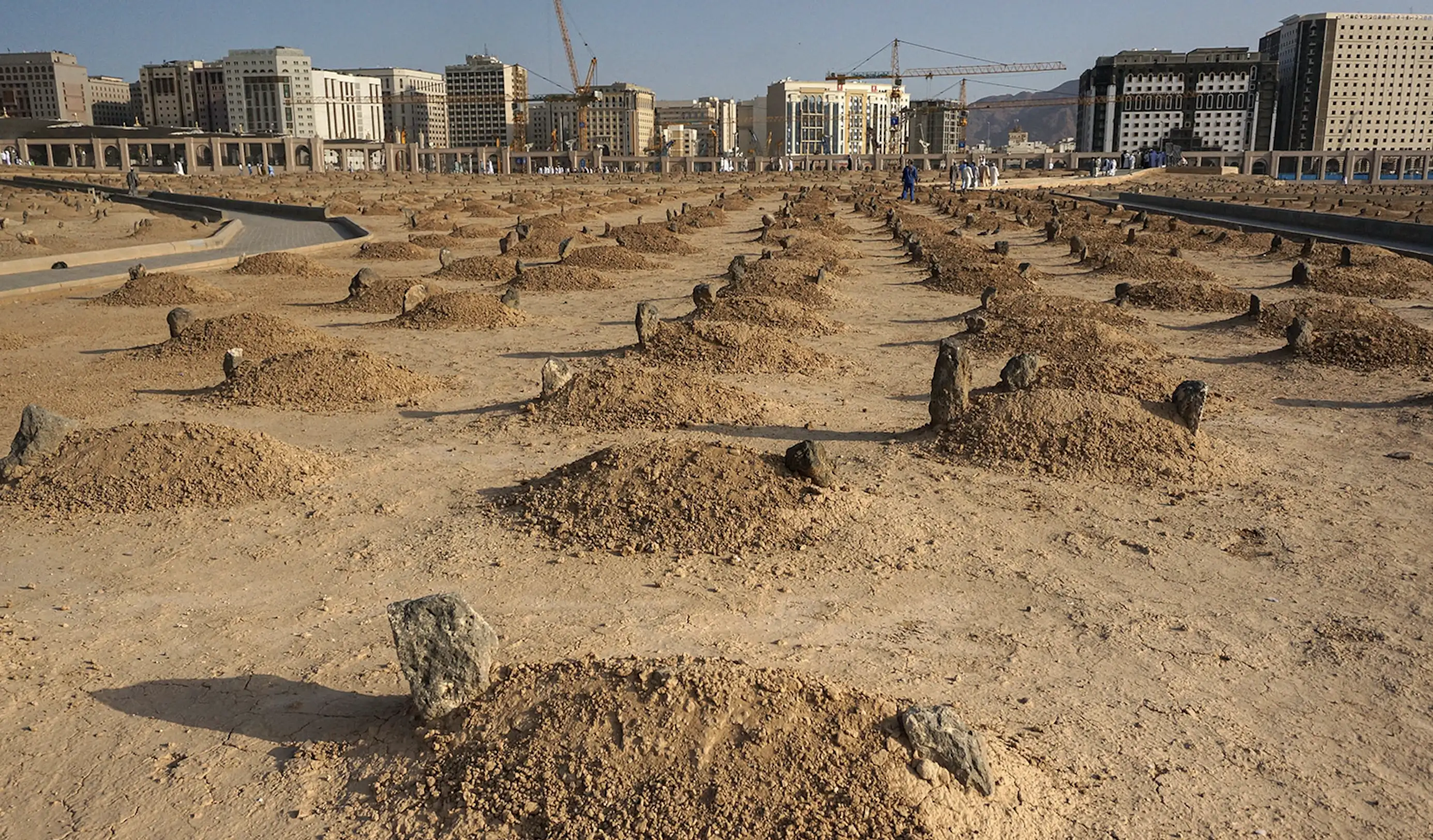
Umm Habiba died in Medina around 666 CE (44 AH), during the caliphate of her brother Muawiyah. She was approximately seventy-two years old — having lived through the entire arc of the early Islamic experience, from the secret beginnings in Mecca through the emigration, the battles, the conquest, the death of the Prophet, and the establishment of the caliphate. She was buried in al-Baqi cemetery in Medina.
Before her death, she called for Aisha bint Abu Bakr and asked for her forgiveness for any offense she might have committed as co-wives, and Aisha forgave her and asked for the same. She then called for Umm Salama and did the same. This act of seeking reconciliation before death — a deathbed clearing of accounts between sisters in faith — demonstrated the piety and self-awareness that had characterized Umm Habiba throughout her life.
Legacy and Historical Significance
A Model of Faith Over Family
Three episodes in Umm Habiba's life are recorded in which her position as a Muslim stood against her family ties: her acceptance of Islam while her father led the Quraysh opposition, her remaining in Islam when her husband left it in Abyssinia, and the incident of the bed during Abu Sufyan's visit to Medina. These are set out above on the basis of the sources that report them.
This example has resonated across Islamic history as a demonstration that the claims of God take precedence over all other loyalties — that family love, however natural and honored, cannot override the demands of faith when the two conflict. Umm Habiba's story has been particularly meaningful for converts to Islam across the centuries who have faced opposition from their own families, for she demonstrated that fidelity to God can survive and ultimately prevail over even the most painful family ruptures.
The Bridge Between Enemies
Umm Habiba's marriage to the Prophet also illustrates the theme of reconciliation through kinship. The daughter of Islam's greatest enemy became the wife of its Prophet — a relationship that created bonds where only enmity had existed. Abu Sufyan's eventual acceptance of Islam at the conquest of Mecca was facilitated, in part, by the family connection that already existed through his daughter's marriage. Umm Habiba was thus a bridge between two worlds: the old Meccan aristocracy and the new Islamic community, the house of Abu Sufyan and the household of Muhammad.
The Abyssinian Years in Detail
Life Under the Negus
The years Umm Habiba spent in Abyssinia — from her arrival as part of the second wave of emigration (c. 616 CE) until her departure for Medina after the conquest of Khaybar (628 CE) — constituted more than a decade of exile. During this period she experienced the full range of the emigrant's life: the initial relief of finding safety, the establishment of a small community of believers in a foreign land, the challenge of maintaining Islamic practice far from the Prophet and the growing community in Medina, and the devastating personal crisis of her husband's apostasy and death.
The Negus of Abyssinia, al-Najashi, provided the Muslim emigrants with protection and freedom of worship. He was a just ruler whose Christianity inclined him toward sympathy with the monotheistic message of Islam, and he resisted pressure from Quraysh delegations who came seeking the extradition of the Muslims. Under his protection, the emigrants could practice their faith openly, but they remained a small, isolated community far from the center of Islamic life.
For Umm Habiba, these years were marked by the particular trial of her husband Ubaydullah ibn Jahsh's apostasy. The man who had been her companion in faith, who had emigrated with her to preserve their religion, abandoned Islam and embraced Christianity. The sources record that he drank wine and attempted to persuade Umm Habiba to follow him in his new faith. Her refusal was absolute — she would not abandon the God who had guided her, regardless of what her husband chose. When Ubaydullah died, she was left alone with her young daughter Habiba, a Muslim widow in a Christian country, sustained by nothing but her faith and the protection of the Negus.
The Marriage Proposal and the Negus's Role
When the Prophet sent his proposal of marriage to Umm Habiba through the Negus, the king took it upon himself to facilitate the marriage with care and ceremony. He assembled the Muslim emigrants, announced the Prophet's proposal, and conducted the marriage ceremony on the Prophet's behalf. The dowry was provided at the ceremony. The amount and the question of who furnished it are reported differently across the sources, and no figure is asserted here.
The Negus addressed Umm Habiba through her representative Khalid ibn Sa'id ibn al-As, who acted as her guardian (wali) for the ceremony. Khalid gave a brief speech praising God and the Prophet, and accepted the marriage on Umm Habiba's behalf. The marriage was thus contracted in Abyssinia, in the Prophet's absence and with the Negus acting on his behalf. It is the only one of the Prophet's marriages reported to have been concluded in this manner, and jurists cite it in discussions of marriage contracted by proxy.
The Journey to Medina
Umm Habiba's departure from Abyssinia came with the group of emigrants who traveled to Medina around the time of the conquest of Khaybar in 628 CE (7 AH). After more than a decade in exile, she finally made the journey to the Prophet's city — not as a refugee seeking protection but as a wife of the Prophet and a Mother of the Believers. The transition from the isolation of Abyssinia to the bustling center of the Muslim community was immense, and Umm Habiba had to adjust to a life very different from the quiet exile she had known.
She arrived in a household that already included several wives and had to find her place among them. But her position was secure: she was married to the Prophet, she was a Mother of the Believers, and her years of suffering and steadfastness had earned her a place of honor that no one could question. Whatever the domestic adjustments required, Umm Habiba had proven her faith in the hardest way possible, and the community received her with the respect her sacrifice deserved.
Political Significance of the Marriage
The Umayyad Connection
Umm Habiba's marriage to the Prophet created a family connection between the Prophet and the Banu Umayya — the clan that had led the opposition to Islam and that would later rule the Islamic empire as the Umayyad dynasty. Her father Abu Sufyan, her brother Muawiyah, and her broader Umayyad relatives were among the Prophet's most persistent opponents, yet through Umm Habiba, a bond of kinship now existed between the two camps.
This connection did not immediately end the hostility — Abu Sufyan continued to oppose Islam for some time after the marriage, as demonstrated by his diplomatic visit to Medina and the incident with the bed. Abu Sufyan accepted Islam at the conquest of Mecca in 630 CE, and the Banu Umayya entered the community they had fought for two decades.
The Conquest of Mecca and Family Reunification
At the conquest of Mecca in 630 CE (8 AH) her family's position reversed. Her father Abu Sufyan, who had led the Quraysh opposition, accepted Islam. Her brother Muawiyah, who would later found the Umayyad dynasty, entered Islam. The family whose head had led the opposition to Islam now entered it.
For Umm Habiba, the conquest represented a personal vindication. She had chosen Islam over her family two decades earlier, suffering exile and isolation as a result. Now her family had come to Islam — not because she had returned to them, but because truth had prevailed. She had been right all along, and her father's eventual acceptance of Islam proved it. The daughter who had been rejected for her faith was now vindicated by history.
Umm Habiba's Household in Medina
Domestic Life and Relationships
In the Prophet's household in Medina, Umm Habiba occupied her place with the dignity and composure that her life experiences had forged. She was not among the more voluble or publicly prominent of the wives, but her inner strength was recognized by those who knew her. She maintained her household, participated in the communal life of the Prophet's family, and observed the regulations of the hijab that governed the Mothers of the Believers' interactions with the broader community.
Her relationships with her co-wives were generally harmonious, though the deathbed scene — in which she called for Aisha and Umm Salama to seek mutual forgiveness — suggests that the normal frictions of shared domestic life had not entirely passed her by. The tradition treats this deathbed reconciliation as a sign of her piety and self-awareness: a believer who wished to meet God with a clear conscience and no unresolved grievances against her sisters in faith.
Hadith Narration in Detail
Umm Habiba transmitted a number of hadith that have been preserved in the canonical collections. Among her most significant narrations is the hadith concerning the twelve voluntary rak'at of prayer (two before Fajr, four before and two after Dhuhr, two after Maghrib, and two after Isha) — a report that became foundational for the Sunni understanding of the sunan rawatib, the recommended voluntary prayers that accompany the obligatory ones. The Prophet told her: "No Muslim servant prays twelve voluntary rak'at every day, other than the obligatory prayers, except that Allah will build for him a house in Paradise." This hadith, transmitted through Umm Habiba, is among the most frequently cited traditions concerning voluntary worship and has shaped Muslim devotional practice across the centuries.
Her other narrations concerned matters of personal conduct, domestic practice, and the Prophet's worship — contributing to the comprehensive portrait of the Prophetic Sunnah that the community preserved through the testimony of those who had been closest to him.
References and Further Reading
Primary Islamic Sources
- Quran, Surah al-Mumtahana (60:7) — "Perhaps Allah will put, between you and those to whom you have been enemies among them, affection" — understood in connection with the Prophet's marriage to Umm Habiba and the eventual reconciliation with Abu Sufyan
- Quran, Surah al-Ahzab (33:6) — concerning the status of the Prophet's wives
- Sahih Muslim, Book of Voluntary Prayer — narrations from Umm Habiba concerning the Prophet's prayer practices
- Sunan Abu Dawood — traditions transmitted by Umm Habiba
- Musnad Ahmad ibn Hanbal — narrations concerning her marriage and the role of the Negus
Classical Islamic Sources
- Ibn Sa'd, Muhammad. Al-Tabaqat al-Kubra. Edited by Eduard Sachau. Leiden: Brill, 1904–1940. [Compiled c. 845 CE]
- Ibn Hisham. Al-Sirah al-Nabawiyyah. Edited by Mustafa al-Saqqa et al. Cairo: 1936. [Based on Ibn Ishaq, 8th century CE]
- Al-Tabari, Muhammad ibn Jarir. Tarikh al-Rusul wa al-Muluk. Edited by M.J. de Goeje. Leiden: Brill, 1879–1901. [Completed c. 915 CE]
- Al-Dhahabi, Shams al-Din. Siyar A'lam al-Nubala'. Beirut: Mu'assasat al-Risalah, 1981–1988. [Compiled c. 1348 CE]
- Ibn Kathir, Ismail. Al-Bidaya wa al-Nihaya. Beirut: Dar al-Kutub al-Ilmiyyah, 1994. [Compiled c. 1373 CE]
- Ibn Hajar al-Asqalani. Al-Isabah fi Tamyiz al-Sahabah. Beirut: Dar al-Kutub al-Ilmiyyah, 1995. [Compiled c. 1449 CE]
Academic and Scholarly Sources
- Stowasser, Barbara Freyer. Women in the Qur'an, Traditions, and Interpretation. New York: Oxford University Press, 1994.
- Ahmed, Leila. Women and Gender in Islam. New Haven: Yale University Press, 1992.
- Lings, Martin. Muhammad: His Life Based on the Earliest Sources. Cambridge: Islamic Texts Society, 1983.
- Haykal, Muhammad Husayn. The Life of Muhammad. Translated by Isma'il Razi al-Faruqi. Indianapolis: North American Trust Publications, 1976.
- Watt, W. Montgomery. Muhammad at Medina. Oxford: Oxford University Press, 1956.
- Kennedy, Hugh. The Prophet and the Age of the Caliphates. London: Routledge, 2004.
Further Reading
- Ghadanfar, Mahmood Ahmad. Great Women of Islam. Riyadh: Darussalam, 2001.
- al-Mubarakpuri, Safi-ur-Rahman. Ar-Raheeq Al-Makhtum (The Sealed Nectar). Riyadh: Darussalam, 1979.
- Nadwi, Mohammad Akram. Al-Muhaddithat: The Women Scholars in Islam. Oxford: Interface Publications, 2007.
- Rogerson, Barnaby. The Heirs of the Prophet Muhammad. London: Little, Brown, 2006.
Mentioned In
6 articles reference this topic