Ridda Wars
The Ridda Wars (11-12 AH / 632-633 CE) were the campaigns by which the first caliph Abu Bakr suppressed the tribal revolts, zakat refusals and rival prophetic movements that broke out across Arabia after the Prophet's death, restoring Medinan authority over the peninsula in about four months.
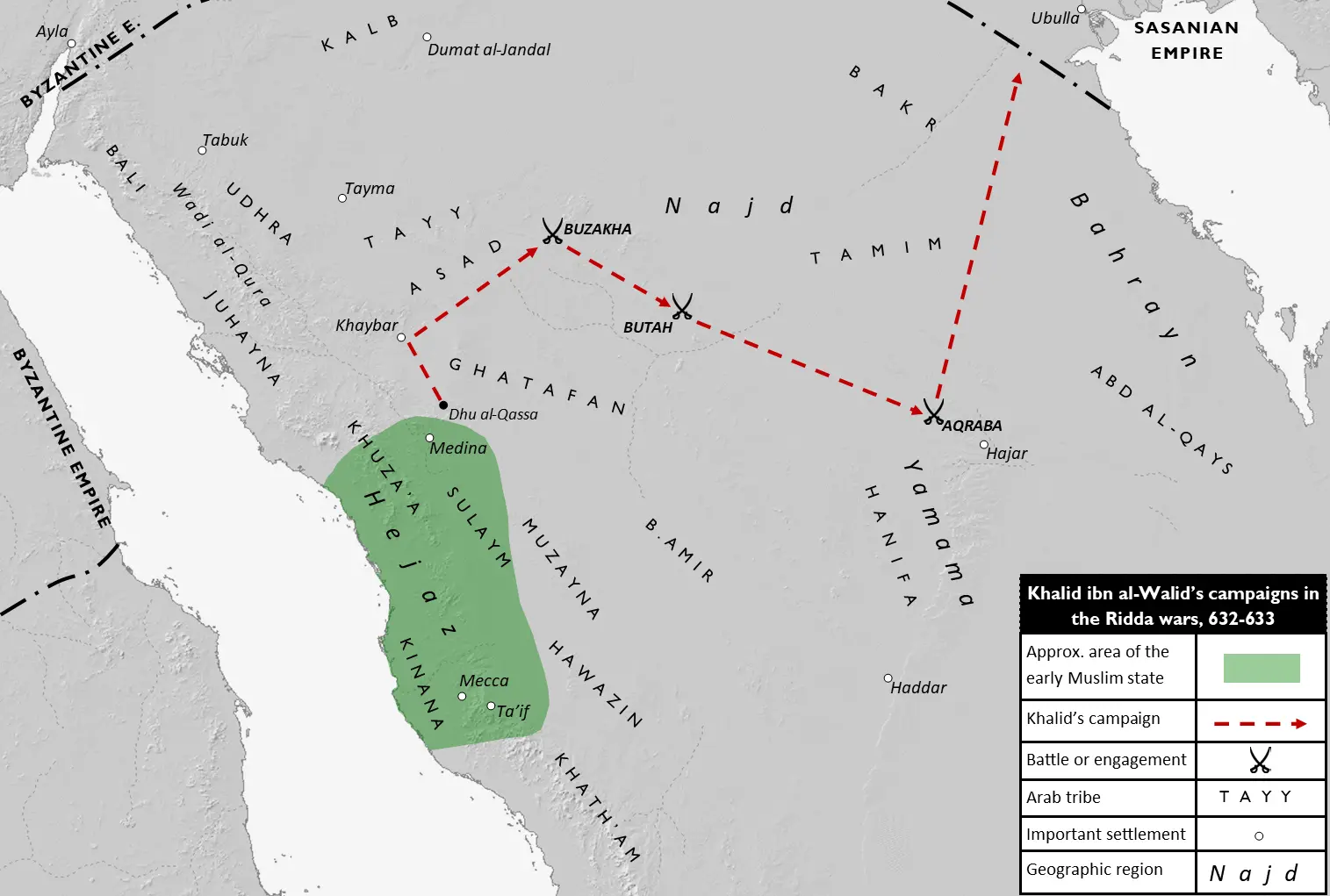
The Ridda Wars (Arabic: حروب الردة, Hurub al-Ridda), known in the Arabic sources as the wars against the apostates, were the campaigns by which Abu Bakr al-Siddiq restored the authority of Medina over the Arabian Peninsula after the death of Prophet Muhammad ﷺ in 11 AH. The word ridda means a turning back, and it covers a range of conduct that the sources themselves distinguish: outright abandonment of Islam, the withholding of the zakat by communities that continued to pray, and the rise of men and one woman who claimed prophethood of their own. The revolts began within weeks of the Prophet's death and were fought down in a single concentrated effort. The Atlas of the Islamic Conquests records that the brigades Abu Bakr dispatched completed their tasks in about four months, and that before the end of 11 AH — February 633 CE — the whole of the peninsula had returned to Islam.
The wars were the first test of whether the community the Prophet had built could outlive him, and they were decided as much by a judgement of principle as by fighting. Abu Bakr refused at the outset to treat the payment of zakat as separable from prayer, and so refused every offer of partial allegiance. The campaigns that followed were conducted by Khalid ibn al-Walid as overall commander of operations, cost the community a large number of those who had memorised the Quran, and produced, as a direct consequence, the first written compilation of the Quranic text. Within months of their conclusion the same armies were moving north into Iraq and Syria.
The Death of the Prophet and the Crisis of Authority
The Prophet died at Medina on 12 Rabi al-Awwal 11 AH. The question of the succession was settled quickly at the Saqifah of the Banu Sa'idah with the recognition of Abu Bakr as caliph, but the settlement at Medina did not travel. Across Arabia, the tribal delegations that had come to the Prophet in the preceding years had pledged themselves to him, and many of their leaders understood that pledge as having lapsed with the man who received it.
That reading was not simply opportunism. The obligations of pre-Islamic Arabian politics ran between persons, and they dissolved when a person died; loyalty to a man and loyalty to the institution he represented were not cleanly separable in that framework. Many of those who now withheld the zakat continued to pray and to keep the fast, and reasoned that what they owed had been owed to Muhammad himself. Some offered to go on collecting the zakat but to distribute it among their own poor rather than remit it to Medina. Abu Bakr refused every such proposal.
His first act as caliph pointed in the same direction. The Prophet had appointed Usamah ibn Zayd to lead an expedition northwards shortly before his death, and with revolt breaking out on every side there was an obvious case for keeping the army at home. Abu Bakr sent it out as the Prophet had commanded. The force returned successfully — after two months, or by some accounts forty days — and its absence had been noticed: seeing Medina stripped of its fighting men, the tribes of Abs and Dhibyan set out to attack the city itself.
Meanwhile the Muslim officials posted in the provinces were writing to Medina for instructions. The crisis was experienced as an administrative problem as much as a military one, and in some regions it was not at first clear to the men on the spot whether what they faced was rebellion, tax resistance or simple confusion.
Abu Bakr's Decision: Prayer and Zakat Are Not Separable
The decision that shaped everything that followed was taken in the first weeks, and it was contested. Umar ibn al-Khattab argued for restraint. His case rested on a saying of the Prophet that those who professed the faith were protected by it, and on the plain prudence of not opening new fronts while the community was newly bereaved and surrounded.
Abu Bakr's answer is preserved in the Musnad of Abu Bakr in Musnad Ahmad ibn Hanbal, where the editors grade the report sahih and note its parallels at Sahih al-Bukhari 6924 and Sahih Muslim 20. When some people apostatised, Umar asked him whether he would fight them when he had heard the Messenger of Allah say what he had said. Abu Bakr replied:
"By Allah, I will not separate prayer and zakah, and I shall certainly fight anyone who separates them."
Umar's own testimony completes the report: "So we fought them alongside him and we realised that that was the right thing to do."
The principle settled in that exchange was that the obligations of Islam form a single body, and that the fiscal obligation is not a political arrangement that a change of ruler can reopen. Its practical consequence was that no middle status existed. A tribe was either within the Medinan system or in revolt against it, and the negotiated partial autonomy that several tribal leaders were seeking was foreclosed. It committed the caliphate to a wider and more dangerous war than Umar's course would have required, and zakat itself became the test of allegiance: its resumption, region by region, was the measure by which the revolt was judged to be over.
The First Blows: Dhu Husa and al-Abraq
Abu Bakr did not wait for the brigades to be formed before fighting. When Abs and Dhibyan moved on Medina, he took their force by surprise in a night attack and scattered it. The Atlas of the Islamic Conquests places this in Jumada al-Ula or Jumada al-Akhirah of 11 AH, July or August 632 CE.
He then went out himself. At Dhu Husa he found al-Nu'man, Abdullah and Suwayd holding the area on his behalf, and finding matters in order there he moved against the people of al-Rabdhah at al-Abraq. In the fighting that followed al-Harith and Awf were defeated and al-Hutay'ah was taken captive, and the tribes of Abs and Banu Bakr were driven from the district. Sword of Allah records that the apostates at al-Abraq were the more numerous and held for a time before breaking. Abu Bakr remained encamped there for some days, made peace with those who returned to Islam, and took the territory of Banu Dhibyan as spoil, declaring that it was not lawful for Dhibyan to hold those lands because God had given them to the Muslims as booty. Not every submission, therefore, restored what had been lost.
From al-Abraq he returned to Medina, and then moved out again to the valley of Dhu'l-Qissah, a day's journey from the city, intending once more to lead in person. The Companions pressed him not to; Aisha's account has him going out with his sword drawn and mounted, and Ali ibn Abi Talib taking hold of the reins of his animal. Ali told him what the Prophet had told him at Uhud — to sheathe his sword — and added that if the community were bereaved of him, Islam would be left without an ordered rule. Abu Bakr accepted the argument and returned to Medina. He had established that the caliph would fight; he now accepted that he should not.
The Eleven Brigades
At Dhu'l-Qissah the returning army of Usamah, no longer his but the army of the Muslims, was reorganised. Sword of Allah notes that this was the first time the Muslim army was formed into separate corps. Because the revolts were scattered across the whole peninsula rather than concentrated in one place, Abu Bakr divided his force under eleven banners, appointed a commander to each, directed each to a specific objective, and ordered every commander to raise what fighters he could from the tribes he passed on the way. The Atlas dates the departure to Sha'ban 11 AH, about October 632 CE. As-Sallabi, citing al-Tabari, gives the assignments:
| # | Commander | Objective |
|---|---|---|
| 1 | Khalid ibn al-Walid | Banu Asad, then Tamim, then al-Yamamah |
| 2 | Ikrimah ibn Abi Jahl | Musailamah and Banu Hanifah, then Oman, Mahrah, Hadramawt, Yemen |
| 3 | Shurahbil ibn Hasanah | al-Yamamah, to reinforce Ikrimah, then Hadramawt |
| 4 | Tarifah ibn Hajiz | Banu Sulaym |
| 5 | Amr ibn al-As | Quda'ah |
| 6 | Khalid ibn Sa'id ibn al-As | the highlands of al-Sham |
| 7 | Al-Ala ibn al-Hadrami | Bahrain |
| 8 | Hudhayfah ibn Mihsan al-Ghilfani | Oman |
| 9 | Arfajah ibn Harthamah | Mahrah |
| 10 | Al-Muhajir ibn Abi Umayyah | Yemen: San'a, then Hadramawt |
| 11 | Suwayd ibn Muqrin | Tihamah |
Almost every column fought in more than one place, so that the war was a continual business of grouping, redeploying and moving on to the next objective. Khalid ibn al-Walid, in as-Sallabi's assessment, was the overall commander of operations for all eleven.
One further instrument went ahead of the armies. The Atlas records that Abu Bakr sent a proclamation to all the tribes announcing that the armies were coming, ordering them not to fight until they had first called the people to God, to leave alone those who responded, and to fight and punish those who refused. The campaigns were therefore framed as a summons backed by force rather than a punitive sweep, and in several regions the summons was enough.
The Claimants to Prophethood
Four movements organised around claims to revelation, and they differed greatly in character. All four claims were made before the Prophet's death rather than after it. History of Islam places their emergence in Muharram 11 AH, when his final illness became known: Musailamah, Tulaihah ibn Khuwaylid, al-Aswad and Sajah bint al-Harith each put themselves forward, expecting the success his own claim had met with. The same source preserves his account of a dream from those weeks, delivered to the Companions when he came out to them with his head bandaged from a headache — that he had seen two gold bracelets on his wrists and thrown them away in dislike, and had interpreted them as the two men of Yamamah and Yemen, Musailamah and al-Aswad. The report is in Sahih al-Bukhari (no. 3621) and Sahih Muslim (no. 2273), where the Prophet identifies the bracelets as two liars who would appear after him.
Al-Aswad al-Ansi in Yemen was the earliest of the four, and the only one of them put down in the Prophet's own lifetime; History of Islam records that Musailamah, by contrast, was not killed until Abu Bakr's caliphate. His name was Abhalah ibn Ka'b. He was called Dhu'l-Khimar, the possessor of the veil, because he kept his head and face covered, and al-Aswad, the black one, for his dark complexion; as-Sallabi takes these details from al-Kamil fi'l-Tarikh. He drove out the Muslim governors of Yemen and killed Shahr ibn Badhan, and at his height held most of the province, San'a included.
He was removed not by battle but by assassination, and the choice was deliberate. As-Sallabi records that the Prophet had written to Mu'adh ibn Jabal, Abu Musa al-Ash'ari and al-Tahir ibn Abi Halah leaving them the option of fighting al-Aswad or killing him, and that the Muslim leaders of the Yemeni districts, though by then strong enough to attack, agreed to attempt the assassination first — on the reasoning that what held al-Aswad's army together was the man's own hold over it rather than any shared belief, so that his death would scatter it. The two people who made it possible were both inside his circle: Qays ibn Makshuh al-Muradi, the commander of his army, who had quarrelled with him and feared for his life, and Azad al-Farisiyyah, whom al-Aswad had taken as a wife after killing her husband Shahr ibn Badhan, and who was a cousin of Fayruz al-Daylami, one of the Persian settlers of Yemen.
The timing matters for the shape of the war that followed. As-Sallabi states that the detailed account of the assassination reached Medina not only after the Prophet's death but after Usamah's army had already marched, so that al-Aswad's death was the first news of victory Abu Bakr received as caliph — and that among Abu Bakr's first acts was to appoint Fayruz al-Daylami governor of San'a, passing over Qays on the principle that he would not give a province to a man who had apostatised. Yemen was thus spared a major campaign at the weakest moment of the caliphate. Apostasy nevertheless broke out there a second time afterwards, Qays himself turning against Fayruz.
Tulaihah ibn Khuwaylid of Banu Asad was a warrior of standing who had accepted Islam and then claimed revelation, and whose claim served mainly to hold a coalition together. By the beginning of the campaigning season he had drawn in elements of Asad, Ghatafan and Tayy and stood as the most serious military concentration in the Najd. Sword of Allah records that he moved from Samira to Buzakhah, and that the survivors fleeing al-Abraq made their way to him there.
Sajah bint al-Harith was of Banu Taghlib, a Christian tribe of the Jazira, and is the one woman among the claimants. She came south with a following drawn from her own people and from tribes of the Tamim, made for Yamamah, and concluded an agreement with Musailamah — a brief formal marriage whose purpose was alliance. Her movement dissolved with his defeat.
Musailamah ibn Habib of Banu Hanifah in Yamamah was the most dangerous. He had written to the Prophet during his lifetime proposing that the earth be divided between them, and the Prophet's reply was that the earth belonged to God, who gave it to whom He willed. The Banu Hanifah were numerous, well organised and capable, and what Musailamah offered them was a prophet of their own rather than submission to a Hijazi centre. Two episodes fixed the enmity. The envoy Habib ibn Zayd al-Ansari was sent to him and was killed by him — dismembered, in as-Sallabi's account — and al-Rajjal ibn Unfuwah al-Hanafi, who had come to Medina and learned the Quran, returned to his people and testified that the Prophet had made Musailamah his partner in prophethood, a defection whose harm as-Sallabi records as being reckoned greater than Musailamah's own.
Buzakhah and the Central Arabian Campaign
Khalid's column moved first against Tulaihah. Before engaging he detached the coalition's components: the Tayy, whose chief Adi ibn Hatim was a Muslim, were brought back to their allegiance and their contingent neutralised, which left Tulaihah with Asad and Ghatafan.
The battle at Buzakhah broke the coalition. Tulaihah left the field before the issue was decided and fled, abandoning his followers to make their own terms. Uyaynah ibn Hisn, the Ghatafan chief who had commanded a wing of the confederate army at the Battle of Khandaq and had attached himself to Tulaihah, was captured and sent to Medina, where Abu Bakr released him; he afterwards remained within the community. Tulaihah himself later accepted Islam and fought in the Muslim armies in Iraq.
From Buzakhah, Khalid reduced the remaining concentrations of the Najd in a series of engagements and negotiated submissions, on terms consistent with Abu Bakr's policy: tribes that submitted and renewed their Islam were received, their leaders kept, and their fighters made eligible for the columns that were forming.
Malik ibn Nuwairah at Butah
The most disputed episode of the war concerns Malik ibn Nuwairah of the Banu Yarbu' of Tamim, who was encamped at Butah. Malik had been one of the Prophet's collectors of zakat and a man of standing, and after the Prophet's death he had released to his tribe the zakat he had gathered rather than sending it on. He had raised no army against Medina and claimed no prophethood.
He was taken by Khalid's force and killed, and Khalid married his widow. The circumstances are reported in conflicting ways: in the harshest account the execution was ordered on the night of his capture on the ground of apostasy, while in the more favourable account he was killed in confused fighting after his men had taken up arms again.
Abu Bakr investigated. He accepted Khalid's account that the killing had been a military decision rather than a murder, but required him to pay the blood money to Malik's family — a judgement that conceded an error even while refusing to find a crime. Umar was not satisfied and pressed for Khalid's dismissal; Abu Bakr refused, on the ground that he would not sheathe a sword God had drawn against the enemies of Islam. The matter did not die there. When Malik's brother Mutammim ibn Nuwairah was later consoled by Umar over his brother's death, he answered that had his brother died as Umar's brother Zayd had died, he would not have grieved — a remark that set the killing at Butah against the martyrdom at Yamamah, and that Umar received as the best consolation he had been offered.
The episode exposed the difficulty that ran through the whole war: in the field, and at speed, the distinction between withholding zakat, abandoning Islam, and simple administrative hesitation was not easy to draw.
The Battle of Yamamah
The campaign against Musailamah was the decisive operation, and it opened badly. Ikrimah ibn Abi Jahl, sent directly against Banu Hanifah with Shurahbil ibn Hasanah ordered to reinforce him, attacked as soon as he reached Yamamah without waiting. Musailamah met him with forty thousand men and Ikrimah was beaten with heavy loss. Abu Bakr, informed of it, relieved him of the command and directed him not to return to Medina at all but to go on and join Hudhayfah and Arfajah in Oman and Mahrah. Shurahbil was ordered to halt where he stood until Khalid came up, and his men were rested when Khalid arrived and took the combined force on to Yamamah. Reinforcing columns joined on the march, bringing Khalid's strength to thirteen thousand.
What the Banu Hanifah were defending was not in every case a belief in Musailamah. History of Islam records that among the forty thousand of Rabi'ah who followed him there were men who knew him for a liar and wished him success regardless, saying openly that Musailamah was a liar and Muhammad truthful, but that the liar-prophet of Rabi'ah was dearer to them than the truthful Prophet of Banu Mudar. The revolt in Yamamah was, for a considerable part of its strength, a matter of tribal precedence rather than of religion.
Khalid halted a day short of the town and sent forward an advance guard. Musailamah had that same day sent out Mujja'ah ibn Murarah with sixty men to raid Banu Tamim, and the two parties met; Mujja'ah was taken and held, and his captivity would matter at the end of the campaign.
The armies met in the Yamamah, at Aqraba. Sword of Allah, citing al-Tabari, places the opening early on a cold morning in the third week of December 632, at the beginning of Shawwal 11 AH. Khalid ordered a general attack and led the centre himself. The Banu Hanifah did not break. They fought, in Akram's description, preferring death to the loss of ground, and the Muslims found to their surprise that they were making no headway; disorder began to appear in their own ranks. The sources describe the pressure reaching the rear of the Muslim camp before the line was recovered. Part of the recovery came from reorganising the army so that each tribe fought under its own banner and was answerable for its own sector.
The fighting produced a roll of losses among the most senior Companions. Zayd ibn al-Khattab, Umar's elder brother, an early convert and a veteran of Badr, carried the banner of the Muhajirun and advanced with it until he was killed, after which Salim, the freed slave of Abu Hudhayfah ibn Utbah — himself a commander of one of Khalid's wings, and killed on the same field — took it up; before he fell, Zayd had killed al-Rajjal ibn Unfuwah. Zayd's killer, Abu Maryam al-Hanafi, afterwards became a Muslim and said to Umar that God had honoured Zayd by his hand and had not humiliated him at Zayd's. Umar's judgement on his brother was that "he beat me to goodness twice: he embraced Islam before I did, and he was the first of us to be martyred." Ma'an ibn Adi al-Ansari, who had been at the Pledge of Aqabah and at Badr, Uhud and Khandaq, was killed in the same battle, as was Abdullah ibn Suhayl ibn Amr, who at Badr had crossed from the Quraysh line to fight beside the Muslims.
When the Banu Hanifah broke, Musailamah and his best men withdrew into a walled garden, remembered in the sources as the Garden of Death. The walls made an assault impracticable until al-Bara' ibn Malik al-Ansari, brother of Anas ibn Malik, asked to be thrown over them; he was lifted across, fought his way to the gate and opened it from within, and the army poured in. Musailamah was killed in the garden. The sources divide the act between Wahshi ibn Harb — the man who had killed Hamza ibn Abd al-Muttalib at the Battle of Uhud and who is reported to have observed that he had killed the best of men and the worst of men with the same weapon — and Abu Dujanah al-Ansari, who was himself killed at Yamamah. Both claims are transmitted.
The casualties were the heaviest the community had yet taken in a single engagement, and among the dead was a large number of the qurra', those who held the Quran by memory. The figures given for the dead on either side vary widely between the sources and are better read as marking a catastrophe for Banu Hanifah than as counts. What is not in doubt is the scale of the loss among the reciters, because of what followed from it.
The Compilation of the Quran
Zayd ibn Thabit, one of the Prophet's scribes, gave the account that Sahih al-Bukhari records in its Book of Commentary on Quran 9:128 (hadith 4679). Abu Bakr sent for him after the casualties at Yamamah, with Umar present, and said that Umar had come to him saying that the people had suffered heavily on the day of Yamamah, that he feared further losses among the reciters at other battlefields, and that a large part of the Quran might be lost unless it were collected. Abu Bakr had objected: "How can I do something which Allah's Messenger has not done?" Umar pressed the point until, in Abu Bakr's words, God opened his breast to it and he came to Umar's opinion.
Zayd raised the same objection, and yielded to the same argument. Abu Bakr told him that he was young and wise, that they had no doubts about him, and that he had written revelation under the Prophet's own supervision, and set him to search out and collect the text. Zayd gathered what had been written — on stone slabs, palm leaves, animal skins and the like — and matched it against what men held in memory. The result was a safeguarded written record rather than a publication, kept with Abu Bakr and afterwards with Hafsa bint Umar, and it became the basis on which Uthman ibn Affan later had the standard copies prepared and distributed. The textual history of the Quran as a written book begins, in the historical narrative, with the losses at Yamamah, and the compilation of the Qur'an under Abu Bakr is treated in its own right elsewhere.
Bahrain, Oman, Mahrah, Yemen and Hadramawt
While the central Arabian operations were decided, the remaining columns worked the coasts and the south.
In Bahrain and eastern Arabia, al-Ala ibn al-Hadrami, who had been the Prophet's governor there, faced a mixed country of Arab tribes and Persian settlers. The Banu Abd al-Qays, who had held to Islam, gave him substantial local support against the tribes that had turned and the following of al-Hutam ibn Dubay'ah. The fighting was hard and the Gulf coast and the routes to Oman were secured by it.
Oman was assigned to Hudhayfah ibn Mihsan, with Ikrimah ibn Abi Jahl arriving after his reverse at Yamamah. The province was held for Islam by the two brothers Jayfar and Abd, sons of al-Julanda, but much of the population had turned, and the rebellion had to be put down by force; the decisive engagement was at Dabba. Ikrimah's presence in these campaigns is itself notable: he was the son of Abu Jahl, the Prophet's most determined Meccan opponent, and had himself been among the last to submit, at the conquest of Mecca.
Mahrah fell to Arfajah ibn Harthamah, and the columns then converged on Yemen and Hadramawt, the most politically broken region of the peninsula and the one still unsettled by al-Aswad's movement. Al-Muhajir ibn Abi Umayyah led there, by way of San'a, with Ikrimah and Shurahbil arriving into Hadramawt. The Persian settlers of Yemen, Muslims for a generation and the community whose governor al-Aswad had killed, were among the steadiest supporters of the restoration of Medinan authority. Yemen took longest to settle, and administrative consolidation there continued into Umar's caliphate.
Mecca and the Northern Frontier
The revolt touched Mecca itself. As-Sallabi records that most of its inhabitants were seriously considering turning away, and that the governor, Uttab ibn Asid, went into hiding. Suhayl ibn Amr — a Quraysh notable who had come to Islam only at the conquest, and whose son Abdullah was to be killed at Yamamah — did not hide. He stood before the people, praised God, spoke of the Prophet's death, and told them that Islam was as strong as it had ever been and that whoever turned from it would be killed. The city changed its mind, the tension eased, and the governor came out of hiding. That the old capital of the opposition was held by the speech of a late convert is among the more telling episodes of the year.
In the north, Amr ibn al-As was sent against Quda'ah and Khalid ibn Sa'id ibn al-As to the highlands of al-Sham. The northern tribes were in general watching rather than committed, waiting to see whether Medina would prove able to enforce its authority; as news of the southern and central victories travelled, several submitted without fighting. Khalid ibn Sa'id's operations on the Syrian approaches went less well than most, and the frontier had to be stabilised — an early indication that the move beyond Arabia would not be straightforward.
Reintegration and the Turn Outward
What distinguished the settlement from a punitive campaign was the speed with which defeated communities were brought back in. Military action was followed immediately by administration: governors restored, zakat collection resumed, and former rebel fighters enrolled in the columns now forming for Iraq and Syria. The terms were not uniform. Where Muslim officials had been killed, blood money was assessed and acceptance was conditional on demonstrated compliance; elsewhere the renewed profession, the payment of arrears and the resumption of practice sufficed.
The treatment of Banu Hanifah after Yamamah shows the logic. The tribe that had been Musailamah's strength, and had fought with the greatest ferocity of the war, was neither destroyed nor enslaved; the survivors were received back and their men became available for service. The policy was principled and it was also useful, since the peninsula's fighting strength was about to be needed elsewhere.
The resumption of zakat across Arabia was the concrete measure of success, for it was both the fiscal base of the state and the institutional mark of belonging to the community whose unity Abu Bakr had refused to let be taken apart. The Atlas sets out the results plainly: the wars united the peninsula under the Islamic state; they served as a middle phase of training between the Prophet's expeditions and the conquests, larger than the one and smaller than the other; they proved the competence of the commanders on whom the conquests would rest; they gave the Muslims confidence in their own capacity to organise; and at their conclusion the armies turned towards the Persians and the Romans.
Abu Bakr did not live long after. He died in Jumada al-Akhirah 13 AH, having also opened the campaigns in Iraq and Syria, and left to Umar a unified peninsula, a functioning administration and an army with a year's hard experience behind it.
Legacy
The most direct consequence was the Arabian base from which the conquests of Iraq, Syria, Egypt and Persia were launched. The tribal forces fighting against Medina in 11 AH were, within a year or two, fighting in its armies; the logistical practice of running simultaneous operations across great distances, and the habit of absorbing diverse contingents into a single command, carried directly into the conquests. Abu Bakr and those who followed him treated the two as one enterprise.
The legal precedent was equally durable. The ruling that the obligations of Islam cannot be disaggregated, and that the fiscal duty stands with the ritual one, became a fixed point of later juristic discussion, and the Ridda cases supplied the material for centuries of argument about what constitutes apostasy and when force may be used against those who profess the faith.
The career of Khalid ibn al-Walid was made by these campaigns. He had shown tactical ability before them; the Ridda year showed a commander who could hold several fronts, manage supply over distance, and combine force with political judgement in the handling of the defeated. Umar's later removal of him from supreme command in Syria was, in part, the management of a reputation these campaigns had created.
Other careers were formed in the same year. Ikrimah ibn Abi Jahl went from Yamamah through Oman, Mahrah and Yemen to the Syrian frontier, where he was killed at Ajnadayn. Amr ibn al-As, whose northern operations had given him the tribal contacts and the ground knowledge of the Syrian approaches, went on to command in Syria and then in Egypt. Al-Ala ibn al-Hadrami, having held Bahrain through the revolt, afterwards led the first Muslim expedition across the Gulf.
Finally, the wars fixed a principle in Islamic political thought: that the unity of the community is not merely a political good but an obligation, and that its dissolution is to be resisted. Abu Bakr's refusal to accept a partial allegiance, taken when the state he had inherited held little more than Medina and its neighbourhood, is the decision on which the rest of the first century rests.
Historiographical Note
Several points in the account above are reported differently in the sources, and the differences are worth naming.
The duration of Usamah's expedition. As-Sallabi records that the force returned two months after leaving Medina, and notes that some historians make it forty days rather than two months.
The killing of Malik ibn Nuwairah. The accounts diverge on whether Khalid ordered his execution after his capture or whether he was killed in renewed fighting. Abu Bakr's own resolution — accepting the explanation while requiring the blood money — treats the question as unresolved, and the sources preserve both readings.
The killer of Musailamah. The act is attributed both to Wahshi ibn Harb and to Abu Dujanah al-Ansari, and the tradition transmits both without deciding between them.
The casualty figures at Yamamah. The numbers given for the strength of Banu Hanifah and for the dead on both sides vary very widely between sources. They establish the scale of the defeat and of the Muslim loss, particularly among the reciters, but they are not reliable as counts.
The naming of the wars. The Arabic sources speak of the wars against the apostates, and apply the term to conduct ranging from armed revolt and claimed prophethood to the withholding of zakat by communities that continued to pray. The sources themselves draw these distinctions even while grouping the campaigns under one name, and Abu Bakr's ruling is what brought them under one heading.
References and Further Reading
Primary Islamic Sources
- Sahih al-Bukhari 6924, with Sahih Muslim 20 — Abu Bakr's refusal to separate prayer from zakat, and his declaration that he would fight whoever separated them.
- Musnad Ahmad ibn Hanbal, the Musnad of Abu Bakr al-Siddiq — the same report with Umar's testimony that the community fought alongside him and recognised that this was right; graded sahih by the editors.
- Sahih al-Bukhari 4679, Book of Commentary, on Quran 9:128 — Zayd ibn Thabit's account of the compilation of the Quran after the casualties at Yamamah, including Abu Bakr's and Zayd's initial objections and Umar's insistence.
- Sahih al-Bukhari 3621, Book of Virtues, narrated by Abu Hurayrah, with Sahih Muslim 2273 — the dream of the two gold bracelets, blown away and interpreted as two liars who would appear after the Prophet, named in the report as al-Ansi and Musailamah al-Kadhdhab of al-Yamamah.
- Sunan Abi Dawud 2522, Book of Jihad, chapter "The Martyr Will Intercede" — the report Suhayl ibn Amr cited on hearing of his son's death at Yamamah.
- Quran, Surah al-Tawbah (9:128) — the verse under which the compilation report is placed in Sahih al-Bukhari.
Classical Islamic Sources
- Al-Tabari, Tarikh al-Rusul wa'l-Muluk — the underlying narrative for the eleven brigades and for the Battle of Yamamah, cited here through as-Sallabi and through Akram rather than consulted directly.
- Ibn Kathir, Al-Bidayah wa'l-Nihayah — the source, through as-Sallabi, for the episode at Dhu'l-Qissah and for the notices of the Companions killed at Yamamah.
- Ibn al-Athir, Al-Kamil fi'l-Tarikh — for the name and epithets of al-Aswad al-Ansi, cited through as-Sallabi.
- Ibn Hajar al-Asqalani, Fath al-Bari — the commentary through which Zayd ibn Thabit's compilation narrative is transmitted in Ma'ariful Quran.
- Al-Suyuti, Jalal al-Din. The History of the Khalifahs — the caliphate of Abu Bakr and notices of those who fought in these campaigns.
Academic and Scholarly Sources
- As-Sallabi, Ali Muhammad. Abu Bakr as-Siddeeq: His Life and Times — a full modern biography of the caliph, and the principal source drawn on here.
- Akram, A. I. Sword of Allah: Khalid bin Al-Waleed, His Life and Campaigns — the campaign narrative of al-Abraq, Buzakhah, Butah and Yamamah.
- Atlas of the Islamic Conquests — the chronology of the revolt and the campaigns, the proclamation sent ahead of the armies, and the stated results of the wars.
- As-Sallabi, Ali Muhammad. Umar Ibn al-Khattab: His Life and Times — Umar's position in the zakat debate and the consolidation continued under his caliphate.
- Usmani, Mufti Muhammad Shafi. Ma'ariful Quran, vol. 1, Introduction — the compilation of the Quran and the materials on which it had been written.
- History of Islam, vols. 1-2 — the emergence of the four prophetic claims during the Prophet's final illness, the strengths of the two armies at Yamamah, and the tribal reasoning behind Banu Hanifah's support for Musailamah.
- Commanders of the Muslim Army — Ikrimah ibn Abi Jahl at Yamamah and his removal from command.
Further Reading
- Ibn Kathir. Al-Bidayah wa'l-Nihayah, the volumes covering the caliphate of Abu Bakr, for the fullest classical narrative of the year.
- Al-Waqidi. Kitab al-Ridda — the earliest dedicated monograph on these campaigns, surviving in part.
- Donner, Fred M. The Early Islamic Conquests. Princeton: Princeton University Press, 1981. For the transition from the Ridda campaigns to the conquests.
- Shoufani, Elias. Al-Riddah and the Muslim Conquest of Arabia. Toronto: University of Toronto Press, 1973. A study devoted to the subject.
Mentioned In
21 articles reference this topic
and 9 more articles